


Baltic Way 2013
Riga, Latvia

Problems and solutions
Problem 1
Let $n$ be a positive integer. Assume that $n$ numbers are to be chosen from the table
with no two of them from the same row or the same column. Find the maximal value of the product of these $n$ numbers.
Solution
The product is $R(\sigma)=\prod_{i=0}^{n-1}(n i+\sigma(i))$, for some permutation $\sigma:{0,1, \ldots, n-1} \rightarrow{0,1, \ldots, n-1}$. Let $\sigma$ be such that $R(\sigma)$ is maximal. We may assume that all the multipliers $n i+\sigma(i)$ are positive, because otherwise the product is zero, that is the smallest possible. Assume further that $\sigma(a)>\sigma(b)$ for some $a>b$. Let a permutation $\tau$ be defined by
We have
as $(n a+\sigma(b))(n b+\sigma(a))-(n a+\sigma(a))(n b+\sigma(b))=n(a \sigma(a)+b \sigma(b)-a \sigma(b)-b \sigma(a))=n(a-b)(\sigma(a)-\sigma(b))>0$. This is a contradiction with the maximality of $R(\sigma)$, hence, $\sigma$ has to satisfy $\sigma(a)<\sigma(b)$ for all $a>b$. Thus, $\sigma(i)=n-1-i$ for all $i$, and
Problem 2
Let $k$ and $n$ be positive integers and let $x_{1}, x_{2}, \ldots, x_{k}, y_{1}, y_{2}, \ldots, y_{n}$ be distinct integers. A polynomial $P$ with integer coefficients satisfies
and
Determine the maximal value of $k n$.
Solution
Letting $Q(x)=P(x)-54$, we see that $Q$ has $k$ zeroes at $x_{1}, \ldots, x_{k}$, while $Q\left(y_{i}\right)=1959$ for $i=1, \ldots, n$. We notice that $1959=3 \cdot 653$, and an easy check shows that 653 is a prime number. As
and $S(x)$ is a polynomial with integer coefficients, we have
Now all numbers $a_{i}=y_{i}-x_{1}$ have to be in the set ${ \pm 1, \pm 3, \pm 653, \pm 1959}$. Clearly, $n$ can be at most 4 , and if $n=4$, then two of the $a_{i}$ 's are $\pm 1$, one has absolute value 3 and the fourth one has absolute value 653 . Assuming $a_{1}=1, a_{2}=-1, x_{1}$ has to be the average of $y_{1}$ and $y_{2}$. Let $\left|y_{3}-x_{1}\right|=3$. If $k \geq 2$, then $x_{2} \neq x_{1}$, and the set of numbers $b_{i}=y_{i}-x_{2}$ has the same properties as the $a_{i}$ 's. Then $x_{2}$ is the average of, say $y_{2}$ and $y_{3}$ or $y_{3}$ and $y_{1}$. In either case $\left|y_{4}-x_{2}\right| \neq 653$. So if $k \geq 2$, then $n \leq 3$. In a quite similar fashion one shows that $k \geq 3$ implies $n \leq 2$. The polynomial $P(x)=653 x^{2}\left(x^{2}-4\right)+2013$ shows the $n k=6$ indeed is possible.
Problem 3
Let $\mathbb{R}$ denote the set of real numbers. Find all functions $f: \mathbb{R} \rightarrow \mathbb{R}$ such that
Solution
Let $f(0)=c$. We make the following substitutions in the initial equation:
- $x=0, y=0 \Longrightarrow f(0)+f(-c)=f(0) \Longrightarrow f(-c)=0$.
- $x=0, y=-c \Longrightarrow f(-c)+f(-c)=f\left(c-c^{2}\right)-c \Longrightarrow f\left(c-c^{2}\right)=c$.
- $x=-c, y=-c \Longrightarrow f(-c)+f(0)=f(c)-c \Longrightarrow f(c)=2 c$.
- $x=0, y=c \Longrightarrow f(c)+f(-c)=f\left(c^{2}-c\right)+c \Longrightarrow f\left(c^{2}-c\right)=c$.
- $x=-c, y=c^{2}-c \Longrightarrow f(-c)+f(0)=f\left(c-c^{2}\right)+c^{2}-c \Longrightarrow c=c^{2} \Longrightarrow c=0$ or 1 .
Suppose that $c=0$. Let $f(-1)=d+1$. We make the following substitutions in the initial equation:
- $x=0 \Longrightarrow f(y)+f(0)=f(-y)+y \Longrightarrow y-f(y)=-f(-y)$ for any $y \in \mathbb{R}$.
- $y=0 \Longrightarrow f(0)+f(-f(x))=f(0) \Longrightarrow f(-f(x))=0$ for any $x \in \mathbb{R}$.
- $x=-1 \Longrightarrow f(y-f(y))+0=f(d y)+y \Longrightarrow f(d y)=-y+f(-f(-y))=-y$ for any $y \in \mathbb{R}$.
Thus, for any $x \in \mathbb{R}$ we have $f(x)=f(-f(d x))=0$. However, this function does not satisfy the initial equation. Suppose that $c=1$. We take $x=0$ in the initial equation:
for any $y \in \mathbb{R}$. The function satisfies the initial equation. Answer: $\quad f(x) \equiv x+1$.
Problem 4
Prove that the following inequality holds for all positive real numbers $x, y, z$ :
Solution
The inequality is symmetric, so we may assume $x \leq y \leq z$. Then we have
Therefore, by the rearrangement inequality we have:
What's more, by the rearrangement inequality we have:
Applying it to the previous inequality we obtain:
Which is the thesis.
Problem 5
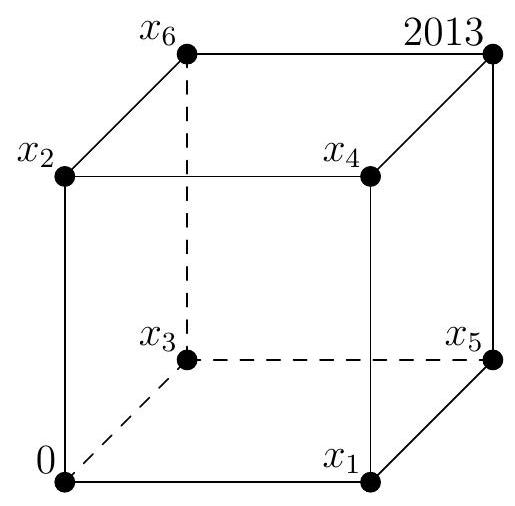
Numbers 0 and 2013 are written at two opposite vertices of a cube. Some real numbers are to be written at the remaining 6 vertices of the cube. On each edge of the cube the difference between the numbers at its endpoints is written. When is the sum of squares of the numbers written on the edges minimal?
Solution 1
Answer:
The function
attains its minimum when $x=\frac{a+b+c}{3}$. Let's call the vertices of the cube adjacent, if they are connected with an edge. If $S$ is minimal then numbers $x_{1} \ldots, x_{6}$ are such that any of them is the arithmetic mean of the numbers written on adjacent vertices (otherwise, S can be made smaller). This gives us 6 equalities:
Here $x_{1}, x_{2}, x_{3}$ are written on vertices that are adjacent to the vertex that contains 0 . By solving this system we get the answer.
Solution 2
Consider the expression
and note that
If the sum of 5 numbers is fixed, then the sum of their squares is minimal if all of them are equal. It follows that:
from where we get $x_{1}=2 \cdot 2013 / 5$ and $x_{4}=3 \cdot 2013 / 5$. Values for $x_{2}, x_{3}, x_{5}, x_{6}$ can be obtained similarly.
Problem 6
Santa Claus has at least $n$ gifts for $n$ children. For $i \in{1,2, \ldots, n}$, the $i$-th child considers $x_{i}>0$ of these items to be desirable. Assume that
Prove that Santa Claus can give each child a gift that this child likes.
Solution
Evidently the age of the children is immaterial, so we may suppose
Let us now consider the following procedure. First the oldest child chooses its favourite present and keeps it, then the second oldest child chooses its favourite remaining present, and so it goes on until either the presents are distributed in the expected way or some unlucky child is forced to take a present it does not like. Let us assume, for the sake of a contradiction, that the latter happens, say to the $k$-th oldest child, where $1 \leq k \leq n$. Since the oldest child likes at least one of the items Santa Claus has, we must have $k \geq 2$. Moreover, at the moment the $k$-th child is to make its decision, only $k-1$ items are gone so far, which means that $x_{k} \leq k-1$. For this reason, we have
contrary to our assumption. This proves that the procedure considered above always leads to a distribution of the presents to the children of the desired kind, whereby the problem is solved.
Problem 7
A positive integer is written on a blackboard. Players $A$ and $B$ play the following game: in each move one has to choose a divisor $m$ of the number $n$ written on the blackboard for which $1<m<n$ and replace $n$ with $n-m$. Player $A$ makes the first move, players move alternately. The player who can't make a move loses the game. For which starting numbers is there a winning strategy for player $B$ ?
Solution
Firstly note that for a given $n$ exactly one player has a winning strategy. We'll show by induction that $B$ has a winning strategy if $n$ is odd. First step of the induction is clear. Assume $n$ is odd and $B$ has a winning strategy for all odd integers smaller than $n$. If player $A$ can't make a move, $B$ wins. In other case, $A$ chooses a divisor $m$. Note that $m \mid n-m$ and $m<n-m$, because $m \leq \frac{n}{3}$ as $n$ is odd. Therefore $B$ may choose $m$ (in particular can make a move) and pass a number $n-2 m$ to player $A$. The number is odd and smaller than $n$, so the thesis is correct by induction. Now, let $n$ be even, but not a power of 2 . In that case $n$ has an odd divisor greater than one. Player $A$ may choose an odd divisor and pass an odd integer to player $B$. Then we have a situation where $B$ starts with an odd integer, so $A$ has a winning strategy. Consider now $n=2^{k}$ for positive integer $k$. Once again we'll prove it by induction. Thesis: for odd $k$ player $B$ has a winning strategy and for even $k$ player $A$ has a winning strategy. Base: for $k=1$ player $B$ has a winning strategy as $A$ can't make the first move. For $k=2$ player $A$ may win, passing 2 to player $B$. The step of the induction is split to two parts:
- Assume $A$ has a winning strategy for $2^{k}$, then player $B$ has one for $2^{k+1}$. Let $n=2^{k+1}$. Player $A$ has to choose a divisor $2^{l}$ for $1 \leq l \leq k$. If he chooses $2^{k}$, he passes $n-2^{k}=2^{k}$ to player $B$. By induction player $B$ has a winning strategy. If $A$ chooses a smaller divisor, passes an even integer, which is not a power of 2 as $2^{k}<n-2^{l}<n=2^{k+1}$. We have already proved that the starting player (in that case $B$ ) has a winning strategy for such number.
- Assume $B$ has a winning strategy for $2^{k}$, then player $A$ has one for $2^{k+1}$. Let $n=2^{k+1}$. It is sufficient for player $A$ to choose a divisor $2^{k}$, then he passes number $2^{k}$ to $B$. By induction second player (in this case $A$ ) has a winning strategy.
To sum up: player $B$ has a winning strategy for odd $n$ and for $n=2 \cdot 4^{k}$ for non-negative integer $k$.
Problem 8
There are $n$ rooms in a sauna, each has unlimited capacity. No room may be attended by a female and a male simultaneously. Moreover, males want to share a room only with males that they don't know and females want to share a room only with females that they know. Find the biggest number $k$ such that any $k$ couples can visit the sauna at the same time, given that two males know each other if and only if their wives know each other.
Solution
First we'll show it by induction that it is possible for $n-1$ couples to visit the sauna at the same time. The base of induction is clear. Assume that $n-2$ couples may be placed in $n-1$ rooms. Take an additional couple. Let $k$ be the number of couples that they know and $m$ be the number of rooms taken by males. If $m>k$, there is a room with males that aren't known by the additional guy. Then he may enter the room and his wife may enter an empty room ( $n$-th room). If $m \leq k$ we have $n-2-k<n-1-m$. There are $n-2-k$ females that the additional woman doesn't know and $n-1-m$ rooms taken by females (or empty). It means, that there is a room taken only by females (maybe $0)$ that the additional woman know, so she may join them. The additional man may enter the $n$-th room. Now we only have to show that it is the biggest number. For $n$ couples that don't know each other, men need to be placed in different rooms, so they need $n$ rooms. Then there is no place for women.
Problem 9
In a country there are 2014 airports, no three of them lying on a line. Two airports are connected by a direct flight if and only if the line passing through them divides the country in two parts, each with 1006 airports in it. Show that there are no two airports such that one can travel from the first to the second, visiting each of the 2014 airports exactly once.
Solution
Denote airports as points on the plane. Each airport that is a vertex of the convex hull of these points has only one direct flight. (When we rotate the line that passes through such point the numbers of other points in the half-planes change monotonically.) If an airport has only one direct flight then it can be only the starting point or the endpoint of the journey that visits all 2014 airports. The convex hull contains at least 3 vertices, so there are at least three airports that has only one direct flight. It means that such a journey is impossible.
Problem 10
A white equilateral triangle is split into $n^{2}$ equal smaller triangles by lines that are parallel to the sides of the triangle. Denote a line of triangles to be all triangles that are placed between two adjacent parallel lines that form the grid. In particular, a triangle in a corner is also considered to be a line of triangles. We are to paint all triangles black by a sequence of operations of the following kind: choose a line of triangles that contains at least one white triangle and paint this line black (a possible situation with $n=6$ after four operations is shown in Figure 1; arrows show possible next operations in this situation). Find the smallest and largest possible number of operations.
Solution
Answer: The smallest possible number of operations is $n$ and the largest possible number of operations is $3 n-2$.
If all the operations are done with lines parallel to one side of the triangle, then the game will end after $n$ operations. Let's show by induction that the number of operations cannot be smaller. The basis for the induction, $n=1$, is evident, assume that for $n=k$ at least $k$ operations are necessary. For $n=k+1$ there will be an operation that colors the bottom right corner triangle, we can assume that it is done, coloring all the
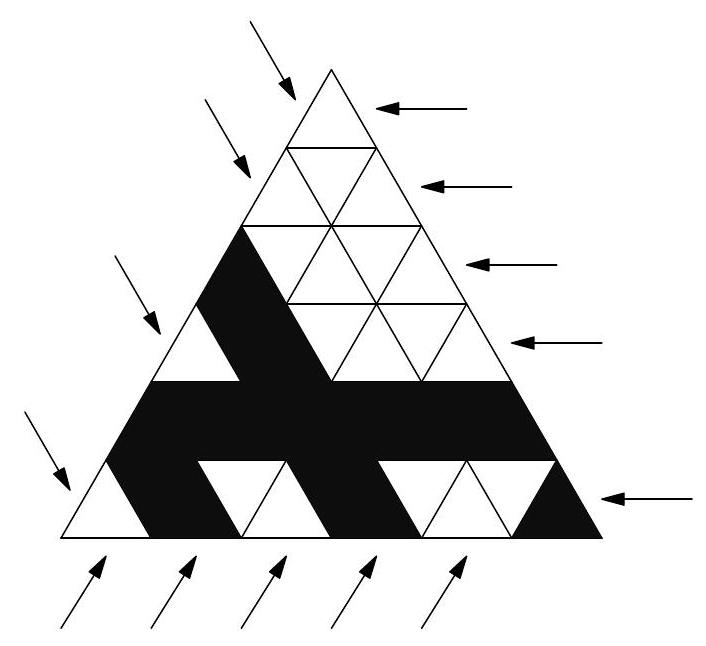
Figure 1
bottom line of the triangle (it can only increase the number of black squares). Order of operations is irrelevant, if we do this operation as the first one then a white triangle with $n=k$ remains for which at least $k$ operations are needed.
Now let's show that it is possible to do $3 n-2$ operations. If $n=1$ then it is evident. Assume that we have proved it for $n=k$. For $n=k+1$ we start with three operations $\mathrm{A}, \mathrm{B}$ and C coloring two rightmost corners and the rightmost line. We have used 3 operations and reduced the field to the situation when $n=k$ (Fig. 2).
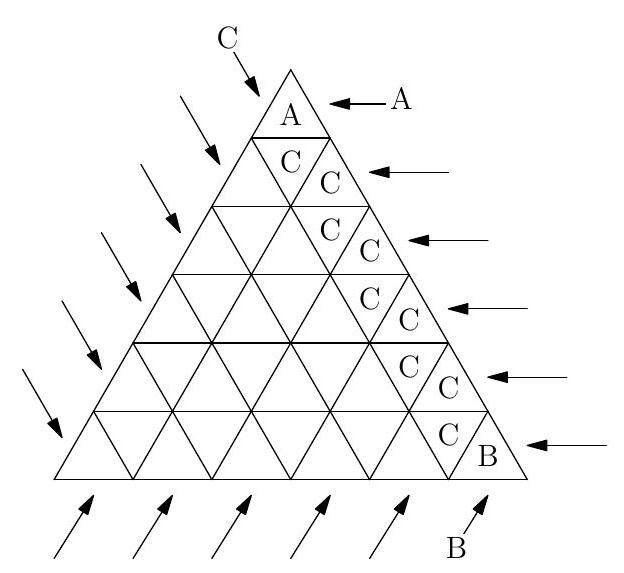
Figure 2 At last we show that there cannot be more than $3 n-2$ operations. If all $n$ lines parallel to one side of the triangle are colored then the whole triangle is colored black. Therefore the number of operations made before the last operation cannot be greater than $3(n-1)$, which gives the total number of operations not greater than $3 n-2$.
Problem 11
In an acute triangle $A B C$ with $A C>A B$, let $D$ be the projection of $A$ on $B C$, and let $E$ and $F$ be the projections of $D$ on $A B$ and $A C$, respectively. Let $G$ be the intersection point of the lines $A D$ and $E F$. Let $H$ be the second intersection point of the line $A D$ and the circumcircle of triangle $A B C$. Prove that
Solution 1

From similar right triangles we get
and analogously
Now, because $A C>A B$, the lines $B C$ and $E F$ intersect in a point $X$ on the extension of segment $B C$ beyond $B$. Menelaus' theorem gives
Adding these relations and rerranging terms we arrive at
whence
Hence follows
which is equivalent to the problem's assertion.
Solution 2
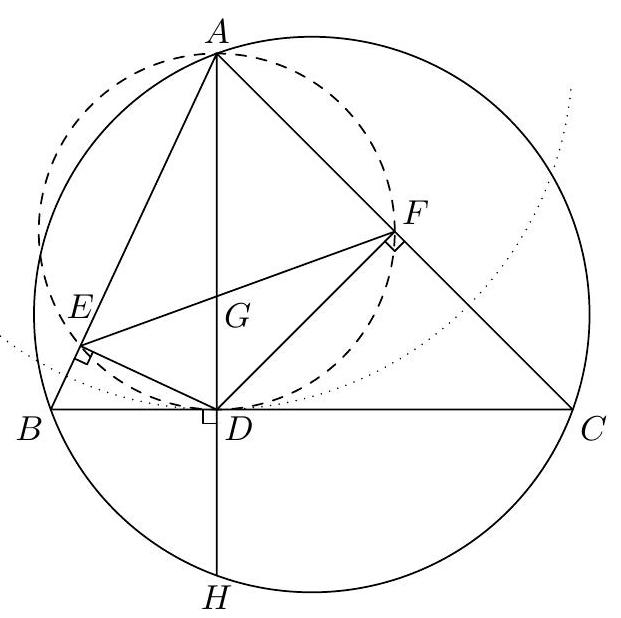
Inversion in the circle with centre $A$ and radius $A D$ maps the line $B C$ and the circle with diameter $A D$, passing through $E$ and $F$, therefore $B$ and $E$ and $C$ and $F$, therefore the circumcircle and the line $E F$ and therefore $H$ and $G$ onto one another. Hence the assertion follows.
Solution 3
Since $\angle A E D$ and $\angle A F D$ are right angles, $A F D E$ is cyclic. Then
Segment $D F$ is an altitude in a right triangle $A D C$, so
and
as angles inscribed in the circumcircle of $\triangle A B C$. Thus $\angle A E F=\angle A H B$, and $B E G H$ is cyclic. Then by the power of the point
On the other hand, since $D E$ is an altitude in a right triangle $A D B$,
It follows that $A G \cdot A H=A D^{2}$, and the result follows.
Problem 12
A trapezoid $A B C D$ with bases $A B$ and $C D$ is such that the circumcircle of the triangle $B C D$ intersects the line $A D$ in a point $E$, distinct from $A$ and $D$. Prove that the circumcircle of the triangle $A B E$ is tangent to the line $B C$.
Solution 1

If point $E$ lies on the segment $A D$ it is sufficient to prove $\angle C B E=\angle B A E$. It is true, since both angles are equal to $180^{\circ}-\angle A D C$. If point $D$ lies on the segment $A E$ we have $\angle C B E=\angle C D E=\angle B A E$, which proves the thesis. In the end, if point $A$ lies on the segment $D E$ we have $180^{\circ}-\angle C B E=\angle C D E=\angle B A E$.
Solution 2
By $\measuredangle$ denote a directed angle modulo $\pi$. Since $A B C D$ is a trapezoid, $\measuredangle B A E=\measuredangle C D E$, and since $B C D E$ is cyclic, $\measuredangle C D E=\measuredangle C B E$. Hence $\measuredangle B A E=\measuredangle C B E$, and the result follows.
Problem 13
All faces of a tetrahedron are right-angled triangles. It is known that three of its edges have the same length $s$. Find the volume of the tetrahedron.
Solution
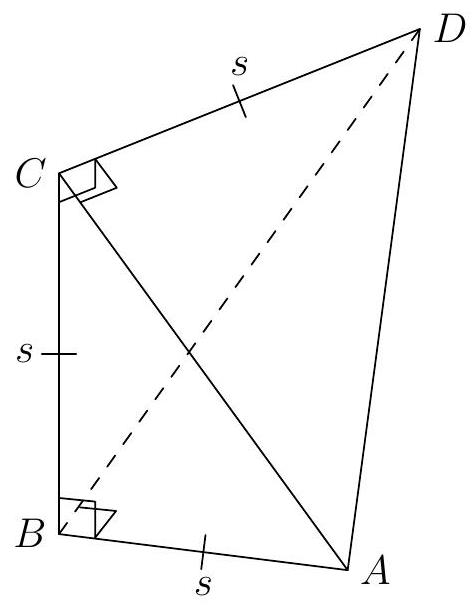
The three equal edges clearly cannot bound a face by themselves, for then this triangle would be equilateral and not right-angled. Nor can they be incident to the same vertex, for then the opposite face would again be equilateral. Hence we may name the tetrahedron $A B C D$ in such a way that $A B=B C=C D=s$. The angles $\angle A B C$ and $\angle B C D$ must then be right, and $A C=B D=s \sqrt{2}$. Suppose that $\angle A D C$ is right. Then by the Pythagorean theorem applied to $A C D$, we find $A D=s$. The reverse of the Pythagorean theorem applied to $A B D$, we see that $\angle D A B$ is right too. The quadrilateral $A B C D$ then has four right angles, and so must be a square. From this contradiction, we conclude that $\angle A D C$ is not right. Since we already know that $A C>C D, \angle C A D$ cannot be right either, and the right angle of $A C D$ must be $\angle A C D$. The Pythagorean theorem gives $A D=s \sqrt{3}$. From the reverse of the Pythagorean theorem, we may now conclude that $\angle A B D$ is right. Consequently, $A B$ is perpendicular to $B C D$, and the volume of the tetrahedron may be simply calculated as
Problem 14
Circles $\alpha$ and $\beta$ of the same radius intersect in two points, one of which is $P$. Denote by $A$ and $B$, respectively, the points diametrically opposite to $P$ on each of $\alpha$ and $\beta$. A third circle of the same radius passes through $P$ and intersects $\alpha$ and $\beta$ in the points $X$ and $Y$, respectively. Show that the line $X Y$ is parallel to the line $A B$.
Solution
Let $M$ be the third circle, and denote by $Z$ the point on $M$ diametrically opposite to $P$. Since $\angle A X P=\angle P X Z=90^{\circ}$, the three points $A, X, Z$ are collinear. Likewise, the three points $B, Y, Z$ are collinear. Point $P$ is equidistant to the three vertices of triangle $A B Z$, for $P A=P B=P Z$ is the common diameter of the circles. Therefore $P$ is the circumcentre of $A B Z$, which means the perpendiculars $P X$ and $P Y$ bisect the sides $A Z$ and $B Z$. Ergo, $X$ and $Y$ are midpoints on $A Z$ and $B Z$, which leads to the desired conclusion $X Y | A B$.
Remark. Note that $A$ and $Z$ are symmetric with respect to $P X$, thus we immediately obtain $A X=X Z$, and similarly $B Y=Y Z$.
Problem 15
Four circles in a plane have a common center. Their radii form a strictly increasing arithmetic progression. Prove that there is no square with each vertex lying on a different circle.
Solution
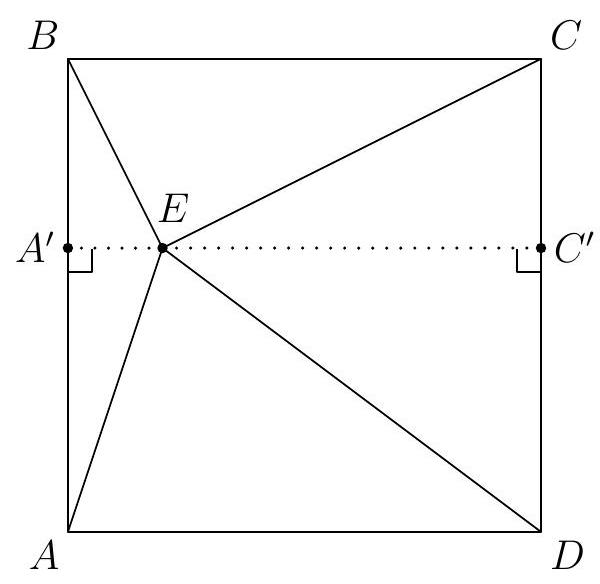
First we prove the following lemma: Lemma 1. If $A B C D$ is a square then for arbitrary point $E$
Proof. Let $A^{\prime}, C^{\prime}$ be projections of $E$ on sides $A B$, and $C D$ respectively. Then
As $A^{\prime} B=C C^{\prime}$ and $A A^{\prime}=C^{\prime} D$ then $E A^{2}+E C^{2}=E B^{2}+E D^{2}$. Note that $E$ does not have to be inside the square, it is true for arbitrary point.
Now let $O$ be the common center of circles and $A B C D$ be a square with each vertex lying on a different circle, assume that $A$ lies on the largest circle. If $a$ is the radius of the smallest circle and $p$ is the difference of the arithmetic progression then the radii of the circles are $a, a+p, a+2 p$ and $a+3 p$, these are also distances from $O$ to the vertices of the square $A B C D, O A=a+3 p$. Consider the expression $O A^{2}+O C^{2}-O B^{2}-O D^{2}$. Its smallest possible value is attained when $O C=a$, therefore
what contradicts the lemma.
Problem 16
We call a positive integer $n$ delightful if there exists an integer $k, 1<k<n$, such that
Does there exist a delightful number $N$ satisfying the inequalities
Solution
Consider a delightful number $n$. Then there exists an integer $x, 1<x<n$ satisfying
Now $n$ and $n+1$ are relatively prime so one of them is divisible by 2 and the other one must then be a perfect, odd square, as $x^{2}$ is on the LHS. Now consider the inequality
The only perfect square in this interval is clearly $\left(2013^{2013}+1\right)^{2}$ which is even. Therefore neither $n$ nor $n+1$ can be an odd, perfect square. Hence no delightful number $N$ satisfy the condition.
Problem 17
Let $c$ and $n>c$ be positive integers. Mary's teacher writes $n$ positive integers on a blackboard. Is it true that for all $n$ and $c$ Mary can always label the numbers written by the teacher by $a_{1}, \ldots, a_{n}$ in such an order that the cyclic product $\left(a_{1}-a_{2}\right) \cdot\left(a_{2}-a_{3}\right) \cdot \ldots \cdot\left(a_{n-1}-a_{n}\right) \cdot\left(a_{n}-a_{1}\right)$ would be congruent to either 0 or $c$ modulo $n$ ?
Solution
Answer: Yes. Solution: If some two of these $n$ integers are congruent modulo $n$ then Mary can choose them consecutively and obtain a product divisible by $n$. Hence we may assume in the rest that these $n$ integers written by the teacher are pairwise incongruent modulo $n$. This means that they cover all residues modulo $n$. If $n$ is composite then Mary can find integers $k$ and $l$ such that $n=k l$ and $2 \leq k \leq l \leq n-2$. Let Mary denote $a_{1}, a_{2}, a_{3}, a_{4}$ such that $a_{1} \equiv k, a_{2} \equiv 0, a_{3} \equiv l+1$ and $a_{4} \equiv 1$. The remaining numbers can be denoted in arbitrary order. The product is divisible by $n$ as the product of the first and the third factor is $(k-0) \cdot((l+1)-1)=k l=n$. If $n$ is prime then the numbers $c i$, where $i=0,1, \ldots, n-1$, cover all residues modulo $n$. Let Mary denote the numbers in such a way that $a_{i} \equiv c(n-i)$ for every $i=1, \ldots, n$. Then every factor in the product is congruent to $c$ modulo $n$, meaning that the product is congruent to $c^{n}$ modulo $n$. But $c^{n} \equiv c$ by Fermat's theorem, and Mary has done.
Problem 18
Find all pairs $(x, y)$ of integers such that $y^{3}-1=x^{4}+x^{2}$.
Solution
If $x=0$, we get a solution $(x, y)=(0,1)$. This solution will turn out to be the only one. If $(x, y)$ is a solution then $(-x, y)$ also is a solution therefore we can assume that $x \geq 1$. We add 1 to both sides and factor: $y^{3}=x^{4}+x^{2}+1=\left(x^{2}+x+1\right)\left(x^{2}-x+1\right)$. We show that the factors $x^{2}+x+1$ and $x^{2}-x+1$ are co-prime. Assume that a prime $p$ divides both of them. Then $p \mid x^{2}+x+1-\left(x^{2}-x+1\right)=2 x$. Since $x^{2}+x+1$ is always odd, $p \mid x$. But then $p$ does not divide $x^{2}+x+1$, a contradiction. Since $x^{2}+x+1$ and $x^{2}-x+1$ have no prime factors in common and their product is a cube, both of them are cubes by a consequence of the fundamental theorem of arithmetic. Therefore, $x^{2}+x+1=a^{3}$ and $x^{2}-x+1=b^{3}$ for some non-negative integers $a$ and $b$.
As $x \geq 1$ the first equation implies that $a>x^{\frac{2}{3}}$. But since clearly $b<a$ we get
when $2 a^{2} \leq 3 a^{2}-3 a$, i.e. $a^{2} \geq 3 a$ which holds for $a \geq 3$. Clearly $a=2$ is impossible and $a=1$ means $x=0$. We got $x^{2}-x+1<x^{2}+x+1-2 x^{\frac{4}{3}}$ which means $0 \leq 2 x-2 x^{\frac{4}{3}}$. Hence $x=1$, but then 3 would be a cube, a contradiction.
Remark. There are many ways to guess the factorization $x^{4}+x^{2}+1=\left(x^{2}+x+1\right)\left(x^{2}-x+1\right)$. Writing $x^{4}+x+1=\left(x^{2}+1\right)^{2}-x^{2}$ we immediately obtain it. Another way to see it is to write $p(x)=x^{4}+x^{2}+1$ and notice that $p(0)=1 \cdot 1, p(1)=3 \cdot 1, p(2)=7 \cdot 3$, so there probably is a quadratic factor $q(x)$ for which $q(0)=1, q(1)=3, q(2)=7$ (clearly, there cannot be linear factors). It is easy to see then that $q(x)=x^{2}+x+1$ and the factorization can be completed with the long division. One more way is to write $x^{4}+x^{2}+1=$ $\left(x^{2}+a x+b\right)\left(x^{2}+c x+d\right)$ and compare the coefficients. It is well-known that if $s$ and $t$ are co-prime integers whose product is a perfect $k$ th power, then $s$ and $t$ both are perfect $k$ th powers. The proof goes like this. Let $a=p_{1}^{\alpha_{1}} \ldots p_{h}^{\alpha_{h}}, b=q_{1}^{\beta_{1}} \ldots q_{\ell}^{\beta_{\ell}}$ and $x=r_{1}^{\gamma_{1}} \ldots r_{m}^{\gamma_{m}}$ be the prime factorizations of $a, b$ and $x$. In the prime factorization of $x^{k}$, every exponent is divisible by $k$, so the same must hold for the factorization of $s t$. But $s$ and $t$ are co-prime, so the exponents of primes in $s$ and $t$ must be divisible by $k$. Therefore $s$ and $t$ are perfect $k$ th powers.
Problem 19
Let $a_{0}$ be a positive integer and $a_{n}=5 a_{n-1}+4$, for all $n \geq 1$. Can $a_{0}$ be chosen so that $a_{54}$ is a multiple of 2013?
Solution 1
Let $x_{n}=\frac{a_{n}}{5^{n}}$. Then $x_{0}=a$ and $5^{n} x_{n}=a_{n}=5 a_{n-1}+4=5^{n} x_{n-1}+4$. So $x_{n}=x_{n-1}+\frac{4}{5^{n}}$. By induction,
So $a_{n}=5^{n} x_{n}=5^{n}(a+1)-1$. Now 2013 and $5^{n}$ are relatively prime. So there is a $b, 0<b<2013$, also relatively prime to 2013 , such that $5^{54}=2013 c+b$. To have 2013 as a factor of $a_{54}$, it suffices to find an integer $y$ such that $(a+1) b-1=2013 y$. But this is a linear Diophantine equation in $a+1$ and $y$; it has an infinite family of solutions, among them such that $a+1 \geq 2$.
Solution 2
Denote $f(x)=5 x+4$, this function is a bijection for residues modulo 2013, and it has an inverse $g(x)=$ $1208 x+1207$. One can easily check that $f(g(x)) \equiv g(f(x)) \equiv x(\bmod 2013)$. Denote $f^{0}(x)=x$ and $f^{n+1}(x)=f\left(f^{n}(x)\right)$, in other words $f^{n}(x)$ is an $n$-fold application of $f$ to $x$. Take $a_{0}=g^{54}(0)$, clearly $a_{0}>0$ and
Problem 20
Find all polynomials $f$ with non-negative integer coefficients such that for all primes $p$ and positive integers $n$ there exist a prime $q$ and a positive integer $m$ such that $f\left(p^{n}\right)=q^{m}$.
Solution
Notice that among the constant polynomials the only solutions are $P(t)=q^{m}$ where $q$ is a prime and $m$ a positive integer. Assume that
where $a_{k} \neq 0$ and $a_{0}, a_{1}, \ldots, a_{k}$ are non-negative integers, is a polynomial that fullfills the conditions. First consider the case $a_{0} \neq 1$. Since $a_{0}$ is a non-negative integer different from 1 , there exists a prime $p$ such that $p$ divides $a_{0}$, and hence $p$ divides $P\left(p^{n}\right)$ for all $n$. Thus $P\left(p^{n}\right)$ is a power of $p$ for all positive integers $n$. If there exists a $k^{\prime}<k$ such that $a_{k^{\prime}} \neq 0$, then for sufficiently large $n$ we have
and hence $P\left(p^{n}\right) \not \equiv 0\left(\bmod p^{n k}\right)$, but this contradicts $P\left(p^{n}\right)=p^{m}$ for some integer $m$ since obviously $P\left(p^{n}\right)>$ $p^{n k}$ and therefore $m$ must be greater than $n k$. We conclude that in this case $P(t)=a_{k} t^{k}$, and it is easy to see that only $a_{k}=1$ is a possibility. Now consider the case $a_{0}=1$. Let $Q(t)=P(P(t))$. Now $Q$ must as well as $P$ satisfy the conditions. Since $Q(0)=P(P(0))=P(1)>1$ and $Q$ is not constant, we know from the previous that $Q(t)=t^{k}$, which contradicts that $Q(0)>1$. Hence there are no solutions in this case. Thus all polynomials that satisfy the conditions are $P(t)=t^{m}$ where $m$ is a positive integer, and $P(t)=q^{m}$ where $q$ is a prime and $m$ is a positive integer.
The 20 contest problems were submitted by 9 countries:
| Country | Proposed problems | |||
|---|---|---|---|---|
| Denmark | 1 | 11 | 16 | 20 |
| Estonia | 17 | |||
| Finland | 2 | 18 | 19 | |
| Germany | 6 | |||
| Lithuania | 3 | |||
| Latvia | 5 | 10 | 15 | |
| Poland | 4 | 7 | 8 | |
| St. Petersburg | 9 | |||
| Sweden | 13 | 14 |
The solution 2 of the problem 19 originate from the contest paper of the Germany team. Some solutions have been added by coordinators.