


Contents
Problems . . . . . . . . . . . . . . . . . . . . . . . . . . . . 2
Solutions . . . . . . . . . . . . . . . . . . . . . . . . . . . . 6
Problems
Problem 1
Show that
Problem 2
Let $a_{0}, a_{1}, \ldots, a_{N}$ be real numbers satisfying $a_{0}=a_{N}=0$ and
for $i=1,2, \ldots, N-1$. Prove that $a_{i} \leqslant 0$ for $i=1,2, \ldots, N-1$.
Problem 3
Positive real numbers $a, b, c$ satisfy $\frac{1}{a}+\frac{1}{b}+\frac{1}{c}=3$. Prove the inequality
Problem 4
Find all functions $f$ defined on all real numbers and taking real values such that
for all real numbers $x, y$.
Problem 5
Given positive real numbers $a, b, c, d$ that satisfy equalities
find all possible values of the expression $\frac{a b+c d}{a d+b c}$.
Problem 6
In how many ways can we paint 16 seats in a row, each red or green, in such a way that the number of consecutive seats painted in the same colour is always odd?
Problem 7
Let $p_{1}, p_{2}, \ldots, p_{30}$ be a permutation of the numbers $1,2, \ldots, 30$. For how many permutations does the equality $\sum_{k=1}^{30}\left|p_{k}-k\right|=450$ hold?
Problem 8
Albert and Betty are playing the following game. There are 100 blue balls in a red bowl and 100 red balls in a blue bowl. In each turn a player must make one of the following moves:
a) Take two red balls from the blue bowl and put them in the red bowl.
b) Take two blue balls from the red bowl and put them in the blue bowl.
c) Take two balls of different colors from one bowl and throw the balls away.
They take alternate turns and Albert starts. The player who first takes the last red ball from the blue bowl or the last blue ball from the red bowl wins. Determine who has a winning strategy.
Problem 9
What is the least possible number of cells that can be marked on an $n \times n$ board such that for each $m>\frac{n}{2}$ both diagonals of any $m \times m$ sub-board contain a marked cell?
Problem 10
In a country there are 100 airports. Super-Air operates direct flights between some pairs of airports (in both directions). The traffic of an airport is the number of airports it has a direct Super-Air connection with. A new company, Concur-Air, establishes a direct flight between two airports if and only if the sum of their traffics is at least 100. It turns out that there exists a round-trip of Concur-Air flights that lands in every airport exactly once. Show that then there also exists a round-trip of Super-Air flights that lands in every airport exactly once.
Problem 11
Let $\Gamma$ be the circumcircle of an acute triangle $A B C$. The perpendicular to $A B$ from $C$ meets $A B$ at $D$ and $\Gamma$ again at $E$. The bisector of angle $C$ meets $A B$ at $F$ and $\Gamma$ again at $G$. The line $G D$ meets $\Gamma$ again at $H$ and the line $H F$ meets $\Gamma$ again at $I$. Prove that $A I=E B$.
Problem 12
Triangle $A B C$ is given. Let $M$ be the midpoint of the segment $A B$ and $T$ be the midpoint of the arc $B C$ not containing $A$ of the circumcircle of $A B C$. The point $K$ inside the triangle $A B C$ is such that $M A T K$ is an isosceles trapezoid with $A T | M K$. Show that $A K=K C$.
Problem 13
Let $A B C D$ be a square inscribed in a circle $\omega$ and let $P$ be a point on the shorter arc $A B$ of $\omega$. Let $C P \cap B D=R$ and $D P \cap A C=S$. Show that triangles $A R B$ and $D S R$ have equal areas.
Problem 14
Let $A B C D$ be a convex quadrilateral such that the line $B D$ bisects the angle $A B C$. The circumcircle of triangle $A B C$ intersects the sides $A D$ and $C D$ in the points $P$ and $Q$, respectively. The line through $D$ and parallel to $A C$ intersects the lines $B C$ and $B A$ at the points $R$ and $S$, respectively. Prove that the points $P, Q, R$ and $S$ lie on a common circle.
Problem 15
The sum of the angles $A$ and $C$ of a convex quadrilateral $A B C D$ is less than $180^{\circ}$. Prove that
Problem 16
Determine whether $712 !+1$ is a prime number.
Problem 17
Do there exist pairwise distinct rational numbers $x, y$ and $z$ such that
Problem 18
Let $p$ be a prime number, and let $n$ be a positive integer. Find the number of quadruples $\left(a_{1}, a_{2}, a_{3}, a_{4}\right)$ with $a_{i} \in\left{0,1, \ldots, p^{n}-1\right}$ for $i=1,2,3,4$ such that
Problem 19
Let $m$ and $n$ be relatively prime positive integers. Determine all possible values of
Problem 20
Consider a sequence of positive integers $a_{1}, a_{2}, a_{3}, \ldots$ such that for $k \geqslant 2$ we have
where $2015^{i}$ is the maximal power of 2015 that divides $a_{k}+a_{k-1}$. Prove that if this sequence is periodic then its period is divisible by 3 .
Solutions
Problem 1
Show that
Solution. We start by rewriting the expression as follows:
$\cos \left(56^{\circ}\right) \cdot \cos \left(2 \cdot 56^{\circ}\right) \cdot \ldots \cdot \cos \left(2^{23} \cdot 56^{\circ}\right)=\frac{\sin \left(56^{\circ}\right) \cdot \cos \left(56^{\circ}\right) \cdot \cos \left(2 \cdot 56^{\circ}\right) \cdot \ldots \cdot \cos \left(2^{23} \cdot 56^{\circ}\right)}{\sin \left(56^{\circ}\right)}$
Now, by applying the double-angle formula $\sin (x) \cos (x)=\sin (2 x) / 2$ to $x=56^{\circ}$, we obtain
Similarly, by applying the double-angle formula 24 times, we get
It remains to prove that $\sin \left(2^{24} \cdot 56^{\circ}\right)=\sin \left(56^{\circ}\right)$. If we can show that
for some integer $k$, then the desired equality follows by the periodicity of the sine function. Note that
Since $\varphi(45)=24$, the Euler theorem implies that $k$ is indeed an integer, as claimed.
Problem 2
Let $a_{0}, a_{1}, \ldots, a_{N}$ be real numbers satisfying $a_{0}=a_{N}=0$ and
for $i=1,2, \ldots, N-1$. Prove that $a_{i} \leqslant 0$ for $i=1,2, \ldots, N-1$.
Solution. Assume the contrary. Then, there is an index $i$ for which $a_{i}=\max {0 \leqslant j \leqslant N} a{j}$ and $a_{i}>0$. This $i$ cannot be equal to 0 or $N$, since $a_{0}=a_{N}=0$. Thus, from $a_{i} \geqslant a_{i-1}$ and $a_{i} \geqslant a_{i+1}$ we obtain $0<a_{i}^{2}=\left(a_{i+1}-a_{i}\right)+\left(a_{i-1}-a_{i}\right) \leqslant 0$, which is a contradiction.
Problem 3
Positive real numbers $a, b, c$ satisfy $\frac{1}{a}+\frac{1}{b}+\frac{1}{c}=3$. Prove the inequality
Solution. Applying several AM-GM inequalities (and using $1 / a+1 / b+1 / c=3$ ) we obtain
Problem 4
Find all functions $f$ defined on all real numbers and taking real values such that
for all real numbers $x, y$.
Answer: $f(x)=0$.
Solution. Substituting $x=y=0$ into the original equality gives $f(f(0))+f(0)=f(0)$, implying
Selecting $x=\frac{f(0)}{2}$ and $y=f(0)$ in the original equality gives
Applying (1) here leads to $f(0)+f\left(-\frac{f(0)}{2}\right)=f\left(-\frac{f(0)}{2}\right)$ which yields
Substituting $y=0$ into the original equation we obtain $f(f(0))+f(x)=f(x f(0)-x)$, which in the light of (2) reduces to
for all $x$. Finally, let us substitute $x=0$ into the original equation. In the light of (2) and (3), we obtain $f(f(y))+f(y)=0$, i. e.,
for all real numbers $y$. Now, for each real $y$, we have
so that $f(y)=0$.
Problem 5
Given positive real numbers $a, b, c, d$ that satisfy equalities
find all possible values of the expression $\frac{a b+c d}{a d+b c}$.
Answer: $\frac{\sqrt{3}}{2}$.
Solution 1. Let $A_{1} B C_{1}$ be a triangle with $A_{1} B=b, B C_{1}=c$ and $\angle A_{1} B C_{1}=120^{\circ}$, and let $C_{2} D A_{2}$ be another triangle with $C_{2} D=d, D A_{2}=a$ and $\angle C_{2} D A_{2}=60^{\circ}$. By the law of cosines and the assumption $a^{2}+d^{2}-a d=b^{2}+c^{2}+b c$, we have $A_{1} C_{1}=A_{2} C_{2}$. Thus, the two triangles can be put together to form a quadrilateral $A B C D$ with $A B=b$, $B C=c, C D=d, D A=a$ and $\angle A B C=120^{\circ}, \angle C D A=60^{\circ}$. Then $\angle D A B+\angle B C D=$ $360^{\circ}-(\angle A B C+\angle C D A)=180^{\circ}$.
Suppose that $\angle D A B>90^{\circ}$. Then $\angle B C D<90^{\circ}$, whence $a^{2}+b^{2}<B D^{2}<c^{2}+d^{2}$, contradicting the assumption $a^{2}+b^{2}=c^{2}+d^{2}$. By symmetry, $\angle D A B<90^{\circ}$ also leads to a contradiction. Hence, $\angle D A B=\angle B C D=90^{\circ}$. Now, let us calculate the area of $A B C D$ in two ways: on one hand, it equals $\frac{1}{2} a d \sin 60^{\circ}+\frac{1}{2} b c \sin 120^{\circ}$ or $\frac{\sqrt{3}}{4}(a d+b c)$. On the other hand, it equals $\frac{1}{2} a b+\frac{1}{2} c d$ or $\frac{1}{2}(a b+c d)$. Consequently,
Solution 2. Setting $T^{2}=a^{2}+b^{2}=c^{2}+d^{2}$, where $T>0$, we can write
for some $\alpha, \beta \in(0, \pi / 2)$. With this notation, the first equality gives
Hence, $\cos (2 \beta)-\cos (2 \alpha)=\sin (\alpha+\beta)$. Since $\cos (2 \beta)-\cos (2 \alpha)=2 \sin (\alpha-\beta) \sin (\alpha+\beta)$ and $\sin (\alpha+\beta) \neq 0$, this yields $\sin (\alpha-\beta)=1 / 2$. Thus, in view of $\alpha-\beta \in(-\pi / 2, \pi / 2)$ we deduce that $\cos (\alpha-\beta)=\sqrt{1-\sin ^{2}(\alpha-\beta)}=\sqrt{3} / 2$.
Now, observing that $a b+c d=\frac{T^{2}}{2}(\sin (2 \alpha)+\sin (2 \beta))=T^{2} \sin (\alpha+\beta) \cos (\alpha-\beta)$ and $a d+b c=T^{2} \sin (\alpha+\beta)$, we obtain $(a b+c d) /(a d+b c)=\cos (\alpha-\beta)=\sqrt{3} / 2$.
Problem 6
In how many ways can we paint 16 seats in a row, each red or green, in such a way that the number of consecutive seats painted in the same colour is always odd?
Answer: 1974.
Solution. Let $g_{k}, r_{k}$ be the numbers of possible odd paintings of $k$ seats such that the first seat is painted green or red, respectively. Obviously, $g_{k}=r_{k}$ for any $k$. Note that $g_{k}=r_{k-1}+g_{k-2}=g_{k-1}+g_{k-2}$, since $r_{k-1}$ is the number of odd paintings with first seat green and second seat red and $g_{k-2}$ is the number of odd paintings with first and second seats green. Moreover, $g_{1}=g_{2}=1$, so $g_{k}$ is the $k$ th element of the Fibonacci sequence. Hence, the number of ways to paint $n$ seats in a row is $g_{n}+r_{n}=2 f_{n}$. Inserting $n=16$ we obtain $2 f_{16}=2 \cdot 987=1974$.
Problem 7
Let $p_{1}, p_{2}, \ldots, p_{30}$ be a permutation of the numbers $1,2, \ldots, 30$. For how many permutations does the equality $\sum_{k=1}^{30}\left|p_{k}-k\right|=450$ hold?
Answer: $(15 !)^{2}$.
Solution. Let us define pairs $\left(a_{i}, b_{i}\right)$ such that $\left{a_{i}, b_{i}\right}=\left{p_{i}, i\right}$ and $a_{i} \geqslant b_{i}$. Then for every $i=1, \ldots, 30$ we have $\left|p_{i}-i\right|=a_{i}-b_{i}$ and
It is clear that the sum $\sum_{i=1}^{30} a_{i}-\sum_{i=1}^{30} b_{i}$ is maximal when
where exactly two $a_{i}$ 's and two $b_{j}$ 's are equal, and the maximal value equals
The number of such permutations is $(15 !)^{2}$.
Problem 8
Albert and Betty are playing the following game. There are 100 blue balls in a red bowl and 100 red balls in a blue bowl. In each turn a player must make one of the following moves:
a) Take two red balls from the blue bowl and put them in the red bowl.
b) Take two blue balls from the red bowl and put them in the blue bowl.
c) Take two balls of different colors from one bowl and throw the balls away.
They take alternate turns and Albert starts. The player who first takes the last red ball from the blue bowl or the last blue ball from the red bowl wins. Determine who has a winning strategy.
Answer: Betty has a winning strategy.
Solution. Betty follows the following strategy. If Albert makes move a), then Betty makes move b) and vice verse. If Albert makes move c) from one bowl, Betty makes move c) from the other bowl. The only exception of this rule is that if Betty can make a winning move, that is, a move where she removes the last blue ball from the red bowl, or the last red ball from the blue bowl, then she makes her winning move.
Firstly, we prove that it is possible to follow this strategy. Let
At the beginning $b=r=(100,0)$. If $b=r$ and Albert takes a move a), then it must be possible for Betty to take a move b) and again leave a situation with $b=r$ to Albert. The same happens when Albert takes a move b). If $b=r$ and Albert takes a move c) from one bowl, then it is possible for Betty to take a move c) from the other bowl and again leave a situation with $b=r$. Thus, by following this strategy, Betty always leaves to Albert a situation with $b=r$ if she is not taking a winning move. Notice that there is one situation from which no legal move is possible, that is, $b=r=(1,0)$, but this could not happen, because the number of balls in a bowl is always even. (It is either increased or decreased by 2 , or doesn't change.)
Now, we will prove that, by using this strategy, Betty wins. Assume that at some point Albert wins, that is, he takes a winning move. Since, before his move, we have $b=r$, the situation was either $b=r=(1, s), s \geqslant 1$, or $b=r=(2, t), t \geqslant 0$. But that means that either $b$ or $r$ was either $\left(1, s^{\prime}\right), s^{\prime} \geqslant 1$ (because $1+s^{\prime}$ is even), or $\left(2, t^{\prime}\right), t^{\prime} \geqslant 0$, before Betty made her last move. This is a contradiction with Betty's strategy, because in this situation Betty would have taken a winning move, and the game would have stopped. Hence, Betty always wins.
Problem 9
What is the least possible number of cells that can be marked on an $n \times n$ board such that for each $m>\frac{n}{2}$ both diagonals of any $m \times m$ sub-board contain a marked cell?
Answer: $n$.
Solution. For any $n$ it is possible to set $n$ marks on the board and get the desired property, if they are simply put on every cell in row number $\left\lceil\frac{n}{2}\right\rceil$. We now show that $n$ is also the minimum amount of marks needed.
If $n$ is odd, then there are $2 n$ series of diagonal cells of length $>\frac{n}{2}$ and both end cells on the edge of the board, and, since every mark on the board can at most lie on two of these diagonals, it is necessary to set at least $n$ marks to have a mark on every one of them.
If $n$ is even, then there are $2 n-2$ series of diagonal cells of length $>\frac{n}{2}$ and both end cells on the edge of the board. We call one of these diagonals even if every coordinate $(x, y)$ on it satisfies $2 \mid x-y$ and odd else. It can be easily seen that this is well defined. Now, by symmetry, the number of odd and even diagonals is the same, so there are exactly $n-1$ of each of them. Any mark set on the board can at most sit on two diagonals and these two have to be of the same kind. Thus, we will need at least $\frac{n}{2}$ marks for the even diagonals, since there are $n-1$ of them and $2 \nmid n-1$, and, similarly, we need at least $\frac{n}{2}$ marks for the the odd diagonals. So we need at least $\frac{n}{2}+\frac{n}{2}=n$ marks to get the desired property.
Problem 10
In a country there are 100 airports. Super-Air operates direct flights between some pairs of airports (in both directions). The traffic of an airport is the number of airports it has a direct Super-Air connection with. A new company, Concur-Air, establishes a direct flight between two airports if and only if the sum of their traffics is at least 100. It turns out that there exists a round-trip of Concur-Air flights that lands in every airport exactly once. Show that then there also exists a round-trip of Super-Air flights that lands in every airport exactly once.
Solution. Let $G$ and $G^{\prime}$ be two graphs corresponding to the flights of Super-Air and Concur-Air, respectively. Then the traffic of an airport is simply the degree of a corresponding vertex, and the assertion means that the graph $G$ has a Hamiltonian cycle.
Lemma. Let a graph $H$ has 100 vertices and contains a Hamiltonian path (not cycle) that starts at the vertex $A$ and ends in $B$. If the sum of degrees of vertices $A$ and $B$ is at least 100, then the graph $H$ contains a Hamiltonian cycle.
Proof. Put $N=\operatorname{deg} A$. Then $\operatorname{deg} B \geqslant 100-N$. Let us enumarate the vertices along the Hamiltonian path: $C_{1}=A, C_{2}, \ldots, C_{100}=B$. Let $C_{p}, C_{q}, C_{r}, \ldots$ be the $N$ vertices which are connected directly to $A$. Consider $N$ preceding vertices: $C_{p-1}, C_{q-1}, C_{r-1}, \ldots$ Since the remaining part of the graph $H$ contains $100-N$ vertices (including $B$ ) and $\operatorname{deg} B \geqslant 100-N$, we conclude that at least one vertex under consideration, say $C_{r-1}$, is connected directly to $B$. Then
is a Hamiltonian cycle.
Now, let us solve the problem. Assume that the graph $G$ contains no Hamiltonian cycle. Consider arbitrary two vertices $A$ and $B$ not connected by an edge in the graph $G$ but connected in $G^{\prime}$. The latter means that $\operatorname{deg} A+\operatorname{deg} B \geqslant 100$ in the graph $G$. Let us add the edge $A B$ to the graph $G$. By the lemma, there was no Hamiltonian path from $A$ to $B$ in the graph $G$. Therefore, the graph $G$ still does not contain a Hamiltonian cycle after adding this new edge. By repeating this operation, we will obtain that all the vertices connected by an edge in the graph $G^{\prime}$ are also connected in the graph $G$ and at the same time the graph $G$ has no Hamiltonian cycle (in contrast to $G^{\prime}$ ). This is a contradiction.
Problem 11
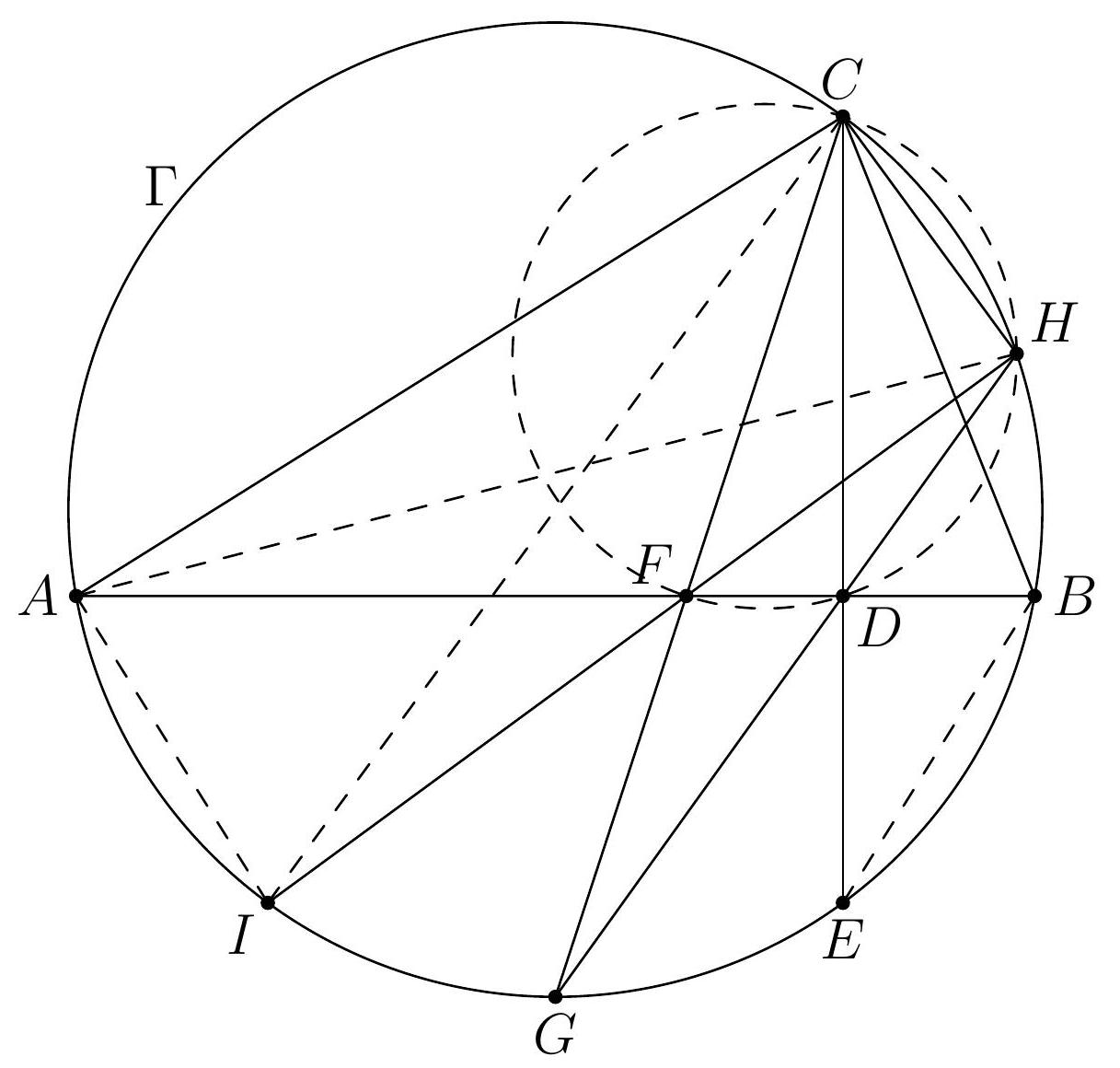
Let $\Gamma$ be the circumcircle of an acute triangle $A B C$. The perpendicular to $A B$ from $C$ meets $A B$ at $D$ and $\Gamma$ again at $E$. The bisector of angle $C$ meets $A B$ at $F$ and $\Gamma$ again at $G$. The line $G D$ meets $\Gamma$ again at $H$ and the line $H F$ meets $\Gamma$ again at $I$. Prove that $A I=E B$.
Solution. Since $C G$ bisects $\angle A C B$, we have $\angle A H G=\angle A C G=\angle G C B$. Thus, from the triangle $A D H$ we find that $\angle H D B=\angle H A B+\angle A H G=\angle H C B+\angle G C B=\angle G C H$. It follows that a pair of opposite angles in the quadrilateral $C F D H$ are supplementary, whence $C F D H$ is a cyclic quadrilateral. Thus, $\angle G C E=\angle F C D=\angle F H D=\angle I H G=$ $\angle I C G$. In view of $\angle A C G=\angle G C B$ we obtain $\angle A C I=\angle E C B$, which implies $A I=E B$.
Problem 12
Triangle $A B C$ is given. Let $M$ be the midpoint of the segment $A B$ and $T$ be the midpoint of the arc $B C$ not containing $A$ of the circumcircle of $A B C$. The point $K$ inside the triangle $A B C$ is such that $M A T K$ is an isosceles trapezoid with $A T | M K$. Show that $A K=K C$.
Solution. Assume that $T K$ intersects the circumcircle of $A B C$ at the point $S$ (where $S \neq T)$. Then $\angle A B S=\angle A T S=\angle B A T$, so $A S B T$ is a trapezoid. Hence, $M K|A T| S B$ and $M$ is the midpoint of $A B$. Thus, $K$ is the midpoint of $T S$. From $\angle T A C=\angle B A T=$ $\angle A T S$ we see that $A C T S$ is an inscribed trapezoid, so it is isosceles. Thus, $A K=K C$, since $K$ is the midpoint of $T S$.
Problem 13
Let $A B C D$ be a square inscribed in a circle $\omega$ and let $P$ be a point on the shorter arc $A B$ of $\omega$. Let $C P \cap B D=R$ and $D P \cap A C=S$. Show that triangles $A R B$ and $D S R$ have equal areas.
Solution. Let $T=P C \cap A B$. Then $\angle B T C=90^{\circ}-\angle P C B=90^{\circ}-\angle P D B=90^{\circ}-$ $\angle S B D=\angle B S C$, thus the points $B, S, T, C$ are concyclic. Hence $\angle T S C=90^{\circ}$, and, therefore, $T S | B D$. It follows that
where $[\Delta]$ denotes the area of a triangle $\Delta$.
Problem 14
Let $A B C D$ be a convex quadrilateral such that the line $B D$ bisects the angle $A B C$. The circumcircle of triangle $A B C$ intersects the sides $A D$ and $C D$ in the points $P$ and $Q$, respectively. The line through $D$ and parallel to $A C$ intersects the lines $B C$ and $B A$ at the points $R$ and $S$, respectively. Prove that the points $P, Q, R$ and $S$ lie on a common circle.
Solution 1. Since $\angle S D P=\angle C A P=\angle R B P$, the quadrilateral $B R D P$ is cyclic (see Figure 1). Similarly, the quadrilateral $B S D Q$ is cyclic. Let $X$ be the second intersection point of the segment $B D$ with the circumcircle of the triangle $A B C$. Then
and, moreover, $\angle A B X=\angle D B R$. It means that triangles $A B X$ and $D B R$ are similar. Thus
which implies that the points $R, X$ and $P$ are collinear. Analogously, we can show that the points $S, X$ and $Q$ are collinear.
Thus, we obtain $R X \cdot X P=D X \cdot X B=S X \cdot X Q$, which proves that the points $P$, $Q, R$ and $S$ lie on a common circle.
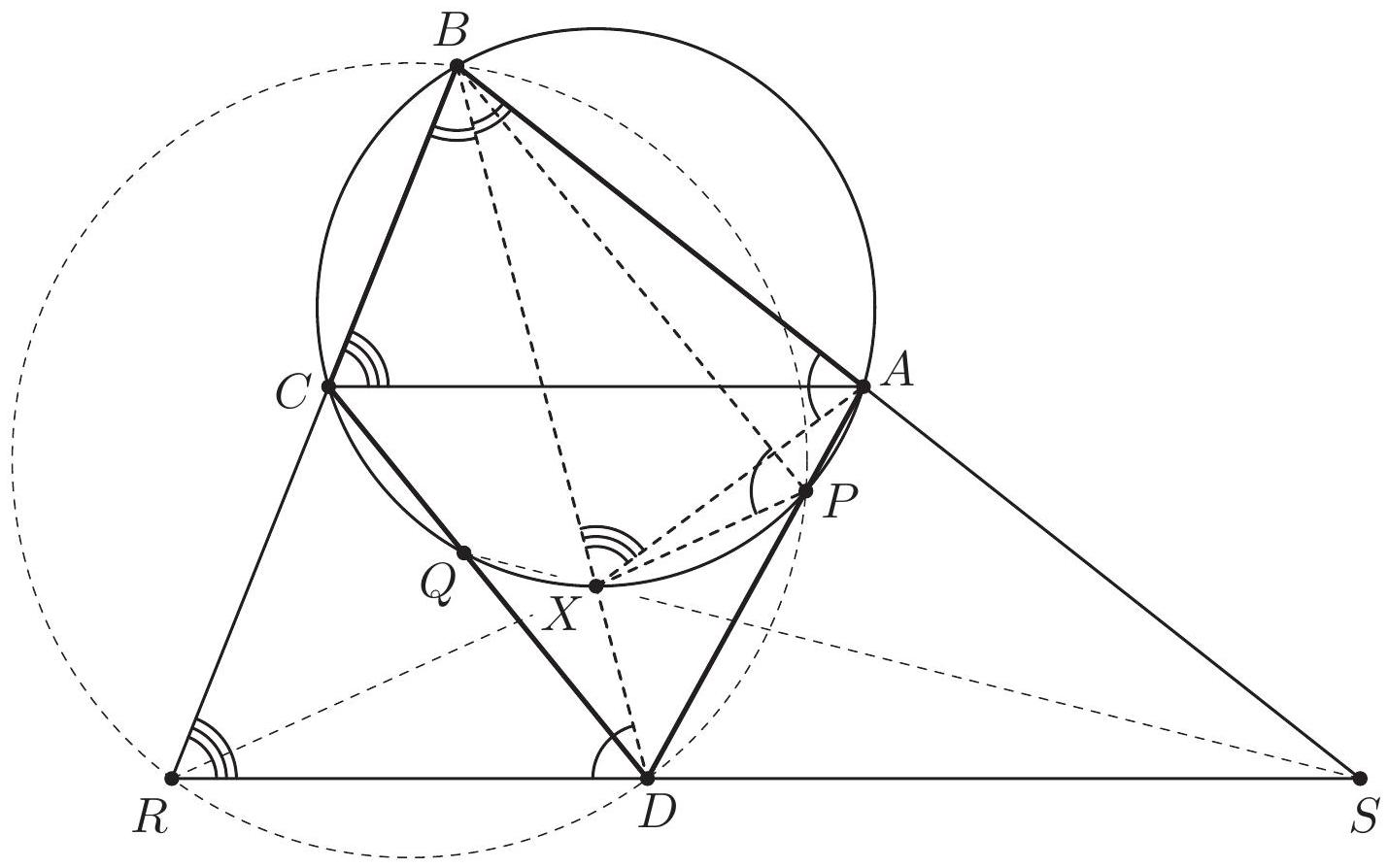
Figure 1
Solution 2. If $A B=B C$, then the points $R$ and $S$ are symmetric to each other with respect to the line $B D$. Similarly, the points $P$ and $Q$ are symmetric to each other with respect to the line $B D$. Therefore, $R S P Q$ is an isosceles trapezoid, so the claim follows.
Assume that $A B \neq B C$. Denote by $\omega$ the circumcircle of the triangle $A B C$ (see Figure 2). Since the lines $A C$ and $S R$ are parallel, the dilation with center $B$, which takes $A$ to $S$, also takes $C$ to $R$ and the circle $\omega$ to the circumcircle $\omega_{1}$ of $B S R$. This implies that $\omega$ and $\omega_{1}$ are tangent at $B$.
Note that $\angle R D Q=\angle D C A=\angle D P Q$, which means that the circumcircle $\omega_{2}$ of the triangle $P Q D$ is tangent to the line $R S$ at $D$.
Denote by $K$ the intersection point of the line $R S$ with the common tangent to $\omega$ and $\omega_{1}$ at $B$. Then we have
which implies that $K D=K B$. Therefore, the powers of the point $K$ with respect to the circles $\omega$ and $\omega_{2}$ are equal, so $K$ lies on their radical axis. This implies that the points $K, P$ and $Q$ are collinear. Finally, we obtain
which shows that the points $P, Q, R$ and $S$ lie on a common circle.

Figure 2
Solution 3. Denote by $X^{\prime}$ the image of the point $X$ under some fixed inversion with center $B$. At the beginning of Solution 2 we noticed that the circumcircles of the triangles $A B C$ and $S B R$ are tangent at the point $B$. Therefore, the images of these two circles under the considered inversion become two parallel lines $A^{\prime} C^{\prime}$ and $S^{\prime} R^{\prime}$ (see Figure 3).
Since $D$ lies on the line $R S$ and also on the angle bisector of the angle $A B C$, the point $D^{\prime}$ lies on the circumcircle of the triangle $B R^{\prime} S^{\prime}$ and also on the angle bisector of the angle $A^{\prime} B C^{\prime}$. Since the point $P$, other than $A$, is the intersection point of the line $A D$ and the circumcircle of the triangle $A B C$, the point $P^{\prime}$, other than $A^{\prime}$, is the intersection point of the circumcircle of the triangle $B A^{\prime} D^{\prime}$ and the line $A^{\prime} C^{\prime}$. Similarly, the point $Q^{\prime}$ is the intersection point of the circumcircle of the triangle $B C^{\prime} D^{\prime}$ and the line $A^{\prime} C^{\prime}$.
Therefore, we obtain
and
This implies that the points $P^{\prime}$ and $S^{\prime}$ are symmetric to the points $Q^{\prime}$ and $R^{\prime}$ with respect to the line passing through $D^{\prime}$ and perpendicular to the lines $A^{\prime} C^{\prime}$ and $S^{\prime} R^{\prime}$. Thus $P^{\prime} S^{\prime} R^{\prime} Q^{\prime}$ is an isosceles trapezoid, so the points $P^{\prime}, S^{\prime}, R^{\prime}$ and $Q^{\prime}$ lie on a common circle. Therefore, the points $P, Q, R$ and $S$ also lie on a common circle.
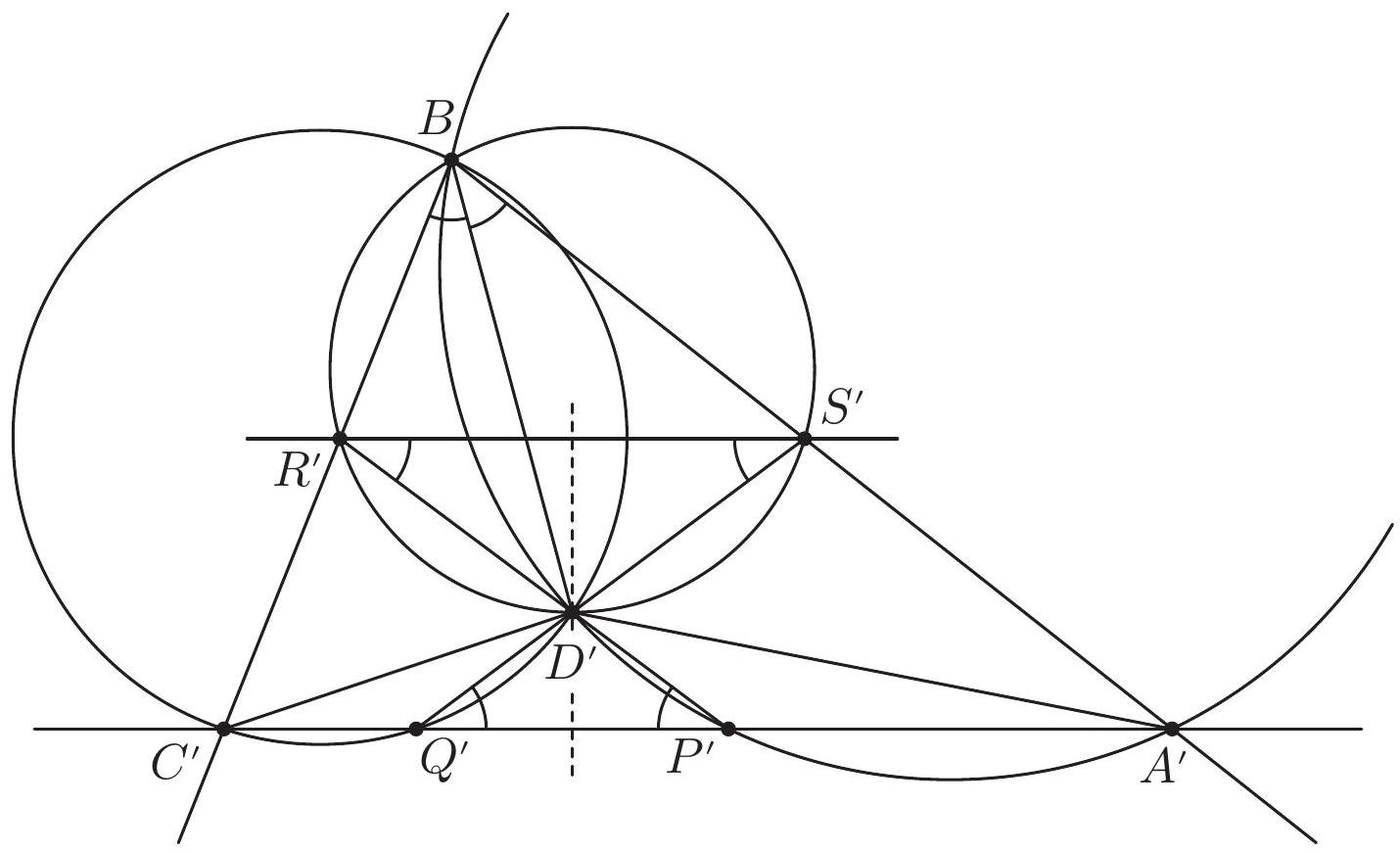
Figure 3
Problem 15
The sum of the angles $A$ and $C$ of a convex quadrilateral $A B C D$ is less than $180^{\circ}$. Prove that
Solution 1. Let $\omega$ be the circumcircle $A B D$. Then the point $C$ is outside this circle, but inside the angle $B A D$. Let us ppply the inversion with the center $A$ and radius 1 . This inversion maps the circle $\omega$ to the line $\omega^{\prime}=B^{\prime} D^{\prime}$, where $B^{\prime}$ and $D^{\prime}$ are images of $B$ and $D$. The point $C$ goes to the point $C^{\prime}$ inside the triangle $A B^{\prime} D^{\prime}$. Therefore, $B^{\prime} C^{\prime}+C^{\prime} D^{\prime}<A B^{\prime}+A D^{\prime}$. Now, due to inversion properties, we have
Hence
Multiplying by $A B \cdot A C \cdot A D$, we obtain the desired inequality.
Solution 2. Consider an inscribed quadrilateral $A^{\prime} B^{\prime} C^{\prime} D^{\prime}$ with sides of the same lengths as $A B C D$ (such a quadrilateral exists, because we can draw these 4 sides in a big circle and afterwards continuously decrease its radius). Then $\angle B^{\prime}+\angle D^{\prime}=180^{\circ}<\angle B+\angle D$. Therefore, $\angle B^{\prime}<\angle B$ or $\angle D^{\prime}<\angle D$ and hence $A^{\prime} C^{\prime}<A C$, by the cosine theorem.
So the inequality under consideration for $A^{\prime} B^{\prime} C^{\prime} D^{\prime}$ is stronger than that for $A B C D$. However, the inequality for $A^{\prime} B^{\prime} C^{\prime} D^{\prime}$ follows immediately from Ptolemy's theorem.
Problem 16
Determine whether $712 !+1$ is a prime number.
Answer: It is composite.
Solution. We will show that 719 is a prime factor of given number (evidently, $719<$ $712 !+1$ ). All congruences are considered modulo 719 . By Wilson's theorem, $718 ! \equiv-1$. Furthermore,
Hence $712 ! \equiv-1$, which means that $712 !+1$ is divisible by 719 .
We remark that 719 is the smallest prime greater then 712 , so 719 is the smallest prime divisor of $712 !+1$.
Problem 17
Do there exist pairwise distinct rational numbers $x, y$ and $z$ such that
Answer: No.
Solution. Put $a=x-y$ and $b=y-z$. Then
On the other hand, 2014 is not a square of a rational number. Hence, such numbers $x, y, z$ do not exist.
Problem 18
Let $p$ be a prime number, and let $n$ be a positive integer. Find the number of quadruples $\left(a_{1}, a_{2}, a_{3}, a_{4}\right)$ with $a_{i} \in\left{0,1, \ldots, p^{n}-1\right}$ for $i=1,2,3,4$ such that
Answer: $p^{3 n}-p^{3 n-2}$.
Solution. We have $p^{n}-p^{n-1}$ choices for $a_{1}$ such that $p \nmid a_{1}$. In this case for any of the $p^{n} \cdot p^{n}$ choices of $a_{3}$ and $a_{4}$, there is a unique choice of $a_{2}$, namely,
This gives $p^{2 n}\left(p^{n}-p^{n-1}\right)=p^{3 n-1}(p-1)$ of quadruples.
If $p \mid a_{1}$ then we obviously have $p \nmid a_{3}$, since otherwise the condition
is violated. Now, if $p \mid a_{1}, p \nmid a_{3}$, for any choice of $a_{2}$ there is a unique choice of $a_{4}$, namely,
Thus, for these $p^{n-1}$ choices of $a_{1}$ and $p^{n}-p^{n-1}$ choices of $a_{3}$, we have for each of the $p^{n}$ choices of $a_{2}$ a unique $a_{4}$. So in this case there are $p^{n-1}\left(p^{n}-p^{n-1}\right) p^{n}=p^{3 n-2}(p-1)$ of quadruples.
Thus, the total number of quadruples is
Problem 19
Let $m$ and $n$ be relatively prime positive integers. Determine all possible values of
Answer: 1 and 7 .
Solution. Without restriction of generality we may assume that $m \geqslant n$. It is well known that
SO
Let $d \geqslant 1$ be a divisor of $m-n$. Clearly, $\operatorname{gcd}(m, d)=1$, since $m$ and $n$ are relatively prime. Assume that $d$ also divides $m^{2}+m n+n^{2}$. Then $d$ divides $3 m^{2}$. In view of $\operatorname{gcd}(m, d)=1$ the only choices for $d$ are $d=1$ and $d=3$. Hence $\operatorname{gcd}\left(m-n, m^{2}+m n+n^{2}\right)$ is either 1 or 3 . Consequently, $\operatorname{gcd}\left(2^{m}-2^{n}, 2^{m^{2}+m n+n^{2}}-1\right)$ may only assume the values $2^{1}-1=1$ and $2^{3}-1=7$.
Both values are attainable, since $m=2, n=1$ gives
whereas $m=1, n=1$ gives
Problem 20
Consider a sequence of positive integers $a_{1}, a_{2}, a_{3}, \ldots$ such that for $k \geqslant 2$ we have
where $2015^{i}$ is the maximal power of 2015 that divides $a_{k}+a_{k-1}$. Prove that if this sequence is periodic then its period is divisible by 3 .
Solution. If all the numbers in the sequence are even, then we can divide each element of the sequence by the maximal possible power of 2 . In this way we obtain a new sequence of integers which is determined by the same recurrence formula and has the same period, but now it contains an odd number. Consider this new sequence modulo 2. Since the number 2015 is odd, it has no influence to the calculations modulo 2 , so we may think that modulo 2 this sequence is given by the Fibonacci recurrence $a_{k+1} \equiv a_{k}+a_{k-1}$ with $a_{j} \equiv 1$ $(\bmod 2)$ for at least one $j$. Then it has the following form $\ldots, 1,1,0,1,1,0,1,1,0, \ldots$ (with period 3 modulo 2), so that the length of the original period of our sequence (if it is periodic!) must be divisible by 3 .
Remark. It is not known whether a periodic sequence of integers satisfying the recurrence condition of this problem exists. The solution of such a problem is apparently completely out of reach. See, e.g., the recent preprint
Brandon Avila and Tanya Khovanova, Free Fibonacci sequences, 2014, preprint at http://arxiv.org/pdf/1403.4614v1.pdf
for more information. (The problem given at the olympiad is Lemma 28 of this paper, where 2015 can be replaced by any odd integer greater than 1.)