Baltic Way 2016 - Solutions
- Find all pairs of primes $(p, q)$ such that
Solution. Assume first that neither of the numbers equals 3. Then, if $p \equiv q \bmod 3$, the left hand side is divisible by 3 , but the right hand side is not. But if $p \equiv-q \bmod 3$, the left hand side is not divisible by 3 , while the right hand side is. So this is not possible.
If $p=3$, then $q^{5}<27$, which is impossible. Therefore $q=3$, and the equation turns into $p^{3}-243=(p+3)^{2}$ or
As $p>3$ then $p^{2}-p-6$ is positive and increases with $p$. So the equation has at most one solution. It is easy to see that $p=7$ is the one and $(7,3)$ is a solution to the given equation.
- Prove or disprove the following hypotheses.
a) For all $k \geq 2$, each sequence of $k$ consecutive positive integers contains a number that is not divisible by any prime number less than $k$.
b) For all $k \geq 2$, each sequence of $k$ consecutive positive integers contains a number that is relatively prime to all other members of the sequence.
Solution. We give a counterexample to both claims. So neither of them is true.
For a), a counterexample is the sequence $(2,3,4,5,6,7,8,9)$ of eight consecutive integers all of which are divisible by some prime less than 8 .
To construct a counterexample to b), we notice that by the Chinese Remainder Theorem, there exists an integer $x$ such that $x \equiv 0 \bmod 2, x \equiv 0 \bmod 5, x \equiv 0 \bmod 11, x \equiv 2 \bmod 3$, $x \equiv 5 \bmod 7$ and $x \equiv 10 \bmod 13$. The last three of these congruences mean that $x+16$ is a multiple of 3,7 , and 13 . Now consider the sequence $(x, x+1, \ldots, x+16)$ of 17 consequtive integers. Of these all numbers $x+2 k, 0 \leq k \leq 8$, are even and so have a common factor with some other. Of the remaining, $x+1, x+7$ and $x+13$ are divisible by $3, x+3$ is a multiple of 13 as is $x+16, x+5$ is divisible by 5 as $x, x+9$ is a multiple of 7 as $x+2$, $x+11$ a multiple of 11 as is $x$, and finally $x+15$ is a multiple of 5 as is $x$.
Remark. The counterexample given to either hypothesis is the shortest possible. The only counterexamples of length 8 to the first hypothesis are those where numbers give remainders $2,3, \ldots, 9 ; 3,4, \ldots, 10 ;-2,-3, \ldots,-9 ;$ or $-3,-4, \ldots,-10$ modulo 210 . The only counterexamples of length 17 to the second hypothesis are those where the numbers give remainders $2184,2185, \ldots, 2200$ or $-2184,-2185, \ldots,-2200$ modulo 30030.
- For which integers $n=1, \ldots, 6$ does the equation
have a solution in integers?
Solution. A solution clearly exists for $n=1,2,3$ :
We show that for $n=4,5,6$ there is no solution.
For $n=4$, the equation $a^{4}+b^{4}=c^{4}+4$ may be considered modulo 8 . Since each fourth power $x^{4} \equiv 0,1 \bmod 8$, the expression $a^{4}+b^{4}-c^{4}$ can never be congruent to 4 .
For $n=5$, consider the equation $a^{5}+b^{5}=c^{5}+5$ modulo 11 . As $x^{5} \equiv 0$ or $\equiv \pm 1 \bmod 11$ (This can be seen by Fermat's Little Theorem or by direct computation), $a^{5}+b^{5}-c^{5}$ cannot be congruent to 5 .
The case $n=6$ is similarly dismissed by considering the equation modulo 13 .
- Let $n$ be a positive integer and let $a, b, c, d$ be integers such that $n \mid a+b+c+d$ and $n \mid a^{2}+b^{2}+c^{2}+d^{2}$. Show that
Solution 1. Consider the polynomial
It is clear that $w(a)=w(b)=w(c)=w(d)=0$. By adding these values we get
Hence
Using Vieta's formulas, we can see that $D=a b c d$ and $-A=a+b+c+d$. Therefore the right hand side of the equation above is divisible by $n$, and so is the left hand side.
Solution 2. Since the numbers $(a+b+c+d)\left(a^{3}+b^{3}+c^{3}+d^{3}\right),\left(a^{2}+b^{2}+c^{2}+d^{2}\right)(a b+$ $a c+a d+b c+b d+c d)$ and $(a+b+c+d)(a b c+a c d+a b d+b c d)$ are divisible by $n$, then so is the number
(Heiki Niglas, Estonia)
- Let $p>3$ be a prime such that $p \equiv 3(\bmod 4)$. Given a positive integer $a_{0}$, define the sequence $a_{0}, a_{1}, \ldots$ of integers by $a_{n}=a_{n-1}^{2^{n}}$ for all $n=1,2, \ldots$ Prove that it is possible to choose $a_{0}$ such that the subsequence $a_{N}, a_{N+1}, a_{N+2}, \ldots$ is not constant modulo $p$ for any positive integer $N$.
Solution. Let $p$ be a prime with residue 3 modulo 4 and $p>3$. Then $p-1=u \cdot 2$ where $u>1$ is odd. Choose $a_{0}=2$. The order of 2 modulo $p$ (that is, the smallest positive integer $t$ such that $\left.2^{t} \equiv 1 \bmod p\right)$ is a divisor of $\phi(p)=p-1=u \cdot 2$, but not a divisor of 2 since $1<2^{2}<p$. Hence the order of 2 modulo $p$ is not a power of 2 . By definition we see that $a_{n}=a_{0}^{2^{1+2+\cdots+n}}$. Since the order of $a_{0}=2$ modulo $p$ is not a power of 2 , we know that $a_{n} \not \equiv 1 \quad(\bmod p)$ for all $n=1,2,3, \ldots$ We proof the statement by contradiction. Assume there exists a positive integer $N$ such that $a_{n} \equiv a_{N}(\bmod p)$ for all $n \geq N$. Let $d>1$ be the order of $a_{N}$ modulo $p$. Then $a_{N} \equiv a_{n} \equiv a_{n+1}=a_{n}^{2^{n+1}} \equiv a_{N}^{2^{n+1}} \quad(\bmod p)$, and hence $a_{N}^{2^{n+1}-1} \equiv 1 \quad(\bmod p)$ for all $n \geq N$. Now $d$ divides $2^{n+1}-1$ for all $n \geq N$, but this is a contradiction since
$\operatorname{gcd}\left(2^{n+1}-1,2^{n+2}-1\right)=\operatorname{gcd}\left(2^{n+1}-1,2^{n+2}-1-2\left(2^{n+1}-1\right)\right)=\operatorname{gcd}\left(2^{n+1}-1,1\right)=1$.
Hence there does not exist such an $N$.
- The set ${1,2, \ldots, 10}$ is partitioned into three subsets $A, B$ and $C$. For each subset the sum of its elements, the product of its elements and the sum of the digits of all its elements are calculated. Is it possible that $A$ alone has the largest sum of elements, $B$ alone has the largest product of elements, and $C$ alone has the largest sum of digits?
Solution. It is indeed possible. Choose $A={1,9,10}, B={3,7,8}, C={2,4,5,6}$. Then the sum of elements in $A, B$ and $C$, respectively, is 20,18 and 17 , the sum of digits 11, 18 and 17, while the product of elements is 90,168 and 240.
- Find all positive integers $n$ for which
holds for all real numbers $x$.
Solution. We show that the inequality holds for even $n$ and only for them.
If $n$ is odd, the for $x=-1$ the left hand side of the inequality equals $n-6$ while the right hand side is $n$. So the inequality is not true for $x=-1$ for any odd $n$. So now assume that $n$ is even. Since $|x| \geq x$, it is enough to prove $3 x^{n}+2 n-3 \geq n x^{2}+n|x|$ for all $x$ or equivalently that $3 x^{n}+(2 n-3) \geq n x^{2}+n x$ for $x \geq 0$. Now the AGM-inequality gives
and similarly
Adding (1) and (2) yields the claim.
- Find all real numbers a for which there exists a non-constant function $f: \mathbb{R} \rightarrow \mathbb{R}$ satisfying the following two equations for all $x \in \mathbb{R}$ : i) $\quad f(a x)=a^{2} f(x)$ and
ii) $f(f(x))=a f(x)$.
Solution. The conditions of the problem give two representations for $f(f(f(x)))$ :
and
So $a^{2} f(x)=a^{3} f(x)$ for all $x$, and if there is an $x$ such that $f(x) \neq 0$, the $a=0$ or $a=1$. Otherwise $f$ is the constant function $f(x)=0$ for all $x$. If $a=1$, the function $f(x)=x$ satisfies the conditions. For $a=0$, one possible solution is the function $f$,
- Find all quadruples $(a, b, c, d)$ of real numbers that simultaneously satisfy the following equations:
Solution 1. Consider the polynomial $P(x)=(a x+b)^{3}+(c x+d)^{3}=\left(a^{3}+b^{3}\right) x^{3}+3\left(a^{2} b+\right.$ $\left.c^{2} d\right) x^{2}+3\left(a b^{2}+c d^{2}\right) x+b^{3}+d^{3}$. By the conditions of the problem, $P(x)=2 x^{3}-18 x+1$. Clearly $P(0)>0, P(1)<0$ and $P(3)>0$. Thus $P$ has three distinct zeroes. But $P(x)=0$ implies $a x+b=-(c x+d)$ or $(a+c) x+b+d=0$. This equation has only one solution, unless $a=-c$ and $b=-d$. But since the conditions of the problem do not allow this, we infer that the system of equations in the problem has no solution.
Solution 2. If $0 \in{a, b}$, then one easily gets that $0 \in{c, d}$, which contradicts the equation $a b^{2}+c d^{2}=-6$. Similarly, if $0 \in{c, d}$, then $0 \in{a, b}$ and this contradicts $a b^{2}+c d^{2}=-6$ again. Hence $a, b, c, d \neq 0$.
Let the four equations in the problem be (i), (ii), (iii) and (iv), respectively. Then $(i)+3(i i)+3(i i i)+(i v)$ will give
According to the equation (ii), $b$ and $d$ have different sign, and similarly (iv) yields that $a$ and $c$ have different sign.
First, consider the case $a>0, b>0$. Then $c<0$ and $d<0$. By $(i)$, we have $a>-c$ (i.e. $|a|>|c|)$ and (iii) gives $b>-d$. Hence $a+b>-(c+d)$ and so $(a+b)^{3}>-(c+d)^{3}$, thus $(a+b)^{3}+(c+d)^{3}>0$ which contradicts (1).
Next, consider the case $a>0, b<0$. Then $c<0$ and $d>0$. By $(i)$, we have $a>-c$ and by (iii), $d>-b$ (i.e. $b>-d$ ). Thus $a+b>-(c+d)$ and hence $(a+b)^{3}+(c+d)^{3}>0$ which contradicts (1).
The case $a<0, b<0$ leads to $c>0, d>0$. By (i), we have $c>-a$ and by (iii) $d>-b$. So $c+d>-(a+b)$ and hence $(c+d)^{3}+(a+b)^{3}>0$ which contradicts (1) again.
Finally, consider the case $a<0, b>0$. Then $c>0$ and $d<0$. By (i), $c>-a$ and by (iii) $b>-d$ which gives $c+d>-(a+b)$ and hence $(c+d)^{3}+(a+b)^{3}>0$ contradicting (1).
Hence there is no real solution to this system of equations. (Heiki Niglas)
Solution 3. As in Solution 2, we conclude that $a, b, c, d \neq 0$. The equation $a^{2} b+c^{2} d=0$ yields $a= \pm \sqrt{\frac{-d}{b}} c$. On the other hand, we have $a^{3}+c^{3}=2$ and $a b^{2}+c d^{2}=-6<0$ which implies that $\min {a, c}<0<\max {a, c}$ and thus $a=-\sqrt{\frac{-d}{b}} c$.
Let $x=-\sqrt{\frac{-d}{b}}$. Then $a=x c$ and so
Also $-6=a b^{2}+c d^{2}=c x b^{2}+c d^{2}$, which, using (2), gives
Thus
If $x^{3}+1=0$, then $x=-1$ and hence $a=-c$, which contradicts $a^{3}+c^{3}=2$. So $x^{3}+1 \neq 0$ and (3) gives
Now note that
and hence (4) yields that
Let $y=\sqrt{\frac{b^{3}-1}{b^{3}}}$. Then $b^{3}=\frac{1}{1-y^{2}}$ and so (5) implies
i.e.
If $y=0$, then $b=1$ and so $d=0$, a contradiction. So
Clearly $y \neq 1$ and hence $y=108+108 y^{2}+216 y$, or $108 y^{2}+215 y+108=0$. The last equation has no real solutions and thus the initial system of equations has no real solutions.
Remark 1. Note that this solution worked because RHS of $a^{2} b+c^{2} d=0$ is zero. If instead it was, e.g., $a^{2} b+c^{2} d=0.1$ then this solution would not work out, but the first solution still would.
Remark 2. The advantage of this solution is that solving the last equation $108 y^{2}+$ $215 y+108=0$ one can find complex solutions of this system of equations. (Heiki Niglas)
- Let $a_{0,1}, a_{0,2}, \ldots, a_{0,2016}$ be positive real numbers. For $n \geq 0$ and $1 \leq k<2016$ set
Show that $\max {1 \leq k \leq 2016} a{2016, k}>44$.
Solution. We prove
for all $n$. The claim then follows from $44^{2}=1936<2016$. To prove (1), first notice that the inequality certainly holds for $n=0$. Assume (1) is true for $n$. There is a $k$ such that $a_{n, k}=m_{n}$. Also $a_{n, k+1} \leq m_{n}$ (or if $k=2016, a_{n, 1} \leq m_{n}$ ). Now (assuming $k<2016$ )
Since $m_{n+1}^{2} \geq a_{n+1, k}^{2}$, we are done.
- The set $A$ consists of 2016 positive integers. All prime divisors of these numbers are smaller than 30. Prove that there are four distinct numbers $a, b, c$ and $d$ in $A$ such that abcd is a perfect square.
Solution. There are ten prime numbers $\leq 29$. Let us denote them as $p_{1}, p_{2}, \ldots, p_{10}$. To each number $n$ in $A$ we can assign a 10 -element sequence $\left(n_{1}, n_{2}, \ldots, n_{10}\right)$ such that $n_{i}=1$ $p_{i}$ has an odd exponent in the prime factorization of $n$, and $n_{i}=0$ otherwise. Two numbers to which identical sequences are assigned, multiply to a perfect square. There are only 1024 different 10-element ${0,1}$-sequences so there exist some two numbers $a$ and $b$ with identical sequencies, and after removing these from $A$ certainly two other numbers $c$ and $d$ with identical sequencies remain. These $a, b, c$ and $d$ satisfy the condition of the problem.
- Does there exist a hexagon (not necessarily convex) with side lengths 1, 2, 3, 4, 5, 6 (not necessarily in this order) that can be tiled with a) 31 b) 32 equilateral triangles with side length 1 ?
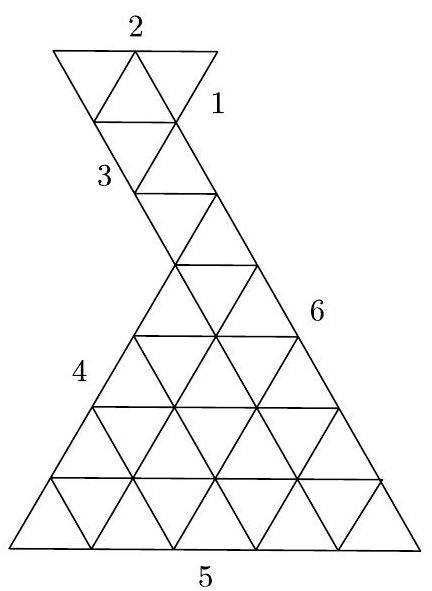
Solution. The adjoining figure shows that question a) can be answered positively.
For a negative answer to b), we show that the number of triangles has to be odd. Assume there are $x$ triangles in the triangulation. They hav altogether $3 x$ sides. Of these, $1+2+3+4+6=21$ are on the perimeter of the hexagon. The remaining $3 x-21$ sides are in the interior, and they touch each other pairwise. So $3 x-21$ has to be even, which is only possible, if $x$ is odd.
- Let $n$ numbers all equal to 1 be written on a blackboard. A move consists of replacing two numbers on
 the board with two copies of their sum. It happens that after $h$ moves all $n$ numbers on the blackboard are equal to $m$. Prove that $h \leq \frac{1}{2} n \log _{2} m$.
Solution. Let the product of the numbers after the $k$-th move be $a_{k}$. Suppose the numbers involved in a move were $a$ and $b$. By the arithmetic-geometric mean inequality, $(a+b)(a+b) \geq 4 a b$. Therefore, regardless of the choice of the numbers in the move, $a_{k} \geq 4 a_{k-1}$, and since $a_{0}=1, a_{h}=m^{n}$, we have $m^{n} \geq 4^{h}=2^{2 h}$ and $h \leq \frac{1}{2} n \log _{2} m$.
- A cube consists of $4^{3}$ unit cubes each containing an integer. At each move, you choose a unit cube and increase by 1 all the integers in the neighbouring cubes having a face in common with the chosen cube. Is it possible to reach a position where all the $4^{3}$ integers are divisible by 3 , no matter what the starting position is?
Solution. Two unit cubes with a common face are called neighbours. Colour the cubes either black or white in such a way that two neighbours always have different colours. Notice that the integers in the white cubes only change when a black cube is chosen. Now recolour the white cubes that have exactly 4 neighbours and make them green. If we look at a random black cube it has either 0,3 or 6 white neighbours. Hence if we look at the sum of the integers in the white cubes, it changes by 0,3 or 6 in each turn. From this it follows that if this sum is not divisible by 3 at the beginning, it will never be, and none of the integers in the white cubes is divisible by 3 at any state.
- The Baltic Sea has 2016 harbours. There are two-way ferry connections between some of them. It is impossible to make a sequence of direct voyages $C_{1}-C_{2}-\cdots-C_{1062}$ where all the harbours $C_{1}, \ldots, C_{1062}$ are distinct. Prove that there exist two disjoint sets $A$ and $B$ of 477 harbours each, such that there is no harbour in $A$ with a direct ferry connection to a harbour in $B$.
Solution. Let $V$ be the set of all harbours. Take any harbour $C_{1}$ and set $U=V \backslash\left{C_{1}\right}$, $W=\emptyset$. If there is a ferry connection from $C$ to another harbour, say $C_{2}$ in $V$, consider the route $C_{1} C_{2}$ and remove $C_{2}$ from $U$. Extend it as long as possible. Since there is no route of length 1061, So we have a route from $C_{1}$ to some $C_{k}, k \leq 1061$, and no connection from $C_{k}$ to a harbor not already included in the route exists. There are at least $2016-1062$ harbours in $U$. Now we move $C_{k}$ from $U$ to $W$ and try to extend the route from $C_{k-1}$ onwards. The extension again terminates at some harbor, which we then move from $U$ to $W$. If no connection from $C_{1}$ to any harbour exists, we move $C_{1}$ to $W$ and start the process again from some other harbour. This algorithm produces two sets of harbours, $W$ and $U$, between which there are no direct connections. During the process, the number of harbours in $U$ always decreases by 1 and the number of harbours in $W$ increases by 1 . So at some point the number of harbours is the same, and it then is at least $\frac{1}{2}(2016-1062)=477$. By removing, if necessary, some harbours fron $U$ and $W$ we get sets of exactly 477 harbours.
- In triangle $A B C$, the points $D$ and $E$ are the intersections of the angular bisectors from $C$ and $B$ with the sides $A B$ and $A C$, respectively. Points $F$ and $G$ on the extensions of $A B$ and $A C$ beyond $B$ and $C$, respectively, satisfy $B F=C G=B C$. Prove that $F G | D E$.
Solution. Since $B E$ and $C D$ are angle bisectors,
So
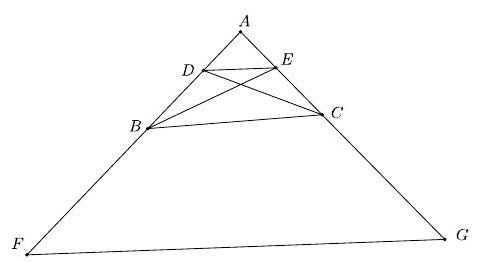
and
Since $\frac{A D}{A F}=\frac{A E}{A G}, D E$ and $F G$ are parallel.
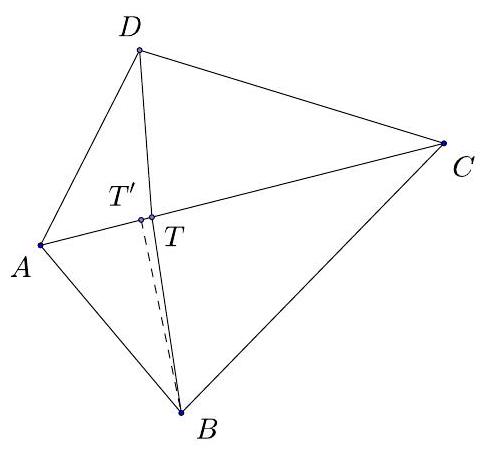
- Let $A B C D$ be a convex quadrilateral with $A B=A D$. Let $T$ be a point on the diagonal $A C$ such that $\angle A B T+\angle A D T=\angle B C D$. Prove that $A T+A C \geq A B+A D$.
Solution. On the segment $A C$, consider the unique point $T^{\prime}$ such that $A T^{\prime} \cdot A C=A B^{2}$. The triangles $A B C$ and $A T^{\prime} B$ are similar: they have the angle at $A$ common, and $A T^{\prime}: A B=A B: A C$. So $\angle A B T^{\prime}=\angle A C B$. Analogously, $\angle A D T^{\prime}=\angle A C D$. So $\angle A B T^{\prime}+\angle A D T^{\prime}=\angle B C D$. But $A B T^{\prime}+A D T^{\prime}$ increases strictly monotonously, as $T^{\prime}$ moves from $A$ towards $C$ on $A C$. The assumption on $T$ implies that $T^{\prime}=T$. So, by the arithmetic-geometric mean inequality,
- Let $A B C D$ be a parallelogram such that $\angle B A D=60^{\circ}$. Let $K$ and $L$ be the midpoints of $B C$ and $C D$, respectively. Assuming that $A B K L$ is a cyclic quadrilateral, find $\angle A B D$.
Solution. Let $\angle B A L=\alpha$. Since $A B K L$ is cyclic, $\angle K K C=\alpha$. Because $L K | D B$ and $A B | D C$, we further have $\angle D B C=\alpha$ and $\angle A D B=\alpha$. Let $B D$ and $A L$ intersect at $P$. The triangles $A B P$ and $D B A$ have two equal angles, and hence $A B P \sim D B A$. So
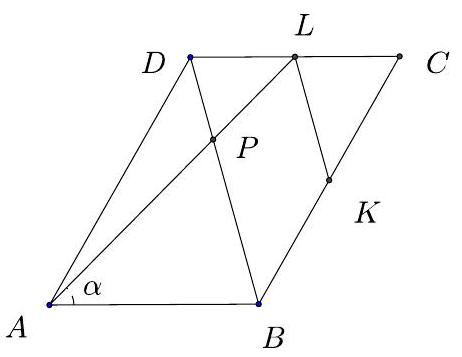
The triangles $A B P$ and $L D P$ are clearly similar with similarity ratio $2: 1$. Hence $B P=$ $\frac{2}{3} D B$. Inserting this into (1) we get
The sine theorem applied to $A B D$ (recall that $\angle D A B=60^{\circ}$ ) immediately gives
So $\angle A B D=180^{\circ}-60^{\circ}-45^{\circ}=75^{\circ}$.
- Consider triangles in the plane where each vertex has integer coordinates. Such a triangle can be legally transformed by moving one vertex parallel to the opposite side to a different point with integer coordinates. Show that if two triangles have the same area, then there exists a series of legal transformations that transforms one to the other.
Solution. We will first show that any such triangle can be transformed to a special triangle whose vertices are at $(0,0),(0,1)$ and $(n, 0)$. Since every transformation preserves the triangle's area, triangles with the same area will have the same value for $n$.
Define th $y$-span of a triangle to be the difference between the largest and the smallest $y$ coordinate of its vertices. First we show that a triangle with a $y$-span greater than one can be transformed to a triangle with a strictly lower $y$-span.
Assume $A$ has the highest and $C$ the lowest $y$ coordinate of $A B C$. Shifting $C$ to $C^{\prime}$ by the vector $\overrightarrow{B A}$ results in the new triangle $A B C^{\prime}$ where $C^{\prime}$ has larger $y$ coordinate than $C$ baut lower than $A$, and $C^{\prime}$ has integer coordinates. If $A C$ is parallel to the $x$-axis, a horizontal shift of $B$ can be made to transform $A B C$ into $A B^{\prime} C$ where $B^{\prime} C$ is vertical, and then $A$ can be vertically shifted so that the $y$ coordinate of $A$ is between those of $B^{\prime}$ and $C$. Then the $y$-span of $A B^{\prime} C$ can be reduced in the manner described above. Continuing the process, one necessarily arrives at a triangle with $y$-span equal to 1 . Such a triangle then necessarily has one side, say $A C$, horizontal. A legal horizontal move can take $B$ to the a position $B^{\prime}$ where $A B^{\prime}$ is horizontal and $C$ has the highest $x$-coordinate. If $B^{\prime}$ is above $A C$, perform a vertical and a horizontal legal move to take $B^{\prime}$ to the origin; the result is a special triangle. If $B^{\prime}$ is below $A C$, legal transformation again can bring $B^{\prime}$ to the origin, and a final horizontal transformation of one vertex produces the desired special triangle.
The inverse of a legal transformation is again a legal transformation. Hence any two triangles having vertices with integer coordinates and same area can be legally transformed into each other via a special triangle.
- Let $A B C D$ be a cyclic quadrilateral with $A B$ and $C D$ not parallel. Let $M$ be the midpoint of $C D$. Let $P$ be a point inside $A B C D$ such that $P A=P B=C M$. Prove that $A B, C D$ and the perpendicular bisector of $M P$ are concurrent.
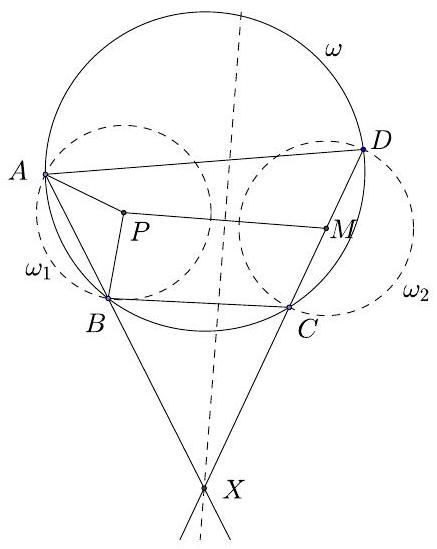
Solution. Let $\omega$ be the circumcircle of $A B C D$. Let $A B$ and $C D$ intersect at $X$. Let $\omega_{1}$ and $\omega_{2}$ be the circles with centers $P$ and $M$ and with equal radius $P B=M C=r$. The power of $X$ with respect to $\omega$ and $\omega_{1}$ equals $X A \cdot X B$ and with respect to $\omega$ and $\omega_{2} X D \cdot X C$. The latter power also equals $(X M+$ $r)(X M-r)=X M^{2}-r^{2}$. Analogously, the first power is $X P^{2}-r^{2}$. But since $X A \cdot X B=X D \cdot X C$, we must have $X M^{2}=X P^{2}$ or $X M=X P . X$ indeed is on the perpendicular bisector of $P M$, and we are done.