


1 Algebra
- A finite collection of positive real numbers (not necessarily distinct) is balanced if each number is less than the sum of the others. Find all $m \geq 3$ such that every balanced finite collection of $m$ numbers can be split into three parts with the property that the sum of the numbers in each part is less than the sum of the numbers in the two other parts.
Solution.
Answer: The partition is always possible precisely when $m \neq 4$.
For $m=3$ it is trivially possible, and for $m=4$ the four equal numbers $g, g, g, g$ provide a counter-example. Henceforth, we assume $m \geq 5$.
Among all possible partitions $A \sqcup B \sqcup C={1, \ldots, m}$ such that
select one for which the difference $S_{C}-S_{A}$ is minimal. If there are several such, select one so as to maximise the number of elements in $C$. We will show that $S_{C}<S_{A}+S_{B}$, which is clearly sufficient.
If $C$ consists of a single element, this number is by assumption less than the sum of the remaining ones, hence $S_{C}<S_{A}+S_{B}$ holds true.
Suppose now $C$ contains at least two elements, and let $g_{c}$ be a minimal number indexed by a $c \in C$. We have the inequality
The first is by the minimality of $S_{C}-S_{A}$, the second by the minimality of $g_{c}$. These two inequalities together yield
If either of these inequalities is strict, we are finished.
Hence suppose all inequalities are in fact equalities, so that
It follows that $C={c, d}$, where $g_{d}=g_{c}$. If $A$ contained more than one element, we could increase the number of elements in $C$ by creating instead a partition
resulting in the same sums. A similar procedure applies to $B$. Consequently, $A$ and $B$ must be singleton sets, whence
- A $100 \times 100$ table is given. For each $k, 1 \leq k \leq 100$, the $k$-th row of the table contains the numbers $1,2, \ldots, k$ in increasing order (from left to right) but not necessarily in consecutive cells; the remaining $100-k$ cells are filled with zeroes. Prove that there exist two columns such that the sum of the numbers in one of the columns is at least 19 times as large as the sum of the numbers in the other column.
Solution.
Observe that the sum of numbers in the first column is at most $1 \cdot 100=100$, the sum in the first and second columns is at most $1 \cdot 100+2 \cdot 99$, the sum in the first, second and third columns is at most $1 \cdot 100+2 \cdot 99+3 \cdot 98$, etc. But the sum of all nonzero numbers equals $\sum_{i=1}^{100} i(101-i)$, therefore the sum in the columns from $31^{\text {th }}$ to $100^{\text {th }}$ is at least
Therefore one of these columns has a sum at least $27 \cdot 71=1917$. Therefore the ratio of sums in this column and in the first one is more that 19.
- Let $a, b, c, d$ be positive real numbers such that $a b c d=1$. Prove the inequality
Solution.
Let $x, y, z, t$ be positive numbers such that $a=x^{4}, b=y^{4}, c=z^{4}, d=t^{4}$.
By AM-GM ineguality $x^{4}+y^{4}+z^{4}+1 \geq 4 x y z, y^{4}+z^{4}+1+1 \geq 4 y z$ and $z^{4}+1+1+1 \geq 4 z$. Therefore we have the following estimation for the first fraction
Transform analogous estimations for the other fractions:
Thus, the sum does not exceed
It remains to apply inequality $\sqrt{\alpha}+\sqrt{\beta}+\sqrt{\gamma}+\sqrt{\delta} \leq 2 \sqrt{\alpha+\beta+\gamma+\delta}$, which can be easily proven by taking squares or derived from inequality between arithmetical and quadratic means.
- Find all functions $f:[0,+\infty) \rightarrow[0,+\infty)$, such that for any positive integer $n$ and for any non-negative real numbers $x_{1}, \ldots, x_{n}$
Solution.
Answer: the functions $f(x)=0$ and $f(x)=x$.
A first observation is that
so that $f(1)$ is either 0 or 1 .
Assume first that $f(1)=0$. For each positive integer $n$, we find
Given an arbitrary $x$, find $y$ so that $x^{2}+y^{2}$ becomes a positive integer $n$. Then
Consequently, $f(x)=0$ for all $x$.
Now assume $f(1)=1$. We shall prove that $f(x)=x$ for all $x$. For each positive integer $n$, we find
For a non-negative rational number $\frac{p}{q}$, we find
hence $f(x)=x$ also for rational numbers.
Finally, let $x$ be an irrational number. Select a rational number $\frac{p}{q}>x$. Choosing $y$ so that $x^{2}+y^{2}=\frac{p^{2}}{q^{2}}$, we deduce
hence $f(x) \leq \frac{p}{q}$. Next, select a (positive) rational number $\frac{r}{s}<\sqrt{x}$, i.e. $\frac{r^{2}}{s^{2}}<x$. Choosing $z$ so that $\frac{r^{2}}{s^{2}}+z^{2}=x$, we deduce
hence $f(x) \geq \frac{r^{2}}{s^{2}}$. Together, these two bounds for $f(x)$ imply $f(x)=x$, and we are finished.
Remark of the Problem committee. The main part of this solution is the proof of well known fact that if an additive function is non negative (for non negative arguments) then it is linear.
- A polynomial $f(x)$ with real coefficients is called generating, if for each polynomial $\varphi(x)$ with real coefficients there exist a positive integer $k$ and polynomials $g_{1}(x), \ldots, g_{k}(x)$ with real coefficients such that
Find all generating polynomials.
Solution.
Answer: the generating polynomials are exactly the polynomials of odd degree.
Take an arbitrary polynomial $f$. We call a polynomial good if it can pe represented as $\sum f\left(g_{i}(x)\right)$ for some polynomials $g_{i}$. It is clear that the sum of good polynomials is good, and if $\phi$ is a good polynomial then each polynomial of the form $\phi(g(x))$ is good also. Therefore for the proof that $f$ is generating it is sufficient to show that $x$ is good polynomial. Consider two cases.
- Let the degree $n$ of $f$ is odd. Check that $x$ is good polynomial. Observe that by substitutions of the form $f(u x)$ we can obtain a good polynomial $\phi_{n}$ of degree $n$ with leading coefficient 1 , and a good polynomial $\psi_{n}$ of degree $n$ with leading coefficient -1 (because $n$ is odd). Then for each $a$ a polynomial $\phi_{n}(x+a)+\psi_{n}(x)$ is good. It is clear that its coefficient of $x^{n}$ equals 0 ; moreover, by choosing appropriate $a$ we can obtain a good polynomial $\phi_{n-1}$ of degree $n-1$ with leading coefficient 1 , and a good polynomial $\psi_{n-1}$ with leading coefficient -1 . Continuing in this way we will obtain a good poynomial $\phi_{1}(x)=x+c$. Then $\phi_{1}(x-c)=x$ is also good.
- Let the degree $n$ of $f$ is even. Prove that $f(x)$ is not generating. It follows from the observation that the degree of every good polynomial is even in this case. Indeed, the degree of each polynomial $f\left(g_{i}\right)$ is even and the leading coefficient has the same sign as the leading coefficient of $f$. Therefore the degree of polynomial $\sum f\left(g_{i}(x)\right)$ is even.
2 Combinatorics
- Let $n$ be a positive integer. Elfie the Elf travels in $\mathbb{R}^{3}$. She starts at the origin: $(0,0,0)$. In each turn she can teleport to any point with integer coordinates which lies at distance exactly $\sqrt{n}$ from her current location. However, teleportation is a complicated procedure. Elfie starts off normal but she turns strange with her first teleportation. Next time she teleports she becomes normal again, then strange again... etc.
For which $n$ can Elfie travel to any given point with integer coordinates and be normal when she gets there?
Solution.
Answer: there are no such $n$.
We colour all the points in $\mathbb{Z}^{3}$ white and black: The point $(x, y, z)$ is colored white if $x+y+z \equiv_{2} 0$ and black if if $x+y+z \equiv_{2} 1$.
After the first move Elfie is at a point $(a, b, c)$ where $a^{2}+b^{2}+c^{2}=n$. Thus, $a+b+c \equiv_{2}$ $a^{2}+b^{2}+c^{2}=n$.
Now, if $n$ is even then $(a, b, c)$ is white. Thus, in that case Elfie only jumps between white points.
On the other hand, if $n$ is odd, then $(a, b, c)$ is certainly black. And one can easily see that Elfie alternates between black and white squares after each move. But since Elfie is normal after even number of moves, and is then on a white point, she can never reach any black point being normal. Thus, there no $n$ such that Elfie can travel to any given point and be normal when she gets there.
- On a $16 \times 16$ torus as shown all 512 edges are colored red or blue. A coloring is good if every vertex is an endpoint of an even number of red edges. A move consists of switching the color of each of the 4 edges of an arbitrary cell. What is the largest number of good colorings such that none of them can be converted to another by a sequence of moves?
Solution.
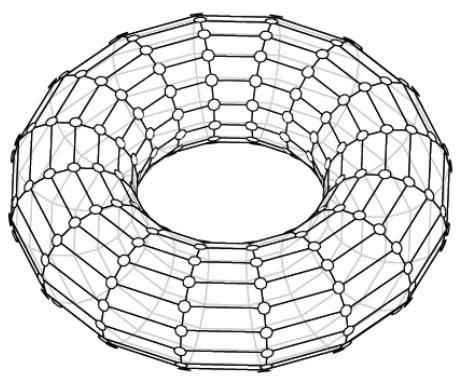
Answer: 4. Representatives of the equivalence classes are: all blue, all blue with one longitudinal red ring, all blue with one transversal red ring, all blue with one longitudinal and one transversal red ring.
First, show that these four classes are non equivalent. Consider any ring transversal or longitudinal and count the number of red edges going out from vertices of this ring in the same halftorus. This number can not be changed mod 2.
Now we show that each configuration can be transformed to one of these four classes. We suggest two independent reasoning.
Scanning of the square.
Cut the torus up in a square $16 \times 16$. In order to restore the initial torus we will identify the opposite sides of the square, but we will do it in the end of solution. Now we will work with the square. It is clear that during all recolorings each vertex of torus has even red degree. The same is true for the degrees of the inner vertices of the $16 \times 16$ square when we deal with it instead of the torus.
Scan all cells of this square one by one from left to right and from bottom to top. For convenience we may think that in each moment the scanned area is colored grey. First we take bottom left corner cell ( $a 1$ in chess notations) and color it grey. Then we consider the next cell ( $b 1$ in chess notations) color it grey and if the edge between the cells $a 1$ and $b 1$ is red, change the colors of the cell $b 1$ edges.
We obtain a grey area with no red edges in its interior. After that when we scan each new cell we append this cell to the grey figure and if it is necessary change the colors of edges of the new cell to make the color of all new edges in the grey area blue.
The latter is always possible because the new cell have either one common edge with the grey figure (as in the case " $a 1-b 1$ " above) or two common edges. For example let grey figure consist of the first row of the square and $a 2$ cell. When we append the cell $b 2$ to the grey figure two edges of its lower left corner vertex already belong to the grey figure, they are blue. Therefore the other two edges $a 2-b 2$ and $b 1-b 2$ have the same color and we can make them both blue (if they are not) by recoloring the edges of cell $b 2$.
So by doing that with all cells of the square we obtain $16 \times 16$ square with blue edges inside it. Now its time to recall that the sides of the square should be identified, and the red degree of each vertex of torus is even. It follows that the whole (identified) vertical sides of the square are either red or blue, and the same for horizontal sides.
Deformations of red loops (sketch).
To see that any configuration can be made into one of the above four configurations it is most clear to cut the torus up in a square with opposite edges identified.
Since the red degree of each vertex is even we can always find a loop consisting of red edges only. Now, suppose that one can make a (simple) red loop that does not cross the boundary of the square. We can change the color of this loop by changing one by one the colors of unit squares inside it. In the remaining configuration every vertex is still an endpoint of an even number of red edges and we can repeat the operation. So by doing that to every red loop we are left with a configuration where one can not make red loops that do not intersect the boundary. Second, any red loop left that passes through more than one boundary vertex can be deformed into a loop containing only one boundary vertex. Finally, any two loops crossing the same side of the square can be removed by changing colors of all unit squares between these loops. Thus, we are left with only the four possibilities mentioned.
- A graph has $N$ vertices. An invisible hare sits in one of the vertices. A group of hunters tries to kill the hare. In each move all of them shoot simultaneously: each hunter shoots at a single vertex, they choose the target vertices cooperatively. If the hare was in one of the target vertices during a shoot, the hunt is finished. Otherwise the hare can stay in its vertex or jump to one of the neighboring vertices.
The hunters know an algorithm that allows them to kill the hare in at most $N$ ! moves. Prove that then there exists an algorithm that allows them to kill the hare in at most $2^{N}$ moves.
Solution.
Let hunters apply optimal (fastest) algorithm. Let say that a vertex has a smell of a hare, if there exists an initial vertex and a sequence of moves of the hare for which the hare is still alive and now occupies this vertex. After every shoot mark the set of all the vertices that have a smell of a hare. In the beginning all the vertices of the graph have a smell of hare, and after finish of hunting this set is empty. The idea is that in optimal strategy these sets can not repeat!
Indeed, the hunting does not imply feedback, the hunters' shoots do not depend on hare's moves because the hunters try to foresee all possible moves of hare. So if a set of vertices $A$ appears after the k-th shoot and once again after the $m$-th shoot, then then the strategy is not optimal because all shoots form $k$-th to $(m-1)$-th can be omitted with the same result of hunting.
Since it is possible to mark at most $2^{N}$ sets the hunting will finish in at most $2^{N}-1$ shoots.
- Olga and Sasha play a game on an infinite hexagonal grid. They take turns in placing a stone on a free hexagon of their choice. Olga starts the game. Just before the 2018th stone is placed, a new rule comes into play. A stone may now be placed only on those free hexagons having at least two occupied neighbors.
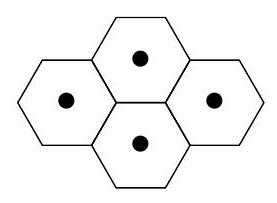
A player loses when she or he either is unable to make a move, or has filled a pattern of the rhomboid shape as shown (rotated in any possible way). Determine which player, if any, possesses a winning strategy.
Solution.
Answer: Olga has a winning strategy.
The game cannot go on forever. Draw a large hexagon enclosing all 2017 counters in play after the 2017th move, as in Figure ??. While it will be possible to place future counters in the hexagonal frame at distance 1 from the shaded part (i.e. immediately surrounding it), where $D$ and $E$ are located, it will be impossible to reach cells at distance 2 from the shaded part, where $F$ is located. Indeed, in order to place a counter at $F$, first counters must be placed on cells $D$ and $E$.
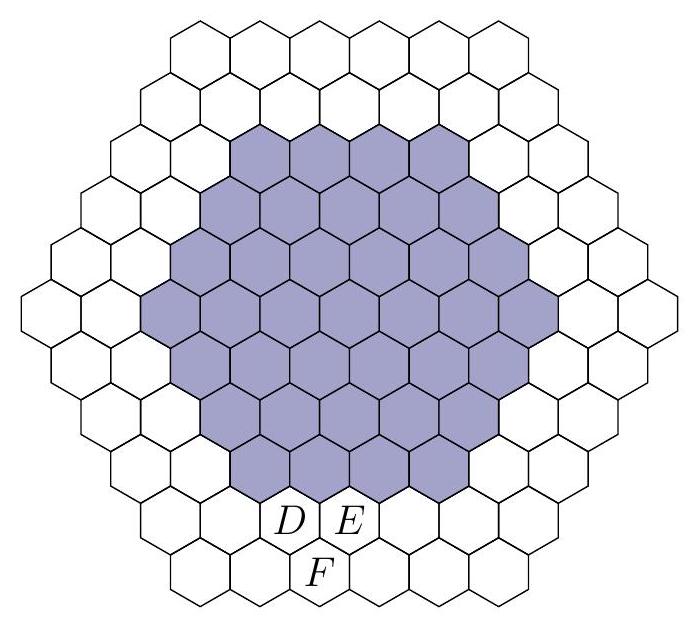
Figure 1: A large shaded hexagon enclosing all 2017 counters in play after the 2017th move.
Assume that the cells $E_{1}, E_{2}, \ldots, E_{n}$ to the right of $E$ contain counters, but the next cell to the right is $E_{n+1}$ and it is empty. Observe that the counter on $E_{n-1}$ has been placed before the counter on $E_{n}$, because otherwise the forbidden rhombus is formed by the cells $E_{n-1}, E_{n}$ and two ancestors of $E_{n}$ in the previous row. By analogous reasoning considering the moment of placing the counter on $E_{n-1}$ one can prove that the counter on $E_{n-2}$ has been placed before the counter on $E_{n-1}$, etc. Thus we conclude that the counter on $D$ has been placed before the counter on $E$. But changing the direction of our reasoning to the left we similarly conclude that counter on $E$ has been placed before the counter on $D$. A contradiction.
Now, let Olga place her first counter in any hexagon $H$, and then respond to each of Sasha's successive moves by symmetry, choosing to place her counter on the reflexion in $H$ of his chosen hexagon (in other words, diametrically opposite to his with respect to $H$ ). It is clear that the gameplay will be completely symmetrical after each of Olga's moves. Hence she may respond, even under the additional rule, to any move Sasha might make. It is also evident that she will never complete a forbidden rhombus if Sasha did not already do so before. Hence Olga is always certain to have a legal move at her disposal, and so will eventually win.
- The integers from 1 to $n$ are written, one on each of $n$ cards. The first player removes one card. Then the second player removes two cards with consecutive integers. After that the first player removes three cards with consecutive integers. Finally, the second player removes four cards with consecutive integers. What is the smallest value of $n$ for which the second player can ensure that he completes both his moves?
Solution.
Answer: $n=14$.
At first, let's show that for $n=13$ the first player can ensure that after his second move no 4 consecutive numbers are left. In the first move he can erase number 4 and in the second move he can ensure that numbers 8,9 and 10 are erased. No interval of length 4 is left.
If $n=14$ the second player can use the following strategy. Let the first player erase number $k$ in his first move, because of symmetry assume that that $k \leq 7$. If $k \geq 5$ then the second player can erase $k+1$ and $k+2$ and there are two intervals left of length at least 4: 1.. $(k-1)$ and $(k+3) . .14$, but the first player can destroy at most one of them. But if $k \leq 4$, then the second player can erase numbers 9 and 10 in his first move and again there are two intervals left of length at least 4: $(k+1) . .8$ and 11..14.
3 Geometry
- The points $A, B, C, D$ lie, in this order, on a circle $\omega$, where $A D$ is a diameter of $\omega$. Furthermore, $A B=B C=a$ and $C D=c$ for some relatively prime integers $a$ and $c$. Show that if the diameter $d$ of $\omega$ is also an integer, then either $d$ or $2 d$ is a perfect square.
Solution.
By Pythagoras, the lengths of the diagonals of quadrangle $A B C D$ are $\sqrt{d^{2}-a^{2}}$ and $\sqrt{d^{2}-c^{2}}$. Applying Ptolemaios' Theorem to the quadrilateral $A B C D$ gives
which after squaring and simplifying becomes
Then $d=-c$ is a root of this equation, hence, $c+d$ is a positive factor of the left-hand side. Hence, the remaining factor (which is quadratic in $d$ ) must vanish, and we obtain $d^{2}=c d+2 a^{2}$. Let $e=2 d-c$. The number $c^{2}+8 a^{2}=(2 d-c)^{2}=e^{2}$ is a square, and it follows that $8 a^{2}=e^{2}-c^{2}$. If $e$ and $c$ both were even, then by $8 \mid\left(e^{2}-c^{2}\right)$ we also have $16 \mid\left(e^{2}-c^{2}\right)=8 a^{2}$ which implies $2 \mid a$, a contradiction to the fact that $a$ and $c$ are relatively prime. Hence, $e$ and $c$ both must be odd. Moreover, $e$ and $c$ are obviously relatively prime. Consequently, the factors on the right-hand side of $2 a^{2}=\frac{e-c}{2} \cdot \frac{e+c}{2}$ are relatively prime. It follows that $d=\frac{e+c}{2}$ is a perfect square or twice a perfect square.
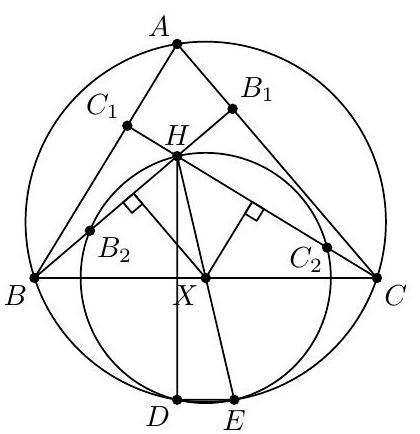
- The altitudes $B B_{1}$ and $C C_{1}$ of an acute triangle $A B C$ intersect in point $H$. Let $B_{2}$ and $C_{2}$ be points on the segments $B H$ and $C H$, respectively, such that $B B_{2}=B_{1} H$ and $C C_{2}=C_{1} H$. The circumcircle of the triangle $B_{2} H C_{2}$ intersects the circumcircle of the triangle $A B C$ in points $D$ and $E$. Prove that the triangle $D E H$ is right-angled.
Solution.
Despite of the logical symmetry of the picture the right angle in triangle $\triangle D E H$ is not $H$ but either $D$ or $E$.
Denote by $w$ the circumcircle of the triangle $\mathrm{B}{2} \mathrm{HC}{2}$. Midperpendicular to the segment $\mathrm{C}{2} \mathrm{H}$ is also the midperpendicular to $C C{1}$ therefore it passes through the midpoint $X$ of side $B C$. By the similar reasoning the midperpendicular to $B_{2} H$ passes through $X$. Therefore $X$ is the center of the circle $w$.
It is well known that the point which is symmetrical to the orthocenter $H$ with respect to the side $B C$ belongs to the circumcircle of the triangle $A B C$. The distance from this point to $X$ equals $X H$ due to symmetry, hence this point belongs $w$, therefore it coincides with $D$ or $E$, without loss of generality with $D$. Thus $D H \perp B C$.
Finally, the centers of $w$ and circumcircle $(A B C)$ belong to the midperpendicular of $B C$, therefore their common chord $D E$ is parallel $B C$. Thus $\angle H D E=90^{\circ}$.
- The bisector of the angle $A$ of a triangle $A B C$ intersects $B C$ in a point $D$ and intersects the circumcircle of the triangle $A B C$ in a point $E$. Let $K, L, M$ and $N$ be the midpoints of the segments $A B, B D, C D$ and $A C$, respectively. Let $P$ be the circumcenter of the triangle $E K L$, and $Q$ be the circumcenter of the triangle $E M N$. Prove that $\angle P E Q=\angle B A C$.
Solution.
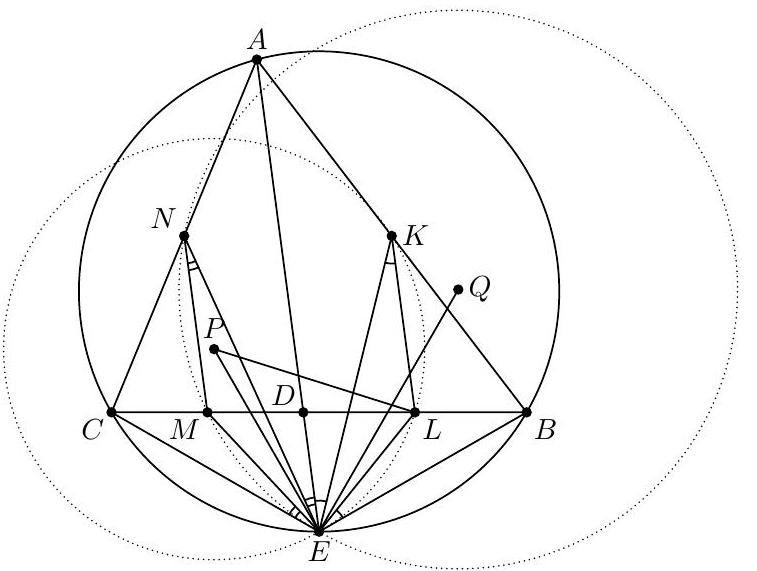
Triangles $A E B$ and $B E D$ are similar since $\angle B A E=\angle E A C=\angle D B E$. Hence $\angle A E K=$ $\angle B E L$ as the angles between a median and a side in similar triangles. Denote these angles by $\varphi$. Then $\angle E K L=\varphi$ since $K L$ is a midline of $\triangle A B D$. Analogously, let $\psi=\angle A E N=\angle C E M=$ $\angle E N M$. And let $\beta=\angle A B C, \gamma=\angle A C B$.
The triangle $P E L$ is isosceles, therefore $\angle P E L=90^{\circ}-\frac{1}{2} \angle E P L=90^{\circ}-\angle E K L=90^{\circ}-\varphi$ and
Analogously $\angle Q E A=90^{\circ}-\beta$.
Thus $\angle P E Q=\angle P E A+\angle Q E A=180^{\circ}-\beta-\gamma=\angle B A C$.
- A quadrilateral $A B C D$ is circumscribed about a circle $\omega$. The intersection point of $\omega$ and the diagonal $A C$, closest to $A$, is $E$. The point $F$ is diametrically opposite to the point $E$ on the circle $\omega$. The tangent to $\omega$ at the point $F$ intersects lines $A B$ and $B C$ in points $A_{1}$ and $C_{1}$, and lines $A D$ and $C D$ in points $A_{2}$ and $C_{2}$, respectively. Prove that $A_{1} C_{1}=A_{2} C_{2}$.
Solution.
Denote by $X$ the intersection point of the lines $A_{1} A_{2}$ and $A C$. Prove that $X$ is a contact point of escribed circle of $\triangle A A_{1} A_{2}$ with side $A_{1} A_{2}$. Indeed, consider a homothety with center $A$ which maps incircle $\omega$ of $\triangle A A_{1} A_{2}$ to its escribed circle. This homothety maps the line that is tangent to $\omega$ in point $E$ to the parallel line which is tangent to the escribed circle, i.e. to the line $A_{1} A_{2}$. Therefore the point $E$ maps to the point $X$, hence $A_{1} A_{2}$ is tangent to the escribed circle of $\triangle A A_{1} A_{2}$ in the point $X$.
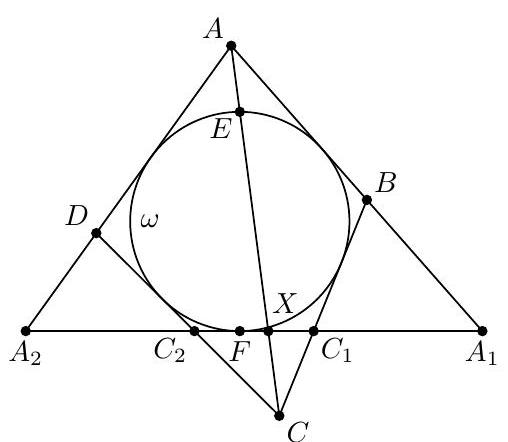
One can similarly prove that $X$ is a tangent point of the line c $C_{1} C_{2}$ and incircle of $\triangle C_{1} C C_{2}$.
From the first statement we conclude that $A_{1} X=F A_{2}$, and from the second one that $C_{1} X=$ $F C_{2}$. It remains to subtract the second equality from the first one.
- Two circles in the plane do not intersect and do not lie inside each other. We choose diameters $A_{1} B_{1}$ and $A_{2} B_{2}$ of these circles such that the segments $A_{1} A_{2}$ and $B_{1} B_{2}$ intersect. Let $A$ and $B$ be the midpoints of the segments $A_{1} A_{2}$ and $B_{1} B_{2}$, and $C$ be the intersection point of these segments. Prove that the orthocenter of the triangle $A B C$ belongs to a fixed line that does not depend on the choice of the diameters.
Solution.
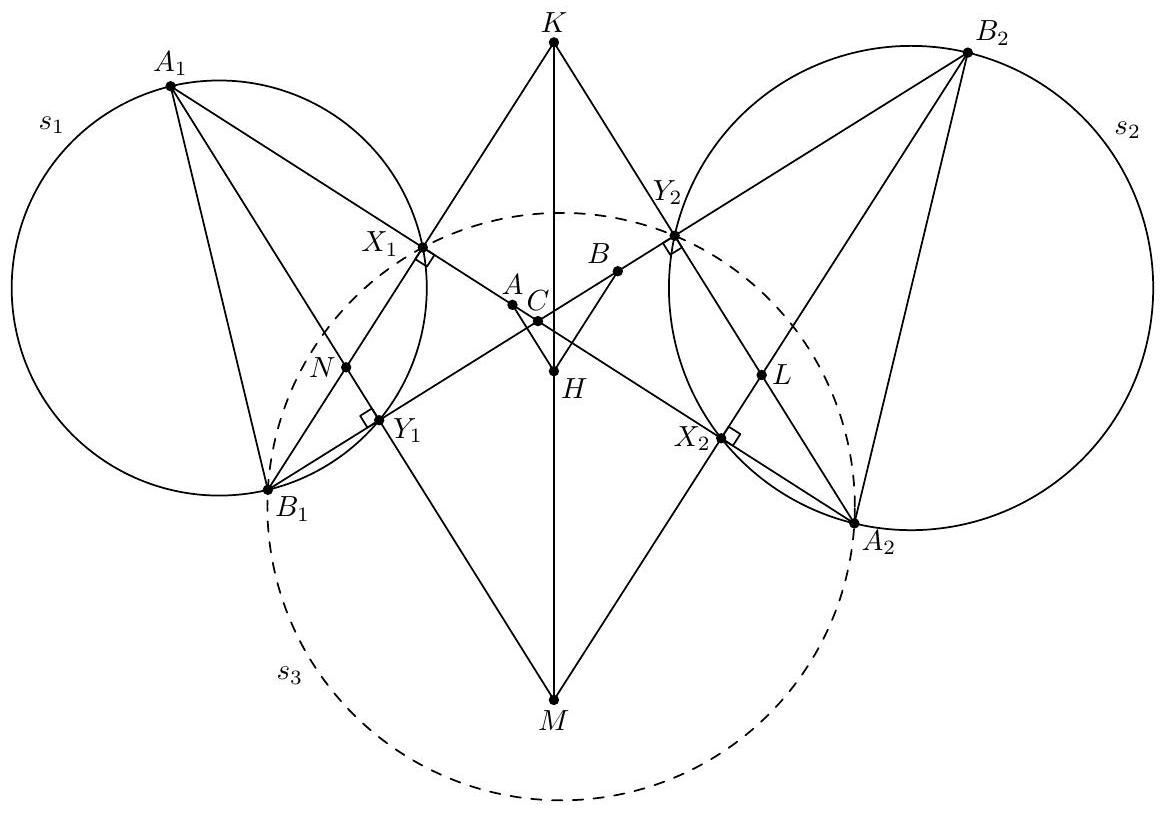
Prove that the orthocenter $H$ of $\triangle A B C$ belongs to their radical axe.
Denote the circles by $s_{1}$ и $s_{2}$. Let the line $A_{1} A_{2}$ intrersect circles $s_{1}$ and $s_{2}$ second time in points $X_{1}$ and $X_{2}$ respectively, and the line $B_{1} B_{2}$ intrersect the circles second time in points $Y_{1}$ and $Y_{2}$.
The lines $A_{1} Y_{1}$ and $A_{2} Y_{2}$ are parallel (because both of them are orthogonal to $B_{1} B_{2}$ ), analogously $B_{1} X_{1}$ and $B_{2} X_{2}$ are parallel. Hence these four lines form a parallelogram $K L M N$ (see fig.). It is clear that perpendiculars from the point $A$ to the line $B C$ and from the point $B$ to the line $A C$ lay on the midlines of this parallelogram. Therefore $H$ is the center of parallelogram $K L M N$ and coincide with the midpoint of segment $K M$.
In order to prove that $H$ lays on the radical axe of $s_{1}$ and $s_{2}$ it is sufficient to show that both points $K$ and $M$ belong to that radical axe.
The points $X_{1}$ and $Y_{2}$ lay on the circle $s_{3}$ with diameter $B_{1} A_{2}$. The line $B_{1} X_{1}$ is radical axe of $s_{1}$ and $s_{3}$, and the line $A_{2} Y_{2}$ is radical axe of $s_{2}$ and $s_{3}$. Therefore $k$ is radical center of these three circles and hence $K$ lays on the radical axe of $s_{1}$ and $s_{2}$. Analogously $M$ lays on the radical axe of $s_{1}$ and $s_{2}$.
4 Number Theory
- Let $p$ be an odd prime. Find all positive integers $n$ for which $\sqrt{n^{2}-n p}$ is a positive integer.
Solution.
Answer: $n=\left(\frac{p+1}{2}\right)^{2}$.
Assume that $\sqrt{n^{2}-p n}=m$ is a positive integer. Then $n^{2}-p n-m^{2}=0$, and hence
Now $p^{2}+4 m^{2}=k^{2}$ for some positive integer $k$, and $n=\frac{p+k}{2}$ since $k>p$. Thus $p^{2}=(k+2 m)(k-2 m)$, and since $p$ is prime we get $p^{2}=k+2 m$ and $k-2 m=1$. Hence $k=\frac{p^{2}+1}{2}$ and
is the only possible value of $n$. In this case we have
- Prove that for any positive integers $p, q$ such that $\sqrt{11}>\frac{p}{q}$, the following inequality holds:
Solution.
We can assume that $p$ and $q$ are coprime, and since both sides of first inequality are positive, we can change it to $11 q^{2}>p^{2}$. The same way we can change second inequality:
To see this one holds, we will prove stronger one:
Indeed, dividing this inequality by $p^{2}$ we get $11 q^{2} \geq p^{2}+2$, and since we already know that $11 q^{2}>p^{2}$ we only have to see, that $11 q^{2}$ can't be equal to $p^{2}+1$. Since we know that the only reminders of squares $(\bmod 11)$ are $0,1,3,4,5$ and $9, p^{2}+1$ can't be divisible by 11 , and therefore $11 q^{2} \neq p^{2}+1$.
- Let $n \geq 3$ be an integer such that $4 n+1$ is a prime number. Prove that $4 n+1$ divides $n^{2 n}-1$.
Solution.
Since $p:=4 n+1$ is a prime number, each non-zero remainder modulo $p$ possesses a unique multiplicative inverse. Since $-4 \cdot n \equiv 1 \bmod p$, we have $n \equiv(-4)^{-1} \bmod p$, from which we deduce that $n \equiv-\left(2^{-1}\right)^{2}$. Consequently,
by Fermat's Little Theorem.
- An infinite set $B$ consisting of positive integers has the following property. For each $a, b \in B$ with $a>b$ the number $\frac{a-b}{(a, b)}$ belongs to $B$. Prove that $B$ contains all positive integers. Here $(a, b)$ is the greatest common divisor of numbers $a$ and $b$.
Solution.
If $d$ is g.c.d. of all the numbers in set $B$, let $A={b / d: b \in B}$. Then for each $a, b \in A(a>b)$ we have
Observe that g.c.d of the set $A$ equals 1 , therefore we can find a finite subset $A_{1} \in A$ for which the $\operatorname{gcd} A_{1}=1$. We may think that the sum of elements of $A_{1}$ is minimal possible. Choose numbers $a, b \in A_{1}(a>b)$ and replace $a$ in the set $A_{1}$ with $\frac{a-b}{d(a, b)}$. The g.c.d. of the obtained set equals 1 . But the sum of numbers decreases by this operations that contradicts minimality of $A_{1}$.
Thus, $A_{1}={1}$. Therefore all the numbers in the set $A$ have residue 1 modulo $d$. Take an arbitrary $a=k d+1 \in A$ and $b=1$. Then $k \in A$ by $(*)$ and hence $k=d s+1$. But $(k, k d+1)=1$, therefore $\frac{k d+1-d s-1}{d}=k-s=(d-1) s+1 \in A$, so $s$ is divisible by $d$. But $s \in A$, therefore $s-1$ is also divisible by $d$, hence $d=1$ (that means that $B=A$ ). Thus we have checked that if $a=k d+1=k+1 \in A$ then $a-1=k \in A$. Then all non-negative integers belong to $A$ because it is infinite.
- Find all the triples of positive integers $(a, b, c)$ for which the number
is an integer and $a+b+c$ is a prime.
Solution.
Answer $(1,1,1),(1,2,2),(2,3,6)$.
Let $p=a+b+c$, then $a+b=p-c, b+c=p-a, c+a=p-b$ and
is a non-negative integer. By expanding brackets we obtain that the number $p^{4}\left(\frac{1}{a}+\frac{1}{b}+\frac{1}{c}\right)$ is integer, too. But the numbers $a, b, c$ are not divisible by $p$, therefore the number $\frac{1}{a}+\frac{1}{b}+\frac{1}{c}$ is (non negative) integer. That is possible for the triples $(1,1,1),(1,2,2),(2,3,6)$ only.