


15th Benelux Mathematical Olympiad Esch-sur-Alzette, 5th - 7th May 2023
Problems and Solutions
BxMO 2023: Problems and Solutions
Problem 1
Find all functions $f: \mathbb{R} \rightarrow \mathbb{R}$ such that
Solution
Clearly, $f(x)=c x$ is a solution for each $c \in \mathbb{R}$ since $(x-y)(c x+c y)=c\left(x^{2}-y^{2}\right)$. To show that there are no other solutions, we observe that (1) $x=y: \quad 0 \leqslant f(0)$; $x=1, y=0: \quad f(0)+f(1) \leqslant f(1) \Rightarrow f(0) \leqslant 0$, whence $f(0)=0 ;$ (2) $y=-x: \quad 2 x(f(x)+f(-x)) \leqslant f(0)=0$; $x \rightarrow-x: \quad-2 x(f(-x)+f(x)) \leqslant 0 \Rightarrow 2 x(f(x)+f(-x)) \geqslant 0 ;$ thus $2 x(f(x)+f(-x))=0$ for all $x$, so $f(-x)=-f(x)$ for all $x \neq 0$, and hence for all $x$, since $f(0)=0$; (3) $x \leftrightarrow y: \quad(y-x)(f(y)+f(x)) \leqslant f\left(y^{2}-x^{2}\right)=-f\left(x^{2}-y^{2}\right) \Rightarrow(x-y)(f(x)+f(y)) \geqslant f\left(x^{2}-y^{2}\right)$; which is the given inequality with the inequality sign reversed, so $(x-y)(f(x)+f(y))=f\left(x^{2}-y^{2}\right)$ must hold for all $x, y \in \mathbb{R}$; (4) $y \leftrightarrow-y: \quad(x-y)(f(x)+f(y))=f\left(x^{2}-y^{2}\right)=f\left(x^{2}-(-y)^{2}\right)=(x+y)(f(x)+f(-y))=(x+y)(f(x)-f(y))$; expanding yields $f(x) y=f(y) x$ for all $x, y \in \mathbb{R}$. Taking $y=1$ in the last result, $f(x)=f(1) x$, i.e. $f(x)=c x$, where $c=f(1)$, for all $x \in \mathbb{R}$. Since we have shown above that, conversely, all such functions are solutions, this completes the proof.
Alternative solution. A slight variation of this argument proves that $(x-y)(f(x)+f(y))=f\left(x^{2}-y^{2}\right)$ must hold for all $x, y \in \mathbb{R}$ as above, and then reaches $f(x)=c x$ as follows: (4) $y= \pm 1: \quad(x \mp 1)(f(x) \pm f(1))=f\left(x^{2}-1\right)$ using $f(-1)=-f(1)$ from (2); hence $(x-1)(f(x)+f(1))=(x+1)(f(x)-f(1)) \Rightarrow f(x)=f(1) x=c x$, where $c=f(1)$, on expanding.
BxMO 2023: Problems and Solutions
Problem 2
Determine all integers $k \geqslant 1$ with the following property: given $k$ different colours, if each integer is coloured in one of these $k$ colours, then there must exist integers $a_{1}<a_{2}<\cdots<a_{2023}$ of the same colour such that the differences $a_{2}-a_{1}, a_{3}-a_{2}, \ldots, a_{2023}-a_{2022}$ are all powers of 2 .
Solution
We claim that only $k=1$ and $k=2$ satisfy the required property. First, if $k \geqslant 3$, we colour each integer with its residue class modulo 3, so that, whenever two integers have the same colour, their difference is divisible by 3 , so is not a power of 2 . This shows that no $k \geqslant 3$ has the required property.
In the case $k=1$, the sequence defined by $a_{n}=2 n$ for $n=1,2, \ldots, 2023$ clearly has the required property. In the case $k=2$, we call the colours "red" and "blue", and construct, for each $n \geqslant 1$ and by induction, integers $a_{1}<a_{2}<\cdots<a_{n}$ of the same colour such that $a_{m+1}-a_{m}$ is a power of 2 for $m=1,2, \ldots, n-1$. The statement is trivial for $n=1$. For $n>1$, let $a_{1}<a_{2}<\cdots<a_{n}$ be red integers (without loss of generality) having the desired property. Consider the $n+1$ integers $b_{i}=a_{n}+2^{i}$, for $i=1,2, \ldots, n+1$. If one of these, say $b_{j}$, is red, then, as $b_{j}-a_{n}=2^{j}$, the $n+1$ red integers $a_{1}<a_{2}<\cdots<a_{n}<b_{j}$ have the desired property. Otherwise, $b_{1}, b_{2}, \ldots, b_{n+1}$ are all blue, and $b_{i+1}-b_{i}=\left(a_{n}+2^{i+1}\right)-\left(a_{n}+2^{i}\right)=2^{i}$ for $i=1,2, \ldots, n$, so the $n+1$ blue integers $b_{1}<b_{2}<\cdots<b_{n+1}$ have the desired property. This completes the inductive step and hence the proof.
BxMO 2023: Problems and Solutions
Problem 3
Let $A B C$ be a triangle with incentre $I$ and circumcircle $\omega$. Let $N$ denote the second point of intersection of line $A I$ and $\omega$. The line through $I$ perpendicular to $A I$ intersects line $B C$, segment $[A B]$, and segment $[A C]$ at the points $D, E$, and $F$, respectively. The circumcircle of triangle $A E F$ meets $\omega$ again at $P$, and lines $P N$ and $B C$ intersect at $Q$. Prove that lines $I Q$ and $D N$ intersect on $\omega$.
Solution 1
By construction, $A P E F$ and $A P B C$ are cyclic, and so
Hence $D B E P$ is cyclic, too. It follows that $\angle I D P=\angle E D P=\angle E B P=\angle A B P=\angle A N P=\angle I N P$ since $A P B N$ is cyclic, and so $P D N I$ is also cyclic. In particular, $\angle D P N=\angle D I N=90^{\circ}$. Let $R$ denote the second intersection of $D P$ and $\omega$, so $N Q \perp D R$. Then $\angle N P R=90^{\circ}$, so $R N$ is a diameter of $\omega$. It is well-known that $N$ is the midpoint of the arc $\widehat{B C}$ not containing $A$, whence $R N \perp B C$. Thus $D Q$ and $N Q$ are altitudes of triangle $R D N$, and so $Q$ is its orthocentre. This implies that $R Q \perp D N$, whence, since $R N$ is a diameter of $\omega$, the intersection $X$ of $R Q$ and $D N$ lies on $\omega$.
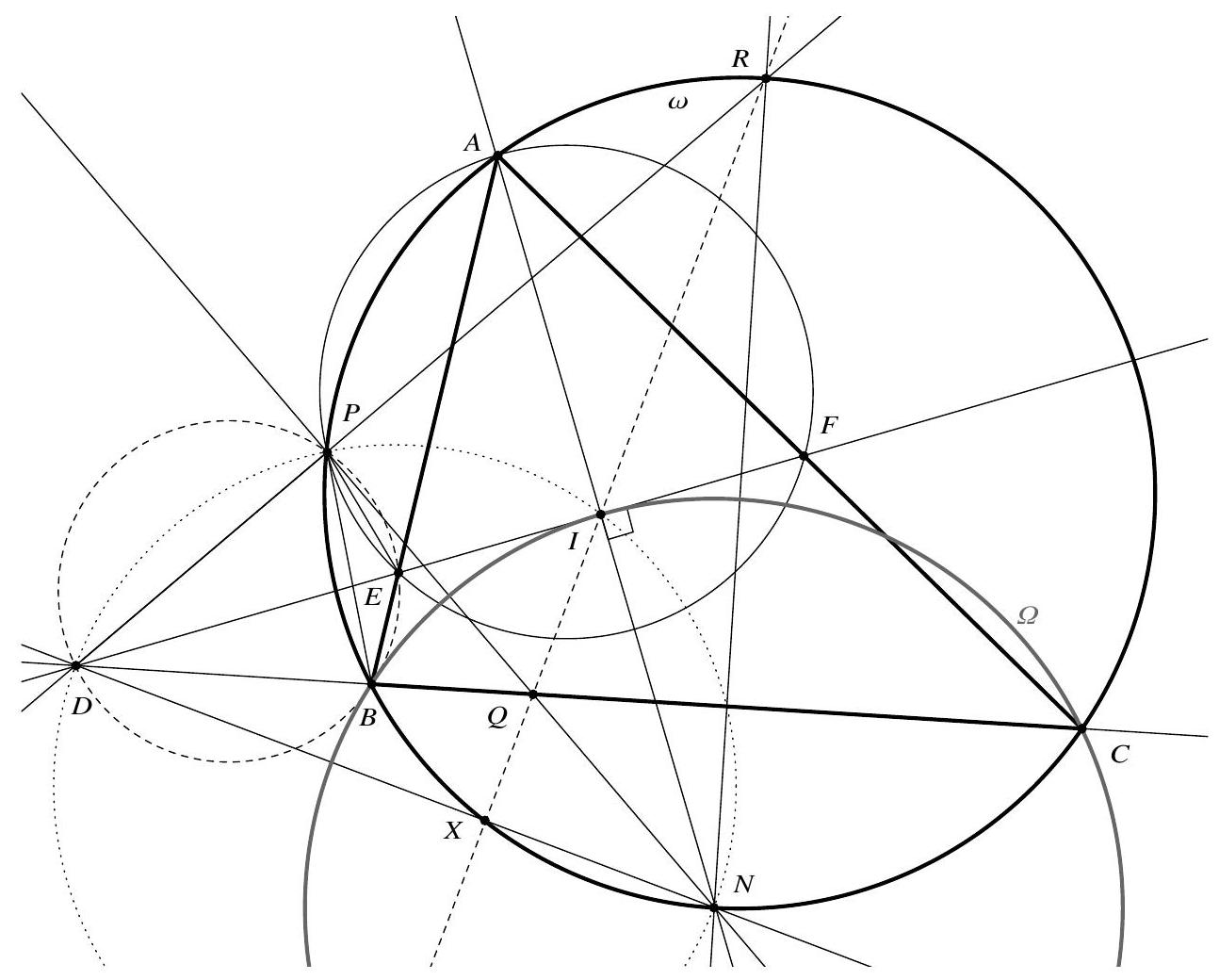
It is also well-known that $N$ is the centre of the circumcircle $\Omega$ of triangle $B C I$. Since $D I \perp I N$ by construction, $D I$ is tangent to $\Omega$ at $I$. As $D$ lies on the radical axis $B C$ of $\omega$ and $\Omega$, it follows that $|D I|^{2}=|D B||D C|=|D X||D N|$. Hence triangles $D N I$ and $D I X$ are similar; in particular, $\angle D X I=\angle D I N=90^{\circ}$. All of this shows that $R, I, Q, X$ lie on a line perpendicular to $D N$ that intersects $D N$ at $X \in \omega$. This completes the proof.
BxMO 2023: Problems and Solutions
Solution 2
Let $K$ be the midpoint of segment [BC]. It is well-known that $N$ is the midpoint of the small arc $\widehat{B C}$ of $\omega$, so $B C \perp K N$. In particular, $\angle D K N=90^{\circ}$. But $\angle D I N=90^{\circ}$ by construction, so $D I K N$ is cyclic, with circumcircle $\Gamma$. Moreover, $\angle P E F=180^{\circ}-\angle P A F=180^{\circ}-\angle P A B=\angle P B C$ and $\angle P F E=\angle P A E=\angle P A B=\angle P C B$ since $A F E P$ and $A C B P$ are cyclic, so triangles $P E F$ and $P B C$ are similar. Now, by construction, $I$ is the midpoint of segment $[E F]$, so, $K$ being the midpoint of $[B C]$, triangles $P I F$ and $P K C$ are similar, too. It follows that $\angle P I D=180^{\circ}-\angle P I F=180^{\circ}-\angle P K C=\angle P K D$, whence $P$ lies on $\Gamma$.
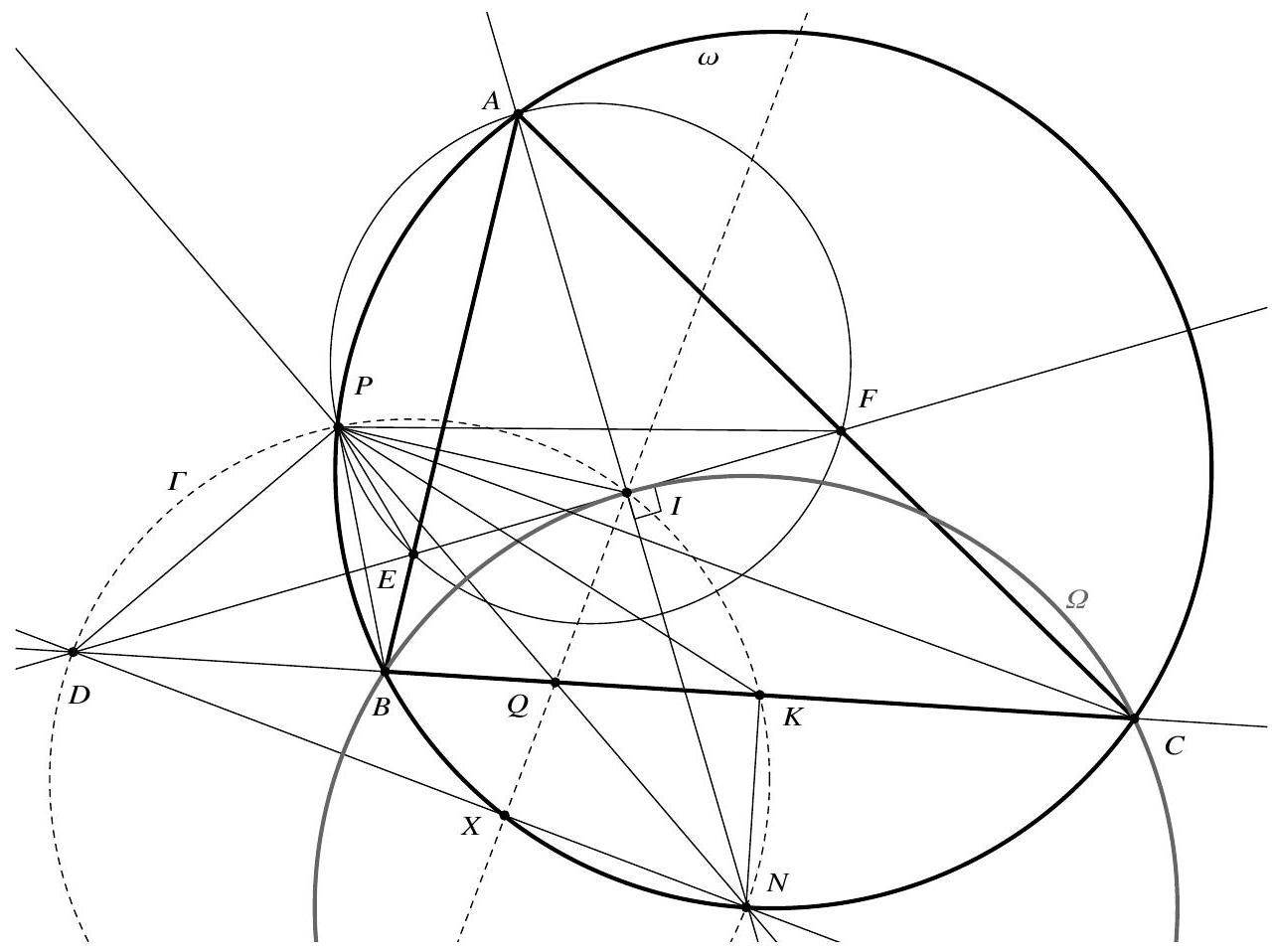
Let $\Omega$ be the circumcircle of triangle $B C I$. By construction, $Q$ lies on the radical axes $P N$ of $\omega, \Gamma$ and $B C$ of $\omega, \Omega$, so is the radical centre of $\omega, \Gamma, \Omega$. In particular, $I Q$ is the radical axis of $\Gamma, \Omega$, so is perpendicular to the line joining the centres of $\Gamma, \Omega$. Now it is well-known that $N$ is the centre of $\Omega$, and, since $\angle D I N=90^{\circ}$, the centre of $\Gamma$ is the midpoint of segment $[D N]$. This shows that $I Q \perp D N$.
Finally, let $D N$ meet $\omega$ again at $X$. Since $D I \perp I N$ by construction and $N$ is the centre of $\Omega, D I$ is tangent to $\Omega$ at $I$. As $D$ lies on the radical axis $B C$ of $\omega, \Omega$, it follows that $|D I|^{2}=|D B||D C|=|D X||D N|$. Hence triangles $D N I$ and $D I X$ are similar; in particular, $\angle D X I=\angle D I N=90^{\circ}$, i.e. $I X \perp D N$. Since $I Q \perp D N$, it follows that $X$ is the intersection of $I Q$ and $D N$. Since $X$ lies on $\omega$ by construction, this completes the proof.
Solution 3
Since $A P E F$ and $A P B C$ are cyclic,
so $D P F C$ is cyclic, too. Thence $\angle C P D=\angle C F D=180^{\circ}-\angle I F A=90^{\circ}+\angle I A F=90^{\circ}+\angle C A N=90^{\circ}+\angle C P N$. Hence $\angle D P N=\angle C P D-\angle C P N=90^{\circ}$. Since $\angle D I N=90^{\circ}$ by construction, it follows that DPIN is cyclic, with
BxMO 2023: Problems and Solutions
circumcircle $\Gamma$. Let $J$ be the second intersection of line $I Q$ and $\Gamma$. Moreover, it is well-known that $N$ is the centre of the circumcircle $\Omega$ of BIC. In particular, $|N I|=|N B|$, and so, since $N I P J$ and $N B P C$ are cyclic,
Let $S$ now be the point of intersection of $P N$ and $\Omega$ such that $P, N, S$ lie on line $P N$ in this order. By construction, $\angle Q P C=\angle N P C=\angle N A C=\angle B A N=\angle B C N=\angle Q C N$, so triangles $C Q N$ and $P C N$ are similar, whence
Combining (1) and (2) shows that $C, J, S$ lie on a circle of Apollonius, the centre of which lies on the line through $P, Q, N, S$, so, since $|N C|=|N S|$ by construction, is $N$. In other words, $J$ lies on $\Omega$.
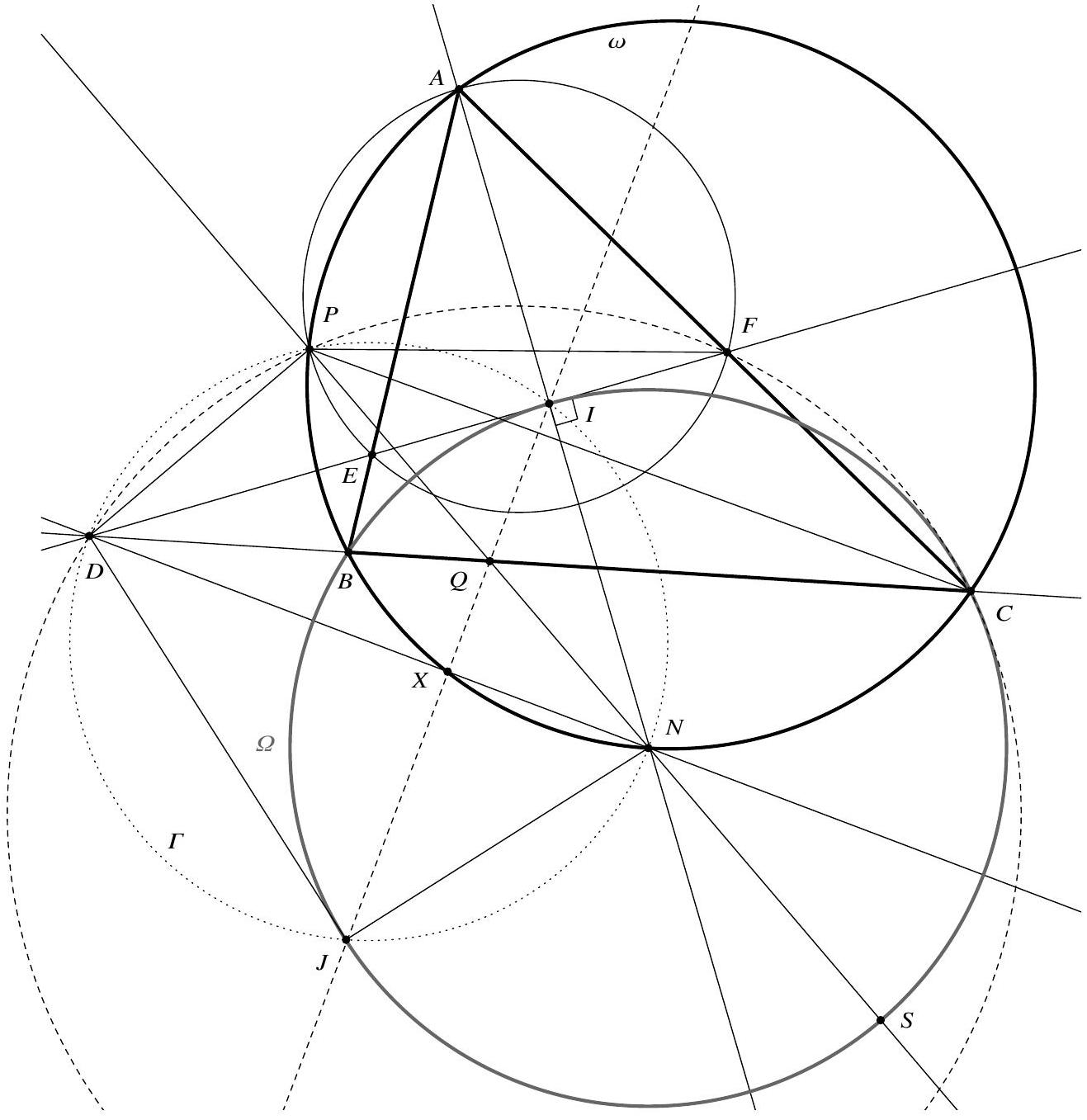
In particular, $|N I|=|N J|$. Now, by construction, $\angle D I N=\angle D J N=90^{\circ}$, so the right-angled triangles $D I N$ and $D J N$ are congruent, whence $D I N J$ is a kite. In particular, $I J \perp D N$. Since $Q$ lies on $I J$ by definition, this shows that $I Q \perp D N$. We can now conclude as in Solution 2.
Solution 4
By construction, $P$ is the Miquel point of quadrilateral $B C F E$ (and the resulting complete quadrilateral with points $A$ and $D$ added) because it is the intersection of $\omega$ and the circumcircle of triangle $A E F$. In particular, $D B E P$ is
BxMO 2023: Problems and Solutions
cyclic. It follows that $\angle I D P=\angle E D P=\angle E B P=\angle A B P=\angle A N P=\angle I N P$ since $A P B N$ is cyclic, and so $P D N I$ is also cyclic.
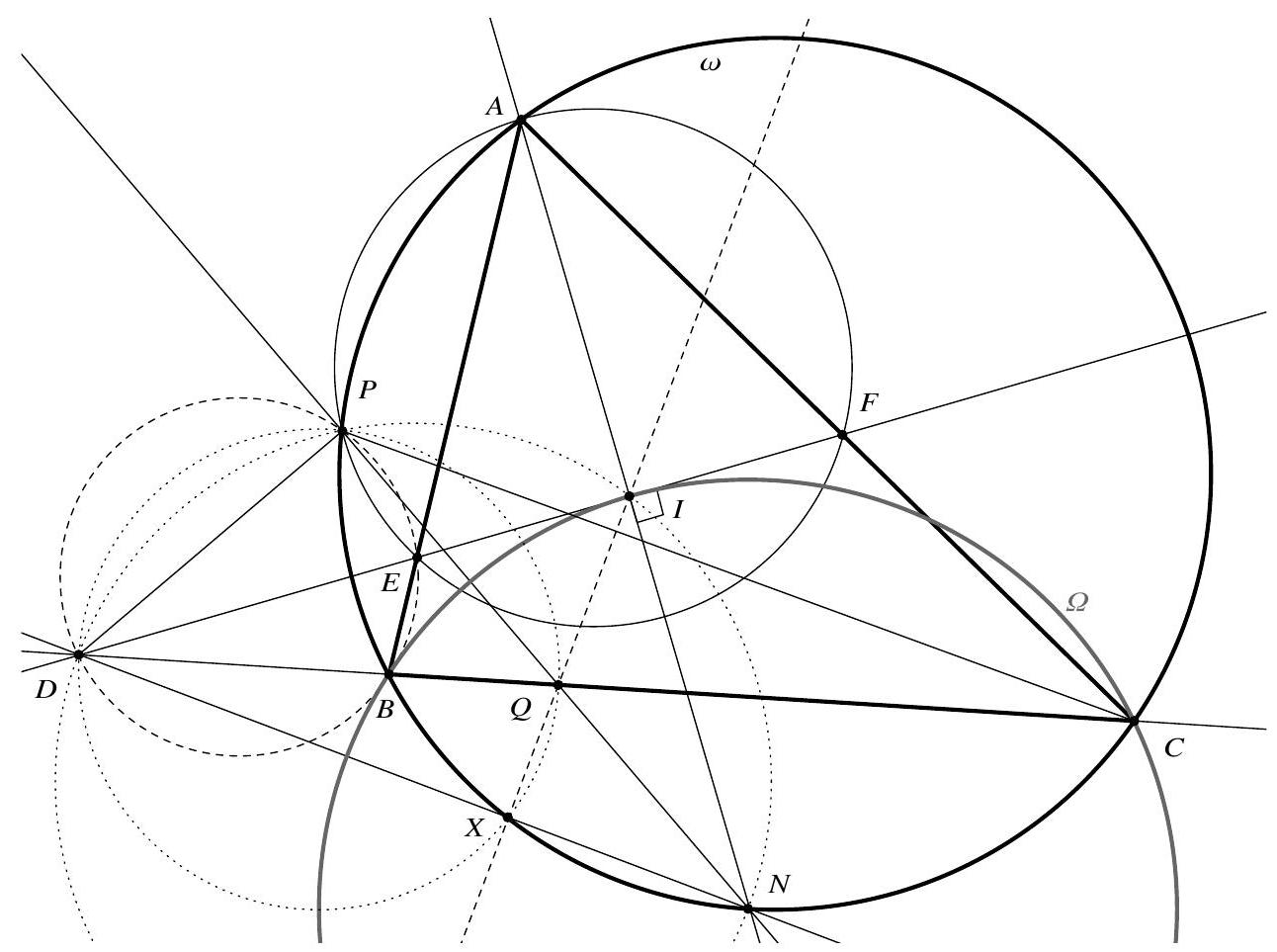
Next, let $X$ be the intersection of $D N$ and $\omega$ and let $A N$ meet $B C$ at $Y$. Then $\angle N A C=\angle A / 2=\angle N C B$, so $\angle B Y A=\angle C+\angle N A C=\angle C+\angle N C B=\angle N C A$ and hence
This implies that $D X Q P$ is cyclic. In particular, $Q X \perp D N$. It now suffices to show that $I X \perp D N$, which we do in the same way as in Solution 2.
BxMO 2023: Problems and Solutions
Problem 4
A positive integer $n$ is friendly if every pair of neighbouring digits of $n$, written in base 10, differs by exactly 1. For example, 6787 is friendly, but 211 and 901 are not.
Find all odd natural numbers $m$ for which there exists a friendly integer divisible by $64 m$.
Solution
Any friendly number divisible by 64 is divisible by 4 , and hence the number formed by its last two digits is a multiple of 4 , so ends in $00,04,08, \ldots$, or 96 . A friendly number divisible by 4 must therefore end in $12,32,56$, or 76 , so cannot be divisible by 5 . In particular, if $5 \mid \mathrm{m}$, then there is no friendly integer divisible by 64 m .
We claim that conversely, if $m$ is odd and $5 \nmid m$, then there exists a friendly integer divisible by $64 m$. First, we notice that $343232=64 \cdot 5363$ is a friendly number divisible by 64 , and hence so is
Now the sequence $N_{0}, N_{1}, N_{2}, \ldots$ eventually repeats modulo $m$, i.e. there exist positive integers $k<\ell$ such that $N_{\ell} \equiv N_{k}(\bmod m)$. Hence $m \mid N_{\ell}-N_{k}=10^{6(k+1)} N_{\ell-k-1}$. Since $m$ is odd and $5 \nmid m,(10, m)=1$, so $m \mid N_{\ell-k-1}$. By construction, $64 \mid N_{\ell-k-1}$. Thus, as $m$ is odd and hence $(64, m)=1$, we conclude that $64 m \mid N_{\ell-k-1}$. This completes the proof.
The solution divides into two parts: (1) showing that, if $5 \mid m$, then there is no friendly integer divisible by $64 m$; (2) showing that, if $5 \nmid m$, then there is a friendly integer divisible by $64 m$.
Alternative solution for part (1). If $5 \mid m$, then $20 \mid 64 m$. The last two digits of a multiple of 20 are $00,20,40,60$, or 80 , so this number is not friendly. Thus, if $m$ is odd and $5 \mid m$, then there is no friendly integer divisible by $64 m$.
Alternative solution for part (2). Notice that $N_{k}=343232 \cdot\left(10^{6(k+1)}-1\right) /\left(10^{6}-1\right)$. Let $M=m\left(10^{6}-1\right)$. Since $5 \nmid m$ and $m$ is odd, $(10, M)=1$, so, taking $k=\varphi(M)-1$, we get $10^{6(k+1)}=10^{6 \varphi(M)} \equiv 1(\bmod M)$ by the Euler-Fermat theorem, i.e. $m \mid\left(10^{6(k+1)}-1\right) /\left(10^{6}-1\right)$, and hence $m \mid N_{k}$.
Alternative constructions of the integers $\boldsymbol{N}{\boldsymbol{k}}$ for part (2). Direct calculation shows that friendly integers divisible by 64 end in $343232,543232,123456$, or 323456 , so the numbers $N{k}$ defined in the solution of part (2) above may be replaced by, for instance,
Remark. Interestingly, friendly numbers cannot be divisible by arbitrarily high powers of 2. Direct calculation shows that the 60-digit friendly integer 101232121234323456543434343210121212323434343234565656543232 is divisible by $2^{60}$, but that there is no friendly integer divisible by $2^{61}$. The problem selection committee is not aware of a proof of this fact that eschews direct calculation.