


Canadian Mathematical Olympiad
1973
Problem 1
(i) Solve the simultaneous inequalities, $x<\frac{1}{4 x}$ and $x<0$; i.e., find a single inequality equivalent to the two given simultaneous inequalities. (ii) What is the greatest integer which satisfies both inequalities $4 x+13<0$ and $x^{2}+3 x>16 ?$ (iii) Give a rational number between $11 / 24$ and $6 / 13$. (iv) Express 100000 as a product of two integers neither of which is an integral multiple of 10. (v) Without the use of logarithm tables evaluate
PROBLEM 2
Find all the real numbers which satisfy the equation $|x+3|-|x-1|=x+1$. (Note: $|a|=a$ if $a \geq 0 ;|a|=-a$ if $a<0$.)
Problem 3
Prove that if $p$ and $p+2$ are both prime integers greater than 3 , then 6 is a factor of $p+1$.
PROBLEM 4
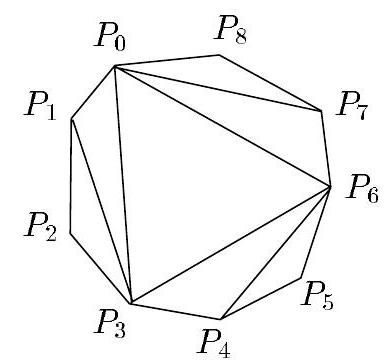
The figure shows a (convex) polygon with nine vertices. The six diagonals which have been drawn dissect the polygon into the seven triangles: $P_{0} P_{1} P_{3}, \quad P_{0} P_{3} P_{6}, \quad P_{0} P_{6} P_{7}, \quad P_{0} P_{7} P_{8}, \quad P_{1} P_{2} P_{3}$, $P_{3} P_{4} P_{6}, P_{4} P_{5} P_{6}$. In how many ways can these triangles be labelled with the names $\triangle_{1}, \triangle_{2}, \triangle_{3}$, $\triangle_{4}, \triangle_{5}, \triangle_{6}, \triangle_{7}$ so that $P_{i}$ is a vertex of triangle $\triangle_{i}$ for $i=1,2,3,4,5,6,7$ ? Justify your answer.
PRoblem 5
For every positive integer $n$, let
For example, $h(1)=1, h(2)=1+\frac{1}{2}, h(3)=1+\frac{1}{2}+\frac{1}{3}$. Prove that for $n=2,3,4, \ldots$
PROBLEM 6 If $A$ and $B$ are fixed points on a given circle not collinear with centre $O$ of the circle, and if $X Y$ is a variable diameter, find the locus of $P$ (the intersection of the line through $A$ and $X$ and the line through $B$ and $Y$ ).
PROBLEM 7
Observe that
State a general law suggested by these examples, and prove it. Prove that for any integer $n$ greater than 1 there exist positive integers $i$ and $j$ such that