


Canadian Mathematical Olympiad
1974
PART A
Problem 1 i) If $x=\left(1+\frac{1}{n}\right)^{n}$ and $y=\left(1+\frac{1}{n}\right)^{n+1}$, show that $y^{x}=x^{y}$. ii) Show that, for all positive integers $n$,
Problem 2
Let $A B C D$ be a rectangle with $B C=3 A B$. Show that if $P, Q$ are the points on side $B C$ with $B P=P Q=Q C$, then
PART B
Problem 3
Let
be a polynomial with coefficients satisfying the conditions:
Let $b_{0}, b_{1}, \ldots, b_{2 n}$ be the coefficients of the polynomial
Prove that
PROBLEM 4 Let $n$ be a fixed positive integer. To any choice of $n$ real numbers satisfying
there corresponds the sum (*)
Let $S(n)$ denote the largest possible value of the sum (*). Find $S(n)$.
Problem 5
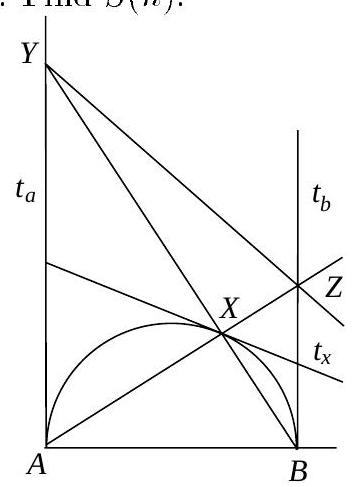
Given a circle with diameter $A B$ and a point $X$ on the circle different from $A$ and $B$, let $t_{a}, t_{b}$ and $t_{x}$ be the tangents to the circle at $A, B$ and $X$ respectively. Let $Z$ be the point where line $A X$ meets $t_{b}$ and $Y$ the point where line $B X$ meets $t_{a}$. Show that the three lines $Y Z, t_{x}$ and $A B$ are either concurrent (i.e., all pass through the same point) or parallel.
Problem 6
An unlimited supply of 8 -cent and 15 -cent stamps is available. Some amounts of postage cannot be made up exactly, e.g., 7 cents, 29 cents. What is the largest unattainable amount, i.e., the amount, say $n$, of postage which is unattainable while all amounts larger than $n$ are attainable? (Justify your answer.)
PROBLEM 7
A bus route consists of a circular road of circumference 10 miles and a straight road of length 1 mile which runs from a terminus to the point $Q$ on the circular road (see diagram). It is served by two buses, each of which requires 20 minutes for the round trip. Bus No. 1, upon leaving the terminus, travels along the straight road, once around the circle clockwise and returns along the straight road to the terminus. Bus No. 2, reaching the terminus 10 minutes after Bus No. 1, has a similar route except that it proceeds counterclockwise
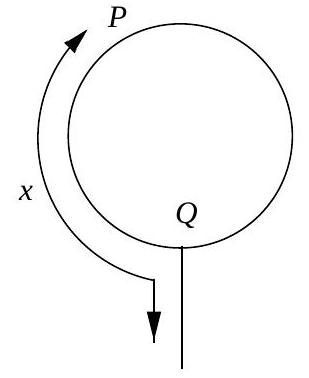
Terminus around the circle. Both buses run continuously and do not wait at any point on the route except for a negligible amount of time to pick up and discharge passengers. A man plans to wait at a point $P$ which is $x$ miles $(0 \leq x<12)$ from the terminus along the route of Bus No. 1 and travel to the terminus on one of the buses.
Assuming that he chooses to board that bus which will bring him to his destination at the earliest moment, there is a maximum time $w(x)$ that his journey (waiting plus travel time) could take. Find $w(2)$; find $w(4)$. For what value of $x$ will the time $w(x)$ be the longest? Sketch a graph of $y=w(x)$ for $0 \leq x<12$.