


Canadian Mathematical Olympiad
1992
PROBLEM 1
Prove that the product of the first $n$ natural numbers is divisible by the sum of the first $n$ natural numbers if and only if $n+1$ is not an odd prime.
Problem 2 For $x, y, z \geq 0$, establish the inequality
and determine when equality holds.
Problem 3
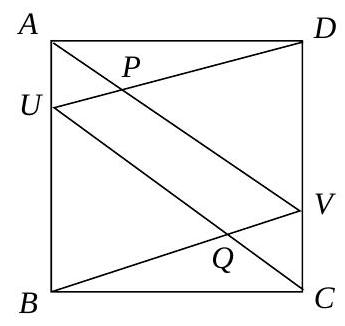
In the diagram, $A B C D$ is a square, with $U$ and $V$ interior points of the sides $A B$ and $C D$ respectively. Determine all the possible ways of selecting $U$ and $V$ so as to maximize the area of the quadrilateral $P U Q V$.
PROBLEM 4
Solve the equation
PROBLEM 5
A deck of $2 n+1$ cards consists of a joker and, for each number between 1 and $n$ inclusive, two cards marked with that number. The $2 n+1$ cards are placed in a row, with the joker in the middle. For each $k$ with $1 \leq k \leq n$, the two cards numbered $k$ have exactly $k-1$ cards between them. Determine all the values of $n$ not exceeding 10 for which this arrangement is possible. For which values of $n$ is it impossible?