


1997 SOLUTIONS
Problem 1 - Deepee Khosla, Lisgar Collegiate Institute, Ottawa, ON
Let $p_{1}, \ldots, p_{12}$ denote, in increasing order, the primes from 7 to 47 . Then
and
Note that $2^{4}, 3^{2}, 5^{2}, p_{1}, \ldots, p_{12}$ all divide 50 !, so all its prime powers differ from those of 5 !
Since $x, y \mid 50$ !, they are of the form
Then $\max \left(n_{i}, m_{i}\right)$ is the $\mathrm{i}^{\text {th }}$ prime power in 50 !
and $\min \left(n_{i}, m_{i}\right)$ is the $\mathrm{i}^{\mathrm{t}}$ prime power in 5 !
Since, by the above note, the prime powers for $p_{12}$ and under differ in 5 ! and 50!, there are $2^{15}$ choices for $x$, only half of which will be less than $y$. (Since for each choice of $x, y$ is forced and either $x<y$ or $y<x$.) So the number of pairs is $2^{15} / 2=2^{14}$.
Problem 2 - Byung Kuy Chun, Harry Ainlay Composite High School, Edmonton, AB
Look at the first point of each given unit interval. This point uniquely defines the given unit interval.
Lemma. In any interval $[x, x+1)$ there must be at least one of these first points $(0 \leq x \leq 49)$.
Proof. Suppose the opposite. The last first point before $x$ must be $x-\varepsilon$ for some $\varepsilon>0$. The corresponding unit interval ends at $x-\varepsilon+1<x+1$. However, the next given unit interval cannot begin until at least $x+1$.
This implies that points $(x-\varepsilon+1, x+1)$ are not in set $A$, a contradiction.
$\therefore$ There must be a first point in $[x, x+1)$.
Note that for two first points in intervals $[x, x+1)$ and $[x+2, x+3)$ respectively, the corresponding unit intervals are disjoint since the intervals are in the range $[x, x+2)$ and $[x+2, x+4)$ respectively.
$\therefore$ We can choose a given unit interval that begins in each of
Since there are 25 of these intervals, we can find 25 points which correspond to 25 disjoint unit intervals.
Problem 2 - Colin Percival, Burnaby Central Secondary School, Burnaby, BC
I prove the more general result, that if $[0,2 n]=\bigcup_{i} A_{i},\left|A_{i}\right|=1, A_{i}$ are intervals then $\exists a_{1} \ldots a_{n}$, such that $A_{a_{i}} \cap A_{a_{j}}=\emptyset$.
Let $0<\varepsilon \leq \frac{2}{n-1}$ and let $b_{i}=(i-1)(2+\varepsilon), i=1 \ldots n$. Then
So all the $b_{i}$ are in $[0,2 n]$.
Let $a_{i}$ be such that $b_{i} \in A_{a_{i}}$. Since $\bigcup A_{i}=[0,2 n]$, this is possible.
Then since $\left(b_{i}-b_{j}\right)=(i-j)(2+\varepsilon) \geq 2+\varepsilon>2$, and the $A_{i}$ are intervals of length $1, \min A_{a_{i}}-$ $\max A_{a_{j}}>2-1-1=0$, so $A_{a_{i}} \bigcap A_{a_{j}}=\emptyset$.
Substituting $n=25$, we get the required result. Q.E.D.
Problem 3 - Mihaela Enachescu, Dawson College, Montréal, PQ
Let $P=\frac{1}{2} \cdot \frac{3}{4} \cdot \ldots \cdot \frac{1997}{1998}$. Then $\frac{1}{2}>\frac{1}{3}$ because $2<3, \frac{3}{4}>\frac{3}{5}$ because $4<5, \ldots$,
.. $\frac{1997}{1998}>\frac{1997}{1999}$ because $1998<1999$.
So
$P>\frac{1}{3} \cdot \frac{3}{5} \cdot \ldots \cdot \frac{1997}{1999}=\frac{1}{1999}$.
Also $\frac{1}{2}<\frac{2}{3}$ because $1 \cdot 3<2 \cdot 2, \frac{3}{4}<\frac{4}{5}$ because $3 \cdot 5<4 \cdot 4, \ldots$
$\frac{1997}{1998}<\frac{1998}{1999}$ because $1997 \cdot 1999=1998^{2}-1<1998^{2}$.
So $P<\frac{2}{3} \cdot \frac{4}{5} \cdot \ldots \cdot \frac{1998}{1999}=\underbrace{\left(\frac{2}{1} \cdot \frac{4}{3} \cdot \frac{6}{5} \cdot \ldots \cdot \frac{1998}{1997}\right)}_{\frac{1}{P}} \frac{1}{1999}$.
Hence $P^{2}<\frac{1}{1999}<\frac{1}{1936}=\frac{1}{44^{2}}$ and $P<\frac{1}{44}$.
Then (1) and (2) give $\frac{1}{1999}<P<\frac{1}{44}$ (q.e.d.)
Problem 4 - Joel Kamnitzer, Earl Haig Secondary School, North York, ON
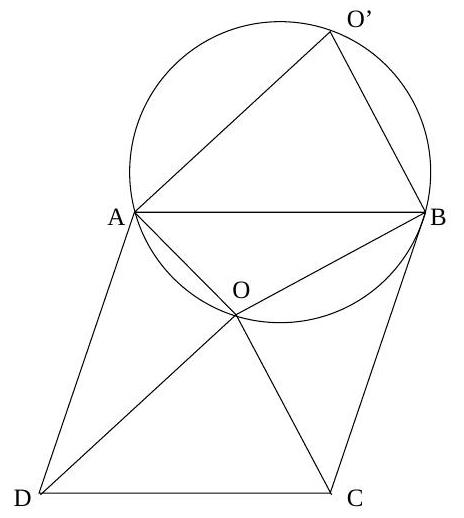
Consider a translation which maps $D$ to $A$. It will map $0 \rightarrow 0^{\prime}$ with $\overline{O O^{\prime}}=\overline{D A}$, and $C$ will be mapped to $B$ because $\overline{C B}=\overline{D A}$.
This translation keeps angles invariant, so $\angle A O^{\prime} B=\angle D O C=180^{\circ}-\angle A O B$.
$\therefore A O B O^{\prime}$ is a cyclic quadrilateral.
$\therefore \angle O D C=\angle O^{\prime} A B=\angle O^{\prime} O B$
but, since $O^{\prime} O$ is parallel to $B C$,
Problem 4 - Adrian Chan, Upper Canada College, Toronto, ON
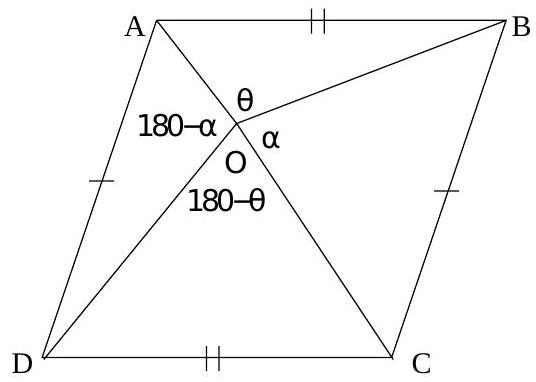
Let $\angle A O B=\theta$ and $\angle B O C=\alpha$. Then $\angle C O D=180^{\circ}-\theta$ and $\angle A O D=180^{\circ}-\alpha$.
Since $A B=C D$ (parallelogram) and $\sin \theta=\sin \left(180^{\circ}-\theta\right)$, the sine law on $\triangle O C D$ and $\triangle O A B$ gives
So
Similarily, the sine law on $\triangle O B C$ and $\triangle O A D$ gives
so
Equations (1) and (2) show that $\sin \angle A B O \cdot \sin \angle C B O=\sin \angle A D O \cdot \sin \angle C D O$ hence
$\frac{1}{2}[\cos (\angle A B O+\angle C B O)-\cos (\angle A B O-\angle C B O)]=\frac{1}{2}[\cos (\angle A D O+\angle C D O)-\cos (\angle A D O-\angle C D O)]$.
Since $\angle A D C=\angle A B C$ (parallelogram) and $\angle A D O+\angle C D O=\angle A D C$ and $\angle A B O+\angle C B O=$ $\angle A B C$ it follows that $\cos (\angle A B O-\angle C B O)=\cos (\angle A D O-\angle C D O)$.
There are two cases to consider.
Case (i): $\angle A B O-\angle C B O=\angle A D O-\angle C D O$.
Since $\angle A B O+\angle C B O=\angle A D O+\angle C D O$, subtracting gives $2 \angle C B O=2 \angle C D O$ so $\angle C B O=$ $\angle C D O$, and we are done.
Case (ii): $\angle A B O-\angle C B O=\angle C D O-\angle A D O$.
Since we know that $\angle A B O+\angle C B O=\angle C D O+\angle A D O$, adding gives $2 \angle A B O=2 \angle C D O$ so $\angle A B O=\angle C D O$ and $\angle C B O=\angle A D O$.
Substituting this into (1), it follows that $O A=O C$.
Also, $\angle A D O+\angle A B O=\angle C B O+\angle A B O=\angle A B C$.
Now, $\angle A B C=180^{\circ}-\angle B A D$ since $A B C D$ is a parallelogram.
Hence $\angle B A D+\angle A D O+\angle A B O=180^{\circ}$ so $\angle D O B=180^{\circ}$ and $D, O, B$ are collinear.
We now have the diagram
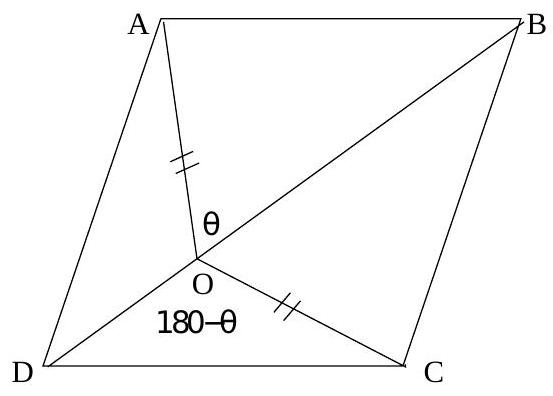
Then $\angle C O D+\angle B O C=180^{\circ}$, so $\angle B O C=\theta=\angle A O B$.
$\triangle A O B$ is congruent to $\triangle C O B$ (SAS, $O B$ is common, $\angle A O B=\angle C O B$ and $A O=C O$ ), so $\angle A B O=\angle C B O$. Since also $\angle A B O=\angle C D O$ we conclude that $\angle C B O=\angle C D O$.
Since it is true in both cases, then $\angle C B O=\angle C D O$.
Q.E.D.
Problem 5 - Sabin Cautis, Earl Haig Secondary School, North York, ON
We first note that
Let $S(n)=\sum_{k=0}^{n} \frac{(-1)^{k}\left(\begin{array}{c}n \ k\end{array}\right)}{k^{2}+9 k^{2}+26 k+24}$.
Then
Let
Now, for $n \geq 1$,
since
Also
Substituting $j=i-1,\left({ }^{*}\right)$ shows that
Hence
Substituting $j=k+4$,
The first two terms are zero because of results $\left({ }^{}\right)$ and $\left({ }^{ *}\right)$ so
Then