


2008
57th Czech and Slovak Mathematical Olympiad
Edited by
Karel Horák
Translated into English by
Miroslav Engliš
- Find all triples $a, b, c$ of real numbers with the following property: each of the equations
has three distinct real roots, but altogether these roots form just five distinct numbers.
Solution. Assume that the numbers $a, b, c$ have the required property. Observe first of all that any two of the given equations must have a common root, otherwise they would have altogether at least six distinct roots.
The common roots of the given three cubic equations are roots of the quadratic equations obtained by subtracting them. These three quadratic equations turn out to be independent of the parameters $a, b, c$ :
We see that the equations (1) and (2) have only one common root $x=1$, thus together they have exactly five distinct roots. Hence each of the roots of the equation (3) must also be a root of at least one of the equations (1) or (2). From the subtracted equations it follows that number $x=1$ is also a root of the equation (3).
We claim that the other two roots of the equation (3) cannot be at the same time also roots of (1) or (2). Otherwise one of the equations (1), (2) would have the same three roots as the equation (3), and thus would have the same coefficient not only at the cubic term. This is however not the case, since for any value of the parameter $c$ the constant terms $c+1, c+2, c+3$ of the three equations are always mutually distinct.
The equation (3) has thus, in addition to $x=1$, one more common root with the equation (1) and one common root with the equation (2); from (3-1) and (3-2) we see that these common roots are $x=-\frac{1}{2}$ and $x=-2$. The left hand side of the equation (3) thus decomposes as
Comparing this with the coefficients of (3) we already obtain $a=-\frac{3}{2}, b=-\frac{7}{2}, c=-2$.
From our argument it follows that for these values of $a, b, c$ the equation (3) has the roots $1,-\frac{1}{2}$ and -2 , that the numbers $1,-\frac{1}{2}$ are roots of the equation (1) and that the numbers $1,-2$ are roots of the equation (2). What remains to be checked is that the third roots of the equations (1) and (2) are another two (distinct) numbers. These third roots can be conveniently found using Vièta's relations. Because the product of the three roots of (1) is the number opposite to the constant term $c+2=0$, the third root of (1) must be the number 0 . Similarly the product of the roots of (2) equals -1 , thus the third root of the equation (2) is the number $x=\frac{1}{2}$.
Conclusion. The problem has the unique solution $a=-\frac{3}{2}, b=-\frac{7}{2}, c=-2$.
- In the plane a segment $A V$ and an acute angle of magnitude $\alpha$ are given. Find the locus of the circumcenters of all triangles $A B C$ with interior angle $\alpha$ at the vertex $A$ and with orthocenter $V$.
Solution. We begin by proving a useful general assertion about the orthocenter $V$ of any acute triangle $A B C$. Denote by $V^{\prime}$ the intersection of the line containing the altitude $C C_{0}$ with the circumcircle of the triangle $A B C$ (Fig. 1). The right triangles

Fig. 1
$C_{0} V A$ and $A_{0} V C$ are similar (they have also the same angle at the vertex $V$ ), therefore $\angle B A A_{0}=\angle B C C_{0}$. The angles $B C C_{0}$ and $V^{\prime} A B$ are congruent as they subtend the same $\operatorname{arc} V^{\prime} B$, hence the points $V$ and $V^{\prime}$ are symmetric with respect to the line $A B$.
Denoting the angles in the triangle $A B C$ in the standard way, we have $\angle A C V^{\prime}=$ $\angle A C C_{0}=90^{\circ}-\alpha$, so for the length of the segment $A V$, in view of the above symmetry, we get
where $r$ is the radius of the circumcircle $k$ of the triangle $A B C$ (and $A V^{\prime} C$ ). The same formula (1) also holds for a triangle $A B C$ with acute interior angle $\alpha$ at the vertex $A$ even if one of the other interior angles is right or obtuse (Fig.2): the argument still works, word by word.

Fig. 2
Coming back to the solution of our problem, the formula (1) leads to the conclusion that the circumcircles of all the triangles $A B C$ in question have the same radius
so their centers $O$ have a fixed distance $r$ from the point $A$. We must, however, determine what part of the circle $l(A, r)$ will the centers $O$ fill; certainly this will be a set symmetric with respect to the line $A V$, since the symmetry with respect to $A V$ transforms any admissible triangle into another admissible triangle. With this aim we express the magnitude of the angle $V A O$ in terms of the interior angles $\beta=\angle A B C$ and $\gamma=\angle A C B$. We may also assume that $\beta \geqslant \gamma$ (otherwise we would interchange the notations $B, C$ for the vertices from the very beginning).
Assume first that $\beta<90^{\circ}$, so the triangle $A B C$ is acute and we can again use Fig. 1. From the isosceles triangle $A B O$ with interior angle $2 \gamma$ at the main vertex $O$ we see that $\angle B A O=90^{\circ}-\gamma$; on the other hand, from the right triangle $B A A_{0}$ we obtain $\angle B A V=90^{\circ}-\beta$. Since both points $O, V$ lie in the half-plane $A B C$, we obtain for the angle $V A O$ the expression
(recall that $\beta \geqslant \gamma$ ).
In the case of $\beta \geqslant 90^{\circ}$ as in Fig. 2 we similarly find that $\angle B A O=90^{\circ}-\gamma$ and $\angle B A V=\beta-90^{\circ}$, whence
We thus see that $\angle V A O=\beta-\gamma$ no matter whether the triangle $A B C$ is acute, right or obtuse.
Now it is already easy to finish the solution: from the formula obtained we have the estimate
so the point $O$ lies on the arc of the circle $l(A, r)$ determined by the inequality
Conversely, for any angle $\epsilon, 0^{\circ} \leqslant \epsilon<180^{\circ}-\alpha$, we easily compute what must be the magnitudes of the interior angles $\beta$ and $\gamma$ in order that $\angle V A O=\epsilon$ :
Consequently, if we inscribe into an arbitrary circle of radius $r$ given by (2) an auxiliary triangle $A^{\prime} B^{\prime} C^{\prime}$ with the given angle $\alpha$ at the vertex $A^{\prime}$ and the computed angles $\beta$, $\gamma$ at the vertices $B^{\prime}$ and $C^{\prime}$, respectively, then for its orthocenter $V^{\prime}$ and circumcenter $O^{\prime}$ there will hold the equalities $A^{\prime} V^{\prime}=A V$ and $\angle V^{\prime} A^{\prime} O^{\prime}=\epsilon$. Applying a congruence which maps the segment $A^{\prime} V^{\prime}$ into the segment $A V$, the triangle $A^{\prime} B^{\prime} C^{\prime}$ gets mapped into an admissible triangle $A B C$, whose circumcenter $O$ lies on the circle $l$ and satisfies $\angle V A O=\epsilon$.
Conclusion. The sought locus of circumcenters $O$ is the arc of the circle with center $A$ and radius $r=\frac{1}{2} A V / \cos \alpha$ determined by the inequality $\angle V A O<180^{\circ}-\alpha$ (the endpoints of the arc do not belong to the locus, cf. Fig.3).

Fig. 3
- A set $M$ consists of $2 n$ mutually distinct positive real numbers, where $n \geqslant 2$. Consider $n$ rectangles, whose dimensions are numbers from $M$, with each element of $M$ being used exactly once. Determine the dimensions of these rectangles if the sum of their areas is known to be
a) the greatest possible; b) the least possible.
Solution. Consider first the simplest situation when $n=2$. The given set $M$ thus consists of four positive numbers, which we denote in the order of their magnitude by
There are only three possibilities how to construct the pair of rectangles in the manner requested; namely, they may have dimensions
We claim that the sums of areas of these rectangles are, in this order, decreasing; that is, that
This is easily checked directly, and also follows from the general fact that
which holds for any four-tuple of real numbers $a, b, c, d$ owing to the equality
Indeed, the inequality on the left in (1) follows from (2) upon choosing
and the inequality on the right upon choosing
This solves the problem in the case of $n=2$, and suggests the following conjecture for general $n \geqslant 2$ :
If $a_{1}<a_{2}<\cdots<a_{2 n}$ are the elements of the given set $M$, then the greatest sum of areas occurs exactly for the n-tuple of rectangles with dimensions given by $a_{1} \times a_{2}, a_{3} \times a_{4}, \ldots, a_{2 n-1} \times a_{2 n}$; while the least sum of areas occurs exactly for the $n$-tuple of rectangles with areas $a_{1} \times a_{2 n}, a_{2} \times a_{2 n-1}, \ldots, a_{n} \times a_{n+1}$.
To prove the first assertion, assume that the maximum sum of areas occurs for some $n$-tuple in which the numbers $a_{1}, a_{2}$ are not the dimensions of the same rectangle. The corresponding $n$-tuple thus contains rectangles $a_{1} \times a_{i}$ and $a_{2} \times a_{j}$, where $i, j>2$. Replacing these by the rectangles $a_{1} \times a_{2}$ and $a_{i} \times a_{j}$, we obtain an $n$-tuple which has bigger sum of areas, since
in view of (2) and the fact that $a_{1}<a_{j}$ and $a_{2}<a_{i}$. It follows that the greatest sum of areas can only occur if the $n$-tuple in question contains the rectangle $a_{1} \times a_{2}$. We can thus put this rectangle aside and concentrate on the remaining $n-1$ rectangles, which is tantamount to solving the greatest-area problem for the reduced set $M^{\prime}$ of $2 n-2$ elements $a_{3}<a_{4}<\cdots<a_{2 n}$. Repeating the above argument we see that the maximal area tuple needs to contain the rectangle $a_{3} \times a_{4}$, and we make another reduction, and so on (formally, we may use the mathematical induction). This proves the assertion concerning the $n$-tuple with greatest possible sum of areas.
The assertion about least possible area is handled in exactly the same way. If $a_{1}$, $a_{2 n}$ are not the dimensions of the same rectangle, the $n$-tuple contains the rectangles $a_{1} \times a_{i}$ and $a_{j} \times a_{2 n}$ where $1<i, j<2 n$; replacing these by the rectangles $a_{1} \times a_{2 n}$ and $a_{i} \times a_{j}$, we obtain a tuple with smaller sum of areas, since
in view of (2) and the inequalities $a_{1}<a_{j}$ and $a_{i}<a_{2 n}$. The least possible sum of areas can thus occur only if the $n$-tuple contains the rectangle $a_{1} \times a_{2 n}$. Put this rectangle aside and consider the minimum sum of areas problem for the reduced set $M^{\prime}$ of $2 n-2$ elements $a_{2}<a_{3}<\cdots<a_{2 n-1}$, etc. This concludes the proof.
- Find the number of finite increasing sequences of natural numbers $a_{1}, a_{2}, \ldots, a_{k}$, of all possible lengths $k$, for which $a_{1}=1, a_{i} \mid a_{i+1}$ for $i=1,2, \ldots, k-1$, and $a_{k}=969969$.
Solution. Clearly all members of the sequence must be divisors of its last member, 969 969. Using the decomposition into prime factors,
we thus see that the following holds:
Each member $a_{i}$ of the sequence $a_{1}, a_{2}, \ldots, a_{k}$ is the product of some (for $i=$ 1 -of none, for $i=k$ - of all) of the six distinct primes in the decomposition (1); furthermore, (for $i<k$ ) the member $a_{i+1}$ has, in addition to all the prime factors of $a_{i}$, also at least one new prime factor (since the sequence is to be increasing!). Conversely, each such finite sequence satisfies the conditions of the problem.
From here it follows how one can describe each such sequence in an "economical manner": it is enough to list the new factors as they are turning up, that is, to give the sequence of ratios
into whose prime factorizations the six primes from (1) are distributed (at least one prime in each). The desired number of sequences is thus equal to the number of ways the six given primes can be distributed into one or several numbered nonempty groups (each corresponding to the prime factors of the ratios in (2), hence the order of the primes in a group is irrelevant). The word "numbered" means that the order of groups, on the other hand, does matter. For instance, for the distribution into two groups ${3,11,19}$ and ${7,13,17}$ we get, depending on the order in which the groups are considered, two possible sequence $(1, u, u v)$ and $(1, v, u v)$, where $u=3 \cdot 11 \cdot 19$ and $v=7 \cdot 13 \cdot 17$.
We have thus arrived at the combinatorial problem of determining the value of $P(6)$, where $P(n)$ denotes the number of ways an $n$-element set $X$ can be partitioned into any number of "numbered" nonempty subsets $X_{1}, X_{2}, X_{3}, \ldots$ To compute $P(6)$ we use the recurrence relation
valid for any $n \geqslant 2$, which we now proceed to prove.
We divide the desired partitions of the $n$-element set $X$ into $n$ groups according to the number $j$ of elements in the first subset $X_{1}(1 \leqslant j \leqslant n)$. This first subset $X_{1}$, having $j$ elements, can be chosen in exactly $\left(\begin{array}{l}n \ j\end{array}\right)$ ways, and then the remaining set $X^{\prime}=X \backslash X_{1}$ can be partitioned into nonempty numbered subsets $X_{2}, X_{3}, X_{4}, \ldots$ in $P(n-j)$ ways. (This holds even for $j=n$, when we set $P(0)=1$, since there is nothing already left to partition.) The number of desired partitions of $X$ whose first set $X_{1}$ consists of exactly $j$ elements is thus equal to $\left(\begin{array}{l}n \ j\end{array}\right) P(n-j)$, and the formula (3) already follows (the last term 1 on the right-hand side of (3) corresponds to the case of $j=n$ ).
From the obvious value $P(1)=1$ we thus compute by (3), in turn, $P(2)=3$, $P(3)=13, P(4)=75, P(5)=541$ and $P(6)=4683$.
Conclusion. There exist exactly 4683 such sequences.
- A circle $k$ is given, a point $O$ which does not lie on $k$, and a line $p$ which does not intersect $k$. Consider an arbitrary circle $l$, which is externally tangent to $k$ and is also tangent to $p$. Denote the corresponding common points by $A$ and $B$, respectively. If $O, A$ and $B$ are not collinear, we construct the circumcircle $m$ of the triangle $O A B$. Prove that all such circles $m$ either have a common point different from $O$, or are tangent to the same line.
Solution. One of the possible circles $l$ is shown on Fig. 4. The common point $A$ of the circles $k, l$ is their center of homothety, under which the tangent $p$ of the circle $l$ gets transformed into the parallel tangent $p^{\prime}$ of the circle $k$. The common point $M$ of $p^{\prime}$ and $k$ lies on the axis $q$ of the circle $k$ perpendicular to the line $p$, and from the two common points $M, N$ of the line $q$ with the circle $k$ the point $M$ is the one farther from $p$, since the segment connecting the homothetic tangent points $M$ and $N$ intersects the circle $k$ at the point $A$ (the center of the homothety).

Fig. 4
Consequently, the point $M$ does not depend on the choice of the circle $l$. The points $A \in k$ and $B \in p$ of course depend on this choice, but we will show that their mutual position on the half-line emanating from $M$ is restricted by the condition
where $P$ is the intersection of the perpendicular lines $p$ and $q$. This follows easily from the similarity
of the right triangles $A M N, P M B$. The relation (1) can also be derived using the power of the point $M$ with respect to the circle above the diameter $N B$ (which passes through the points $P$ and $A$ by the Thaletian theorem).
Now consider the point $O$. On Fig. 4 the circle $l$ is chosen so that the corresponding line $A B$ does not pass through the point $O$, so that there exists a circle circumscribed to the triangle $O A B$. According to the formulation of the problem $O \notin k$, hence $O \neq M$, so these two points determine a half-line $M O$, which in addition to $O$ has one more common point - say, $R$-with the circle $m$. (If $M O$ happens to be a tangent of $m$, we set $R=O) .{ }^{1}$ Expressing the power of the point $M$ with respect to the circle $m$ in two different ways, we find
whence upon comparing with (1) we see that the segment $M R$ has length equal to
which is clearly independent of the choice of the circle $l$. Since the point $R$ at the same time lies on the (fixed) half-line $M O$, in the case of $M R \neq M O$ the point $R$ is common to all the circles $m(R \neq O)$, while in the case of $M R=M O$ the line $M O$ is their common tangent. This completes the proof.
- Show that for any natural number $n$ there exists an integer $a, 1<a<5^{n}$, such that $5^{n} \mid a^{3}-a+1$.
Solution. For $n=1$, let us list the values of $r^{3}-r+1$ for all possible remainders $r$ upon division by 5 , i.e. for $r \in{0,1,2,3,4}$ :
| $r$ | 0 | 1 | 2 | 3 | 4 |
|---|---|---|---|---|---|
| $r^{3}-r+1$ | 1 | 1 | 7 | 25 | 61 |
We need not compute the values of $a^{3}-a+1$ for other integers $a$; for, if $r$ denotes the remainder of $a$ upon division by 5, i.e. $a=5 q+r$ for suitable integer $q$, then the numbers $a^{3}-a+1$ and $r^{3}-r+1$ give the same remainder upon division by 5 , since
is divisible by $a-r=5 q$, hence is a multiple of $5 .^{2}$ From the table above we see that for an integer $a$, we have $5 \mid a^{3}-a+1$, if and only if $a=5 q+3$.
We proceed to solve the problem by showing inductively that for each $n$, it is possible to choose an integer $a_{n}$ in the interval $\left(1,5^{n}\right)$ satisfying the condition $5^{n}$ $a_{n}^{3}-a_{n}+1$. For $n=1$, this holds true for the unique choice (in the interval $(1,5)$ ) $a_{1}=3$.
For the induction step, assume that for some natural $k$ we have a number $a_{k}$ in the interval $\left(1,5^{k}\right)$ with the property $5^{k} \mid a_{k}^{3}-a_{k}+1$; we proceed to construct $a_{k+1}$.[^0]
The remainder of $a_{k}^{3}-a_{k}+1$ upon division by $5^{k+1}$ must be a number divisible by $5^{k}$, hence, one of the numbers
Let us thus write this number in the form $r \cdot 5^{k}$, where $r \in{0,1,2,3,4}$, and seek the number $a_{k+1}$ in the form $a_{k+1}=a_{k}+s \cdot 5^{k}$ for suitable $s \in{0,1,2,3,4}$. (It is immediate that for $r=0$ we can take $a_{k+1}=a_{k}$, i.e. $s=0$ ). From the condition $1<a_{k}<5^{k}$ and the inequalities $a_{k} \leqslant a_{k+1} \leqslant a_{k}+4 \cdot 5^{k}$ we see already now that the condition $1<a_{k+1}<5^{k+1}$ will be fulfilled regardless of the final choice of $s$. Further, for $a_{k+1}$ of the above form we get
The last sum is an integer whenever both fractions are. The first of them is an integer in view of the way the number $r \in{0,1,2,3,4}$ was defined. We thus only need to find an $s \in{0,1,2,3,4}$ such that the second fraction is also an integer, that is, such that $\left(3 a_{k}^{2}-1\right) s+r$ is divisible by five. To this end, it is enough to show that the five numbers
give different remainders upon division by 5 (one of the remainders must then be zero). If this were not the case, then we would have $5 \mid c(s)-c\left(s^{\prime}\right)$ for some distinct $s, s^{\prime} \in{0,1,2,3,4}$; and from the expression
it would then follow that the number $3 a_{k}^{2}-1$ is divisible by 5 . However, $3 a^{2}-1$ is not divisible by 5 for any integer $a$; indeed, by the argument from the first paragraph it is enough to check this for the five values $a \in{0,1,2,3,4}$ :
| $a$ | 0 | 1 | 2 | 3 | 4 |
|---|---|---|---|---|---|
| $3 a^{2}-1$ | -1 | 2 | 11 | 26 | 47 |
This completes the proof by induction.
- Solve the system of equations
in the domain of real numbers.
Solution. Adding up all three equations and cancelling the quadratic terms gives
Thus $z=-x-y$ and substituting this into the first equation yields $x^{2}-y=(-x-y)^{2}$, or $y(2 x+y+1)=0$, hence either $y=0$ or $2 x+y+1=0$.
If $y=0$ then (1) implies $z=-x$ and upon substituting for $y, z$ into the original system we get for the unknown $x$ the single condition $x(x-1)=0$, which is satisfied only for $x=0$ or $x=1$. This corresponds to solutions $(x, y, z)$ of the form $(0,0,0)$ and $(1,0,-1)$.
If $2 x+y+1=0$, or $y=-2 x-1$, (1) implies $z=-x-y=x+1$. Substituting these $y, z$ into the original system yields for the unknown $x$ the single condition $x(x+1)=0$, which is fulfilled only for $x=0$ and $x=-1$. To these correspond the solutions of he form $(0,-1,1)$ and $(-1,1,0)$.
Conclusion: The given system has exactly four solutions $(x, y, z)$ : namely, the triples $(0,0,0),(1,0,-1),(0,-1,1)$ and $(-1,1,0)$.
- A prism is given whose bases are two congruent convex n-gons. The number $v$ of vertices of the prism, the number $s$ of its face diagonals and the number $t$ of its space diagonals form, in a certain order, the first three terms of an arithmetic progression. For which $n$ this holds?
(Remark: By faces of the prism we mean both the bases and the lateral faces. A space diagonal is a segment connecting two vertices which do not lie in the same face.)
Solution. Any $n$-gonal prism has exactly $n$ vertices in each of its bases, thus $v=2 n$. From each vertex there come out $n-3$ diagonals lying in the base and two diagonals lying in the lateral faces; altogether this is $n-1$ face diagonals. From the $n$ vertices there thus come out $2 n(n-1)$ diagonals in total, however, each of them is counted twice; thus $s=n(n-1)$. Similarly, from each vertex there emanate $n-3$ space diagonals (to all the vertices of the opposite base, except those three to which the given vertex is connected by an edge or a face diagonal); hence $t=2 n(n-3): 2=n(n-3)$.
We are thus looking for those $n \geqslant 3$ for which the numbers
form, in a suitable order, a triple $x, y, z$ with the property $y-x=z-y$, or $y=\frac{1}{2}(x+z)$. An easy check reveals that for $n=3$ this is not the case (we get the triple $6,6,0$ ), while for $n=4$ we get the triple $8,12,4$ which has the required property ( $\operatorname{as} 8=\frac{1}{2}(4+12)$ ). For any $n \geqslant 5$ we have $n-1>n-3 \geqslant 2$, whence, upon multiplying by $n, s>t \geqslant v$; thus the desired arithmetic mean property must be $t=\frac{1}{2}(v+s)$. This gives the equation
whose only relevant root is $n=7$ (the other root $n=0$ has no sense).
Conclusion: the only possible values are $n=4$ and $n=7$.
- An angle $X S Y$ and a circle $k$ with center $S$ are given in the plane. Consider an arbitrary triangle $A B C$ with incircle $k$ whose vertices $A$ and $B$ lie on the half-lines $S X$ and $S Y$, respectively. Find the locus of the vertices $C$ of all such triangles $A B C$.
Solution. Let $r$ denote the radius of $k$ and $\omega$ the magnitude of the (convex) angle $X S Y$. Denoting the interior angles of the triangle $A B C$ in the usual way, we have (Fig. 1)
It follows that the sought locus is an empty set if $\omega \leqslant 90^{\circ}$ or $\omega=180^{\circ}$, and that the interior angle $\gamma$ in the triangle $A B C$ must be equal to

Fig. 1
From the right triangle $C S T$, where $T$ is the common point of the circle $k$ with the side $A C$ (Fig. 1), we express the length of the hypotenuse $S C$ as
The vertex $C$ thus lies on the circle $k_{1}$ with center $S$ and radius $r_{1}=r / \sin \left(\omega-90^{\circ}\right)$.
In addition to the angle $A S B$, the angles $A S C$ and $B S C$ (that is, the angles $X S C$ and $Y S C)$ are also obtuse, since
Altogether we thus see that the point $C$ is an interior point of the arc $K L$ of the circle $k_{1}$, lying outside the given angle $X S Y$, whose endpoints $K, L$ are determined by the right angles $X S K$ and $Y S L$ (Fig. 2).

Fig. 2
Conversely, if we choose any interior point $C$ of the arc $K L$, then the half-lines $S X, S Y$ and $S C$ divide the plane into three obtuse angles, with the half-line $C S$ separating the points $X$ and $Y$. From the equality $S C=r_{1}$ it follows that the tangent from the point $C$ to the circle $k$ lying in the half-plane $C S X$ meets the halfline $C S$ at an acute angle of $\omega-90^{\circ}$, and thus intersects the half-line $S X$ at a point which we denote by $A$. Similarly the tangent from the point $C$ to the circle $k$ lying in the half-plane $C S Y$ intersects the half-line $S Y$ at a point which we denote by $B$.
Let us now choose the values $\alpha, \beta, \gamma$ so that $\omega-90^{\circ}=\frac{1}{2} \gamma, \angle C S K=\frac{1}{2} \beta$ and $\angle C S L=\frac{1}{2} \alpha$; the from the full angle at the vertex $S$ we get
An easy calculation shows that the tangent from the point $A$ just found to the circle $k$, symmetric to the tangent $A C$ with respect to the line $S X$, intersects the half-line $C S$ at an angle of $\frac{1}{2} \gamma+\alpha$, and similarly it follows that the analogous tangent from the point $B$ intersects the said half-line at an angle of $\frac{1}{2} \gamma+\beta$. Since the sum of these two angles equals $180^{\circ}$, the two tangents to $k$ must be parallel, and hence coincide (both points of tangency must lie in the interior of the convex angle $X S Y$ ). The triangle $A B C$ thus has the required properties.
Second Round of the 57th Czech
Mathematical Olympiad
(January 24th, 2008)
$\mathbb{N} / /(0)$
- Let $n$ be a given natural number greater than 1. Find all pairs of integers $s$ and $t$ for which the equations
have at least one common root in the domain of the real numbers.
Solution. Expressing $x^{n}$ from both equations
and comparing, we see that $2007-s x=2008-t x$, which implies that the common root can exist only for $s \neq t$ and must equal $x=1 /(t-s)$. This $x$ will be a common root of the two equations if and only if it is a root of one of them; substituting it e.g. into the first equation thus yields, upon a small manipulation, the equivalent condition
Since both factors on the left-hand side are integers, they must be the numbers 1 and -1 (in some order), whence in any case $t-s= \pm 1$.
a) If $t-s=1$, then the last equation reads $s-2007(t-s)=-1$. The two equations
with unknowns $s, t$ have the unique solution $s=2006$ and $t=2007$. (The common root is $x=1$.)
b) If $t-s=-1$, then $s-2007(t-s)=(-1)^{n}$, from which we find similarly as in a) the solution $s=(-1)^{n}-2007$ and $t=(-1)^{n}-2008$. (The common root is $x=-1$.)
Conclusion: The problem has exactly two solutions $(s, t)=(2006,2007)$ and $(s, t)=\left((-1)^{n}-2007,(-1)^{n}-2008\right)$.
- Two circles $k_{1}, k_{2}$ are given in the plane, with different radii, externally tangent at a point $T$. Consider any two points $A \in k_{1}$ and $B \in k_{2}$, both different from $T$, such that the angle $A T B$ is right.
a) Show that all such lines $A B$ are concurrent.
b) Find the locus of midpoints of all such segments $A B$.
Solution. a) Fig. 1 depicts the diameters $C T, D T$ of the two given circles $k_{1}\left(S_{1}, r_{1}\right)$ and $k_{2}\left(S_{2}, r_{2}\right)$, respectively, and a pair of the possible points $A, B$. Because the

Fig. 1
central line $S_{1} S_{2}$ and the common tangent (perpendicular to it) at $T$ of the circles divide the plane into four quadrants, it is clear that the two points $A, B$, which subtend a right angle at $T$ (and must therefore lie in adjacent quadrants) belong to the same half-plane determined by the line $S_{1} S_{2}$.
From the Thaletian theorem it follows that $C A \perp A T \perp T B \perp B D$, whence $A C | B T$ and $A T | B D$. Thus by the $A A$ theorem $\triangle A C T \sim \triangle B T D$, whence $A C: B T=C T: T D=r_{1}: r_{2}$. Now if e.g. $r_{1}>r_{2}$, then the line $A B$ intersects the half-line $C T$ at a point $H$ such that $C H: T H=r_{1}: r_{2}$ (in view of the similar triangles $A C H$ and $B T H)$. Thanks to this relation, the point $H$ is indeed the same for all the possible lines $A B$. Similar argument applies also in the case of $r_{1}<r_{2}$ (the possibility $r_{1}=r_{2}$ being excluded in the problem formulation). This proves part a).
b) Denote by $M$ the midpoint of the segment $A B$ (Fig. 1) and use again the relations $C A \perp A T \perp T B \perp B D$. The segments $S_{1} M$ and $S_{2} M$ are the midsegments of the trapezoids $C T B A$ and $D T A B$, respectively, so $S_{1} M|T B \perp A T| S_{2} M$, thus the angle $S_{1} M S_{2}$ is right. The point $M$ thus lies on the Thaletian circle with diameter $S_{1} S_{2}$ and is different from the points $S_{1}$ and $S_{2}$ (the segment $A B$ does not intersect the central line $S_{1} S_{2}$ ).
Conversely, if $M$ is any point of the above Thaletian circle different from $S_{1}$, $S_{2}$, and if we construct the chord $T A$ of the circle $k_{1}$ perpendicular to the line $S_{1} M$ and the chord $T B$ of the circle $k_{2}$ perpendicular to the segment $S_{2} M$ (Fig. 2), both angles $A T B$ as well as $S_{1} M S_{2}$ will be right and the lines $S_{1} M, S_{2} M$ will be the perpendicular bisectors of the segments $T A$ and $T B$, respectively. Thus the equalities $M A=M T=M B$ will hold, implying that $M$ will be the circumcenter of the right triangle $T A B$, i.e. will be the midpoint of its hypotenuse $A B$.
The sought locus of midpoints of the segments $A B$ consists of the circle with diameter $S_{1} S_{2}$, with the points $S_{1}, S_{2}$ excluded.
- The fields of an $n \times n$ board, where $n \geqslant 3$, are coloured black and white as on the usual chessboard, with the field in the upper left-hand corner being black. We change the white fields into black ones, in the following manner: in each step we choose an arbitrary rectangle of size $2 \times 3$ or $3 \times 2$, which still contains three white fields, and we blacken these three fields. For which $n$ can we, after some number of steps, make the whole board black?
Solution. In each step we blacken exactly three fields, thus the total number of white fields has to be divisible by three. For even $n$, this number is equal to $\frac{1}{2} n^{2}$ (since there are as many black fields as white). For odd $n$, the number of white

Fig. 2
fields equals $\frac{1}{2}\left(n^{2}-1\right)$ (since there is one more black field than there are white fields). The numbers $\frac{1}{2} n^{2}$ or $\frac{1}{2}\left(n^{2}-1\right)$ are divisible by three if and only if $n=6 k$ or $n=6 k \pm 1$, respectively, for a suitable integer $k$.
We now show that for any $n$ of the above forms it is indeed possible to blacken all fields in the board. For $n=6 k$ this is immediate, since the whole board can be partitioned into disjoint rectangles of size $2 \times 3$ and we can apply the blackening procedure in each of them. Note that the same procedure can be applied, in fact, in any rectangle whose one dimension is divisible by 2 and the other by 3 .
For numbers of the form $n=6 k \pm 1$ we describe the blackening algorithm by induction. For the smallest possible values $n=5$ and $n=7$, Fig. 3 shows the $2 \times 3$

Fig. 3
and $3 \times 2$ rectangles in the respective boards in which we perform the blackening (for clarity, from the original chessboard colouring, only the field in the middle - not covered by the rectangles - is blackened in the picture ). In the induction step it is enough to show that if it is possible to make completely black any board of size $n \times n$ for an odd $n$, then the same is true for the board of size $(n+6) \times(n+6)$. From Fig. 4 it is clear how to proceed: we first blacken the "central" board $n \times n$ (which has black corner fields), and then we blacken each of the four marked rectangles of sizes $(n+3) \times 3$ or $3 \times(n+3)$. (This is possible in view of the observation at the end of the previous paragraph, since for $n$ odd the number $n+3$ is divisible by two.)

Fig. 4
Conclusion: The board can be made completely black if and only if $n$ is of the form $6 k, 6 k+1$ or $6 k-1$ for some integer $k$.
- Let $M$ be an arbitrary interior point of the half-circle $k$ with center $S$ and diameter $A B$. Denote by $k_{A}$ the circle inscribed into the disc sector $A S M$ and $k_{B}$ the circle inscribed into the disc sector BSM. Show that the circles $k_{A}$ and $k_{B}$ lie in the opposite half-planes determined by some line perpendicular to the segment AB. (A circle inscribed into a disc sector touches both arms as well as the boundary arc of the disc sector.)
Solution. Introduce the notations $k_{A}\left(S_{A}, r_{A}\right), k_{B}\left(S_{B}, r_{B}\right), T_{A} \in A B \cap k_{A}, T_{B} \in$ $A B \cap k_{B}$, and $\phi=\frac{1}{2} \angle A S M$ as in Fig. 5. Since the half-lines $S S_{A}, S S_{B}$ are bisectors of the complementary angles $A S M$ and $B S M$, the angle $S_{A} S S_{B}$ is right and we have $\phi=\angle A S S_{A}=\angle S S_{B} T_{B}$.

Fig. 5
The line with the desired property exists if and only if the orthogonal projections of the circles $k_{A}, k_{B}$ onto the line $A B$ have at most one common point. The said projections are segments with centers $T_{A}$ and $T_{B}$ and length $2 r_{A}$ and $2 r_{B}$, respectively.
Thus the condition from the previous sentence is equivalent to the inequality
Let us further denote by $r$ the radius of the half-circle $k$. Then $S S_{A}=r-r_{A}$, $S S_{B}=r-r_{B}$ and from the right triangles $S_{A} S T_{A}, S_{B} S T_{B}$ we get
from which it follows by an easy calculation
Since $T_{A} T_{B}=T_{A} S+T_{B} S$, we can substitute the last four relations into the inequality (1) and then perform some equivalent manipulations:
The last inequality is clearly true, hence so is the inequality (1), completing the solution of the problem.
Another solution. Without loss of generality we may assume that the radii of both circles satisfy $r_{A}<r_{B}$ (for congruent circles $k_{A}, k_{B}$ the problem is trivial), which is equivalent to the inequality $S S_{A}>S S_{B}$. Since the half-lines $S S_{A}, S S_{B}$ are bisectors of the complementary angles $A S M$ and $B S M$, the angle $S_{A} S S_{B}$ is right (Fig.6). In the right triangle $S_{A} S S_{B}$ the angle opposite the longer cathetus $S_{A} S$ therefore satisfies $\angle S_{A} S_{B} S>45^{\circ}$, while $\angle S_{B} S_{A} S<45^{\circ}$. This further means that also the angle $S_{A} S A$, which is smaller than $S_{B} S_{A} S$ (since $r_{A}<r_{B}$ ), is smaller than $45^{\circ}$, i.e. the angle $A S M$ is acute.
Denote by $N$ the intersection of the central line $S_{A} S_{B}$ of the two circles with the tangent $S M$ and construct the second interior common tangent $S^{\prime} N$ (Fig. 6), where $S^{\prime}$ is the point at which the said tangent intersects the segment $A S$ (both tangents are axially symmetric with respect to the central line $S_{A} S_{B}$ ). Denote its common point with the circle $k_{B}$ by $T$, and the common point of the same circle with the first tangent $S M$ by $U$.
Consider now the triangle $S^{\prime} S N$, whose angle at the vertex $S$ is congruent with the angle $A S M$, which we have seen to be acute. We claim that the angle at the vertex $S^{\prime}$ is also acute. Indeed, from the obvious congruence of the pairs of angles $S^{\prime} N S, T S_{B} U$ and $S^{\prime} S N, T_{B} S_{B} U$ (whose arms are perpendicular) it follows for the sum of angles at the vertices $S$ and $N$ of the triangle $S^{\prime} S N$ that
This means that the line containing the altitude from the vertex $N$ in the triangle $S^{\prime} S N$ has the required property: it separates both circles $k_{A}, k_{B}$ and is perpendicular to $A B$.

Fig. 6
Final Round of the 57th Czech Mathematical Olympiad (March 9-12, 2008)

- Solve the system of equations
in the domain of the reals.
Solution. Subtracting the first equation from the second we get
The second factor is positive for any real $x$ and $y$, since
and the three squares cannot simultaneously vanish. Any solution $(x, y)$ of the given system must therefore satisfy $x-y=0$, or $y=x$, which reduces the system to the single equation $x+x^{2}=x^{3}$ with roots $x_{1}=0$ and $x_{2,3}=\frac{1}{2}(1 \pm \sqrt{5})$.
Thus there are exactly three solutions $(x, y)$, namely $y=x \in\left{0, \frac{1}{2}(1+\sqrt{5})\right.$, $\left.\frac{1}{2}(1-\sqrt{5})\right}$.
- Two circles $k_{1}\left(S_{1} ; r_{1}\right)$ and $k_{2}\left(S_{2} ; r_{2}\right)$ are given, with $S_{1} S_{2}>r_{1}+r_{2}$. Consider an arbitrary triangle $A B C$ with vertex $A$ on the circle $k_{1}$ and vertices $B, C$ on the circle $k_{2}$ such that both lines $A B, A C$ are tangent to $k_{2}$. Find the locus of the
a) incenters
b) orthocenters
of all such triangles $A B C$.
Solution. a) The point $A$ can be chosen on the circle $k_{1}$ arbitrarily, the points $B$ and $C$ are then necessarily the common points with $k_{2}$ of the two half-lines starting from $A$ which are tangent to $k_{2}$ (Fig. 1). Owing to their symmetry, $A B C$ is an isosceles

Fig. 1
triangle, symmetric with respect to the line $A S_{2}$. Its incenter is the intersection $S$ of the segment $A S_{2}$ with the circle $k_{2}$. Indeed, this point $S$ lies not only on the bisector of the angle $B A C$, but also on the bisectors of the two (axially symmetric) angles $A B C$ and $A C B$, since $\angle A C S=\angle C B S$ and from the symmetry $\angle C B S=\angle B C S$. Conversely, if we choose any point $S$ on the circle $k_{2}$ in such a way that the half-line $S_{2} S$ intersects the circle $k_{1}$ in at least one point, which we denote by $A$, and to which we construct the triangle $A B C$ as indicated in the first sentence of this solution, then the above argument shows that the point $S$ is the incenter of this triangle $A B C$. The sought locus is thus the set of the intersections of the circle $k_{2}$ with all segments $S_{2} A$, where $A$ runs through the whole circle $k_{1}$. This is apparently the shorter of the two arcs (including the endpoints) into which the circle $k_{2}$ is divided by the two half-lines from $S_{2}$ which are tangent to $k_{1}$.
b) We show that the sought locus is the circle which is the image of $k_{1}$ under the homothety with center $S_{2}$ and positive coefficient
Let us explain why the orthocenter $V$ of each admissible triangle $A B C$ - which lies on the half-line $S_{2} A$ owing to the axial symmetry (in view of the acute angles $A B C$, $A C B$, the points $A, V$ lie in the same half-plane determined by $B C$ ) - is the image under the above-mentioned homothety of the second intersection $Q$ of the half-line $S_{2} A$ with the circle $k_{1}$, which - just as the first intersection $A$ - runs through the whole circle $k_{1}$. (If the half-line $S_{2} A$ is tangent to $k_{1}$, we set $Q=A$.) The desired relation $S_{2} V: S_{2} Q=\lambda$ is obtained upon dividing the two equalities
which we know justify (thus completing the proof).
The first equality expresses the (positive) power of the point $S_{2}$ to the circle $k_{1}$. The second equality follows from Euclid's Cathetus Theorem for the cathetus $S_{2} B$ of the right triangle $S_{2} B A$, since the center $P$ of the segment $B C$ is not only the foot of the altitude from the vertex $A$, but also the center of the rhomb $C S_{2} B V$, whence
- Find for which positive integers $a, b$ is the value of the fraction
equal to an integer.
Solution. We show that the only possible pairs $(a, b)$ are those of the form $(1, b)$, where $b$ is an arbitrary positive integer.
Denote $X=a^{2}+a b+1=a(a+b)+1$ and $Y=b^{2}+a b+a+b-1=(b+1)(a+b)-1$. If $X$ is a divisor of $Y$, then it is also a divisor of
which as a positive multiple of $X$ thus satisfies the inequality
Subtracting the 1 and dividing by $a+b$ gives $1 \geqslant a$, so necessarily $a=1$.
Conversely, if $a=1$, then $X=b+2$ and $Y=b^{2}+2 b=b(b+2)$, so, indeed, $X \mid Y$.
- The equality
is a decomposition of the number 2008 into the sum of several pairwise distinct multi-digit numbers, each of which is represented (in the decimal system) using the same digits. Find
a) at least one such decomposition of the number 8002,
b) all such decompositions of the number 8002 which have the least possible number of summands (the order of summands is irrelevant).
Solution. a) An example of such decomposition is
$8002=3333+999+888+777+666+555+333+99+88+77+66+55+44+22$.
In the second part we show that this is the only such decomposition of the number 2008 into 14 summands, and that no decomposition into a smaller number of summands exists.
b) A number of the form $\overline{a a a a}$, or $\overline{a a a}$, or $\overline{a a}$, is the $a$-multiple of the number 1111, 111, or 11, respectively. Hence any decomposition of the number 8002 of the type considered can be upon summing the summands with the same number of digits brought into the form
where $k, l, m$ are nonnegative integers not exceeding $1+2+\cdots+9=45$ (since the summands that have been summed were pairwise distinct).
We rewrite the last equality as
This implies (in view of $l \leqslant 45$ ) that $l=11 q+5$ where $q \in{0,1,2,3}$. We thus obtain the equality
from which it clearly follows that $k+q=6$ and $10 q+m=71$. The last system has, under the above restriction on $q$, the only solution $q=3, k=3, m=41$. For $l$ this gives $l=38$.
To obtain the desired decomposition it remains to decompose these numbers $k, l$, $m$ into sums of one or more distinct single-digit summands. Since we have exactly the nine summands $9+8+7+6+5+4+3+2+1$ to choose from, whose sum equals 45 , it is evidently simpler to list the decompositions for $k, 45-l$ and $45-m$ (the decompositions of $l$ and $m$ can then be obtained upon omitting the used summands from the sum $1+2+\cdots+9)$ :
We have thus found all the $2 \cdot 5 \cdot 2$ possible decompositions of the number 8002 , each of which has at least $1+6+7=14$ summands, the only decomposition into 14 summands being the one given in part a) of this solution.
- At some moment, Charles noticed that the tip of the minute hand, the tip of the hour hand, and a suitable point of the circumference of his watch formed three vertices of an equilateral triangle. A period $t$ of time elapsed before the next occurrence of this phenomenon. Find the greatest possible $t$ for a given watch, given the ratio $k$ of the lengths of the two hands $(k>1)$, provided that the radius of the circumference of the watch is equal to the length of the minute hand.
Solution. We will show that $t$ is equal to $4 / 11$ hours, independent of the ratio $k$ of the lengths of the hands.
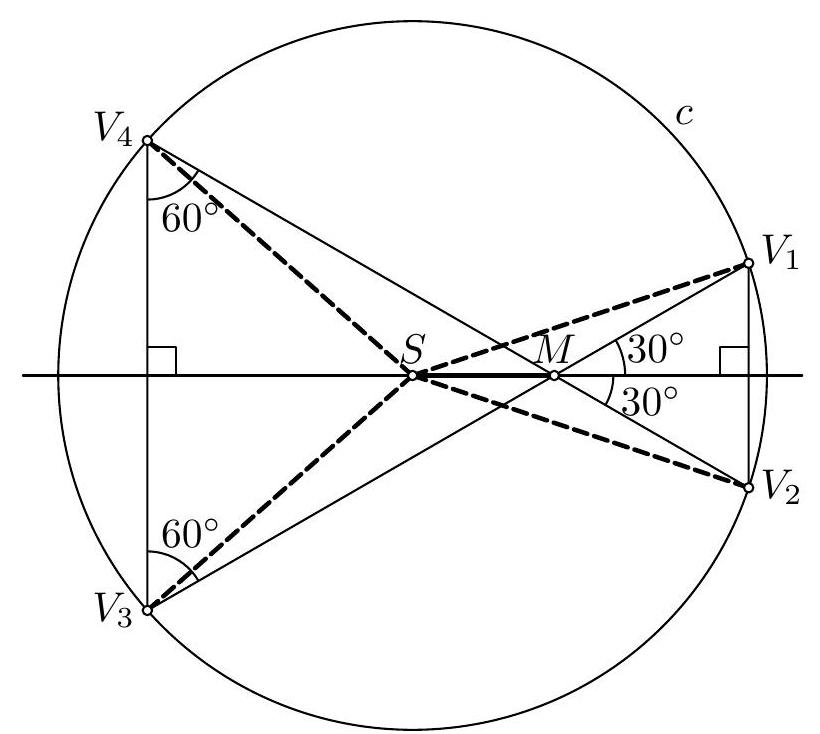
Fig. 2
Denote by $c$ the circumference of the watch, by $S$ its center, and by $M$ the tip of the hour hand (Fig. 2). Let us first explain why for each fixed $M$ there exist precisely two equilateral triangles $M X Y$ with vertices $X, Y$ lying on the circle $c$. Since the line $S M$ must be the axis of the chord $X Y$, hence, also the bisector of the angle $X M Y$, both lines $M X, M Y$ meet the line $S M$ at the same angle of $30^{\circ}$. Thus the triangle $M X Y$ coincides with one of the equilateral triangles $M V_{1} V_{2}, M V_{3} V_{4}$ shown on Fig. 2 .
The points $V_{i}$ divide the circle $c$ into four arcs. At points on the arc $V_{2} V_{3}$, the segment $V_{2} V_{3}$ subtends an angle of the same size as $\angle V_{2} V_{4} V_{3}$, i.e. $60^{\circ}$; similarly for the $\operatorname{arc} V_{4} V_{1}$. Thus
Consequently,
It follows that both angles $V_{1} S V_{2}$ and $V_{3} S V_{4}$ are smaller than $120^{\circ}$.
We may visualize the situation by thinking of the hour hand as being motionless and the minute hand rotating around the circle $S$ at the angular speed of $(360-30)^{\circ}=$ $330^{\circ}$ per hour. We have seen that the phenomenon we are interested in occurs precisely when the tip $V$ of the minute hand coincides with one of the four points $V_{i}$. Between two consecutive occurrences of the phenomenon, the minute hand thus advances by an angle of either $120^{\circ}$, or $\angle V_{1} S V_{2}$ or $\angle V_{3} S V_{4}$ which are both less than $120^{\circ}$ (and depend on the ratio $k$ ). The greatest possible period $t$ is thus independent of the ratio $k$ and equals $120 / 330$ hours.
- Find the greatest real number $p$ and the least real number $q$ for which the inequalities
hold in an arbitrary triangle $A B C$ with sides $a, b$ and medians $m_{a}, m_{b}$.
Solution. We show that the sought numbers are $p=1 / 4$ and $q=4$. It is enough to prove that $q=4$, since the other bound $p=1 / 4$ then follows by observing that interchanging the sides $a, b$ changes the value of the fraction to the reciprocal.
From the triangle inequality it follows that
We multiply the first inequality by two, the second one by three, and add these up:
It follows that every number $q \geqslant 4$ has the desired property; we thus only need to show that no number $q<4$ can have it. To that end, consider the isosceles triangle $A B C$ in which $a=c=1$ and $b \in(0,2)$ (such triangle exists for any $b$ in this interval). From the general formulas
we obtain $m_{a}=\frac{1}{2} \sqrt{1+2 b^{2}}$ and $m_{b}=\frac{1}{2} \sqrt{4-b^{2}}$, whence
The last fraction can be made arbitrarily close to 4 by choosing $b$ small enough. This can be seen as follows: if we choose any $\epsilon>0$, then for all sufficiently small positive $b$ we will have
so
and it is easy to choose $\epsilon>0$ so that the last fraction if greater than any given $q$ less than 4. It is enough take
Czech-Slovak-Polish Match
Zwardoń, June 23-24, 2008

- Determine all triples $(x, y, z)$ of positive numbers satisfying the system of equations
Solution. For any integer $k \geqslant 3$ and any $x \geqslant 0$ we have
To see this, observe that, by AM-GM inequality,
and add it to
Note that we have equality if and only if $x=1$.
Therefore, for $x, y, z$ satisfying the system of equations, we have
or
Now suppose $x \geqslant \max {y, z}$. Then from the second inequality of (1) we infer that $y \leqslant z$ and
which, by the first inequality in (1), implies $x=y=z$.
If $y \geqslant \max {x, z}$, then $z \leqslant x$ by the third inequality in (1) and
hence, by the second inequality in (1), $x=y=z$. ously,
Finally, if $z \geqslant \max {x, y}$, then $x \leqslant y$ by the first estimate in (1) and, as previ-
which again implies $x=y=z$. Thus we have equality in (0) and hence $x=y=z=1$. We easily check that this is the solution to the system.
- Given is a convex hexagon $A B C D E F$, such that $\angle A=\angle C=\angle E$ and $A B=B C$, $C D=D E, E F=F A$. Prove that the lines $A D, B E$ and $C F$ have a common point.
Solution. Assume that the angle bisectors of the angles $\angle B$ and $\angle D$ intersect at $P$ (Fig. 1). We shall prove that the hexagon $A B C D E F$ has an inscribed circle, whose center is $P$. Then the conclusion follows from Brianchon's Theorem.
The equality $A B=B C$ implies that the triangles $A B P$ and $C B P$ are congruent. Hence we have $\angle B A P=\angle B C P=x$. Similarly, triangles $C D P$ and $E D P$ are congruent, so we obtain $\angle D C P=\angle D E P=y$.

Fig. 1
Moreover, we have $A P=C P=E P$, which together with the equality $A F=E F$ implies that the triangles $A F P$ and $E F P$ are congruent. Thus the angle bisector of the angle $\angle F$ passes through the point $P$ and $\angle F A P=\angle F E P=z$.
Now the equalities $\angle A=\angle C=\angle E$ are equivalent to $z+x=x+y=y+z$, which yields $x=y=z$. Therefore the angle bisectors of the angles $\angle A, \angle C$ and $\angle E$ all pass through the point $P$. Thus $P$ is the center of the inscribed circle of the hexagon $A B C D E F$, as claimed.
- Determine all prime numbers $p$, such that the number
is divisible by $p^{3}$.
Solution. We start from the observation that for $k=1,2, \ldots, p$ we have
To see this, note that
hence, multyplying,
and (1) follows. This can be written in an equivalent form
which implies that
for some integer $a_{k}$. Therefore, if $p$ satisfies the given conditions, we have
or $p \mid \sum_{k=1}^{p-1} 1 / k^{2}$, where by $1 / m$ we understand the unique integer $1 \leqslant l \leqslant p-1$ satisfying $m l \equiv 1(\bmod p)$. Now observe that $1 / k^{2} \equiv(1 / k)^{2}(\bmod p)$ and
which is divisible by $p$ if and only if $p \geqslant 5$.
- Prove that there exists a positive integer n, such that for all integers $k$ the number $k^{2}+k+n$ has no prime divisors less than 2008.
Solution. Let $p<2008$ be a fixed prime number. There exists $r=r(p)$ such that $k^{2}+k \not \equiv r(\bmod p)$ for any integer $k$; this follows, for example, from the fact that if $k \equiv 0$ or $k \equiv p-1(\bmod p)$, then $k^{2}+k \equiv 0(\bmod p)$.
Now if $\left{p_{1}, p_{2}, \ldots, p_{m}\right}$ is the set of all prime numbers not exceeding 2008, we take $n$ satisfying
which exists due to Chinese Remainder Theorem. This number has the desired property.
- Given is a regular pentagon $A B C D E$. Determine the least value of the expression
where $P$ is an arbitrary point lying in the plane of the pentagon $A B C D E$.
Solution. Without loss of generality assume that the given pentagon $A B C D E$ has the side equal to 1 . Then the length of its diagonal is equal to
Set $a=P A, b=P B, c=P C, d=P D, e=P E$ (Fig. 2).
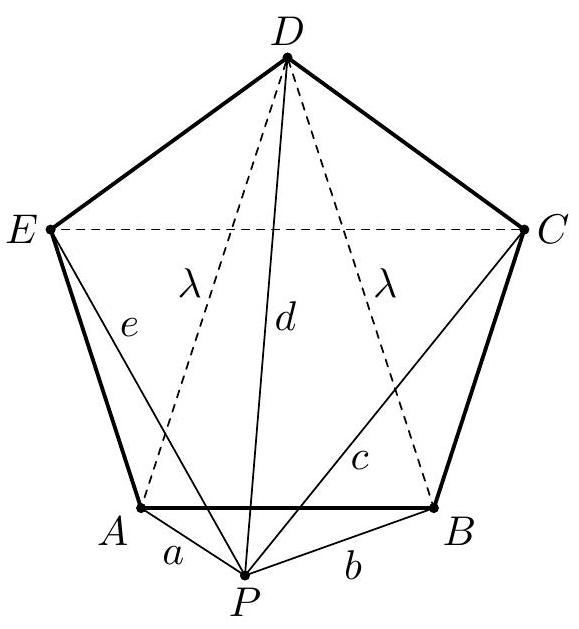
Fig. 2
Applying the Ptolemy inequality for the (not necessarily convex) quadrilaterals $A P D E, B P D C$ and $P C D E$ we obtain (respectively)
We multiply the third inequality by $\frac{\lambda+2}{\lambda+1}$ and add together with the first and the second inequalities. As a result we obtain
Grouping the respective terms, the above inequality reduces to
Therefore
The equality holds if and only if the convex quadrilaterals $A P D E, B P D C$ and $P C D E$ are cyclic. This condition is satisfied if and only if the point $P$ lies on the minor arc $A B$ of the circumcircle of the pentagon $A B C D E$ (Fig. 3). Therefore the smallest possible value of the given expression is $\sqrt{5}-2$.
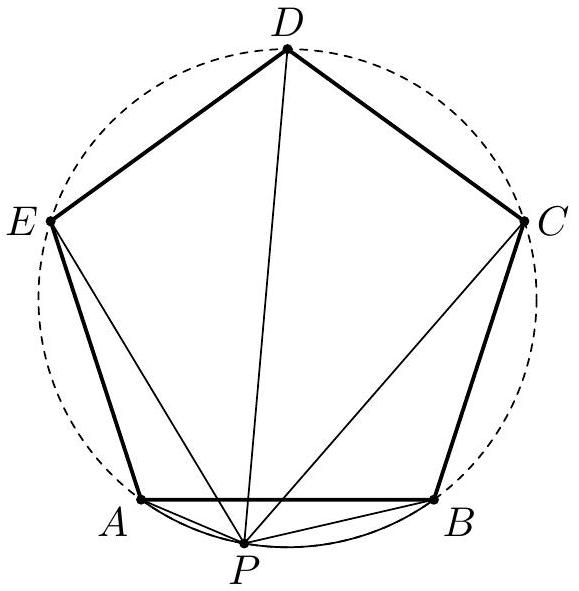
Fig. 3
- Find all triples $(k, m, n)$ of positive integers with the following property: The square with the side length $m$ can be cut into some number of rectangles of dimensions $1 \times k$ and exactly one square of the side length $n$.
Solution. Answer: The triples $(k, m, n)$ must satisfy $n \leqslant m$ and at least one of the two conditions:
$1^{\circ} k \mid m-n$,
$2^{\circ} k \mid m+n$ and $r+n \leqslant m$, where $r$ is the remainder of $m$ modulo $k$.
We start from proving that if $(k, m, n)$ are as above, then the cut is possible. We identify the large square with $[0, m] \times[0, m]$. If $k \mid m-n$, then we first cut the $m \times m$ square into the square $[0, n] \times[0, n]$ and rectangles $[0, n] \times[n, m]$ and $[n, m] \times[0, m]$. These rectangles can trivially be cut into rectangles of dimension $1 \times k$. If $k \mid m+n$ and $r+n \leqslant m$, then we cut $[0, m] \times[0, m]$ into a square $[r, r+n] \times[r, r+n]$ and rectangles $[0, r] \times[0, n+r],[r, m] \times[0, r],[r+n, m] \times[r, m]$ and $[0, n+r] \times[r+n, m]$ (they are well defined if $r+n \leqslant m$ ), each of which can be trivially cut into rectangles $1 \times k$. Note that we have used the assumption $r+n \leqslant m$ here.
Now we show that the conditions on $(k, m, n)$ are necessary. Suppose the smaller square is equal to $[p, p+n] \times[q, q+n]$; by symmetry we may assume that $q \geqslant 1$.
First we show that $r+n \leqslant m$. Each unit square $[i, i+1] \times[0,1]$, where $i \in$ ${p, p+1, \ldots, p+n-1}$, is contained in some rectangle $1 \times k$ coming from the cut. If we had $r+n>m$, then we would have $m-n<k$ and this would imply that each such rectangle would be "level", i.e., of the form $[t, t+k] \times[0,1]$. Let $S$ denote the union of these "level" rectangles and let $P(S)$ denote the area of $S$. Note that we have $n \leqslant P(S) \leqslant m$ and $P(S)$ is divisible by $k$. This contradicts $r+n>m$.
Now we show that $k \mid m-n$ or $k \mid m+n$. Suppose that this is not true. The idea is to write an integer $a_{i j}$ in each unit square $[i-1, i] \times[j-1, j], 1 \leqslant i, j \leqslant m$, in such a way that
(a) for any rectangle $1 \times k$ of the cut the sum of numbers lying inside equals 0 ,
(b) the sum of all the numbers and the sum of the numbers lying inside the square $n \times n$ are different.
The existence of such a sequence clearly yields the claim.
A second idea is to work with the sequences $\left(a_{i j}\right)$ of the form $a_{i j}=a_{i} b_{j}$, where $\left(a_{i}\right){i=1}^{m}$ and $\left(b{j}\right)_{j=1}^{m}$ are $k$-periodic and
This implies (a); furthermore, (b) takes form
or, by periodicity and (1),
where $s$ denotes the remainder coming from the division of $n$ by $k$.
If $r=0$, then the left-hand side is 0 . Furthermore, as $k \nmid m-n$, we have $s>0$; it suffices to take $a_{p+1}=a_{p+2}=\ldots=a_{p+s}=b_{q+1}=b_{q+2}=\ldots=b_{q+s}=1$ and choose the remaining $a_{i}$ 's and $b_{j}$ 's so that the periodicity and (1) hold.
Suppose then, that $r>0$. The conditions $k \nmid m-n, k \nmid m+n$ imply $r \neq s$, $r+s \neq k$. We set $b_{1}=b_{2}=\ldots=b_{r}=1$ and pick the remaining $b_{j}$ 's so that periodicity and (1) hold. Let $A={1,2, \ldots, r}, B={p+1, p+2, \ldots, p+s}(\bmod k)$ denote the sets of indices appearing in the sums involving $\left(a_{j}\right)$. Note that we take the set $B$ modulo $k$. Consider two cases: i) $A \cup B \neq{0,1, \ldots, k-1}$. Then, as $A \neq B$ (as $r \neq s$ ) and $A \neq \emptyset$, we may choose $a_{i}^{\prime} s$ with $i \in A \cup B$ in such a way that
(for example, if $A \backslash B \neq \emptyset$, set $a_{i}=0$ for all $i \in A \cup B$ except for one $i \in A \backslash B$, for which $a_{i}=1$; if $A \subset B$, take $a_{i}=0$ for $i \in A \cup B$ except for one $i \in A$, for which $a_{i}=1$ and except for one $j \in B \backslash A$, for which $a_{j}=-1$ ) and complete the sequence $\left(a_{i}\right)$ so that it satisfies periodicity and (1). This completion is possible as there exists $i \in{0,1, \ldots, k-1}$ not covered by $A \cup B$. Then the right-hand side of (2) is 0 , while the left one is not.
ii) $A \cup B={0,1, \ldots, k-1}$. Then $A \nsubseteq B$ and $B \nsubseteq A$; furthermore, as $r+s \neq k$, we have $A \cap B \neq \emptyset$. Therefore, there exist $i_{1} \in A \backslash B, i_{2} \in B \backslash A, i_{3} \in A \cap B$ and we set $a_{i_{1}}=0, a_{i_{2}}=-1, a_{i_{3}}=1$ and $a_{i}=0$ for $i \in{0,1,2, \ldots, k-1} \backslash\left{i_{1}, i_{2}, i_{3}\right}$. Then we have
and hence the right-hand side of (2) is 0 , while the left one is not.
The proof is complete.
[^0]: 1 Note that in view of the mutual position of the points $M, A, B$, the point $M$ lies in the exterior of any circle passing through the points $A, B$, hence also in the exterior of $m$. The half-line $M O$ thus indeed has, if it is not tangent to $m$, exactly two different common points with $m$.
2 Similarly one can prove the following useful fact: for any polynomial $F$ with integer coefficients, and arbitrary integers $a, b$, the difference $F(a)-F(b)$ is an integer multiple of $a-b$.