


2018
67th Czech and Slovak
Mathematical Olympiad
Translated into English by Josef Tkadlec
First Round of the 67th Czech and Slovak Mathematical Olympiad Problems for the take-home part (October 2017)
$\mathbb{N} / / 10$1. Paul is filling the cells of a rectangular table alternately with crosses and circles (he starts with a cross). When the table is filled in completely, he determines his score as $O-X$ where $O$ is the total number of rows and columns containing more circles than crosses and $X$ is the total number of rows and columns containing more crosses than circles.
a) Prove that for a $2 \times n$ table, the score is always equal to 0 .
b) In terms of $n$, what is the largest possible score Paul can achieve for a $(2 n+1) \times(2 n+1)$ table?
(Josef Tkadlec)
Solution. a) Consider a table with 2 rows and $n$ columns filled in with $n$ crosses and $n$ circles. Since the total number of crosses and circles is the same, crosses dominate in one row if and only if circles dominate in the other one. Hence the rows contribute 0 to the total score.
Next, denote by $x, e$, and $o$ the number of columns containing two, one, and zero crosses, respectively. Since the table contains a total of $n$ crosses and $n$ circles, we have $2 x+e=n=e+2 o$, hence $x=o$. As $x$ and $o$ are the number of columns dominated by crosses and circles, respectively, the columns contribute 0 to the total score too.
b) Consider a $(2 n+1) \times(2 n+1)$ table filled with $\frac{1}{2}\left((2 n+1)^{2}-1\right)=2 n(n+1)$ circles and $2 n(n+1)+1$ crosses. Since $2 n+1$ is odd, each row and column is dominated by one of the two symbols. Circles can dominate in at most $2 n(n+1) /(n+1)=2 n$ rows and thus at least one row is dominated by crosses. Likewise for columns, hence $O \leqslant 2 n+2 n=4 n, X \geqslant 1+1=2$ and therefore $O-X \leqslant 4 n-2$.
Finally, we argue that the score $4 n-2$ can be achieved for any $n$. It suffices to specify a set $\mathcal{S}$ of $2 n(n+1)$ cells that are to be filled with circles. An example is a set $\mathcal{S}$ that consists of $n+1$ "parallel diagonals" in the top-left $2 n \times 2 n$ subsquare of the table and no other cells in the bottom row or right column (see Fig. 1 for $n=3$ ).
- Let $a, b$ be real numbers such that $a+b>2$. Prove that the system of inequalities
has infinitely many real solutions $x$.
(Jaromír Šimša)
Solution. We rewrite the system as
| 0 | $\times$ | $\times$ | 0 | 0 | 0 | $\times$ |
|---|---|---|---|---|---|---|
| 0 | 0 | $\times$ | $\times$ | 0 | 0 | $\times$ |
| 0 | 0 | 0 | $\times$ | $\times$ | 0 | $\times$ |
| 0 | 0 | 0 | 0 | $\times$ | $\times$ | $\times$ |
| $\times$ | 0 | 0 | 0 | 0 | $\times$ | $\times$ |
| $\times$ | $\times$ | 0 | 0 | 0 | 0 | $\times$ |
| $\times$ | $\times$ | $\times$ | $\times$ | $\times$ | $\times$ | $\times$ |
Fig. 1
where $F(x)=x^{2}-(a-1) x-b$ and $G(x)=x^{2}-a x-b+1$. Observe that $F(x)-G(x)=$ $x-1$.
The condition $a+b>2$ implies that
hence $x=1$ is not a solution. However, $G(1)<0$ implies that the quadratic equation $G(x)=0$ has a root $x_{0}>1$. Then
From $F(1)<0$ and $F\left(x_{0}\right)>0$ we deduce that there exists a root $x_{1}$ of $F(x)=0$ that belongs to the open interval $\left(1, x_{0}\right)$. Since
any $x \in\left(x_{1}, x_{0}\right)$ is a solution to the original system.
- Two externally tangent unit circles are given in the plane. Consider any rectangle (or a square) containing both the circles such that each side of the rectangle is tangent to at least one circle. Find the largest and the smallest possible area of such a rectangle.
(Jaroslav Švrček)
Solution. Denote the circles by $k_{1}, k_{2}$, their radius by $r=1$, and their centers by $O_{1}, O_{2}$, respectively. Let $A B C D$ be one such rectangle (or a square) and without loss of generality assume that the sides $A B, B C$ are tangent to $k_{1}$ while the sides $C D$, $D A$ are tangent to $k_{2}$. Let $P$ be the intersection of a line through $O_{1}$ parallel to $A B$ and a line through $O_{2}$ parallel to $B C$. Finally, let $\phi=\angle P O_{1} O_{2}\left(\phi \in\left[0, \frac{1}{4} \pi\right]\right.$, Fig. 2).
Then
It remains to analyze the expression $V(\phi)=(1+\sin \phi)(1+\cos \phi)$ for $\phi \in\left[0, \frac{1}{4} \pi\right]$. Multiplying out, this rewrites as

Fig. 2
and it remains to analyze $u=\sin \phi+\cos \phi$. Squaring and using the formula $\sin 2 \phi=$ $2 \sin \phi \cos \phi$, we obtain $1 \leqslant u \leqslant \sqrt{2}$. Since the function $V(\phi)=\frac{1}{2}+u+\frac{1}{2} u^{2}$ is increasing on interval $[1, \sqrt{2}]$, we get $2 \leqslant \phi \leqslant \frac{3}{2}+\sqrt{2}$ and finally
The first inequality is sharp for $\phi=0$, that is if both $A B$ and $C D$ are tangent to both the circles. The second inequality is sharp for $\phi=\frac{1}{4} \pi$, that is if $A B C D$ is a square.
- Find the largest positive integer $n$ such that
is a prime $(\lfloor x\rfloor$ denotes the largest integer not exceeding $x)$.
(Patrik Bak)
Solution. Consider the infinite sequence $\left{a_{n}\right}{n=1}^{\infty}$ defined by $a{n}=\lfloor\sqrt{n}\rfloor$. This sequence is clearly non-decreasing and since
it contains every integer $k$ precisely $(2 k+1)$-times. This allows us to express the value of the sum $s_{n}=\sum_{i=1}^{n} a_{i}$ as follows: Let $k=\lfloor\sqrt{n}\rfloor$, that is $n=k^{2}+l$ for some $l \in{0,1, \ldots, 2 k}$. Then
where we used $1+2+\cdots+n=\frac{1}{2} n(n+1)$ and $1^{2}+2^{2}+\cdots+n^{2}=\frac{1}{6} n(n+1)(2 n+1)$.
If $k>6$ then the fraction $\frac{1}{6}(k-1) k(4 k+1)$ is an integer sharing a prime factor with $k$, hence the whole right-hand side is sharing a prime factor with $k<s_{n}$ and $s_{n}$ is not a prime.
If $k \leqslant 6$ then $n<(6+1)^{2}=49$. Plugging $n=48$ into the right-hand side we get $s_{48}=203=7 \cdot 29$. For $n=47$ we get $s_{47}=197$, which is a prime. The answer is $n=47$.
- Let $A B C D$ be a convex quadrilateral such that $\angle A B C=\angle A C D$ and $\angle A C B=$ $\angle A D C$. Suppose that the circumcenter $O$ of triangle $B C D$ is different from $A$. Prove that the angle $O A C$ is right.
(Patrik Bak)
Solution. Since $\angle A B C+\angle C D A<180^{\circ}$, point $A$ lies inside the circumcircle $\omega$ of triangle $B C D$. Denote by $C^{\prime}, D^{\prime}$ the second intersection of $\omega$ with rays $C A, D A$, respectively (Fig. 3). We angle chase:
Hence $B C C^{\prime} D^{\prime}$ is an isosceles trapezoid. Moreover, since $\angle C^{\prime} A D^{\prime}=\angle C A D=$ $\angle B A C$, triangles $A B C$ and $A D^{\prime} C^{\prime}$ are similar by $\mathrm{AA}$ and in fact due to $B C=C^{\prime} D^{\prime}$ they are congruent. Point $A$ is thus the midpoint of the chord $C C^{\prime}$ and $\angle O A C=90^{\circ}$ follows.

Fig. 3
Another solution. Let's frame the figure with respect to triangle $A B D$. Then $A C$ is the $A$-angle bisector. The Inscribed angle theorem states that the (reflex) angle $B O D$ is twice the (convex) angle $B C D$, hence for the size of the convex angle $B O D$ we get
Therefore $O$ lies on the arc $B A D$ of the circumcircle of triangle $A B D$. Since $O B=$ $O D$, point $O$ is the midpoint of that arc and thus it lies on the external $A$-angle bisector which is perpendicular to the $A$-angle bisector.

Fig. 4
- Find the largest possible size of a set $\mathbb{M}$ of integers with the following property: Among any three distinct numbers from $\mathbb{M}$, there exist two numbers whose sum is a power of 2 with non-negative integer exponent.
(Ján Mazák)
Solution. The set ${-1,3,5,-2,6,10}$ attests that $\mathbb{M}$ can have 6 elements: The sum of any two numbers from the triplet $(-1,3,5)$ is a power of two and the same is true for triplet $(-2,6,10)$. For the sake of contradiction, assume that some set $\mathbb{M}$ has more than 6 elements.
Clearly, $\mathbb{M}$ can't contain three (or more) non-positive numbers. Hence it contains at least five positive numbers. Denote by $x$ the largest positive number in $\mathbb{M}$ and by $a, b, c, d$ some four other positive numbers in $\mathbb{M}$. Consider pairs $x+a, x+b, x+c$, $x+d$. They are all larger than $x$ and less than $2 x$. The open interval $(x, 2 x)$ contains at most one power of two, hence at least three of the four sums are not a power of two. Without loss of generality, assume those are $x+a, x+b, x+c$. Considering the triplets $(a, b, x),(a, c, x),(b, c, x)$ we infer that all $a+b, a+c, b+c$ are powers of two. However, this is impossible. Without loss of generality, let $a=\max {a, b, c}$. Then $a+b$ and $a+c$ both lie in $(a, 2 a)$, hence at least one of them is not a power of two, a contradiction.
First Round of the 67th Czech and Slovak Mathematical Olympiad (December 12th, 2017) $\mathbb{N} / /(10)$
- Find all real numbers $p$ such that the system
of inequalities has at least one solution $x \in \mathbb{R}$.
Solution. If $p \leqslant 0$ then $x=0$ is clearly a solution. If $p>0$ then summing up we get $2 x^{2}+2 p \leqslant 0$ which doesn't hold for any real $x$.
Answer. The answer is $p \in(-\infty, 0]$.
Another solution. The graphs of functions $f(x)=x^{2}+u x+v$ and $g(x)=x^{2}-u x+v$ are symmetric about the $y$ axis, hence the solutions to the inequalities $f(x) \leqslant 0$, $g(x) \leqslant 0$ are two (possibly degenerate) intervals symmetric about 0 . The intersection of these intervals is nonempty if and only if $v=f(0)=g(0) \leqslant 0$. In our case, this happens if and only if $p \leqslant 0$.
- Let $A B C$ be a triangle and $S_{b}, S_{c}$ the midpoints of the sides $A C, A B$, respectively. Prove that if $A B<A C$ then $\angle B S_{c} C<\angle B S_{b} C$.
(Patrik Bak)
Solution. It suffices to prove that if $A B<A C$ then $S_{b}$ lies inside the circumcircle $k$ of triangle $B S_{c} C$.
The midline $S_{b} S_{c}$ is parallel to $B C$ (Fig. 1). Let line $S_{b} S_{c}$ intersect $k$ for the second time at $P$. We will show that $S_{b}$ lies on the segment $S_{c} P$ (as opposed to lying on the ray opposite to $P S_{c}$ ). To that end, it suffices to prove $\angle B C A<\angle B C P$. By symmetry about the perpendicular bisector of $B C$ we have $\angle B C P=\angle C B A$, so we need to prove $\angle B C A<\angle C B A$ which is in fact clearly equivalent to the given $A B<A C$.

Fig. 1

Fig. 2
Another solution. By power of $A$ with respect to $k$, there exists a point $Q$ on the ray $A C$ such that $A Q \cdot A C=A B \cdot A S_{c}=\frac{1}{2} A B^{2}$. Then (Fig. 2)
hence $Q$ lies on segment $A S_{b}$. As before we conclude that $S_{b}$ lies inside the circumcircle of triangle $B S_{c} C$.
- Paul is filling the cells of a rectangular table alternately with crosses and circles (he starts with a cross). When the table is filled in completely, he determines his score as $X+O$ where $X$ is the number of rows containing more crosses than than circles and $O$ is the number of columns containing more circles than crosses. In terms of $n$, what is the largest possible score Paul can achieve for a $(2 n+1) \times(2 n+1)$ table?
(Josef Tkadlec)
Solution. In total there are $2 n(n+1)+1<(2 n+1)(n+1)$ crosses and $2 n(n+1)$ circles. Hence the crosses can dominate in at most $2 n$ rows and, similarly, circles can dominate in at most $2 n$ columns for the total score $2 n+2 n=4 n$.
Such a score can be achieved if, for example, Paul draws crosses in the left $n+1$ columns of the first $n$ rows, the right $n+1$ columns of the last $n$ rows and the middle cell of the middle row. That is precisely $2 n(n+1)+1$ crosses and we easily check that crosses dominate in all rows except for the middle one while circles dominate in all columns except for the middle one.

Fig. 3
Second Round of the 67th Czech and Slovak Mathematical Olympiad (January 16th, 2018)
$\mathbb{N} / /(2)$
- Paul is filling the cells of a rectangular table alternately with crosses and circles (he starts with a cross). When the table is filled in completely, he determines his score as $X-O$ where $X$ is the sum of squares of the numbers of crosses in all the rows and columns, and $O$ is the sum of squares of the numbers of circles in all the rows and columns. Find all possible values of the score for a $67 \times 67$ table.
(Josef Tkadlec)
Solution. Let $n=67$ and denote by $k=\frac{1}{2}\left(n^{2}+1\right)$ the total number of crosses in the table. A row containing $a$ crosses and $n-a$ circles contributes $a^{2}-(n-a)^{2}=2 n \cdot a-n^{2}$ to the total score and thus all the $n$ rows combined contribute
to the total score. Likewise, columns contribute $n$. Hence the total score is always equal to $2 n=134$.
Another solution. Consider an $n \times n$ table filled with arbitrarily many crosses and circles. We show that replacing any circle by a cross increases the score by $4 n$. Since the score for a table filled with all circles equals $-2 n^{3}$ and Paul's table contains $\frac{1}{2}\left(n^{2}+1\right)$ crosses, the final score will always be equal to $-2 n^{3}+4 n \cdot \frac{1}{2}\left(n^{2}+1\right)=2 n$.
Consider any cell containing a circle and denote by $r$ and $c$ the number of crosses in its row and column, respectively. The contribution of this row and column changes from
to
and the contribution of other rows and columns doesn't change. Since $B-A=4 n$, we are done.
- Let $k$ be a semicircle with diameter $P Q$. Consider a chord $B C$ of fixed length $d$ whose endpoints are distinct from $P, Q$. A ray of light emanating from $B$ reaches point $C$ after reflecting from $P Q$ at such a point $A$ that $\angle P A B=\angle Q A C$. Prove that $\angle B A C$ doesn't depend on the position of the chord $B C$ on $k$.
(Šárka Gergelitsová)
Solution. Reflect $k$ and $C$ about $P Q$ to get $l$ and $C^{\prime}$, respectively (Fig. 1). Then $C^{\prime}$ lies on $l$ and since $\angle Q A C^{\prime}=\angle Q A C=\angle P A B$ it also lies on $B A$. Triangle $C^{\prime} C A$ is isosceles, hence
The chord $B C$ of circle $k \cup l$ has a fixed length, hence the corresponding inscribed angle $B C^{\prime} C$ has fixed size and we may conclude.

Fig. 1

Fig. 2
Another solution. Let $O$ be the midpoint of $P Q$. We will show that $O$ lies on the circumcircle of triangle $A B C$ (Fig. 2). This will imply that $\angle B A C=\angle B O C$ which is clearly fixed.
Observe that $O$ lies on the perpendicular bisector of $B C$. Moreover, if $O \neq A$ then $A O$ is the external $A$-angle bisector with respect to triangle $A B C$. Therefore $O$ is the midpoint of $\operatorname{arc} B A C$.
- Let $a \neq b$ be positive real numbers. Consider the equation
where $\lfloor y\rfloor$ denotes the largest integer not exceeding $y$. Prove that the set of real solutions $x$ to this equation contains an interval of length at least
(Patrik Bak)
Solution. Consider linear functions $f(x)=a x+b, g(x)=b x+a$. Since $a, b$ are distinct and positive, their graphs are two distinct lines with positive slope. As $f(1)=g(1)=a+b$, point $P=[1, a+b]$ is the intersection of these lines (Fig. 3).
Without loss of generality, assume $b>a$ (i.e. the line determined by $g$ is the "steeper" one). Then $f(x)>g(x)$ for $x<1$, whereas $f(x)<g(x)$ for $x>1$ : indeed,

Fig. 3
Let $t=\lfloor a+b\rfloor$ and consider $x_{1} \leqslant 1<x_{2}$ such that $g\left(x_{1}\right)=t$ and $g\left(x_{2}\right)=t+1$ (that is, $x_{1}=\frac{t-a}{b}$ and $\left.x_{2}=\frac{t+1-a}{b}\right)$. We claim that the interval $\left[x_{1}, x_{2}\right)$ has all the desired properties.
First, for any $x \in\left[x_{1}, x_{2}\right)$ we have
and thus $x$ is a solution to the equation.
Second,
and thus $x_{2}-x_{1}=1 / b=1 / \max {a, b}$ and the interval has the desired length.
- Do there exist positive integers $n, k$ such that
is a square of an integer?
(Ján Mazák)
Solution. Such numbers don't exist. For the sake of contradiction, assume that there exist positive integers $n, k, a$ such that
which rewrites as
From $\operatorname{GCD}\left(a^{2}, a^{2}+1\right)=1$ we deduce $a^{2}+1 \mid 11^{k}$ and hence $a^{2}+1=11^{t}$ for $1 \leqslant t \leqslant k$. In particular, $a^{2} \equiv 10(\bmod 11)$. However, this is impossible as the squares of integers give remainders $0,1,4,9,5,3,3,5,9,4,1, \ldots$ upon division by 11 .
Final Round of the 67th Czech and Slovak Mathematical Olympiad
(March 18-21, 2018)

- In a certain club, some pairs of members are friends. Given $k \geqslant 3$, we say that a club is $k$-good if every group of $k$ members can be seated around a round table such that every two neighbors are friends. Prove that if a club is 6-good then it is 7-good.
(Josef Tkadlec)
Solution. Consider a 6 -good club and denote some seven of its members by $A, \ldots, G$. It suffices to show that $A, \ldots, G$ can be seated around a table as required. Consider only friendships among $A, \ldots, G$. First, we show that every member has at least three friends.
Without loss of generality consider $G$. By assumption, $B, \ldots, G$ can be seated as required, hence $G$ has at least two friends. Without loss of generality, $F$ is one of them. By assumption, $A, \ldots, E, G$ (omitting $F$ ) can be seated as required, hence $G$ has at least two more friends apart from $F$ for a total of at least three friends.
Since every member has at least three friends, there exists a member with at least four friends (otherwise the number of friendly pairs equals $\frac{1}{2} \cdot 7 \cdot 3$, which is clearly impossible). Without loss of generality, assume $G$ has at least four friends.
By assumption, $A, \ldots, F$ can be seated as required. In such a seating, some two of the four friends of $G$ are neighbors and we can seat $G$ in between them.
Remark. The statement "If a club is $k$-good then it is $(k+1)$-good" holds precisely for $k \in{3,4,5,6,7,8,10,11,13,16}$. The counterexamples are called hypohamiltonian graphs. For $k=9$, one such example is the Petersen graph (Fig. 1).

Fig. 1
- Let $x, y, z$ be real numbers such that
are side-lengths of a (non-degenerate) triangle. Find all possible values of $x y+$ $y z+z x$.
(Michal Rolínek)
Solution. If $x=y=z=t>0$ then the three fractions are sides of an equilateral triangle and $x y+y z+z x=3 t^{2}$, hence $x y+y z+z x$ can attain all positive values. Similarly, for $x=y=t>0$ and $z=-2 t$ the three fractions are $\frac{1}{3} t^{-2}, \frac{1}{3} t^{-2}, \frac{1}{6} t^{-2}$ which are positive numbers that are side-lengths of an isosceles triangle $\left(\frac{1}{6}<\frac{1}{3}+\frac{1}{3}\right)$. Since $x y+y z+z x=-3 t^{2}$, any negative value can be attained too.
Next we show that $x y+y z+z x$ can't be 0 . Assume otherwise. Numbers $x, y$, $z$ are mutually distinct: if, say, $x$ and $y$ were equal then the denominator of the first fractions would be equal to $\left|x^{2}+2 y z\right|=|x y+(y z+x z)|=0$ which is impossible.
Let's look at the fractions without absolute values. Subtracting $x y+y z+z x=0$ from each denominator we get
This implies that among the original fractions (with absolute values), one of them is a sum of the other two. Hence the fractions don't fulfil triangle inequality and we reached the desired contradiction.
Answer. Possible values are all real numbers except for 0 .
- Let $A B C$ be a triangle. The $A$-angle bisector intersects $B C$ at $D$. Let $E, F$ be the circumcenters of triangles $A B D, A C D$, respectively. Given that the circumcenter of triangle $A E F$ lies on $B C$, find all possible values of $\angle B A C$. (Patrik Bak)
Solution. Let $O$ be the circumcenter of triangle $A E F$ and denote $\alpha=\angle B A C$. Since $\angle B A D$ and $\angle C A D$ are acute (Fig. 2), points $E, F$ lie in the half-plane $B C A$ and the Inscribed angle theorem yields
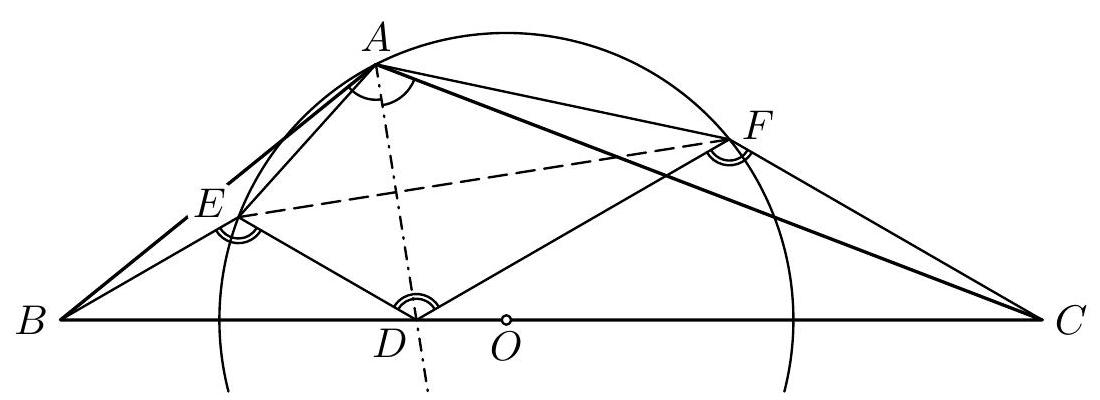
Fig. 2
The isosceles triangles $B E D$ and $D F C$ are thus similar and we easily compute that $\angle E D F=\alpha$ and that $B C$ is the external $D$-angle bisector in triangle $D E F$.
Point $O$ lies on $B C$ and on the perpendicular bisector of $E F$. Framed with respect to triangle $D E F$, it lies on the external $D$-angle bisector and on the perpendicular bisector of the opposite side $E F$. Thus it is the midpoint of $\operatorname{arc} E D F$ and $\angle E O F=$ $\angle E D F=\alpha$.
Quadrilateral $A E D F$ is a kite, hence $\angle E A F=\alpha$. Moreover, line $E F$ separates points $A$ and $O$, thus the Inscribed angle theorem implies that the size of the reflex angle $E O F$ is twice the size of the convex angle $E A F$. This yields $360^{\circ}-\alpha=2 \cdot \alpha$ and $\alpha=120^{\circ}$.
Answer. The only possible value is $\angle B A C=120^{\circ}$.
- Consider positive integers $a, b, c$ that are side-lengths of a non-degenerate triangle and such that $\operatorname{GCD}(a, b, c)=1$ and the fractions
are all integers. Prove that the product of the denominators of the three fractions is either a square or twice a square of an integer.
(Jaromír Šimša)
Solution. Let $z=a+b-c, x=b+c-a, y=c+a-b$ be the (positive) denominators. Then $a=(y+z) / 2, b=(x+z) / 2, c=(x+y) / 2$ and
hence $z \mid x y$ and likewise $y \mid x z$ and $x \mid y z$.
For a prime $p$, let $i_{p}$ be the largest exponent such that $p^{i_{p}} \mid x y z$. It suffices to show that for all odd primes $p$ the corresponding $i_{p}$ is even. If $i_{2}$ is also even then $x y z$ is a square. Otherwise, it is twice a square.
Fix odd prime $p$ and consider the largest exponents $\alpha, \beta, \gamma$ such that $p^{\alpha} \mid x$, $p^{\beta}\left|y, p^{\gamma}\right| z$. Without loss of generality, assume $\min {\alpha, \beta, \gamma}=\gamma$. If $\gamma>0$ then $p$ divides each of $x, y, z$ and thus it divides each of $a, b, c$ ( $p$ is odd), contradicting $\operatorname{GCD}(a, b, c)=1$. Therefore $\gamma=0$.
From $x \mid y z$ we infer $\alpha \leqslant \beta$. Likewise, from $y \mid x z$ we infer $\beta \leqslant \alpha$. Hence $\beta=\alpha$ and $i_{p}=\alpha+\beta+\gamma=2 \alpha$ is an even number as desired.
- Let $A B C D$ be an isosceles trapezoid with longer base $A B$. Let $I$ be the incenter of triangle $A B C$ and $J$ the $C$-excenter of triangle $A C D$. Prove that $I J$ and $A B$ are parallel.
(Patrik Bak)
Solution. Let $K$ be the incenter of triangle $A B D$. Since $I K | A B$, it suffices to show $J K | A B$. Let $\angle A B D=\angle A C D=\phi$. Then $\angle A K D=90^{\circ}+\frac{1}{2} \phi$ and $\angle D J A=$ $90^{\circ}-\frac{1}{2} \phi$, implying that the quadrilateral $A K D J$ is cyclic (Fig. 3).

Fig. 3
As $A K, D J$ are bisectors of alternate interior angles, they are parallel. Together with the cyclic quadrilateral we obtain $\angle A K J=\angle A D J=\angle D A K=\angle K A B$ which concludes the proof.
- Find the smallest positive integer $n$ such that for any coloring of numbers 1,2 , $3, \ldots, n$ by three colors there exist two numbers with the same color whose difference is a square of an integer. (Vojtech Bálint, Michal Rolínek, Josef Tkadlec)
Solution. The answer is $n=29$.
First, for the sake of contradiction, assume that numbers $1,2, \ldots, 29$ can be colored by colors $A, B, C$ such that no two numbers with the same color differ by a square. Let $f(i)$ be the color of number $i$ for $i \in{1,2, \ldots, 29}$.
Since 9, 16, and 25 are squares, numbers 1, 10, 26 are all assigned distinct colors. The same is true for numbers $1,17,26$, hence 10 and 17 are assigned the same color. Likewise we get $f(11)=f(18), f(12)=f(19)$ a $f(13)=f(20)$ (for the last equality we look at numbers $4,13,20,29)$.
Without loss of generality, assume $f(10)=f(17)=A$. As $11=10+1^{2}$, we have $f(11) \neq f(10)$. Without loss of generality, let $f(11)=f(18)=B$. Now $19=18+1^{2}=10+3^{2}$, hence $f(12)=f(19)=C$. Similarly, $20=19+1^{2}=11+3^{2}$ implies $f(13)=f(20)=A$. We have derived $f(13)=A=f(17)$, a contradiction.
On the other hand, if $n \leqslant 28$, we may color the numbers as below. It's easy to check that no two numbers with the same color differ by a square of an integer.
| $B$ | $C$ | $A$ | $C$ | |
| $A$ | ${ }^{6} B$ | $C$ | $B$ | ${ }^{9} C$ |
| 10 | 11 | 12 | 13 | 14 |
| $A$ | $B$ | $C$ | $B$ | $C$ |
| 15 | $16{ }_{D}$ | 17 | 19 | |
| $A$ | $B$ | $A$ | $B$ | $C$ |
| ${ }^{20} A$ | ${ }^{21} B$ | ${ }^{22} A$ | ${ }^{23} B$ | ${ }^{24} C$ |
| ${ }^{25} A$ | ${ }^{26} C$ | ${ }^{27} A$ | ${ }^{28} B$ |
Fig. 4
Results of the Final Round
- Pavel Hudec
- Danil Koževnikov
- Matěj Doležálek
- Martin Raška
- Lenka Kopfová
- Josef Minařík
- Filip Čermák
- Radek Olšák
- Vít Jelínek
- Jonáš Havelka
- Filip Svoboda
- Jana Pallová
- Tomáš Perutka
- Tomáš Sourada
- Dalibor Kramář
- Václav Steinhauser
- Hedvika Ranošová
- Petr Gebauer
- Vít Pískovský
- Matěj Konvalinka
- Adam Janich
22.-23. John Richard Ritter Martin Kurečka
24.-25. Magdaléna Mišinová Václav Kubíček
- Adam Křivka
27.-29. Jiří Vala
Jindřich Jelínek
Bára Tížková
30.-31. Alexandr Jankov Tomáš Křižák
32.-35. Matthew Dupraz
Karel Chwistek
Michal Košek
Jiří Nábělek
- Martin Zimen
- Martin Schmied
- Petr Zahradník
39.-40. Jiří Löffelmann
Vojtěch David
41.-42. Jan Hřebec Anna Mlezivová
- Daniela Opočenská $\begin{array}{lllllll}7 & 7 & 7 & 6 & 7 & 7 & 41\end{array}$
$\begin{array}{lllllll}6 & 7 & 7 & 7 & 7 & 6 & 40\end{array}$
$\begin{array}{lllllll}7 & 7 & 7 & 6 & 7 & 2 & 36\end{array}$
$\begin{array}{lllllll}7 & 4 & 1 & 6 & 7 & 7 & 32\end{array}$
$\begin{array}{lllllll}7 & 3 & 1 & 5 & 7 & 7 & 30\end{array}$
$\begin{array}{lllllll}6 & 4 & 1 & 7 & 7 & 1 & 26\end{array}$
$\begin{array}{lllllll}7 & 3 & 1 & 7 & 7 & 0 & 25\end{array}$
$\begin{array}{lllllll}7 & 1 & 1 & 1 & 7 & 7 & 24\end{array}$
$\begin{array}{lllllll}7 & 1 & 0 & 7 & 7 & 0 & 22\end{array}$
$\begin{array}{lllllll}7 & 3 & 0 & 4 & 1 & 7 & 22\end{array}$
$\begin{array}{lllllll}5 & 3 & 0 & 6 & 7 & 0 & 21\end{array}$
$\begin{array}{lllllll}0 & 0 & 7 & 0 & 7 & 6 & 20\end{array}$
$\begin{array}{lllllll}7 & 0 & 1 & 4 & 7 & 0 & 19\end{array}$
$\begin{array}{lllllll}7 & 0 & 2 & 2 & 7 & 0 & 18\end{array}$
$\begin{array}{lllllll}7 & 3 & 0 & 0 & 7 & 0 & 17\end{array}$
$\begin{array}{lllllll}7 & 3 & 0 & 0 & 7 & 0 & 17\end{array}$
$\begin{array}{lllllll}7 & 0 & 1 & 0 & 7 & 1 & 16\end{array}$
$\begin{array}{lllllll}7 & 3 & 0 & 6 & 0 & 0 & 16\end{array}$
$\begin{array}{lllllll}6 & 3 & 0 & 0 & 7 & 0 & 16\end{array}$
$\begin{array}{lllllll}6 & 0 & 0 & 3 & 7 & 0 & 16\end{array}$
$\begin{array}{lllllll}6 & 0 & 1 & 0 & 7 & 2 & 16\end{array}$
$\begin{array}{lllllll}7 & 0 & 0 & 0 & 7 & 0 & 14\end{array}$
$\begin{array}{lllllll}4 & 0 & 0 & 4 & 6 & 0 & 14\end{array}$
$\begin{array}{lllllll}2 & 0 & 0 & 4 & 7 & 0 & 13\end{array}$
$\begin{array}{lllllll}7 & 3 & 0 & 1 & 0 & 2 & 13\end{array}$
$\begin{array}{lllllll}3 & 0 & 0 & 2 & 7 & 0 & 12\end{array}$
$\begin{array}{lllllll}1 & 3 & 0 & 0 & 0 & 7 & 11\end{array}$
$\begin{array}{lllllll}0 & 0 & 1 & 2 & 7 & 1 & 11\end{array}$
$\begin{array}{lllllll}1 & 0 & 1 & 0 & 7 & 2 & 11\end{array}$
$\begin{array}{lllllll}1 & 0 & 1 & 2 & 6 & 0 & 10\end{array}$
$\begin{array}{lllllll}5 & 0 & 1 & 2 & 0 & 2 & 10\end{array}$
$\begin{array}{lllllll}2 & 0 & 0 & 0 & 7 & 0 & 9\end{array}$
$\begin{array}{lllllll}7 & 0 & 0 & 2 & 0 & 0 & 9\end{array}$
$\begin{array}{lllllll}7 & 0 & 0 & 2 & 0 & 0 & 9\end{array}$
$\begin{array}{lllllll}0 & 0 & 1 & 0 & 4 & 4 & 9\end{array}$
$\begin{array}{lllllll}6 & 0 & 1 & 0 & 0 & 0 & 7\end{array}$
$\begin{array}{lllllll}1 & 3 & 0 & 2 & 0 & 0 & 6\end{array}$
$\begin{array}{lllllll}2 & 3 & 0 & 0 & 0 & 0 & 5\end{array}$
$\begin{array}{lllllll}1 & 3 & 0 & 0 & 0 & 0 & 4\end{array}$
$\begin{array}{lllllll}1 & 1 & 0 & 2 & 0 & 0 & 4\end{array}$
$\begin{array}{lllllll}0 & 3 & 0 & 0 & 0 & 0 & \end{array}$
$\begin{array}{lllllll}1 & 1 & 0 & 0 & 1 & 0 & 3\end{array}$
$\begin{array}{lllllll}0 & 1 & 0 & 0 & 1 & 0 & 2\end{array}$