


Day 1. Solutions
Problem 1 (Netherlands). Find all triples $(a, b, c)$ of real numbers such that $a b+b c+$ $c a=1$ and
Solution 1. First suppose that $a=0$. Then we have $b c=1$ and $c=b^{2} c=b$. So $b=c$, which implies $b^{2}=1$ and hence $b= \pm 1$. This leads to the solutions $(a, b, c)=(0,1,1)$ and $(a, b, c)=(0,-1,-1)$. Similarly, $b=0$ gives the solutions $(a, b, c)=(1,0,1)$ and $(a, b, c)=(-1,0,-1)$, while $c=0$ gives $(a, b, c)=(1,1,0)$ and $(a, b, c)=(-1,-1,0)$. Now we may assume that $a, b, c \neq=0$. We multiply $a b+b c+c a=1$ by $a$ to find $a^{2} b+a b c+c a^{2}=a$, hence $a^{2} b=a-a b c-a^{2} c$. Substituting this in $a^{2} b+c=b^{2} c+a$ yields $a-a b c-a^{2} c+c=b^{2} c+a$, so $b^{2} c+a b c+a^{2} c=c$. As $c \neq=0$, we find $b^{2}+a b+a^{2}=1$. Analogously we have $b^{2}+b c+c^{2}=1$ and $a^{2}+a c+c^{2}=1$. Adding these three equations yields $2\left(a^{2}+b^{2}+c^{2}\right)+a b+b c+c a=3$, which implies $a^{2}+b^{2}+c^{2}=1$. Combining this result with $b^{2}+a b+a^{2}=1$, we get $1-a b=1-c^{2}$, so $c^{2}=a b$. Analogously we also have $b^{2}=a c$ and $a^{2}=b c$. In particular we now have that $a b, b c$ and $c a$ are all positive. This means that $a, b$ and $c$ must all be positive or all be negative. Now assume that $|c|$ is the largest among $|a|,|b|$ and $|c|$, then $c^{2} \geq|a b|=a b=c^{2}$, so we must have equality. This means that $|c|=|a|$ and $|c|=|b|$. Since $(a, b, c)$ must all have the same sign, we find $a=b=c$. Now we have $3 a^{2}=1$, hence $a= \pm \frac{1}{3} \sqrt{3}$. We find the solutions $(a, b, c)=\left(\frac{1}{3} \sqrt{3}, \frac{1}{3} \sqrt{3}, \frac{1}{3} \sqrt{3}\right)$ and $(a, b, c)=\left(-\frac{1}{3} \sqrt{3},-\frac{1}{3} \sqrt{3},-\frac{1}{3} \sqrt{3}\right)$. We conclude that all possible triples $(a, b, c)$ are $(0,1,1),(0,-1,-1),(1,0,1),(-1,0,-1)$, $(1,1,0),(-1,-1,0),\left(\frac{1}{3} \sqrt{3}, \frac{1}{3} \sqrt{3}, \frac{1}{3} \sqrt{3}\right)$ and $\left(-\frac{1}{3} \sqrt{3},-\frac{1}{3} \sqrt{3},-\frac{1}{3} \sqrt{3}\right)$. Solution 2. From the problem statement $a b=1-b c-c a$ and thus $b^{2} c+a=a^{2} b+c=$ $a-a b c-a^{2} c+c, c\left(b^{2}+a^{2}+a b-1\right)=0$. If $c=0$ then $a b=1$ and $a^{2} b=b$, which implies $a=b= \pm 1$. Otherwise $b^{2}+a^{2}+a b=1$. Cases $a=0$ and $b=0$ are completely analogous to $c=0$, so we may suppose that $a, b, c \neq 0$. In this case we end up with
Adding first three equations and subtracting the fourth yields $2\left(a^{2}+b^{2}+c^{2}\right)=2=$ $2(a b+b c+c a)$. Consequently, $(a-b)^{2}+(b-c)^{2}+(c-a)^{2}=0$. Now we can easily conclude that $a=b=c= \pm \frac{1}{\sqrt{3}}$. Solution by Achilleas Sinefakopoulos, Greece. We have
and so
Similarly, we have
If $c=0$, then we get $a b=1$ and $a^{2} b=a=b$, which give us $a=b=1$, or $a=b=-1$. Similarly, if $a=0$, then $b=c=1$, or $b=c=-1$, while if $b=0$, then $a=c=1$, or $a=c=-1$.
So assume that $a b c \neq 0$. Then
Adding these gives us
and using the fact that $a b+b c+c a=1$, we get
Hence
and so $a=b=c= \pm \frac{1}{\sqrt{3}}$. Therefore, the solutions $(a, b, c)$ are $(0,1,1),(0,-1,-1),(1,0,1),(-1,0,-1),(1,1,0)$, $(-1,-1,0),\left(\frac{1}{\sqrt{3}}, \frac{1}{\sqrt{3}}, \frac{1}{\sqrt{3}}\right),\left(-\frac{1}{\sqrt{3}},-\frac{1}{\sqrt{3}},-\frac{1}{\sqrt{3}}\right)$
Solution by Eirini Miliori (HEL2). It is $a b+b c+c a=1$ and
We have
First, consider the case where one of $a, b, c$ is equal to 0 . Without loss of generality, assume that $a=0$. Then $b c=1$ and $b=c$ from (1), and so $b^{2}=1$ giving us $b=1$ or -1 . Hence $b=c=1$ or $b=c=-1$.
Therefore, $(a, b, c)$ equals one of the triples $(0,1,1),(0,-1,-1)$, as well as their rearrangements $(1,0,1)$ and $(-1,0,-1)$ when $b=0$, or $(1,1,0)$ and $(-1,-1,0)$ when $c=0$.
Now consider the case where $a \neq 0, b \neq 0$ and $c \neq 0$. Then (2) gives us
The quadratic $P(x)=x^{2}+b x+b^{2}-1$ has $x=a$ as a root. Let $x_{1}$ be its second root (which could be equal to $a$ in the case where the discriminant is 0 ). From Vieta's formulas we get
Using $a^{2} b+c=c^{2} a+b$ we obtain $b\left(a^{2}-1\right)=c(a c-1)$ yielding $a^{2}+a c+c^{2}-1=0$ in a similar way. The quadratic $Q(x)=x^{2}+c x+c^{2}-1$ has $x=a$ as a root. Let $x_{2}$ be its second root (which could be equal to $a$ in the case where the discriminant is 0 ). From Vieta's formulas we get
Then
which give us
By symmetry, we get
Adding equations (3), (4), and (5), we get
From this and (3), since $a b+b c+c a=1$, we get
Similarly, from (4) we get
and from (4),
Clearly, it is $a+b+c \neq 0$ (for otherwise it would be $0=1$, a contradiction). Therefore,
and so $3 a^{2}=1$ giving us $a=b=c= \pm \frac{1}{\sqrt{3}}$. In conclusion, the solutions $(a, b, c)$ are $(0,1,1),(0,-1,-1),(1,0,1),(-1,0,-1),(1,1,0)$, $(-1,-1,0),\left(\frac{1}{\sqrt{3}}, \frac{1}{\sqrt{3}}, \frac{1}{\sqrt{3}}\right)$, and $\left(-\frac{1}{\sqrt{3}},-\frac{1}{\sqrt{3}},-\frac{1}{\sqrt{3}}\right)$. Solution by ISR5. First, homogenize the condition $a^{2} b+c=b^{2} c+a=c^{2} a+b$ by replacing $c$ by $c(a b+b c+c a)$ (etc.), yielding
Thus, after substracting the cyclicly symmetric part $a b c+\sum_{c y c} a^{2} b$ we find the condition is eqivalent to
Ending 1. It is easy to see that if e.g. $a=0$ then $b=c= \pm 1$, and if e.g. $a=b$ then either $a=b=c= \pm \frac{1}{\sqrt{3}}$ or $a=b= \pm 1, c=0$, and these are indeed solutions. So, to show that these are all solutions (up to symmetries), we may assume by contradiction that $a, b, c$ are pairwise different and non-zero. All conditions are preserved under cyclic shifts and under simultaenously switching signs on all $a, b, c$, and by applying these operations as necessary we may assume $a<b<c$. It follows that $D^{3}=a^{2} b^{2} c^{2}(c-b)(a-c)(b-a)$ must be negative (the only negative term is $a-c$, hence $D$ is negative, i.e. $b c, a b<0<a c$. But this means that $a, c$ have the same sign and $b$ has a different one, which clearly contradicts $a<b<c$ ! So, such configurations are impossible.
Ending 2. Note that $3 D=\sum c^{2} b-\sum b^{2} c=(c-b)(c-a)(b-a)$ and $D^{3}=a^{2} b^{2} c^{2}(c-$ $b)(a-c)(b-a)=-3 a^{2} b^{2} c^{2} D$. Since $3 D$ and $D^{3}$ must have the same sign, and $-3 a^{2} b^{2} c^{2}$ is non-positive, necessarily $D=0$. Thus (up to cyclic permutation) $a=b$ and from there we immediately find either $a=b= \pm 1, c=0$ or $a=b=c= \pm \frac{1}{\sqrt{3}}$.
Problem 2 (Luxembourg). Let $n$ be a positive integer. Dominoes are placed on a $2 n \times 2 n$ board in such a way that every cell of the board is adjacent to exactly one cell covered by a domino. For each $n$, determine the largest number of dominoes that can be placed in this way. (A domino is a tile of size $2 \times 1$ or $1 \times 2$. Dominoes are placed on the board in such a way that each domino covers exactly two cells of the board, and dominoes do not overlap. Two cells are said to be adjacent if they are different and share a common side.)
Solution 1. Let $M$ denote the maximal number of dominoes that can be placed on the chessboard. We claim that $M=n(n+1) / 2$. The proof naturally splits into two parts: we first prove that $n(n+1) / 2$ dominoes can be placed on the board, and then show that $M \leq n(n+1) / 2$ to complete the proof.
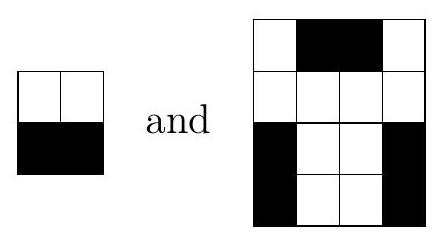
We construct placings of the dominoes by induction. The base cases $n=1$ and $n=2$ correspond to the placings
Next, we add dominoes to the border of a $2 n \times 2 n$ chessboard to obtain a placing of dominoes for the $2(n+2) \times 2(n+2)$ board,
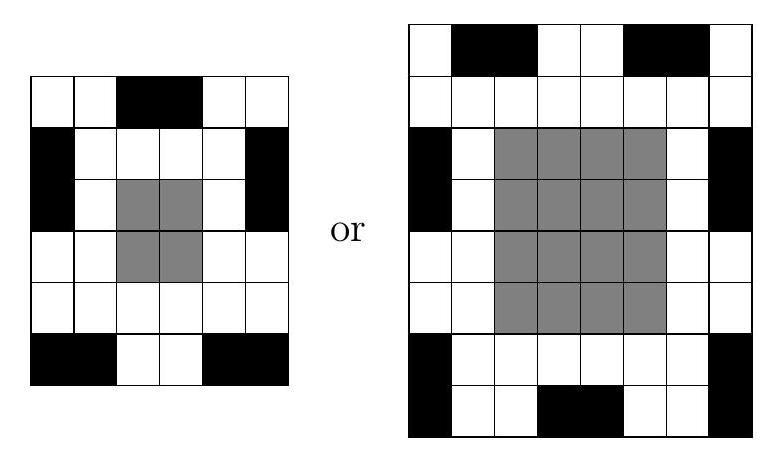 depending on whether $n$ is odd or even. In these constructions, the interior square is filled with the placing for the $2 n \times 2 n$ board. This construction adds $2 n+3$ dominoes, and therefore places, in total,
dominoes on the board. Noticing that the contour and the interior mesh together appropriately, this proves, by induction, that $n(n+1) / 2$ dominoes can be placed on the $2 n n$ board.
To prove that $M \leq n(n+1) / 2$, we border the $2 n \times 2 n$ square board up to a $(2 n+2) \times(2 n+2)$ square board; this adds $8 n+4$ cells to the $4 n^{2}$ cells that we have started with. Calling a cell covered if it belongs to a domino or is adjacent to a domino, each domino on the $2 n \times 2 n$ board is seen to cover exactly 8 cells of the $(2 n+2) \times(2 n+2)$ board (some of which may belong to the border). By construction, each of the $4 n^{2}$ cells of the $2 n \times 2 n$ board is covered by precisely one domino.
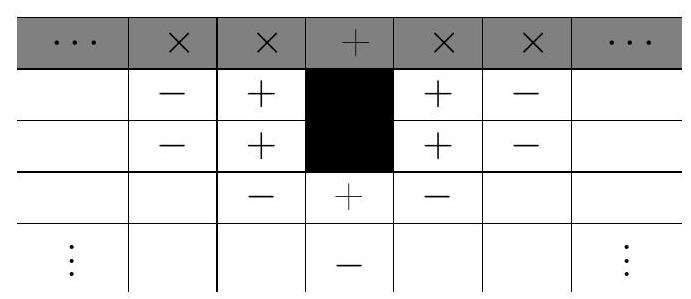
If two adjacent cells on the border, away from a corner, are covered, then there will be at least two uncovered cells on both sides of them; if one covered cell lies between uncovered cells, then again, on both sides of it there will be at least two uncovered cells; three or more adjacent cells cannot be all covered. The following diagrams, in which the borders are shaded, $\times$ marks an uncovered cell on the border, + marks a covered cell not belonging to a domino, and - marks a cell which cannot belong to a domino, summarize the two possible situations,
| $\cdots$ | $\times$ | $\times$ | + | + | $\times$ | $\times$ | $\cdots$ |
|---|---|---|---|---|---|---|---|
| - | + | + | - | ||||
| - | + | + | - | ||||
| - | - | ||||||
| $\vdots$ | $\vdots$ |
or
Close to a corner of the board, either the corner belongs to some domino,
| $\times$ | + | + | $\times$ | $\times$ | $\cdots$ |
|---|---|---|---|---|---|
| + | + | - | |||
| $\times$ | + | + | - | ||
| $\times$ | - | - | |||
| $\vdots$ |
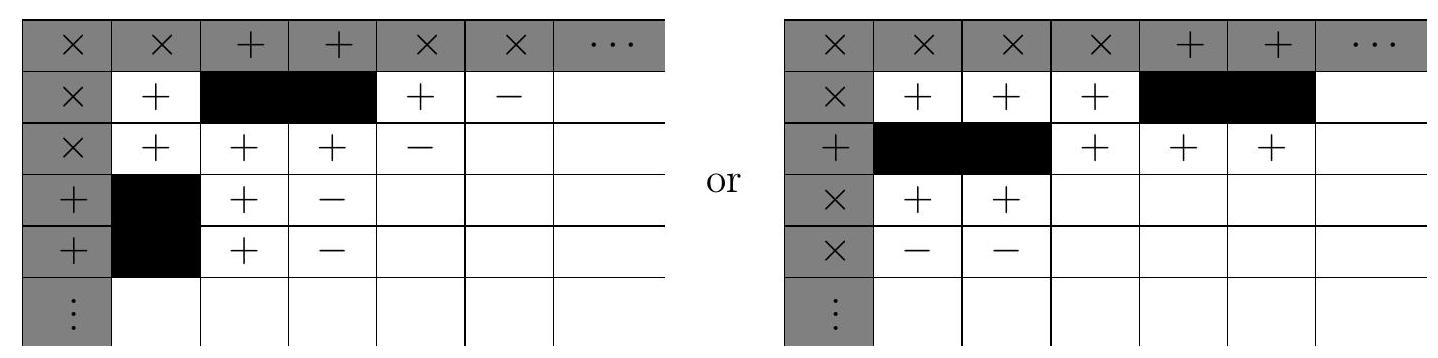
or one of the following situations, in which the corner cell of the original board is not covered by a domino, may occur:
It is thus seen that at most half of the cells on the border, i.e. $4 n+2$ cells, may be covered, and hence
which completes the proof of our claim.
Solution 2. We use the same example as in Solution 1. Let $M$ denote the maximum number of dominoes which satisfy the condition of the problem. To prove that $M \leq$ $n(n+1) / 2$, we again border the $2 n \times 2 n$ square board up to a $(2 n+2) \times(2 n+2)$ square board. In fact, we shall ignore the corner border cells as they cannot be covered anyway and consider only the $2 n$ border cells along each side. We prove that out of each four border cells next to each other at most two can be covered. Suppose three out of four cells $A, B, C, D$ are covered. Then there are two possibilities below:

The first option is that $A, B$ and $D$ are covered (marked with + in top row). Then the cells inside the starting square next to $A, B$ and $D$ are covered by the dominoes, but the cell in between them has now two adjacent cells with dominoes, contradiction. The second option is that $A, B$ and $C$ are covered. Then the cells inside the given square next to $A, B$ and $C$ are covered by the dominoes. But then the cell next to B has two adjacent cells with dominoes, contradiction.
Now we can split the border cells along one side in groups of 4 (leaving one group of 2 if $n$ is odd). So when $n$ is even, at most $n$ of the $2 n$ border cells along one side can be covered, and when $n$ is odd, at most $n+1$ out of the $2 n$ border cells can be covered. For all four borders together, this gives a contribution of $4 n$ when $n$ is even and $4 n+4$ when $n$ is odd. Adding $4 n^{2}$ and dividing by 8 we get the desired result.
Solution (upper bound) by ISR5. Consider the number of pairs of adjacent cells, such that one of them is covered by a domino. Since each cell is adjacent to one covered cell, the number of such pairs is exactly $4 n^{2}$. On the other hand, let $n_{2}$ be the number of covered corner cells, $n_{3}$ the number of covered edge cells (cells with 3 neighbours), and $n_{4}$ be the number of covered interior cells (cells with 4 neighbours). Thus the number of pairs is $2 n_{2}+3 n_{3}+4 n_{4}=4 n^{2}$, whereas the number of dominoes is $m=\frac{n_{2}+n_{3}+n_{4}}{2}$.
Considering only the outer frame (of corner and edge cells), observe that every covered cell dominates two others, so at most half of the cells are ccovered. The frame has a total of $4(2 n-1)$ cells, i.e. $n_{2}+n_{3} \leq 4 n-2$. Additionally $n_{2} \leq 4$ since there are only 4 corners, thus $8 m=4 n_{2}+4 n_{3}+4 n_{4}=\left(2 n_{2}+3 n_{3}+4 n_{4}\right)+\left(n_{2}+n_{3}\right)+n_{2} \leq 4 n^{2}+(4 n-2)+4=4 n(n+1)+2$ Thus $m \leq \frac{n(n+1)}{2}+\frac{1}{4}$, so in fact $m \leq \frac{n(n+1)}{2}$. Solution (upper and lower bound) by ISR5. We prove that this is the upper bound (and also the lower bound!) by proving that any two configurations, say $A$ and $B$, must contain exactly the same number of dominoes.
Colour the board in a black and white checkboard colouring. Let $W$ be the set of white cells covered by dominoes of tiling $A$. For each cell $w \in W$ let $N_{w}$ be the set of its adjacent (necessarily black) cells. Since each black cell has exactly one neighbour (necessarily white) covered by a domino of tiling $A$, it follows that each black cell is contained in exactly one $N_{w}$, i.e. the $N_{w}$ form a partition of the black cells. Since each white cell has exactly one (necessarily black) neighbour covered by a tile of $B$, each $B_{w}$ contains exactly one black tile covered by a domino of $B$. But, since each domino covers exactly one white and one black cell, we have
as claimed.
Problem 3 (Poland). Let $A B C$ be a triangle such that $\angle C A B>\angle A B C$, and let $I$ be its incentre. Let $D$ be the point on segment $B C$ such that $\angle C A D=\angle A B C$. Let $\omega$ be the circle tangent to $A C$ at $A$ and passing through $I$. Let $X$ be the second point of intersection of $\omega$ and the circumcircle of $A B C$. Prove that the angle bisectors of $\angle D A B$ and $\angle C X B$ intersect at a point on line $B C$.
Solution 1. Let $S$ be the intersection point of $B C$ and the angle bisector of $\angle B A D$, and let $T$ be the intersection point of $B C$ and the angle bisector of $\angle B X C$. We will prove that both quadruples $A, I, B, S$ and $A, I, B, T$ are concyclic, which yields $S=T$.
Firstly denote by $M$ the middle of $\operatorname{arc} A B$ of the circumcenter of $A B C$ which does not contain $C$. Consider the circle centered at $M$ passing through $A, I$ and $B$ (it is well-known that $M A=M I=M B$ ); let it intersect $B C$ at $B$ and $S^{\prime}$. Since $\angle B A C>\angle C B A$ it is easy to check that $S^{\prime}$ lies on side $B C$. Denoting the angles in $A B C$ by $\alpha, \beta, \gamma$ we get
Moreover since $\angle M B C=\angle M B A+\angle A B C=\frac{\gamma}{2}+\beta$, then
It follows that $\angle B A S^{\prime}=2 \angle B M S^{\prime}=2 \angle B A D$ which gives us $S=S^{\prime}$.
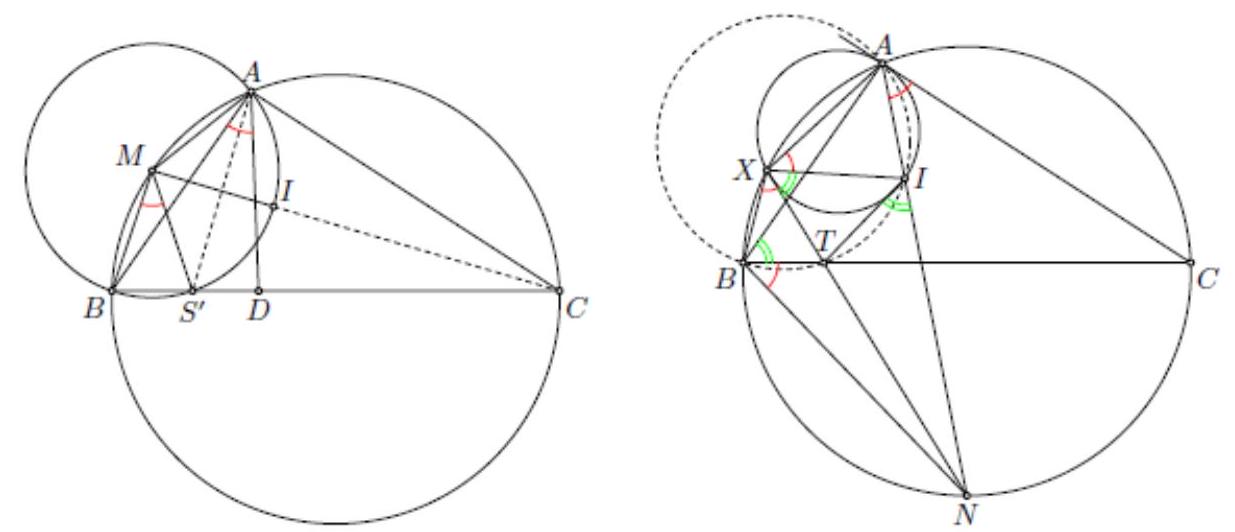
Secondly let $N$ be the middle of arc $B C$ of the circumcenter of $A B C$ which does not contain $A$. From $\angle B A C>\angle C B A$ we conclude that $X$ lies on the $\operatorname{arc} A B$ of circumcircle of $A B C$ not containing $C$. Obviously both $A I$ and $X T$ are passing through $N$. Since $\angle N B T=\frac{\alpha}{2}=\angle B X N$ we obtain $\triangle N B T \sim \triangle N X B$, therefore
It follows that $\triangle N T I \sim \triangle N I X$. Keeping in mind that $\angle N B C=\angle N A C=\angle I X A$ we get
It means that $A, I, B, T$ are concyclic which ends the proof. Solution 2. Let $\angle B A C=\alpha, \angle A B C=\beta, \angle B C A=\gamma \angle A C X=\phi$. Denote by $W_{1}$ and $W_{2}$ the intersections of segment $B C$ with the angle bisectors of $\angle B X C$ and $\angle B A D$ respectively. Then $B W_{1} / W_{1} C=B X / X C$ and $B W_{2} / W_{2} D=B A / A D$. We shall show that $B W_{1}=B W_{2}$.
Since $\angle D A C=\angle C B A$, triangles $A D C$ and $B A C$ are similar and therefore
By the Law of sines
Consequently
Note that $A X B C$ is cyclic and so $\angle B X C=\angle B A C=\alpha$. Hence, $\angle X B C=180^{\circ}-$ $\angle B X C-\angle B C X=180^{\circ}-\alpha-\phi$. By the Law of sines for the triangle $B X C$, we have
So, it's enough to prove that
Since $A C$ is tangent to the circle $A I X$, we have $\angle A X I=\angle I A C=\alpha / 2$. Moreover $\angle X A I=\angle X A B+\angle B A I=\phi+\alpha / 2$ and $\angle X I A=180^{\circ}-\angle X A I-\angle A X I=180^{\circ}-\alpha-\phi$. Applying the Law of sines again $X A C, X A I, I A C$ we obtain
Combining the last three equalities we end up with
Subtracting 1 from both sides yields
and the result follows. We are left to note that none of the denominators can vanish. Solution by Achilleas Sinefakopoulos, Greece. We first note that
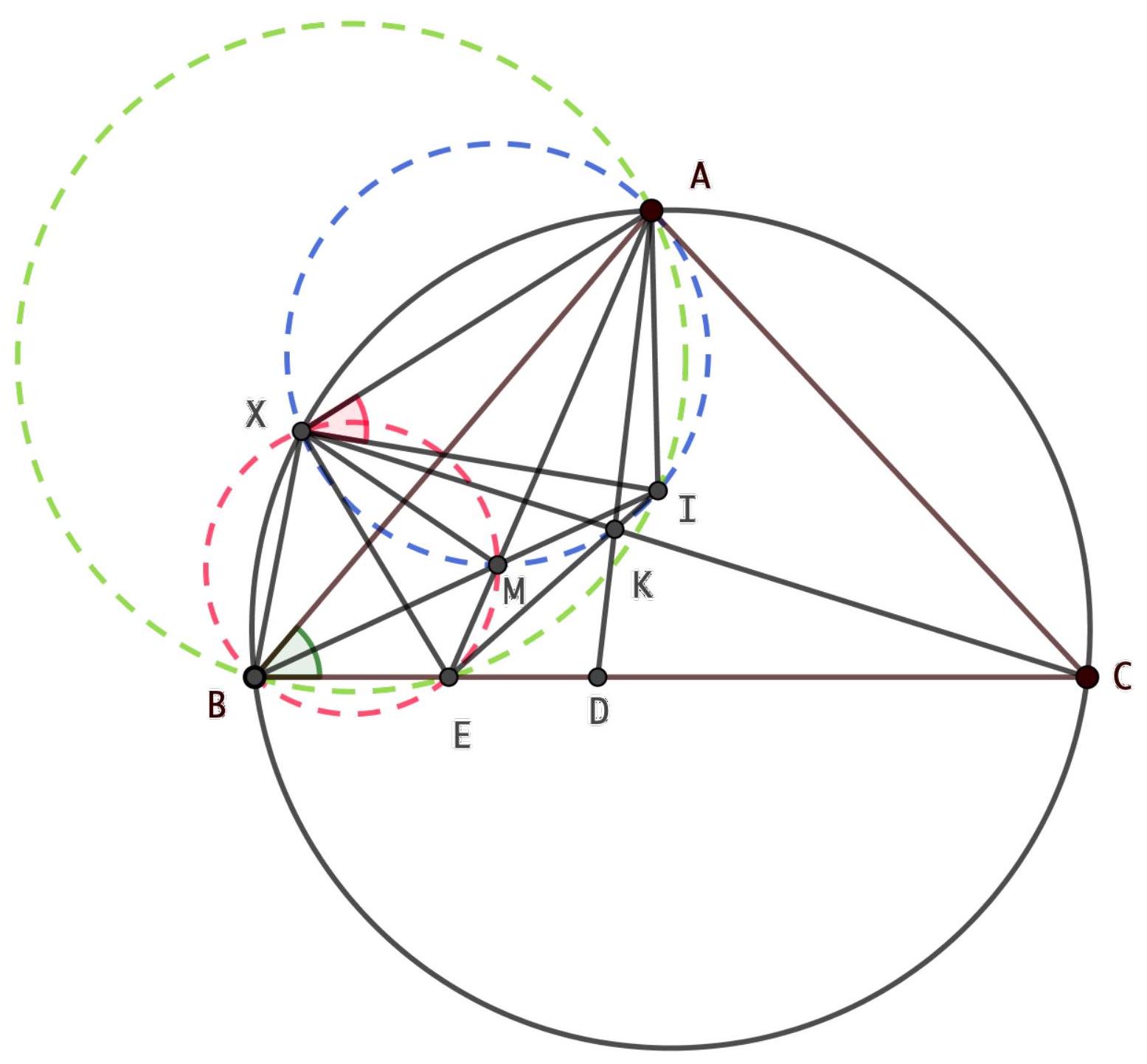
Let $C X$ and $A D$ meet at $K$. Then $\angle C X A=\angle A B C=\angle K A C$. Also, we have $\angle I X A=$ $\angle A / 2$, since $\omega$ is tangent to $A C$ at $A$. Therefore,
(the absolute value depends on whether $\angle B \geq \angle A / 2$ or not) which means that $X K I A$ is cyclic, i.e. $K$ lies also on $\omega$.
Let $I K$ meet $B C$ at $E$. (If $\angle B=\angle A / 2$, then $I K$ degenerates to the tangent line to $\omega$ at I.) Note that BEIA is cyclic, because
We have $\angle E K A=180^{\circ}-\angle A X I=180^{\circ}-\angle A / 2$ and $\angle A E I=\angle A B I=\angle B / 2$. Hence
This means that $A E$ is the angle bisector of $\angle B A D$. Next, let $M$ be the point of intersection of $A E$ and $B I$. Then
and so, its supplement is
so $X, M, K, I, A$ all lie on $\omega$. Next, we have
and so $X, B, E, M$ are concyclic. Hence
This means that $X E$ is the angle bisector of $\angle B X C$ and so we are done!
Solution based on that by Eirini Miliori (HEL2), edited by A. Sinefakopoulos, Greece. It is $\angle A B D=\angle D A C$, and so $\overline{A C}$ is tangent to the circumcircle of $\triangle B A D$ at $A$. Hence $C A^{2}=C D \cdot C B$.
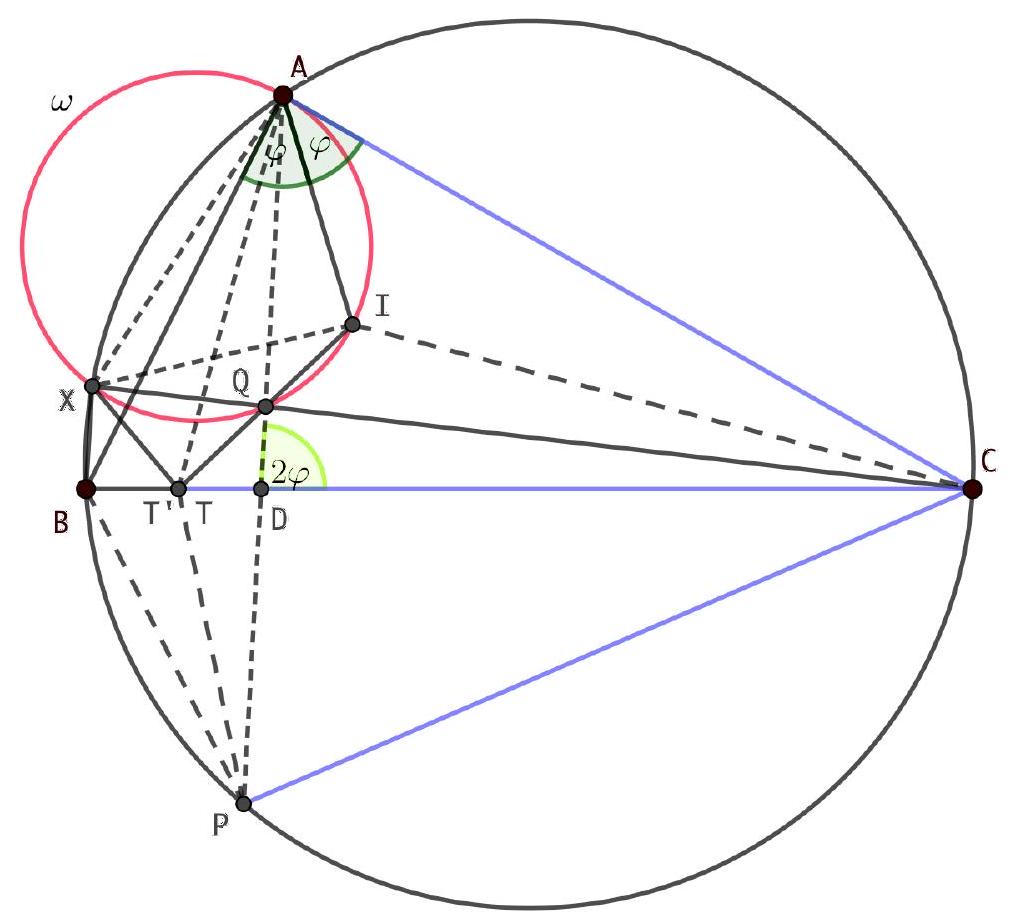
Triangle $\triangle A B C$ is similar to triangle $\triangle C A D$, because $\angle C$ is a common angle and $\angle C A D=\angle A B C$, and so $\angle A D C=\angle B A C=2 \varphi$. Let $Q$ be the point of intersection of $\overline{A D}$ and $\overline{C X}$. Since $\angle B X C=\angle B A C=2 \varphi$, it follows that $B D Q X$ is cyclic. Therefore, $C D \cdot C B=C Q \cdot C X=C A^{2}$ which implies that $Q$ lies on $\omega$. Next let $P$ be the point of intersection of $\overline{A D}$ with the circumcircle of triangle $\triangle A B C$. Then $\angle P B C=\angle P A C=\angle A B C=\angle A P C$ yielding $C A=C P$. So, let $T$ be on the side $\overline{B C}$ such that $C T=C A=C P$. Then
that is, line $\overline{A T}$ is the angle bisector of $\angle B A D$. We want to show that $\overline{X T}$ is the angle bisector of $\angle B X C$. To this end, it suffices to show that $\angle T X C=\varphi$. It is $C T^{2}=C A^{2}=C Q \cdot C X$, and so $\overline{C T}$ is tangent to the circumcircle of $\triangle X T Q$ at $T$. Since $\angle T X Q=\angle Q T C$ and $\angle Q D C=2 \varphi$, it suffices to show that $\angle T Q D=\varphi$, or, in other words, that $I, Q$, and $T$ are collinear.
Let $T^{\prime}$ is the point of intersection of $\overline{I Q}$ and $\overline{B C}$. Then $\triangle A I C$ is congruent to $\triangle T^{\prime} I C$, since they share $\overline{C I}$ as a common side, $\angle A C I=\angle T^{\prime} C I$, and
Therefore, $C T^{\prime}=C A=C T$, which means that $T$ coincides with $T^{\prime}$ and completes the proof.
Solution based on the work of Artemis-Chrysanthi Savva (HEL4), completed by A. Sinefakopoulos, Greece. Let $G$ be the point of intersection of $\overline{A D}$ and $\overline{C X}$. Since the quadrilateral $A X B C$ is cyclic, it is $\angle A X C=\angle A B C$.
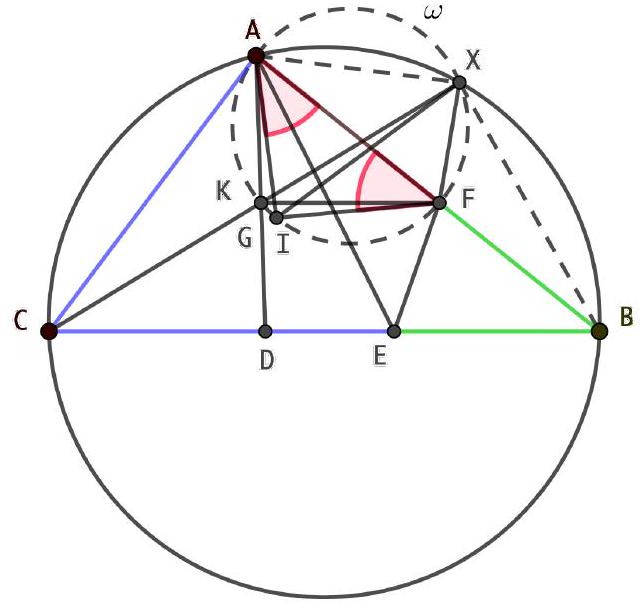
Let the line $\overline{A D}$ meet $\omega$ at $K$. Then it is $\angle A X K=\angle C A D=\angle A B C$, because the angle that is formed by a chord and a tangent to the circle at an endpoint of the chord equals the inscribed angle to that chord. Therefore, $\angle A X K=\angle A X C=\angle A X G$. This means that the point $G$ coincides with the point $K$ and so $G$ belongs to the circle $\omega$.
Let $E$ be the point of intersection of the angle bisector of $\angle D A B$ with $\overline{B C}$. It suffices to show that
Let $F$ be the second point of intersection of $\omega$ with $\overline{A B}$. Then we have $\angle I A F=\frac{\angle C A B}{2}=$ $\angle I X F$, where $I$ is the incenter of $\triangle A B C$, because $\angle I A F$ and $\angle I X F$ are inscribed in the same arc of $\omega$. Thus $\triangle A I F$ is isosceles with $A I=I F$. Since $I$ is the incenter of $\triangle A B C$, we have $A F=2(s-a)$, where $s=(a+b+c) / 2$ is the semiperimeter of $\triangle A B C$. Also, it is $C E=A C=b$ because in triangle $\triangle A C E$, we have
and so $\angle C A E=180^{\circ}-\angle A E C-\angle A C E=90^{\circ}-\frac{\angle A C E}{2}=\angle A E C$. Hence
Moreover, triangle $\triangle C A X$ is similar to triangle $\triangle B F X$, because $\angle A C X=\angle F B X$ and
Therefore
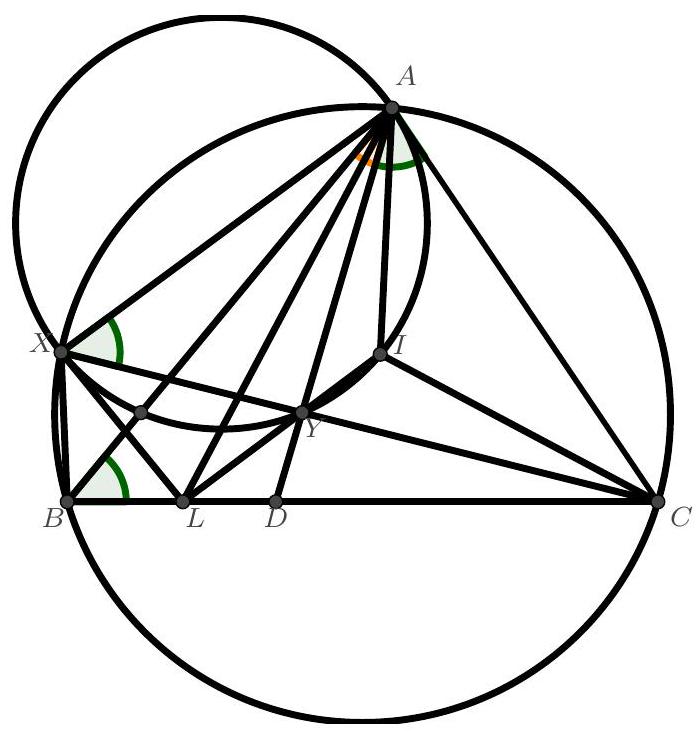
as desired. The proof is complete. Solution by IRL1 and IRL 5. Let $\omega$ denote the circle through $A$ and $I$ tangent to $A C$. Let $Y$ be the second point of intersection of the circle $\omega$ with the line $A D$. Let $L$ be the intersection of $B C$ with the angle bisector of $\angle B A D$. We will prove $\angle L X C=$ $1 / 2 \angle B A C=1 / 2 \angle B X C$.
We will refer to the angles of $\triangle A B C$ as $\angle A, \angle B, \angle C$. Thus $\angle B A D=\angle A-\angle B$. On the circumcircle of $\triangle A B C$, we have $\angle A X C=\angle A B C=\angle C A D$, and since $A C$ is tangent to $\omega$, we have $\angle C A D=\angle C A Y=\angle A X Y$. Hence $C, X, Y$ are collinear. Also note that $\triangle C A L$ is isosceles with $\angle C A L=\angle C L A=\frac{1}{2}(\angle B A D)+\angle A B C=\frac{1}{2}(\angle A+$ $\angle B)$ hence $A C=C L$. Moreover, $C I$ is angle bisector to $\angle A C L$ so it's the symmetry axis for the triangle, hence $\angle I L C=\angle I A C=1 / 2 \angle A$ and $\angle A L I=\angle L I A=1 / 2 \angle B$. Since $A C$ is tangent to $\omega$, we have $\angle A Y I=\angle I A C=1 / 2 \angle A=\angle L A Y+\angle A L I$. Hence $L, Y, I$ are collinear.
Since $A C$ is tangent to $\omega$, we have $\triangle C A Y \sim \triangle C X A$ hence $C A^{2}=C X \cdot C Y$. However we proved $C A=C L$ hence $C L^{2}=C X \cdot C Y$. Hence $\triangle C L Y \sim \triangle C X L$ and hence $\angle C X L=\angle C L Y=\angle C A I=1 / 2 \angle A$.
Solution by IRL 5. Let $M$ be the midpoint of the $\operatorname{arc} B C$. Let $\omega$ denote the circle through $A$ and $I$ tangent to $A C$. Let $N$ be the second point of intersection of $\omega$ with $A B$ and $L$ the intersection of $B C$ with the angle bisector of $\angle B A D$. We know $\frac{D L}{L B}=\frac{A D}{A B}$ and want to prove $\frac{X B}{X C}=\frac{L B}{L C}$.
First note that $\triangle C A L$ is isosceles with $\angle C A L=\angle C L A=\frac{1}{2}(\angle B A D)+\angle A B C$ hence $A C=C L$ and $\frac{L B}{L C}=\frac{L B}{A C}$.
Now we calculate $\frac{X B}{X C}$ :
Comparing angles on the circles $\omega$ and the circumcircle of $\triangle A B C$ we get $\triangle X I N \sim$ $\triangle X M B$ and hence also $\triangle X I M \sim \triangle X N B$ (having equal angles at $X$ and proportional adjoint sides). Hence $\frac{X B}{X M}=\frac{N B}{I M}$.
Also comparing angles on the circles $\omega$ and the circumcircle of $\triangle A B C$ and using the tangent $A C$ we get $\triangle X A I \sim \triangle X C M$ and hence also $\triangle X A C \sim \triangle X I M$. Hence $\frac{X C}{X M}=$ $\frac{A C}{I M}$.
Comparing the last two equations we get $\frac{X B}{X C}=\frac{N B}{A C}$. Comparing with $\frac{L B}{L C}=\frac{L B}{A C}$, it remains to prove $N B=L B$.
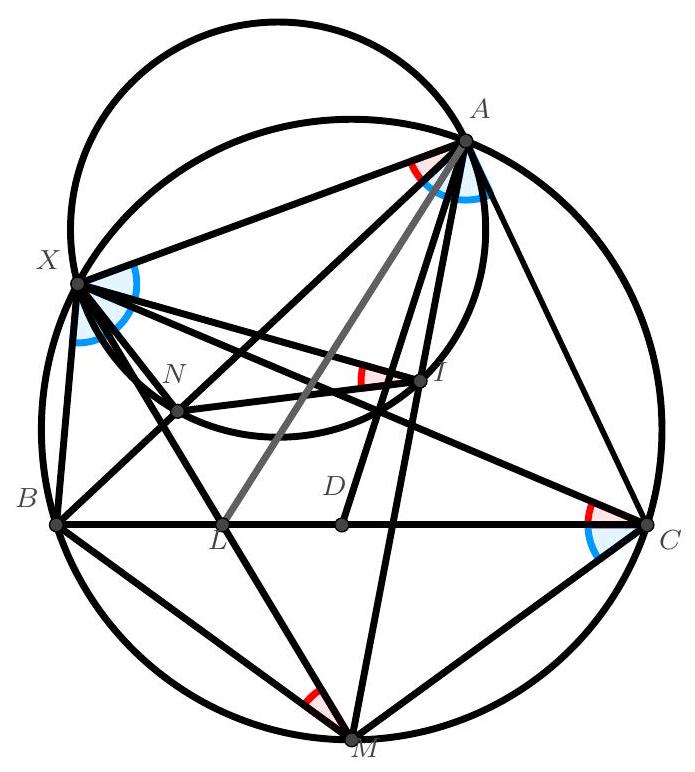
We prove $\triangle I N B \equiv \triangle I L B$ as follows: First, we note that $I$ is the circumcentre of $\triangle A L N$. Indeed, $C I$ is angle bisector in the isosceles triangle $A C L$ so it's perpendicular bisector for $A L$. As well, $\triangle I A N$ is isosceles with $\angle I N A=\angle C A I=\angle I A B$ hence $I$ is also on the perpendicular bisector of $A N$.
Hence $I N=I L$ and also $\angle N I L=2 \angle N A L=\angle A-\angle B=2 \angle N I B$ (the last angle is calculated using that the exterior angle of $\triangle N I B$ is $\angle I N A=\angle A / 2$. Hence $\angle N I B=$ $\angle L I B$ and $\triangle I N B \equiv \triangle I L B$ by SAS.
Solution by ISR5 (with help from IRL5). Let $M, N$ be the midpoints of arcs $B C, B A$ of the circumcircle $A B C$, respectively. Let $Y$ be the second intersection of $A D$ and circle $A B C$. Let $E$ be the incenter of triangle $A B Y$ and note that $E$ lies on the angle bisectors of the triangle, which are the lines $Y N$ (immediate), $B C$ (since $\angle C B Y=\angle C A Y=\angle C A D=\angle A B C)$ and the angle bisector of $\angle D A B$; so the question reduces to showing that $E$ is also on $X M$, which is the angle bisector of $\angle C X B$.
We claim that the three lines $C X, A D Y, I E$ are concurrent at a point $D^{\prime}$. We will complete the proof using this fact, and the proof will appear at the end (and see the solution by HEL5 for an alternative proof of this fact).
To show that XEM are collinear, we construct a projective transformation which projects $M$ to $X$ through center $E$. We produce it as a composition of three other projections. Let $O$ be the intersection of lines $A D^{\prime} D Y$ and $C I N$. Projecting the points $Y N C M$ on the circle $A B C$ through the (concyclic) point $A$ to the line $C N$ yields the points $O N C I$. Projecting these points through $E$ to the line $A Y$ yields $O Y D D^{\prime}$ (here we use the facts that $D^{\prime}$ lies on $I E$ and $A Y$ ). Projecting these points to the circle $A B C$ through $C$ yields $N Y B X$ (here we use the fact that $D^{\prime}$ lies on $C X$ ). Composing, we observe that we found a projection of the circle $A B C$ to itself sending $Y N C M$ to $N Y B X$. Since the projection of the circle through $E$ also sends $Y N C$ to $N Y B$, and three points determine a projective transformation, the projection through $E$ also sends $M$ to $X$, as claimed.
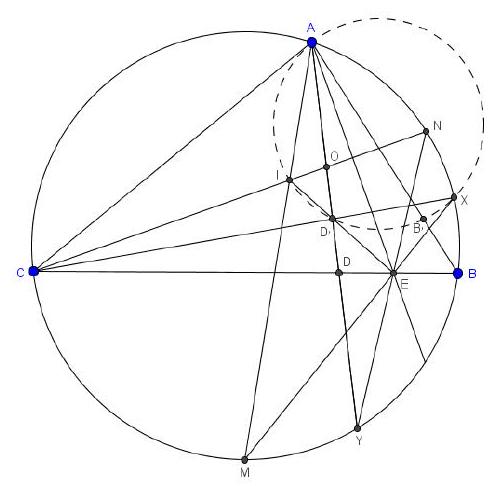
Let $B^{\prime}, D^{\prime}$ be the intersections of $A B, A D$ with the circle $A X I$, respectively. We wish to show that this $D^{\prime}$ is the concurrency point defined above, i.e. that $C D^{\prime} X$ and $I D^{\prime} E$ are collinear. Additionally, we will show that $I$ is the circumcenter of $A B^{\prime} E$.
Consider the inversion with center $C$ and radius $C A$. The circles $A X I$ and $A B D$ are tangent to $C A$ at $A$ (the former by definition, the latter since $\angle C A D=\angle A B C$ ), so they are preserved under the inversion. In particular, the inversion transposes $D$ and $B$ and preserves $A$, so sends the circle $C A B$ to the line $A D$. Thus $X$, which is the second intersection of circles $A B C$ and $A X I$, is sent by the inversion to the second intersection of $A D$ and circle $A X I$, which is $D^{\prime}$. In particular $C D^{\prime} X$ are collinear.
In the circle $A I B^{\prime}, A I$ is the angle bisector of $B^{\prime} A$ and the tangent at $A$, so $I$ is the midpoint of the arc $A B^{\prime}$, and in particular $A I=I B^{\prime}$. By angle chasing, we find that $A C E$ is an isosceles triangle: $\angle C A E=\angle C A D+\angle D A E=\angle A B C+\angle E A B=\angle A B E+\angle E A B=\angle A E B=\angle A E C$, thus the angle bisector $C I$ is the perpendicular bisector of $A E$ and $A I=I E$. Thus $I$ is the circumcenter of $A B^{\prime} E$.
We can now show that $I D^{\prime} E$ are collinear by angle chasing:
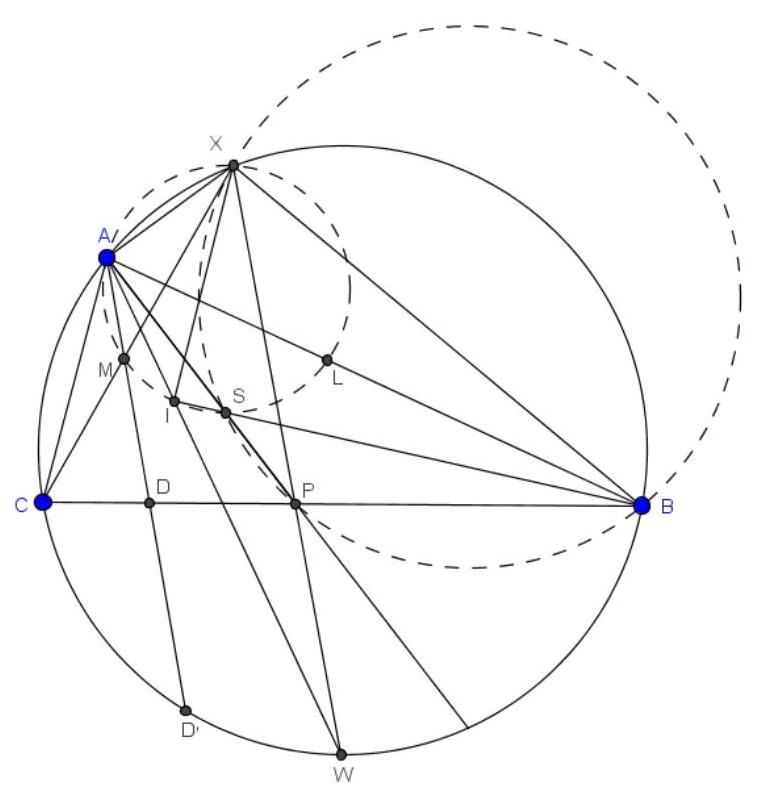
Solution inspired by ISR2. Let $W$ be the midpoint of arc $B C$, let $D^{\prime}$ be the second intersection point of $A D$ and the circle $A B C$. Let $P$ be the intersection of the angle bisector $X W$ of $\angle C X B$ with $B C$; we wish to prove that $A P$ is the angle bisector of $D A B$. Denote $\alpha=\frac{\angle C A B}{2}, \beta=\angle A B C$.
Let $M$ be the intersection of $A D$ and $X C$. Angle chasing finds:
And in particular $M$ is on $\omega$. By angle chasing we find
and $\angle P X B=\alpha=\angle C A I=\angle A X I$, and it follows that $\triangle X I A \sim \triangle X B P$. Let $S$ be the second intersection point of the cirumcircles of $X I A$ and $X B P$. Then by the spiral map lemma (or by the equivalent angle chasing) it follows that $I S B$ and $A S P$ are collinear.
Let $L$ be the second intersection of $\omega$ and $A B$. We want to prove that $A S P$ is the angle bisector of $\angle D A B=\angle M A L$, i.e. that $S$ is the midpoint of the $\operatorname{arc} M L$ of $\omega$. And this follows easily from chasing angular arc lengths in $\omega$ :
And thus
Solution by inversion, by JPN Observer A, Satoshi Hayakawa. Let $E$ be the intersection of the bisector of $\angle B A D$ and $B C$, and $N$ be the middle point of arc $B C$ of the circumcircle of $A B C$. Then it suffices to show that $E$ is on line $X N$.
We consider the inversion at $A$. Let $P^{}$ be the image of a point denoted by $P$. Then $A, B^{}, C^{}, E^{}$ are concyclic, $X^{}, B^{}, C^{}$ are colinear, and $X^{} I^{}$ and $A C^{}$ are parallel. Now it suffices to show that $A, X^{}, E^{}, N^{}$ are concyclic. Let $Y$ be the intersection of $B^{} C^{}$ and $A E^{}$. Then, by the power of a point, we get
Here, by the property of inversion, we have
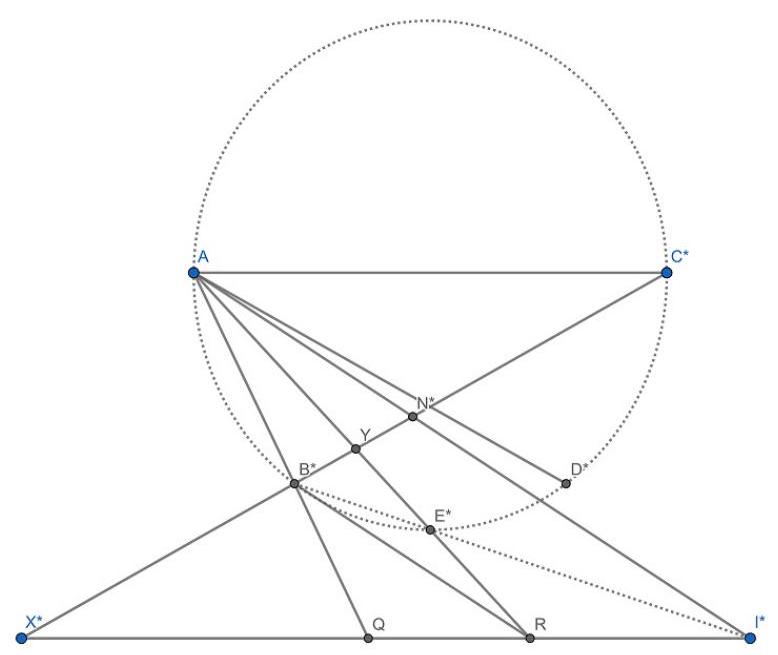
Define $Q, R$ as described in the figure, and we get by simple angle chasing
Especially, $B^{} R$ and $A I^{}$ are parallel, so that we have
and the proof is completed.