
The 35th Nordic Mathematical Contest
Friday, 16 April 2021
Time allowed: 4 hours. Each problem is worth 7 points.
Only writing and drawing tools are allowed.
Problem 1. On a blackboard a finite number of integers greater than one are written. Every minute, Nordi additionally writes on the blackboard the smallest positive integer greater than every other integer on the blackboard and not divisible by any of the numbers on the blackboard. Show that from some point onwards Nordi only writes primes on the blackboard.
Problem 2. Find all functions $f: \mathbb{R} \rightarrow \mathbb{R}$ satisfying that for every $x \in \mathbb{R}$,
Problem 3. Let $n$ be a positive integer. Alice and Bob play the following game. First, Alice picks $n+1$ subsets $A_{1}, \ldots, A_{n+1}$ of $\left{1, \ldots, 2^{n}\right}$ each of size $2^{n-1}$. Second, Bob picks $n+1$ arbitrary integers $a_{1}, \ldots, a_{n+1}$. Finally, Alice picks an integer $t$. Bob wins if there exists an integer $1 \leq i \leq n+1$ and $s \in A_{i}$ such that $s+a_{i} \equiv t\left(\bmod 2^{n}\right)$. Otherwise, Alice wins.
Find all values of $n$ where Alice has a winning strategy.
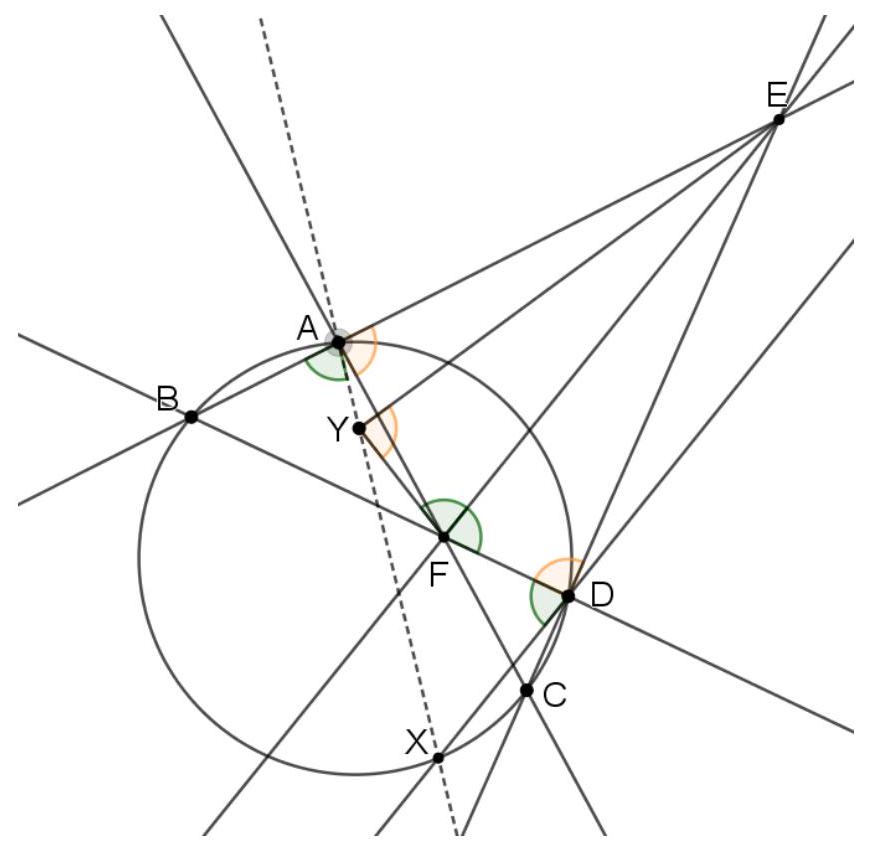
Problem 4. Let $A, B, C$ and $D$ be points on the circle $\omega$ such that $A B C D$ is a convex quadrilateral. Suppose that $A B$ and $C D$ intersect at a point $E$ such that $A$ is between $B$ and $E$ and that $B D$ and $A C$ intersect at a point $F$. Let $X \neq D$ be the point on $\omega$ such that $D X$ and $E F$ are parallel. Let $Y$ be the reflection of $D$ through $E F$ and suppose that $Y$ is inside the circle $\omega$.
Show that $A, X$, and $Y$ are collinear.
Solutions
Problem 1. Let $a$ be the largest integer initially written on the blackboard. Furthermore, denote by $a_{n}$ the integer written by Nordi on the blackboard after $n$ minutes.
Suppose that $p>a$ is prime. If Nordi never writes $p$ on the blackboard, there exist $a_{n}<p<a_{n+1}$ since $a_{1}, a_{2}, \ldots$ is a strictly increasing sequence of positive integers. However, $p$ is a prime greater than $a_{n}$, so $p$ is not divisible by any of the integers written on the blackboard after $n$ minutes. This contradicts that $a_{n+1}$ is the smallest integer greater than $a_{n}$ which is not divisible by any of the integers on the blackboard after $n$ minutes. It follows that every prime greater than $a$ is written on the blackboard.
It follows that every non-prime written on the blackboard contains only prime factors less than or equal to $a$. Assume for contradiction that Nordi writes infinitely many integers on the blackboard that are not integer. Let $b_{1}, b_{2}, \ldots$ be these integers, and let $p_{1}, \ldots, p_{r}$ be the primes less than or equal to $a$. It follows that for every $n \in \mathbb{N}$, we can write
where $e_{n, 1}, \ldots, e_{n, r}$ are non-negative integers.
Note that for any infinite sequence of non-negative integers, we may find an infinite subsequence that is weakly increasing: If the sequence is bounded, some integer occurs infinitely many times, otherwise we may find an infinite strictly increasing subsequence.
Consider now the sequence
For the first coordinate, we may find an infinite weakly increasing subsequence $e_{n_{1}, 1}, e_{n_{2}, 1}, \ldots, e_{n_{i}, 1}, \ldots$. Considering the sequence $e_{n_{1}, 2}, e_{n_{2}, 2}, \ldots$, we may now again find a weakly increasing subsequence $e_{n_{1}^{\prime}, 2}, e_{n_{2}^{\prime}, 2}, \ldots$. In this manner, we may find indices $m_{1}<m_{2}<\ldots$ such that for every $1 \leq i \leq r, e_{m_{1}, i}, e_{m_{2}, i}, \ldots$ is a weakly increasing sequence. However, then $b_{m_{1}}\left|b_{m_{2}}\right| b_{m_{3}} \mid \ldots$ A contradiction. Thus, Nordi only writes finitely many integers on the blackboard that are not primes.
Problem 2. With $g(x)=x(1+|x|)$ we want that $f(g(x)) \leq x \leq g(f(x))$ for all $x$. The solution only uses that $g$ is strictly increasing and surjective with an inverse which is also strictly increasing.
Notice that the inverse function to such $g$ gives a solution $f=g^{-1}$ since $x \leq x \leq x$ is true for all $x \in \mathbb{R}$.
For uniqueness take any $x$ and let $y=g^{-1}(x)$. Then $g(f(x)) \geq x$. On the other hand $f(g(y)) \leq y$ and hence $g(f(x))=g(f(g(y))) \leq g(y)=x$ where we used that $g$ is increasing in the inequality. In other words $g(f(x))=x$ for all $x$ and hence $f(x)=g^{-1}(x)$.
Solving $y(1+|y|)=x$ we get explicitly for $f$ that
Problem 3. Bob has a winning strategy for every $n \in \mathbb{N}$. Initially, note that Bob wins if and only if he can "shift" the sets $A_{1}, \ldots, A_{n+1}$ modulo $2^{n}$ such that they together cover every residue class. For a set of integers $C \subset \mathbb{Z}$ and $r \in \mathbb{N}$, let $C+r$ be the set ${c+r \mid c \in C}$, and let $(C \bmod r)$ denote the subset of ${0,1, \ldots, r-1}$ corresponding to the residue classes modulo $r$ represented by the members of $C$.
Let $A_{1}, \ldots, A_{n+1}$ be the subsets of $\left{1, \ldots, 2^{n}\right}$ chosen by Alice. Bob now proceeds as follows. Suppose some choice of $a_{1}, \ldots, a_{n+1}$ is given, let $B_{0}=$ $\left{0,1,2, \ldots, 2^{n}-1\right}$, and for $1 \leq i \leq n+1$, let $B_{i}=B_{i-1} \backslash\left(\left(A_{i}+a_{i}\right) \bmod 2^{n}\right)$. Note that if Alice chooses $t$ such that the residue class of $t$ modulo $2^{n}$ is not contained in $B_{j}$ for some $1 \leq j \leq n+1$, then Bob can choose an $i \leq j$ and find $s \in A_{i}$ such that $s+a_{i} \equiv t\left(\bmod 2^{n}\right)$. Thus, Bob wins if he can ensure that $B_{n+1}=\emptyset$.
To that end, we show that Bob can choose $a_{1}, \ldots, a_{n+1}$ such that $\left|B_{i}\right| \leq$ $\left|B_{i-1}\right| / 2$ for every $1 \leq i \leq n$. If this holds, $\left|B_{n+1}\right| \leq 2^{n-(n+1)}=1 / 2$, and the conclusion follows. Consider some $1 \leq i \leq n+1$. We wish to find $a_{i}$ such that $\left(A_{i}+a_{i}\right) \bmod 2^{n}$ contains at least half of the elements of $B_{i-1}$. Note that $\left(A_{i}+b\right) \bmod 2^{n}$ contains $2^{n-1}$ elements and consider the sum
For each $b \in B_{i-1}$, there are exactly $2^{n-1}$ choices of $0 \leq a<2^{n}$ such that $b$ is contained in $\left(\left(A_{i}+a\right) \bmod 2^{n}\right)$, one for each element of $A_{i}$. It follows that $S=2^{n-1} \cdot\left|B_{i-1}\right|$. Since there are only $2^{n}$ summands in $S$, at least one must have magnitude at least $\left|B_{i-1}\right| / 2$. Thus, there is some $0 \leq a<2^{n}$ with $\left|\left(\left(A_{i}+a\right) \bmod 2^{n}\right) \cap B_{i-1}\right| \geq\left|B_{i-1}\right| / 2$, so choosing $a_{i}=a$, Bob ensures that
Problem 4. It can be difficult to find out what to do, but the key is to show that $A Y F E$ is cyclic. The motivation for this is that we want to show that $\angle B A Y=\angle B A X$. But $\angle B A X=\angle B D X$ since $B X D A$ is cyclic, and $\angle B D X=$ $\angle F D X=\angle D F E$ since $D X$ and $E F$ are parallel, and $\angle D F E=\angle E F Y$ since $Y$ is the reflection of $D$ through $E F$, so $\angle B A X=\angle E F Y$. Hence we only need to show that $\angle B A Y=180^{\circ}-\angle E A Y=\angle E F Y$, and this is true if and only if $A Y F E$ is cyclic. The trick is to show that $A Y F E$ is cyclic in a different way, i.e. by showing that $\angle E A F=\angle E Y F$. This follows from $A B C D$ being cyclic since then $\angle E A F=180^{\circ}-\angle C A B=180^{\circ}-\angle C D B=\angle F D E=\angle E Y F$. The last equality follows from $Y$ being a reflection.
Note: We have shown the claim for just one configuration, the one in the sketch. The other cases follow from the same idea, but one need to chase angles in a different way. Using oriented angles one can take case of all possibilities.