


JMO 2015 Solution Notes
Evan Chen《陳誼廷》
15 April 2024
Abstract
This is a compilation of solutions for the 2015 JMO. The ideas of the solution are a mix of my own work, the solutions provided by the competition organizers, and solutions found by the community. However, all the writing is maintained by me.
These notes will tend to be a bit more advanced and terse than the "official" solutions from the organizers. In particular, if a theorem or technique is not known to beginners but is still considered "standard", then I often prefer to use this theory anyways, rather than try to work around or conceal it. For example, in geometry problems I typically use directed angles without further comment, rather than awkwardly work around configuration issues. Similarly, sentences like "let $\mathbb{R}$ denote the set of real numbers" are typically omitted entirely.
Corrections and comments are welcome!
Contents
0 Problems ..... 2 1 Solutions to Day 1 1.1 JMO 2015/1, proposed by Razvan Gelca ..... 3 1.2 JMO 2015/2, proposed by Titu Andreescu 1.3 JMO 2015/3, proposed by Zuming Feng, Jacek Fabrykowski ..... 6 2 Solutions to Day 2 2.1 JMO 2015/4, proposed by Iurie Boreico ..... 9 2.2 JMO 2015/5, proposed by Sungyoon Kim ..... 10 2.3 JMO 2015/6, proposed by Maria Monks Gillespie ..... 11
§0 Problems
- Given a sequence of real numbers, a move consists of choosing two terms and replacing each with their arithmetic mean. Show that there exists a sequence of 2015 distinct real numbers such that after one initial move is applied to the sequence - no matter what move - there is always a way to continue with a finite sequence of moves so as to obtain in the end a constant sequence.
- Solve in integers the equation
- Quadrilateral $A P B Q$ is inscribed in circle $\omega$ with $\angle P=\angle Q=90^{\circ}$ and $A P=$ $A Q<B P$. Let $X$ be a variable point on segment $\overline{P Q}$. Line $A X$ meets $\omega$ again at $S$ (other than $A$ ). Point $T$ lies on arc $A Q B$ of $\omega$ such that $\overline{X T}$ is perpendicular to $\overline{A X}$. Let $M$ denote the midpoint of chord $\overline{S T}$. As $X$ varies on segment $\overline{P Q}$, show that $M$ moves along a circle.
- Find all functions $f: \mathbb{Q} \rightarrow \mathbb{Q}$ such that
for all rational numbers $x<y<z<t$ that form an arithmetic progression. 5. Let $A B C D$ be a cyclic quadrilateral. Prove that there exists a point $X$ on segment $\overline{B D}$ such that $\angle B A C=\angle X A D$ and $\angle B C A=\angle X C D$ if and only if there exists a point $Y$ on segment $\overline{A C}$ such that $\angle C B D=\angle Y B A$ and $\angle C D B=\angle Y D A$. 6. Steve is piling $m \geq 1$ indistinguishable stones on the squares of an $n \times n$ grid. Each square can have an arbitrarily high pile of stones. After he finished piling his stones in some manner, he can then perform stone moves, defined as follows. Consider any four grid squares, which are corners of a rectangle, i.e. in positions $(i, k),(i, l)$, $(j, k),(j, l)$ for some $1 \leq i, j, k, l \leq n$, such that $i<j$ and $k<l$. A stone move consists of either removing one stone from each of $(i, k)$ and $(j, l)$ and moving them to $(i, l)$ and $(j, k)$ respectively, or removing one stone from each of $(i, l)$ and $(j, k)$ and moving them to $(i, k)$ and $(j, l)$ respectively. Two ways of piling the stones are equivalent if they can be obtained from one another by a sequence of stone moves. How many different non-equivalent ways can Steve pile the stones on the grid?
§1 Solutions to Day 1
§1.1 JMO 2015/1, proposed by Razvan Gelca
Available online at https://aops.com/community/p4769963.
Problem statement
Given a sequence of real numbers, a move consists of choosing two terms and replacing each with their arithmetic mean. Show that there exists a sequence of 2015 distinct real numbers such that after one initial move is applied to the sequence - no matter what move - there is always a way to continue with a finite sequence of moves so as to obtain in the end a constant sequence.
One valid example of a sequence is $0,1, \ldots, 2014$. We will show how to achieve the all-1007 sequence based on the first move.
Say two numbers are opposites if their average is 1007 . We consider 1007 as its own opposite.
We consider two cases:
- First, suppose the first initial move did not involve the number 1007. Suppose the two numbers changed were $a$ and $b$, replaced by $c=\frac{1}{2}(a+b)$ twice.
- If $a$ and $b$ are opposites, we simply operate on all the other pairs of opposites.
- Otherwise let $a^{\prime}$ and $b^{\prime}$ be the opposites of $a$ and $b$, so all four of $a, b, a^{\prime}, b^{\prime}$ are distinct. Then operate on $a^{\prime}$ and $b^{\prime}$ to get $c^{\prime}=2014-c$. We work with only these four numbers ande replace them as follows:
Finally, we operate on the remaining 1005 pairs of opposites.
- Now suppose the first initial move involved the number 1007 and some $a$. Let $k$ be any number other than $a$ or its opposite, and let $a^{\prime}, k^{\prime}$ be the opposites of $a$ and $k$. We work with only these five numbers: and replace them in the following way:
Finally, we operate on the remaining 1005 pairs of opposites.
Remark. In fact, the same proof basically works for any sequence with average $m$ such that $m$ is in the sequence, and every term has an opposite.
However for "most" sequences one expects the result to not be possible. As a simple example, the goal is impossible for $(0,1, \ldots, 2013,2015)$ since the average of the terms is $1007+\frac{1}{2015}$, but in the process the only denominators ever generated are powers of 2 . This narrows the search somewhat.
§1.2 JMO 2015/2, proposed by Titu Andreescu
Available online at https://aops.com/community/p4769940.
Problem statement
Solve in integers the equation
We do the trick of setting $a=x+y$ and $b=x-y$. This rewrites the equation as
where $a, b \in \mathbb{Z}$ have the same parity. This becomes
which is enough to imply $3 \mid a$, so let $a=3 c$. Miraculously, this becomes
So a solution must have $4 c+1=m^{2}$, with $m$ odd. This gives
For mod 8 reasons, this always generates a valid integer solution, so this is the complete curve of solutions. Actually, putting $m=2 n+1$ gives the much nicer curve
and permutations. For $n=0,1,2,3$ this gives the first few solutions are $(-1,1),(3,3),(19,-1),(53,-17)$, (and permutations).
§1.3 JMO 2015/3, proposed by Zuming Feng, Jacek Fabrykowski
Available online at https://aops.com/community/p4769957.
Problem statement
Quadrilateral $A P B Q$ is inscribed in circle $\omega$ with $\angle P=\angle Q=90^{\circ}$ and $A P=A Q<$ $B P$. Let $X$ be a variable point on segment $\overline{P Q}$. Line $A X$ meets $\omega$ again at $S$ (other than $A$ ). Point $T$ lies on $\operatorname{arc} A Q B$ of $\omega$ such that $\overline{X T}$ is perpendicular to $\overline{A X}$. Let $M$ denote the midpoint of chord $\overline{S T}$.
As $X$ varies on segment $\overline{P Q}$, show that $M$ moves along a circle.
We present three solutions, one by complex numbers, two more synthetic. (A fourth solution using median formulas is also possible.) Most solutions will prove that the center of the fixed circle is the midpoint of $\overline{A O}$ (with $O$ the center of $\omega$ ); this can be recovered empirically by letting
- $X$ approach $P$ (giving the midpoint of $\overline{B P}$ )
- $X$ approach $Q$ (giving the point $Q$ ), and
- $X$ at the midpoint of $\overline{P Q}$ (giving the midpoint of $\overline{B Q}$ ) which determines the circle; this circle then passes through $P$ by symmetry and we can find the center by taking the intersection of two perpendicular bisectors (which two?).
【 Complex solution (Evan Chen). Toss on the complex unit circle with $a=-1, b=1$, $z=-\frac{1}{2}$. Let $s$ and $t$ be on the unit circle. We claim $Z$ is the center.
It follows from standard formulas that
thus
which depends only on $P$ and $Q$, and not on $X$. Thus
does not depend on $X$, done.
【 Homothety solution (Alex Whatley). Let $G, N, O$ denote the centroid, nine-point center, and circumcenter of triangle $A S T$, respectively. Let $Y$ denote the midpoint of $\overline{A S}$. Then the three points $X, Y, M$ lie on the nine-point circle of triangle $A S T$, which is centered at $N$ and has radius $\frac{1}{2} A O$.
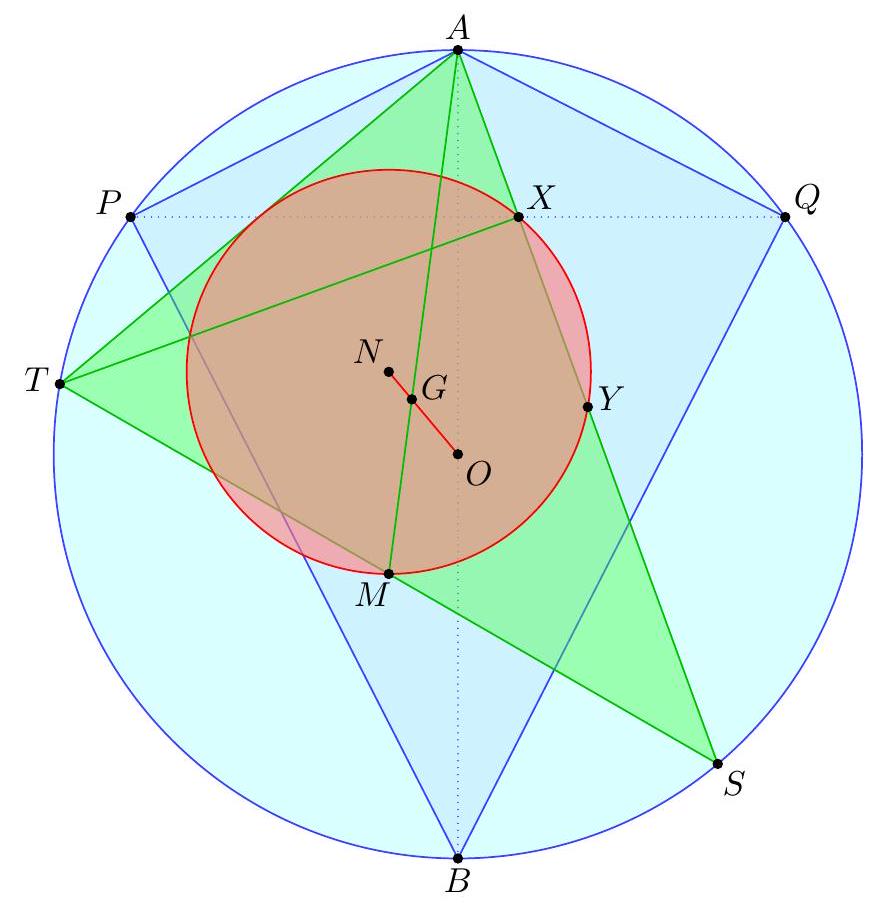
Let $R$ denote the radius of $\omega$. Note that the nine-point circle of $\triangle A S T$ has radius equal to $\frac{1}{2} R$, and hence is independent of $S$ and $T$. Then the power of $A$ with respect to the nine-point circle equals
and hence
which does not depend on the choice of $X$. So $N$ moves along a circle centered at $A$. Since the points $O, G, N$ are collinear on the Euler line of $\triangle A S T$ with
it follows by homothety that $G$ moves along a circle as well, whose center is situated one-third of the way from $A$ to $O$. Finally, since $A, G, M$ are collinear with
it follows that $M$ moves along a circle centered at the midpoint of $\overline{A O}$.
【 Power of a point solution (Zuming Feng, official solution). We complete the picture by letting $\triangle K Y X$ be the orthic triangle of $\triangle A S T$; in that case line $X Y$ meets the $\omega$ again at $P$ and $Q$.
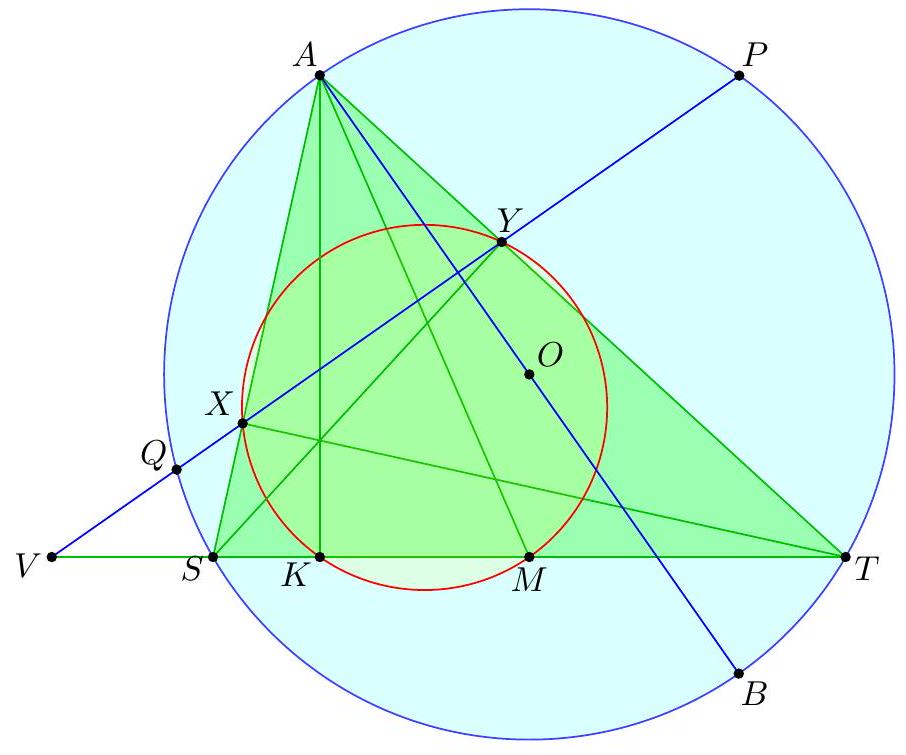
The main claim is: Claim - Quadrilateral $P Q K M$ is cyclic.
Proof. To see this, we use power of a point: let $V=\overline{Q X Y P} \cap \overline{S K M T}$. One approach is that since $(V K ; S T)=-1$ we have $V Q \cdot V P=V S \cdot V T=V K \cdot V M$. A longer approach is more elementary:
using the nine-point circle, and the circle with diameter $\overline{S T}$. But the circumcenter of $P Q K M$, is the midpoint of $\overline{A O}$, since it lies on the perpendicular bisectors of $\overline{K M}$ and $\overline{P Q}$. So it is fixed, the end.
§2 Solutions to Day 2
§2.1 JMO 2015/4, proposed by lurie Boreico
Available online at https://aops.com/community/p4774049.
Problem statement
Find all functions $f: \mathbb{Q} \rightarrow \mathbb{Q}$ such that
for all rational numbers $x<y<z<t$ that form an arithmetic progression.
Answer: any linear function $f$. These work. Here is one approach: for any $a$ and $d>0$
which imply
Thus we conclude that for arbitrary $x$ and $y$ we have
thus $f$ satisfies Jensen functional equation over $\mathbb{Q}$, so linear. The solution can be made to avoid appealing to Jensen's functional equation; here is a presentation of such a solution based on the official ones. Let $d>0$ be a positive integer, and let $n$ be an integer. Consider the two equations
Summing them and simplifying implies that
or equivalently
This implies that on the set of rational numbers with denominator dividing $d$, the function $f$ is linear.
In particular, we should have $f\left(\frac{n}{d}\right)=f(0)+\frac{n}{d} f(1)$ since $\frac{n}{d}, 0,1$ have denominators dividing $d$. This is the same as saying $f(q)=f(0)+q(f(1)-f(0))$ for any $q \in \mathbb{Q}$, which is what we wanted to prove.
§2.2 JMO 2015/5, proposed by Sungyoon Kim
Available online at https://aops.com/community/p4774099.
Problem statement
Let $A B C D$ be a cyclic quadrilateral. Prove that there exists a point $X$ on segment $\overline{B D}$ such that $\angle B A C=\angle X A D$ and $\angle B C A=\angle X C D$ if and only if there exists a point $Y$ on segment $\overline{A C}$ such that $\angle C B D=\angle Y B A$ and $\angle C D B=\angle Y D A$.
Both conditions are equivalent to $A B C D$ being harmonic.
Here is a complex solution. Extend $U$ and $V$ and shown. Thus $u=b d / a$ and $v=b d / c$.

Note $\overline{A V} \cap \overline{C U}$ lies on the perpendicular bisector of $\overline{B D}$ unconditionally. Then $X$ exists as described if and only if the midpoint of $\overline{B D}$ lies on $\overline{A V}$. In complex numbers this is $a+v=m+a v \bar{m}$, or
which is symmetric.
§2.3 JMO 2015/6, proposed by Maria Monks Gillespie
Available online at https://aops.com/community/p4774079.
Problem statement
Steve is piling $m \geq 1$ indistinguishable stones on the squares of an $n \times n$ grid. Each square can have an arbitrarily high pile of stones. After he finished piling his stones in some manner, he can then perform stone moves, defined as follows. Consider any four grid squares, which are corners of a rectangle, i.e. in positions $(i, k),(i, l),(j, k)$, $(j, l)$ for some $1 \leq i, j, k, l \leq n$, such that $i<j$ and $k<l$. A stone move consists of either removing one stone from each of $(i, k)$ and $(j, l)$ and moving them to $(i, l)$ and $(j, k)$ respectively, or removing one stone from each of $(i, l)$ and $(j, k)$ and moving them to $(i, k)$ and $(j, l)$ respectively.
Two ways of piling the stones are equivalent if they can be obtained from one another by a sequence of stone moves. How many different non-equivalent ways can Steve pile the stones on the grid?
The answer is $\binom{m+n-1}{n-1}^{2}$. The main observation is that the ordered sequence of column counts (i.e. the number of stones in the first, second, etc. column) is invariant under stone moves, as does the analogous sequence of row counts.
【 Definitions. Call these numbers $\left(c_{1}, c_{2}, \ldots, c_{n}\right)$ and $\left(r_{1}, r_{2}, \ldots, r_{n}\right)$ respectively, with $\sum c_{i}=\sum r_{i}=m$. We say that the sequence $\left(c_{1}, \ldots, c_{n}, r_{1}, \ldots, r_{n}\right)$ is the signature of the configuration. These are the $2 m$ blue and red numbers shown in the example below (in this example we have $m=8$ and $n=3$ ).

By stars-and-bars, the number of possible values $\left(c_{1}, \ldots, c_{n}\right)$ is $\binom{m+n-1}{n-1}$. The same is true for $\left(r_{1}, \ldots, r_{m}\right)$. So if we're just counting signatures, the total number of possible signatures is $\binom{m+n-1}{n-1}^{2}$.
【 Outline and setup. We are far from done. To show that the number of non-equivalent ways is also this number, we need to show that signatures correspond to pilings. In other words, we need to prove:
- Check that signatures are invariant around moves (trivial; we did this already);
- Check conversely that two configurations are equivalent if they have the same signatures (the hard part of the problem); and
- Show that each signature is realized by at least one configuration (not immediate, but pretty easy).
Most procedures to the second step are algorithmic in nature, but Ankan Bhattacharya gives the following far cleaner approach. Rather than having a grid of stones, we simply consider the multiset of ordered pairs $(x, y)$ corresponding to the stones. Then:
- a stone move corresponds to switching two $y$-coordinates in two different pairs.
- we redefine the signature to be the multiset $(X, Y)$ of $x$ and $y$ coordinates which appear. Explicitly, $X$ is the multiset that contains $c_{i}$ copies of the number $i$ for each $i$.
For example, consider the earlier example which had
- Two stones each at $(1,1),(1,2)$.
- One stone each at $(1,3),(2,1),(2,3),(3,2)$.
Its signature can then be reinterpreted as
In that sense, the entire grid is quite misleading!
I Proof that two configurations with the same signature are equivalent. The second part is completed just because transpositions generate any permutation. To be explicit, given two sets of stones, we can permute the labels so that the first set is $\left(x_{1}, y_{1}\right), \ldots$, $\left(x_{m}, y_{m}\right)$ and the second set of stones is $\left(x_{1}, y_{1}^{\prime}\right), \ldots,\left(x_{m}, y_{m}^{\prime}\right)$. Then we just induce the correct permutation on $\left(y_{i}\right)$ to get $\left(y_{i}^{\prime}\right)$.
I Proof that any signature has at least one configuration. Sort the elements of $X$ and $Y$ arbitrarily (say, in non-decreasing order). Put a stone whose $x$-coordinate is the $i$ th element of $X$, and whose $y$-coordinate is the $i$ th element of $Y$, for each $i=1,2, \ldots, m$. Then this gives a stone placement of $m$ stones with signature $(X, Y)$.
For example, if
then placing stones at $(1,1),(1,1),(1,1),(1,2),(1,2),(2,2),(2,3),(3,3)$ gives a valid piling with this signature.