


JMO 2016 Solution Notes
Evan Chen《陳誼廷》
15 April 2024
Abstract
This is a compilation of solutions for the 2016 JMO. The ideas of the solution are a mix of my own work, the solutions provided by the competition organizers, and solutions found by the community. However, all the writing is maintained by me.
These notes will tend to be a bit more advanced and terse than the "official" solutions from the organizers. In particular, if a theorem or technique is not known to beginners but is still considered "standard", then I often prefer to use this theory anyways, rather than try to work around or conceal it. For example, in geometry problems I typically use directed angles without further comment, rather than awkwardly work around configuration issues. Similarly, sentences like "let $\mathbb{R}$ denote the set of real numbers" are typically omitted entirely.
Corrections and comments are welcome!
Contents
0 Problems 1 Solutions to Day 1 1.1 JMO 2016/1, proposed by Ivan Borsenco, Zuming Feng ..... 3 1.2 JMO 2016/2, proposed by Evan Chen ..... 5 1.3 JMO 2016/3, proposed by Iurie Boreico 2 Solutions to Day 2 ..... 8 2.1 JMO 2016/4, proposed by Gregory Galperin ..... 8 2.2 JMO 2016/5, proposed by Zuming Feng, Jacek Fabrykowski ..... 9 2.3 JMO 2016/6, proposed by Titu Andreescu ..... 11
§0 Problems
- The isosceles triangle $\triangle A B C$, with $A B=A C$, is inscribed in the circle $\omega$. Let $P$ be a variable point on the arc $B C$ that does not contain $A$, and let $I_{B}$ and $I_{C}$ denote the incenters of triangles $\triangle A B P$ and $\triangle A C P$, respectively. Prove that as $P$ varies, the circumcircle of triangle $\triangle P I_{B} I_{C}$ passes through a fixed point.
- Prove that there exists a positive integer $n<10^{6}$ such that $5^{n}$ has six consecutive zeros in its decimal representation.
- Let $X_{1}, X_{2}, \ldots, X_{100}$ be a sequence of mutually distinct nonempty subsets of a set $S$. Any two sets $X_{i}$ and $X_{i+1}$ are disjoint and their union is not the whole set $S$, that is, $X_{i} \cap X_{i+1}=\emptyset$ and $X_{i} \cup X_{i+1} \neq S$, for all $i \in{1, \ldots, 99}$. Find the smallest possible number of elements in $S$.
- Find, with proof, the least integer $N$ such that if any 2016 elements are removed from the set ${1,2, \ldots, N}$, one can still find 2016 distinct numbers among the remaining elements with sum $N$.
- Let $\triangle A B C$ be an acute triangle, with $O$ as its circumcenter. Point $H$ is the foot of the perpendicular from $A$ to line $B C$, and points $P$ and $Q$ are the feet of the perpendiculars from $H$ to the lines $A B$ and $A C$, respectively. Given that
prove that the points $O, P$, and $Q$ are collinear. 6. Find all functions $f: \mathbb{R} \rightarrow \mathbb{R}$ such that for all real numbers $x$ and $y$,
§1 Solutions to Day 1
§1.1 JMO 2016/1, proposed by Ivan Borsenco, Zuming Feng
Available online at https://aops.com/community/p6213607.
Problem statement
The isosceles triangle $\triangle A B C$, with $A B=A C$, is inscribed in the circle $\omega$. Let $P$ be a variable point on the arc $B C$ that does not contain $A$, and let $I_{B}$ and $I_{C}$ denote the incenters of triangles $\triangle A B P$ and $\triangle A C P$, respectively. Prove that as $P$ varies, the circumcircle of triangle $\triangle P I_{B} I_{C}$ passes through a fixed point.
Let $M$ be the midpoint of arc $B C$ not containing $A$. We claim $M$ is the desired fixed point.
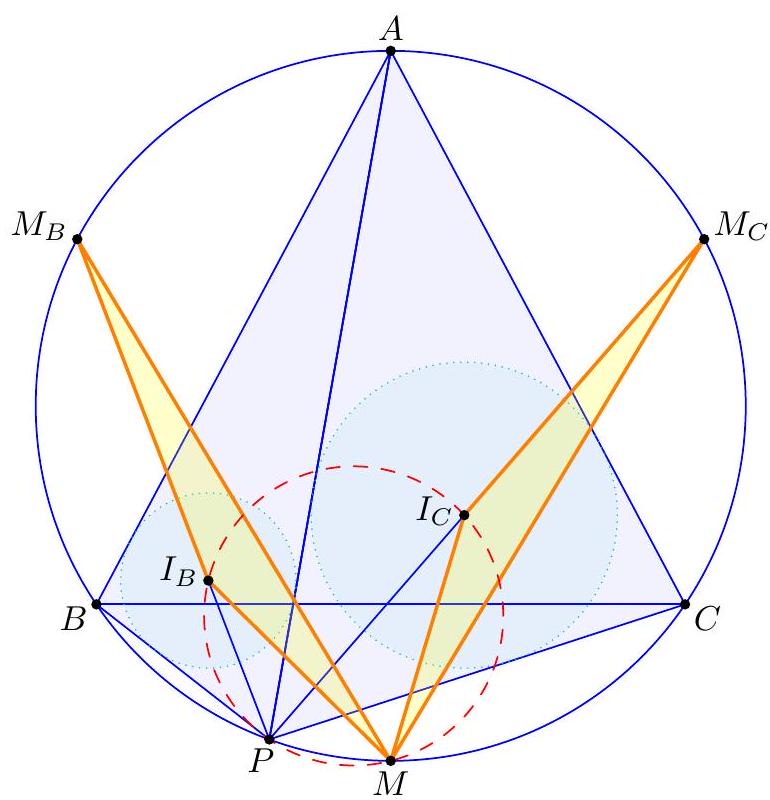
Let $M_{B}, M_{C}$ be the second intersections of $P I_{B}$ and $P I_{C}$ with circumcircle. Claim - We have $\triangle I_{B} M_{B} M \cong \triangle I_{C} M_{C} M$.
Proof. Note that
This implies the desired congruence. Since $\angle M P A=90^{\circ}$ and ray $P A$ bisects $\angle I_{B} P I_{C}$, the conclusion $M I_{B}=M I_{C}$ finishes the problem.
Remark 1.1. Complex in the obvious way DOES NOT WORK, because the usual claim ("the fixed point is arc midpoint") is FALSE if the hypothesis that $P$ lies in the interior of the arc is dropped. See figure below.
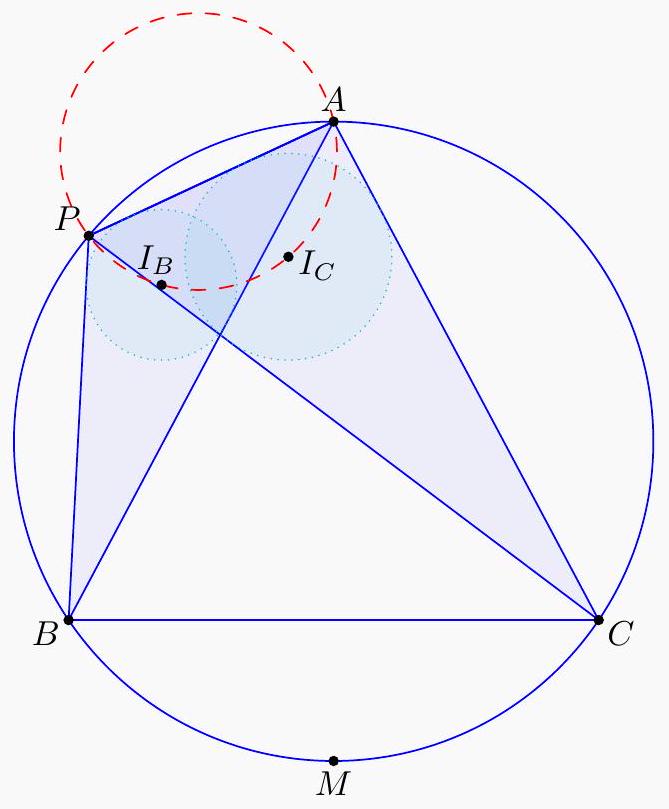
Fun story, I pointed this out to Zuming during grading; I was the only one that realized the subtlety.
§1.2 JMO 2016/2, proposed by Evan Chen
Available online at https://aops.com/community/p6213569.
Problem statement
Prove that there exists a positive integer $n<10^{6}$ such that $5^{n}$ has six consecutive zeros in its decimal representation.
We will prove that $n=20+2^{19}=524308$ fits the bill. First, we claim that
Indeed, the first equality holds since both sides are $0\left(\bmod 5^{20}\right)$, and the second by $\varphi\left(2^{20}\right)=2^{19}$ and Euler's theorem. Hence
In other words, the last 20 digits of $5^{n}$ will match the decimal representation of $5^{20}$, with leading zeros. However, we have
and hence those first six of those 20 digits will all be zero. This completes the proof! (To be concrete, it turns out that $5^{20}=95367431640625$ and so the last 20 digits of $5^{n}$ will be 00000095367431640625.$)$
Remark. Many of the first posts in the JMO 2016 discussion thread (see https://aops. com/community/c5h1230514) claimed that the problem was "super easy". In fact, the problem was solved by only about $10 %$ of contestants.
ब Authorship comments. This problem was inspired by the observation $5^{8} \equiv 5^{4}$ $\left(\bmod 10^{4}\right)$, i.e. that $5^{8}$ ended with 0625.
I noticed this one day back in November, when I was lying on my bed after a long afternoon and was mindlessly computing powers of 5 in my head because I was too tired to do much else. When I reached $5^{8}$ I noticed for the first time that the ending 0625 was actually induced by $5^{4}$. (Given how much MathCounts I did, I really should have known this earlier!)
Thinking about this for a few more seconds, I realized one could obtain arbitrarily long strings of 0 's by using a similar trick modulo larger powers of 10 . This surprised me, because I would have thought that if this was true, then I would have learned about it back in my contest days. However, I could not find any references, and I thought the result was quite nice, so I submitted it as a proposal for the JMO, where I thought it might be appreciated.
The joke about six consecutive zeros is due to Zuming Feng.
§1.3 JMO 2016/3, proposed by lurie Boreico
Available online at https://aops.com/community/p6213589.
Problem statement
Let $X_{1}, X_{2}, \ldots, X_{100}$ be a sequence of mutually distinct nonempty subsets of a set $S$. Any two sets $X_{i}$ and $X_{i+1}$ are disjoint and their union is not the whole set $S$, that is, $X_{i} \cap X_{i+1}=\emptyset$ and $X_{i} \cup X_{i+1} \neq S$, for all $i \in{1, \ldots, 99}$. Find the smallest possible number of elements in $S$.
Solution with Danielle Wang: the answer is that $|S| \geq 8$. 【 Proof that $|S| \geq 8$ is necessary. Since we must have $2^{|S|} \geq 100$, we must have $|S| \geq 7$. To see that $|S|=8$ is the minimum possible size, consider a chain on the set $S=$ ${1,2, \ldots, 7}$ satisfying $X_{i} \cap X_{i+1}=\emptyset$ and $X_{i} \cup X_{i+1} \neq S$. Because of these requirements any subset of size 4 or more can only be neighbored by sets of size 2 or less, of which there are $\binom{7}{1}+\binom{7}{2}=28$ available. Thus, the chain can contain no more than 29 sets of size 4 or more and no more than 28 sets of size 2 or less. Finally, since there are only $\binom{7}{3}=35$ sets of size 3 available, the total number of sets in such a chain can be at most $29+28+35=92<100$, contradiction.
ब Construction. We will provide an inductive construction for a chain of subsets $X_{1}, X_{2}, \ldots, X_{2^{n-1}+1}$ of $S={1, \ldots, n}$ satisfying $X_{i} \cap X_{i+1}=\varnothing$ and $X_{i} \cup X_{i+1} \neq S$ for each $n \geq 4$.
For $S={1,2,3,4}$, the following chain of length $2^{3}+1=9$ will work:
Now, given a chain of subsets of ${1,2, \ldots, n}$ the following procedure produces a chain of subsets of ${1,2, \ldots, n+1}$ :
- take the original chain, delete any element, and make two copies of this chain, which now has even length;
- glue the two copies together, joined by $\varnothing$ in between; and then
- insert the element $n+1$ into the sets in alternating positions of the chain starting with the first.
For example, the first iteration of this construction gives:
It can be easily checked that if the original chain satisfies the requirements, then so does the new chain, and if the original chain has length $2^{n-1}+1$, then the new chain has length $2^{n}+1$, as desired. This construction yields a chain of length 129 when $S={1,2, \ldots, 8}$.
Remark. Here is the construction for $n=8$ in its full glory.
| 345678 | 1 | 235678 | 4 | 125678 | 3 | 145678 | 2 | 5678 |
|---|---|---|---|---|---|---|---|---|
| 34 | 15678 | 23 | 45678 | 12 | 35678 | 14 | 678 | |
| 345 | 1678 | 235 | 4678 | 125 | 3678 | 145 | 2678 | 5 |
| 34678 | 15 | 23678 | 45 | 12678 | 35 | 78 | ||
| 3456 | 178 | 2356 | 478 | 1256 | 378 | 1456 | 278 | 56 |
| 3478 | 156 | 2378 | 456 | 1278 | 356 | 1478 | 6 | |
| 34578 | 16 | 23578 | 46 | 12578 | 36 | 14578 | 26 | 578 |
| 346 | 1578 | 236 | 4578 | 126 | 8 | |||
| 34567 | 18 | 23567 | 48 | 12567 | 38 | 14567 | 28 | 567 |
| 348 | 1567 | 238 | 4567 | 128 | 3567 | 148 | 67 | |
| 3458 | 167 | 2358 | 467 | 1258 | 367 | 1458 | 267 | 58 |
| 3467 | 158 | 2367 | 458 | 1267 | 358 | 7 | ||
| 34568 | 17 | 23568 | 47 | 12568 | 37 | 14568 | 27 | 568 |
| 347 | 1568 | 237 | 4568 | 127 | 3568 | 147 | 68 | |
| 3457 | 168 | 2357 | 468 | 1257 | 368 | 1457 | 268 | 57 |
| 3468 | 157 | 2368 | 457 | 1268 |
§2 Solutions to Day 2
§2.1 JMO 2016/4, proposed by Gregory Galperin
Available online at https://aops.com/community/p6220314.
Problem statement
Find, with proof, the least integer $N$ such that if any 2016 elements are removed from the set ${1,2, \ldots, N}$, one can still find 2016 distinct numbers among the remaining elements with sum $N$.
The answer is
\ Proof that $N \geq 6097392$ is necessary. To see that $N$ must be at least this large, consider the situation when $1,2, \ldots, 2016$ are removed. Among the remaining elements, any sum of 2016 elements is certainly at least $2017+2018+\cdots+4032$. \ा Proof that $N=6097392$ does in fact work. Consider the 3024 pairs of numbers $(1,6048),(2,6047), \ldots,(3024,3025)$. Regardless of which 2016 elements of ${1,2, \ldots, N}$ are deleted, at least $3024-2016=1008$ of these pairs have both elements remaining. Since each pair has sum 6049, we can take these pairs to be the desired numbers.
§2.2 JMO 2016/5, proposed by Zuming Feng, Jacek Fabrykowski
Available online at https://aops.com/community/p6220305.
Problem statement
Let $\triangle A B C$ be an acute triangle, with $O$ as its circumcenter. Point $H$ is the foot of the perpendicular from $A$ to line $B C$, and points $P$ and $Q$ are the feet of the perpendiculars from $H$ to the lines $A B$ and $A C$, respectively.
Given that
prove that the points $O, P$, and $Q$ are collinear.
We present two approaches.
【 First approach (synthetic). First, since $A P \cdot A B=A H^{2}=A Q \cdot A C$, it follows that $P Q C B$ is cyclic. Consequently, we have $A O \perp P Q$.
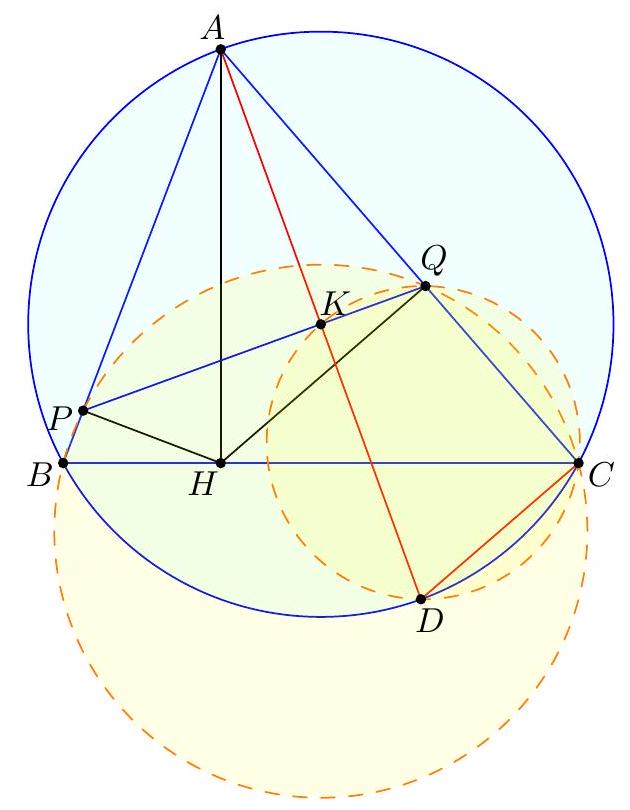
Let $K$ be the foot of $A$ onto $P Q$, and let $D$ be the point diametrically opposite $A$. Thus $A, K, O, D$ are collinear.
Since quadrilateral $K Q C D$ is cyclic $\left(~ \angle Q K D=\angle Q C D=90^{\circ}\right)$, we have
so $K=O$.
ब Second approach (coordinates), with Joshua Hsieh. We impose coordinates with $H$ at the origin and $A=(0, a), B=(-b, 0), C=(c, 0)$, for $a, b, c>0$.
Claim - The circumcenter has coordinates $\left(\frac{c-b}{2}, \frac{a}{2}-\frac{b c}{2 a}\right)$.
Proof. This is a known lemma but but we reproduce its proof for completeness. It uses the following steps:
- By power of a point, the second intersection of line $A H$ with the circumcircle is $\left(0,-\frac{b c}{a}\right)$.
- Since the orthocenter is the reflection of this point across line $B C$, the orthocenter is given exactly by $\left(0, \frac{b c}{a}\right)$.
- The centroid is is $\frac{\vec{A}+\vec{B}+\vec{C}}{3}=\left(\frac{c-b}{3}, \frac{a}{3}\right)$.
- Since $\vec{H}-\vec{O}=3(\vec{G}-\vec{O})$ according to the Euler line, we have $\vec{O}=\frac{3}{2} \vec{G}-\frac{1}{2} \vec{H}$. This gives the desired formula.
Note that $H Q=\frac{H A \cdot H C}{A C}=\frac{a c}{\sqrt{a^{2}+c^{2}}}$. If we let $T$ be the foot from $Q$ to $B C$, then $\triangle H Q T \tilde{+} \triangle A H C$ and so the $x$-coordinate of $Q$ is given by $H Q \cdot \frac{A H}{A C}=\frac{a^{2} c}{a^{2}+c^{2}}$. Repeating the analogous calculation for $Q$ and $P$ gives
Then, $O, P, Q$ are collinear if and only if the following shoelace determinant vanishes (with denominators cleared out):
On the other hand,
So the conditions are equivalent.
§2.3 JMO 2016/6, proposed by Titu Andreescu
Available online at https://aops.com/community/p6220308.
Problem statement
Find all functions $f: \mathbb{R} \rightarrow \mathbb{R}$ such that for all real numbers $x$ and $y$,
We claim that the only two functions satisfying the requirements are $f(x) \equiv 0$ and $f(x) \equiv x^{2}$. These work.
First, taking $x=y=0$ in the given yields $f(0)=0$, and then taking $x=0$ gives $f(y) f(-y)=f(y)^{2}$. So also $f(-y)^{2}=f(y) f(-y)$, from which we conclude $f$ is even. Then taking $x=-y$ gives
for all $x$. Remark. Note that an example of a function satisfying $(\boldsymbol{\star})$ is
So, yes, we are currently in a world of trouble, still. (This function is even continuous; I bring this up to emphasize that "continuity" is completely unrelated to the issue at hand.)
Now we claim
Proof. Let $(x, y)=(3 t, t)$ in the given to get
Now if $f(4 t) \neq 0$ (in particular, $t \neq 0$ ), then $f(8 t) \neq 0$. Thus we have $(\boldsymbol{\phi})$ in the reverse direction.
Then $f(4 t) \neq 0 \xlongequal{(\star)} f(t)=t^{2} \neq 0 \xlongequal{(\bullet)} f(2 t) \neq 0$ implies the forwards direction, the last step being the reverse direction
By putting together $(\boldsymbol{\star})$ and $(\boldsymbol{\leftrightarrow})$ we finally get
We are now ready to approach the main problem. Assume there's an $a \neq 0$ for which $f(a)=0$; we show that $f \equiv 0$.
Let $b \in \mathbb{R}$ be given. Since $f$ is even, we can assume without loss of generality that $a, b>0$. Also, note that $f(x) \geq 0$ for all $x$ by ( $($ ). By using ( $\boldsymbol{\sim}$ ) we can generate $c>b$ such that $f(c)=0$ by taking $c=2^{n} a$ for a large enough integer $n$. Now, select $x, y>0$ such that $x-3 y=b$ and $x+y=c$. That is,
Substitution into the original equation gives
But since $f(b) \geq 0$, it follows $f(b)=0$, as desired.