


APMO 1989 - Problems and Solutions
Problem 1
Let $x_{1}, x_{2}, \ldots, x_{n}$ be positive real numbers, and let
Prove that
Solution 1
Let $\sigma_{k}$ be the $k$ th symmetric polynomial, namely
and more explicitly
Then
The expansion of
has at least $k$ ! occurrences of $\prod_{i \in S} x_{i}$ for each subset $S$ with $k$ indices from ${1,2, \ldots, n}$. In fact, if $\pi$ is a permutation of $S$, we can choose each $x_{\pi(i)}$ from the $i$ th factor of $\left(x_{1}+x_{2}+\cdots+x_{n}\right)^{k}$. Then each term appears at least $k$ ! times, and
Summing the obtained inequalities for $k=1,2, \ldots, n$ yields the result.
Solution 2
By AM-GM,
By the binomial theorem,
and the result follows. Comment: Maclaurin's inequality states that
Then $\sigma_{k} \leq\binom{ n}{k} \frac{S^{k}}{n^{k}}=\frac{1}{k!} \frac{n(n-1) \ldots(n-k+1)}{n^{k}} S^{k} \leq \frac{S^{k}}{k!}$.
Problem 2
Prove that the equation
has no solutions in integers except $a=b=c=n=0$.
Solution
We can suppose without loss of generality that $a, b, c, n \geq 0$. Let $(a, b, c, n)$ be a solution with minimum sum $a+b+c+n$. Suppose, for the sake of contradiction, that $a+b+c+n>0$. Since 6 divides $5 n^{2}, n$ is a multiple of 6 . Let $n=6 n_{0}$. Then the equation reduces to
The number $c$ is a multiple of 3 , so let $c=3 c_{0}$. The equation now reduces to
Now look at the equation modulo 8:
Integers $b$ and $c_{0}$ have the same parity. Either way, since $x^{2}$ is congruent to 0 or 1 modulo 4 , $b^{2}+3 c_{0}^{2}$ is a multiple of 4 , so $n_{0}^{2}-a^{2}=\left(n_{0}-a\right)\left(n_{0}+a\right)$ is even, and therefore also a multiple of 4 , since $n_{0}-a$ and $n_{0}+a$ have the same parity. Hence $2\left(n_{0}^{2}-a^{2}\right)$ is a multiple of 8 , and
If $b$ and $c_{0}$ are both odd, $b^{2}+3 c_{0}^{2} \equiv 4(\bmod 8)$, which is impossible. Then $b$ and $c_{0}$ are both even. Let $b=2 b_{0}$ and $c_{0}=2 c_{1}$, and we find
Look at the last equation modulo 8:
A similar argument shows that $a$ and $n_{0}$ are both even. We have proven that $a, b, c, n$ are all even. Then, dividing the original equation by 4 we find
and we find that $(a / 2, b / 2, c / 2, n / 2)$ is a new solution with smaller sum. This is a contradiction, and the only solution is $(a, b, c, n)=(0,0,0,0)$.
Problem 3
Let $A_{1}, A_{2}, A_{3}$ be three points in the plane, and for convenience,let $A_{4}=A_{1}, A_{5}=A_{2}$. For $n=1,2$, and 3 , suppose that $B_{n}$ is the midpoint of $A_{n} A_{n+1}$, and suppose that $C_{n}$ is the midpoint of $A_{n} B_{n}$. Suppose that $A_{n} C_{n+1}$ and $B_{n} A_{n+2}$ meet at $D_{n}$, and that $A_{n} B_{n+1}$ and $C_{n} A_{n+2}$ meet at $E_{n}$. Calculate the ratio of the area of triangle $D_{1} D_{2} D_{3}$ to the area of triangle $E_{1} E_{2} E_{3}$.
Answer: $\frac{25}{49}$.
Solution
Let $G$ be the centroid of triangle $A B C$, and also the intersection point of $A_{1} B_{2}, A_{2} B_{3}$, and $A_{3} B_{1}$ 。
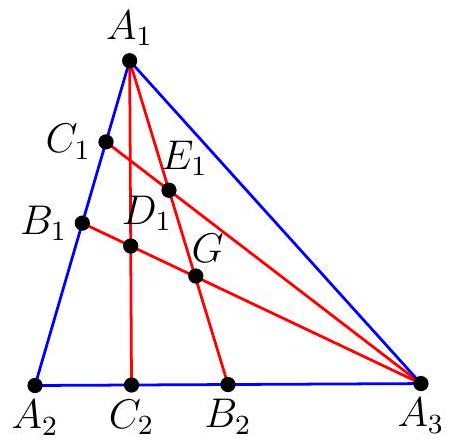
By Menelao's theorem on triangle $B_{1} A_{2} A_{3}$ and line $A_{1} D_{1} C_{2}$,
Since $A_{3} G=\frac{2}{3} A_{3} B_{1}$, if $A_{3} B_{1}=21 t$ then $G A_{3}=14 t, D_{1} B_{1}=\frac{21 t}{7}=3 t, A_{3} D_{1}=18 t$, and $G D_{1}=A_{3} D_{1}-A_{3} G=18 t-14 t=4 t$, and
Similar results hold for the other medians, therefore $D_{1} D_{2} D_{3}$ and $A_{1} A_{2} A_{3}$ are homothetic with center $G$ and ratio $-\frac{2}{7}$. By Menelao's theorem on triangle $A_{1} A_{2} B_{2}$ and line $C_{1} E_{1} A_{3}$,
If $A_{1} B_{2}=15 u$, then $A_{1} G=\frac{2}{3} \cdot 15 u=10 u$ and $G E_{1}=A_{1} G-A_{1} E_{1}=10 u-\frac{2}{5} \cdot 15 u=4 u$, and
Similar results hold for the other medians, therefore $E_{1} E_{2} E_{3}$ and $A_{1} A_{2} A_{3}$ are homothetic with center $G$ and ratio $\frac{2}{5}$. Then $D_{1} D_{2} D_{3}$ and $E_{1} E_{2} E_{3}$ are homothetic with center $G$ and ratio $-\frac{2}{7}: \frac{2}{5}=-\frac{5}{7}$, and the ratio of their area is $\left(\frac{5}{7}\right)^{2}=\frac{25}{49}$.
Problem 4
Let $S$ be a set consisting of $m$ pairs $(a, b)$ of positive integers with the property that $1 \leq a<$ $b \leq n$. Show that there are at least
triples $(a, b, c)$ such that $(a, b),(a, c)$, and $(b, c)$ belong to $S$.
Solution
Call a triple $(a, b, c)$ good if and only if $(a, b),(a, c)$, and $(b, c)$ all belong to $S$. For $i$ in ${1,2, \ldots, n}$, let $d_{i}$ be the number of pairs in $S$ that contain $i$, and let $D_{i}$ be the set of numbers paired with $i$ in $S$ (so $\left|D_{i}\right|=d_{i}$ ). Consider a pair $(i, j) \in S$. Our goal is to estimate the number of integers $k$ such that any permutation of ${i, j, k}$ is good, that is, $\left|D_{i} \cap D_{j}\right|$. Note that $i \notin D_{i}$ and $j \notin D_{j}$, so $i, j \notin D_{i} \cap D_{j}$; thus any $k \in D_{i} \cap D_{j}$ is different from both $i$ and $j$, and ${i, j, k}$ has three elements as required. Now, since $D_{i} \cup D_{j} \subseteq{1,2, \ldots, n}$,
Summing all the results, and having in mind that each good triple is counted three times (one for each two of the three numbers), the number of good triples $T$ is at least
Each term $d_{i}$ appears each time $i$ is in a pair from $S$, that is, $d_{i}$ times; there are $m$ pairs in $S$, so $n$ is subtracted $m$ times. By the Cauchy-Schwartz inequality
Finally, the sum $\sum_{i=1}^{n} d_{i}$ is $2 m$, since $d_{i}$ counts the number of pairs containing $i$, and each pair $(i, j)$ is counted twice: once in $d_{i}$ and once in $d_{j}$. Therefore
Comment: This is a celebrated graph theory fact named Goodman's bound, after A. M. Goodman's method published in 1959. The generalized version of the problem is still studied to this day.
Problem 5
Determine all functions $f$ from the reals to the reals for which (1) $f(x)$ is strictly increasing, (2) $f(x)+g(x)=2 x$ for all real $x$, where $g(x)$ is the composition inverse function to $f(x)$. (Note: $f$ and $g$ are said to be composition inverses if $f(g(x))=x$ and $g(f(x))=x$ for all real x.)
Answer: $f(x)=x+c, c \in \mathbb{R}$ constant.
Solution
Denote by $f_{n}$ the $n$th iterate of $f$, that is, $f_{n}(x)=\underbrace{f(f(\ldots f}{n \text { times }}(x)))$. Plug $x \rightarrow f{n+1}(x)$ in (2): since $g\left(f_{n+1}(x)\right)=g\left(f\left(f_{n}(x)\right)\right)=f_{n}(x)$,
that is,
Therefore $f_{n}(x)-f_{n-1}(x)$ does not depend on $n$, and is equal to $f(x)-x$. Summing the corresponding results for smaller values of $n$ we find
Since $g$ has the same properties as $f$,
Finally, $g$ is also increasing, because since $f$ is increasing $g(x)>g(y) \Longrightarrow f(g(x))>$ $f(g(y)) \Longrightarrow x>y$. An induction proves that $f_{n}$ and $g_{n}$ are also increasing functions. Let $x>y$ be real numbers. Since $f_{n}$ and $g_{n}$ are increasing,
and
Summing it up,
Suppose that $a=f(x)-x$ and $b=f(y)-y$ are distinct. Then, for all positive integers $n$,
which is false for a sufficiently large $n$. Hence $a=b$, and $f(x)-x$ is a constant $c$ for all $x \in \mathbb{R}$, that is, $f(x)=x+c$. It is immediate that $f(x)=x+c$ satisfies the problem, as $g(x)=x-c$.