| # APMO 1991 - Problems and Solutions |
|
|
| ## Problem 1 |
|
|
| Let $G$ be the centroid of triangle $A B C$ and $M$ be the midpoint of $B C$. Let $X$ be on $A B$ and $Y$ on $A C$ such that the points $X, Y$, and $G$ are collinear and $X Y$ and $B C$ are parallel. Suppose that $X C$ and $G B$ intersect at $Q$ and $Y B$ and $G C$ intersect at $P$. Show that triangle $M P Q$ is similar to triangle $A B C$. |
|
|
| ## Solution 1 |
|
|
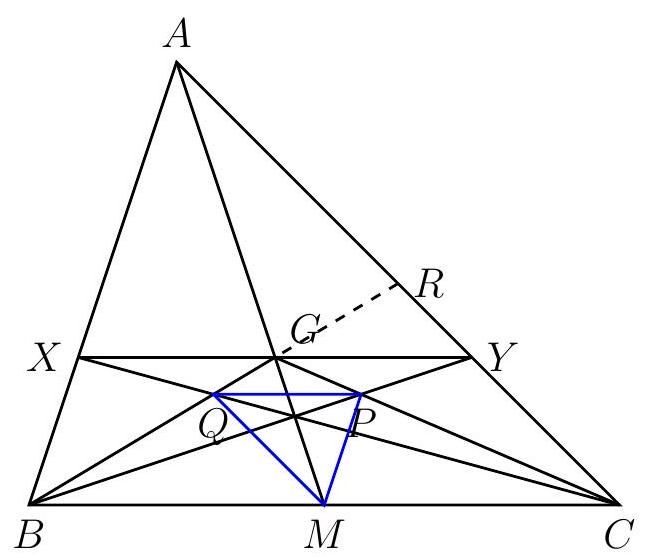
| Let $R$ be the midpoint of $A C$; so $B R$ is a median and contains the centroid $G$. |
|  |
|
|
| It is well known that $\frac{A G}{A M}=\frac{2}{3}$; thus the ratio of the similarity between $A X Y$ and $A B C$ is $\frac{2}{3}$. Hence $G X=\frac{1}{2} X Y=\frac{1}{3} B C$. |
| Now look at the similarity between triangles $Q B C$ and $Q G X$ : |
|
|
| $$ |
| \frac{Q G}{Q B}=\frac{G X}{B C}=\frac{1}{3} \Longrightarrow Q B=3 Q G \Longrightarrow Q B=\frac{3}{4} B G=\frac{3}{4} \cdot \frac{2}{3} B R=\frac{1}{2} B R . |
| $$ |
|
|
| Finally, since $\frac{B M}{B C}=\frac{B Q}{B R}, M Q$ is a midline in $B C R$. Therefore $M Q=\frac{1}{2} C R=\frac{1}{4} A C$ and $M Q \| A C$. Similarly, $M P=\frac{1}{4} A B$ and $M P \| A B$. This is sufficient to establish that $M P Q$ and $A B C$ are similar (with similarity ratio $\frac{1}{4}$ ). |
|
|
| ## Solution 2 |
|
|
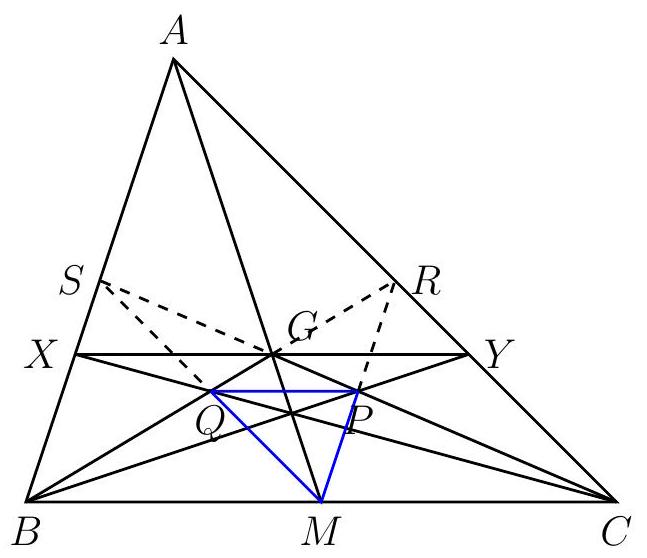
| Let $S$ and $R$ be the midpoints of $A B$ and $A C$, respectively. Since $G$ is the centroid, it lies in the medians $B R$ and $C S$. |
|  |
|
|
| Due to the similarity between triangles $Q B C$ and $Q G X$ (which is true because $G X \| B C$ ), there is an inverse homothety with center $Q$ and ratio $-\frac{X G}{B C}=\frac{X Y}{2 B C}$ that takes $B$ to $G$ and $C$ to $X$. This homothety takes the midpoint $M$ of $B C$ to the midpoint $K$ of $G X$. |
|
|
| Now consider the homothety that takes $B$ to $X$ and $C$ to $G$. This new homothety, with ratio $\frac{X Y}{2 B C}$, also takes $M$ to $K$. Hence lines $B X$ (which contains side $A B$ ), $C G$ (which contains the median $C S$ ), and $M K$ have a common point, which is $S$. Thus $Q$ lies on midline $M S$. |
| The same reasoning proves that $P$ lies on midline $M R$. Since all homothety ratios are the same, $\frac{M Q}{M S}=\frac{M P}{M R}$, which shows that $M P Q$ is similar to $M R S$, which in turn is similar to $A B C$, and we are done. |
|
|
| ## Problem 2 |
|
|
| Suppose there are 997 points given in a plane. If every two points are joined by a line segment with its midpoint coloured in red, show that there are at least 1991 red points in the plane. Can you find a special case with exactly 1991 red points? |
|
|
| ## Solution |
|
|
| Embed the points in the cartesian plane such that no two points have the same $y$-coordinate. Let $P_{1}, P_{2}, \ldots, P_{997}$ be the points and $y_{1}<y_{2}<\ldots<y_{997}$ be their respective $y$-coordinates. Then the $y$-coordinate of the midpoint of $P_{i} P_{i+1}, i=1,2, \ldots, 996$ is $\frac{y_{i}+y_{i+1}}{2}$ and the $y$-coordinate of the midpoint of $P_{i} P_{i+2}, i=1,2, \ldots, 995$ is $\frac{y_{i}+y_{i+2}}{2}$. Since |
| |
| $$ |
| \frac{y_{1}+y_{2}}{2}<\frac{y_{1}+y_{3}}{2}<\frac{y_{2}+y_{3}}{2}<\frac{y_{2}+y_{4}}{2}<\cdots<\frac{y_{995}+y_{997}}{2}<\frac{y_{996}+y_{997}}{2} |
| $$ |
| |
| there are at least $996+995=1991$ distinct midpoints, and therefore at least 1991 red points. The equality case happens if we take $P_{i}=(0,2 i), i=1,2, \ldots, 997$. The midpoints are $(0, i+j)$, $1 \leq i<j \leq 997$, which are the points $(0, k)$ with $1+2=3 \leq k \leq 996+997=1993$, a total of $1993-3+1=1991$ red points. |
| |
| ## Problem 3 |
| |
| Let $a_{1}, a_{2}, \ldots, a_{n}, b_{1}, b_{2}, \ldots, b_{n}$ be positive real numbers such that $a_{1}+a_{2}+\cdots+a_{n}=b_{1}+b_{2}+$ $\cdots+b_{n}$. Show that |
| |
| $$ |
| \frac{a_{1}^{2}}{a_{1}+b_{1}}+\frac{a_{2}^{2}}{a_{2}+b_{2}}+\cdots+\frac{a_{n}^{2}}{a_{n}+b_{n}} \geq \frac{a_{1}+a_{2}+\cdots+a_{n}}{2} |
| $$ |
| |
| ## Solution |
| |
| By the Cauchy-Schwartz inequality, |
| |
| $$ |
| \left(\frac{a_{1}^{2}}{a_{1}+b_{1}}+\frac{a_{2}^{2}}{a_{2}+b_{2}}+\cdots+\frac{a_{n}^{2}}{a_{n}+b_{n}}\right)\left(\left(a_{1}+b_{1}\right)+\left(a_{2}+b_{2}\right)+\cdots+\left(a_{n}+b_{n}\right)\right) \geq\left(a_{1}+a_{2}+\cdots+a_{n}\right)^{2} . |
| $$ |
| |
| Since $\left(\left(a_{1}+b_{1}\right)+\left(a_{2}+b_{2}\right)+\cdots+\left(a_{n}+b_{n}\right)\right)=2\left(a_{1}+a_{2}+\cdots+a_{n}\right)$, |
| |
| $$ |
| \frac{a_{1}^{2}}{a_{1}+b_{1}}+\frac{a_{2}^{2}}{a_{2}+b_{2}}+\cdots+\frac{a_{n}^{2}}{a_{n}+b_{n}} \geq \frac{\left(a_{1}+a_{2}+\cdots+a_{n}\right)^{2}}{2\left(a_{1}+a_{2}+\cdots+a_{n}\right)}=\frac{a_{1}+a_{2}+\cdots+a_{n}}{2} |
| $$ |
| |
| ## Problem 4 |
| |
| During a break, $n$ children at school sit in a circle around their teacher to play a game. The teacher walks clockwise close to the children and hands out candies to some of them according to the following rule. He selects one child and gives him a candy, then he skips the next child and gives a candy to the next one, then he skips 2 and gives a candy to the next one, then he skips 3, and soon. Determine the values of $n$ for which eventually, perhaps after many rounds, all children will have at least one candy each. |
| |
| Answer: All powers of 2 . |
| |
| ## Solution 1 |
| |
| Number the children from 0 to $n-1$. Then the teacher hands candy to children in positions $f(x)=1+2+\cdots+x \bmod n=\frac{x(x+1)}{2} \bmod n$. Our task is to find the range of $f: \mathbb{Z}_{n} \rightarrow \mathbb{Z}_{n}$, and to verify whether the range is $\mathbb{Z}_{n}$, that is, whether $f$ is a bijection. |
| If $n=2^{a} m, m>1$ odd, look at $f(x)$ modulo $m$. Since $m$ is odd, $m|f(x) \Longleftrightarrow m| x(x+1)$. Then, for instance, $f(x) \equiv 0(\bmod m)$ for $x=0$ and $x=m-1$. This means that $f(x)$ is not a bijection modulo $m$, and there exists $t$ such that $f(x) \not \equiv t(\bmod m)$ for all $x$. By the Chinese Remainder Theorem, |
|
|
| $$ |
| f(x) \equiv t \quad(\bmod n) \Longleftrightarrow \begin{cases}f(x) \equiv t & \left(\bmod 2^{a}\right) \\ f(x) \equiv t & (\bmod m)\end{cases} |
| $$ |
|
|
| Therefore, $f$ is not a bijection modulo $n$. |
| If $n=2^{a}$, then |
|
|
| $$ |
| f(x)-f(y)=\frac{1}{2}(x(x+1)-y(y+1))=\frac{1}{2}\left(x^{2}-y^{2}+x-y\right)=\frac{(x-y)(x+y+1)}{2} . |
| $$ |
|
|
| and |
|
|
| $$ |
| f(x) \equiv f(y) \quad\left(\bmod 2^{a}\right) \Longleftrightarrow(x-y)(x+y+1) \equiv 0 \quad\left(\bmod 2^{a+1}\right) |
| $$ |
|
|
| If $x$ and $y$ have the same parity, $x+y+1$ is odd and $(*)$ is equivalent to $x \equiv y\left(\bmod 2^{a+1}\right)$. If $x$ and $y$ have different parity, |
| |
| $$ |
| (*) \Longleftrightarrow x+y+1 \equiv 0 \quad\left(\bmod 2^{a+1}\right) |
| $$ |
|
|
| However, $1 \leq x+y+1 \leq 2\left(2^{a}-1\right)+1=2^{a+1}-1$, so $x+y+1$ is not a multiple of $2^{a+1}$. Therefore $f$ is a bijection if $n$ is a power of 2 . |
|
|
| ## Solution 2 |
|
|
| We give a full description of $a_{n}$, the size of the range of $f$. |
| Since congruences modulo $n$ are defined, via Chinese Remainder Theorem, by congruences modulo $p^{\alpha}$ for all prime divisors $p$ of $n$ and $\alpha$ being the number of factors $p$ in the factorization of $n, a_{n}=\prod_{p^{\alpha} \| n} a_{p^{\alpha}}$. |
| Refer to the first solution to check the case $p=2: a_{2^{\alpha}}=2^{\alpha}$. |
| For an odd prime $p$, |
| |
| $$ |
| f(x)=\frac{x(x+1)}{2}=\frac{(2 x+1)^{2}-1}{8} |
| $$ |
| |
| and since $p$ is odd, there is a bijection between the range of $f$ and the quadratic residues modulo $p^{\alpha}$, namely $t \mapsto 8 t+1$. So $a_{p^{\alpha}}$ is the number of quadratic residues modulo $p^{\alpha}$. |
| Let $g$ be a primitive root of $p^{\alpha}$. Then there are $\frac{1}{2} \phi\left(p^{\alpha}\right)=\frac{p-1}{2} \cdot p^{\alpha-1}$ quadratic residues that are coprime with $p: 1, g^{2}, g^{4}, \ldots, g^{\phi\left(p^{n}\right)-2}$. If $p$ divides a quadratic residue $k p$, that is, $x^{2} \equiv k p$ $\left(\bmod p^{\alpha}\right), \alpha \geq 2$, then $p$ divides $x$ and, therefore, also $k$. Hence $p^{2}$ divides this quadratic residue, and these quadratic residues are $p^{2}$ times each quadratic residue of $p^{\alpha-2}$. Thus |
|
|
| $$ |
| a_{p^{\alpha}}=\frac{p-1}{2} \cdot p^{\alpha-1}+a_{p^{\alpha}-2} . |
| $$ |
|
|
| Since $a_{p}=\frac{p-1}{2}+1$ and $a_{p^{2}}=\frac{p-1}{2} \cdot p+1$, telescoping yields |
|
|
| $$ |
| a_{p^{2 t}}=\frac{p-1}{2}\left(p^{2 t-1}+p^{2 t-3}+\cdots+p\right)+1=\frac{p\left(p^{2 t}-1\right)}{2(p+1)}+1 |
| $$ |
| |
| and |
| |
| $$ |
| a_{p^{2 t-1}}=\frac{p-1}{2}\left(p^{2 t-2}+p^{2 t-4}+\cdots+1\right)+1=\frac{p^{2 t}-1}{2(p+1)}+1 |
| $$ |
|
|
| Now the problem is immediate: if $n$ is divisible by an odd prime $p, a_{p^{\alpha}}<p^{\alpha}$ for all $\alpha$, and since $a_{t} \leq t$ for all $t, a_{n}<n$. |
| |
| ## Problem 5 |
| |
| Given are two tangent circles and a point $P$ on their common tangent perpendicular to the lines joining their centres. Construct with ruler and compass all the circles that are tangent to these two circles and pass through the point $P$. |
| |
| ## Solution |
| |
| Throughout this problem, we will assume that the given circles are externally tangent, since the problem does not have a solution otherwise. |
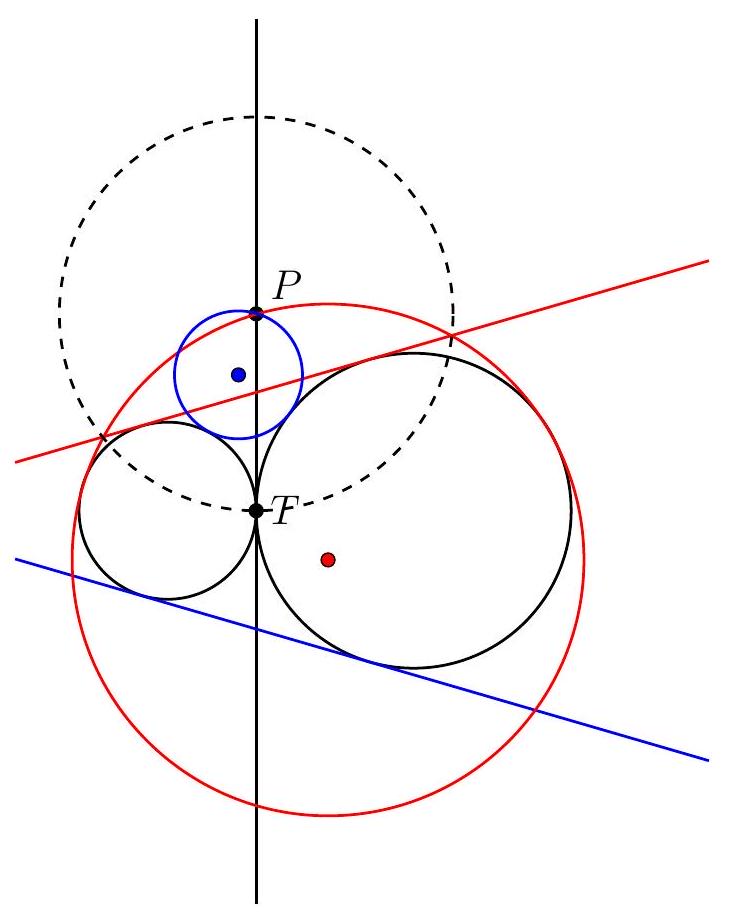
| Let $\Gamma_{1}$ and $\Gamma_{2}$ be the given circles and $T$ be their tangency point. Suppose $\omega$ is a circle that is tangent to $\Gamma_{1}$ and $\Gamma_{2}$ and passes through $P$. |
| Now invert about point $P$, with radius $P T$. Let any line through $P$ that cuts $\Gamma_{1}$ do so at points $X$ and $Y$. The power of $P$ with respect to $\Gamma_{1}$ is $P T^{2}=P X \cdot P Y$, so $X$ and $Y$ are swapped by this inversion. Therefore $\Gamma_{1}$ is mapped to itself in this inversion. The same applies to $\Gamma_{2}$. Since circle $\omega$ passes through $P$, it is mapped to a line tangent to the images of $\Gamma_{1}$ (itself) and $\Gamma_{2}$ (also itself), that is, a common tangent line. This common tangent cannot be $P T$, as $P T$ is also mapped to itself. Since $\Gamma_{1}$ and $\Gamma_{2}$ have exactly other two common tangent lines, there are two solutions: the inverses of the tangent lines. |
|  |
| |
| We proceed with the construction with the aid of some macro constructions that will be detailed later. |
| |
| Step 1. Draw the common tangents to $\Gamma_{1}$ and $\Gamma_{2}$. |
| Step 2. For each common tangent $t$, draw the projection $P_{t}$ of $P$ onto $t$. |
| Step 3. Find the inverse $P_{1}$ of $P_{t}$ with respect to the circle with center $P$ and radius $P T$. |
| Step 4. $\omega_{t}$ is the circle with diameter $P P_{1}$. |
| Let's work out the details for steps 1 and 3 . Steps 2 and 4 are immediate. |
| Step 1. In this particular case in which $\Gamma_{1}$ and $\Gamma_{2}$ are externally tangent, there is a small shortcut: |
| |
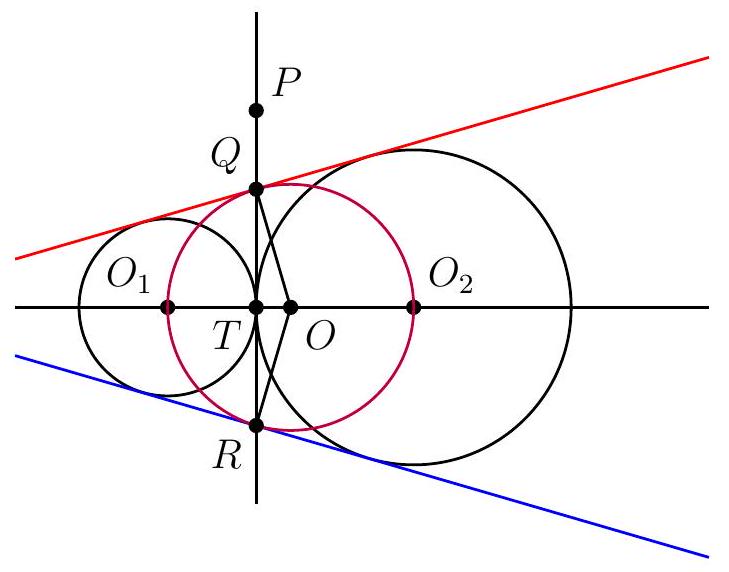
| - Draw the circle with diameter on the two centers $O_{1}$ of $\Gamma_{1}$ and $O_{2}$ of $\Gamma_{2}$, and find its center $O$. |
| - Let this circle meet common tangent line $O P$ at points $Q, R$. The required lines are the perpendicular to $O Q$ at $Q$ and the perpendicular to $O R$ at $R$. |
|  |
| |
| Let's show why this construction works. Let $R_{i}$ be the radius of circle $\Gamma_{i}$ and suppose without loss of generality that $R_{1} \leq R_{2}$. Note that $O Q=\frac{1}{2} O_{1} O_{2}=\frac{R_{1}+R_{2}}{2}, O T=O O_{1}-R_{1}=\frac{R_{2}-R_{1}}{2}$, so |
| |
| $$ |
| \sin \angle T Q O=\frac{O T}{O Q}=\frac{R_{2}-R_{1}}{R_{1}+R_{2}} |
| $$ |
| |
| which is also the sine of the angle between $O_{1} O_{2}$ and the common tangent lines. |
| Let $t$ be the perpendicular to $O Q$ through $Q$. Then $\angle\left(t, O_{1} O_{2}\right)=\angle(O Q, Q T)=\angle T Q O$, and $t$ is parallel to a common tangent line. Since |
| |
| $$ |
| d(O, t)=O Q=\frac{R_{1}+R_{2}}{2}=\frac{d\left(O_{1}, t\right)+d\left(O_{2}, t\right)}{2} |
| $$ |
| |
| and $O$ is the midpoint of $O_{1} O_{2}, O$ is also at the same distance from $t$ and the common tangent line, so these two lines coincide. |
| Step 3. Finding the inverse of a point $X$ given the inversion circle $\Omega$ with center $O$ is a well known procedure, but we describe it here for the sake of completeness. |
| |
| - If $X$ lies in $\Omega$, then its inverse is $X$. |
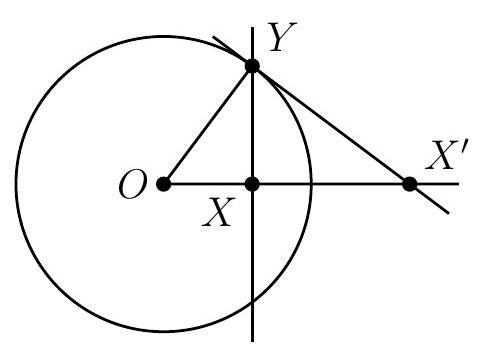
| - If $X$ lies in the interior of $\Omega$, draw ray $O X$, then the perpendicular line $\ell$ to $O X$ at $X$. Let $\ell$ meet $\Omega$ at a point $Y$. The inverse of $X$ is the intersection $X^{\prime}$ of $O X$ and the line perpendicular to $O Y$ at $Y$. This is because $O Y X^{\prime}$ is a right triangle with altitude $Y X$, and therefore $O X \cdot O X^{\prime}=O Y^{2}$. |
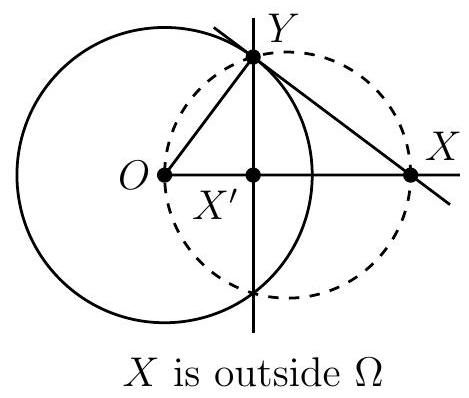
| - If $X$ is in the exterior of $\Omega$, draw ray $O X$ and one of the tangent lines $\ell$ from $X$ to $\Omega$ (just connect $X$ to one of the intersections of $\Omega$ and the circle with diameter $O X$ ). Let $\ell$ touch $\Omega$ at a point $Y$. The inverse of $X$ is the projection $X^{\prime}$ of $Y$ onto $O X$. This is because $O Y X^{\prime}$ is a right triangle with altitude $Y X^{\prime}$, and therefore $O X \cdot O X^{\prime}=O Y^{2}$. |
|  |
| $X$ is inside $\Omega$ |
|  |
| |
| |