


APMO 2024 - Problems and Solutions
Problem 1
Let $A B C$ be an acute triangle. Let $D$ be a point on side $A B$ and $E$ be a point on side $A C$ such that lines $B C$ and $D E$ are parallel. Let $X$ be an interior point of $B C E D$. Suppose rays $D X$ and $E X$ meet side $B C$ at points $P$ and $Q$, respectively such that both $P$ and $Q$ lie between $B$ and $C$. Suppose that the circumcircles of triangles $B Q X$ and $C P X$ intersect at a point $Y \neq X$. Prove that points $A, X$, and $Y$ are collinear.
Solution 1
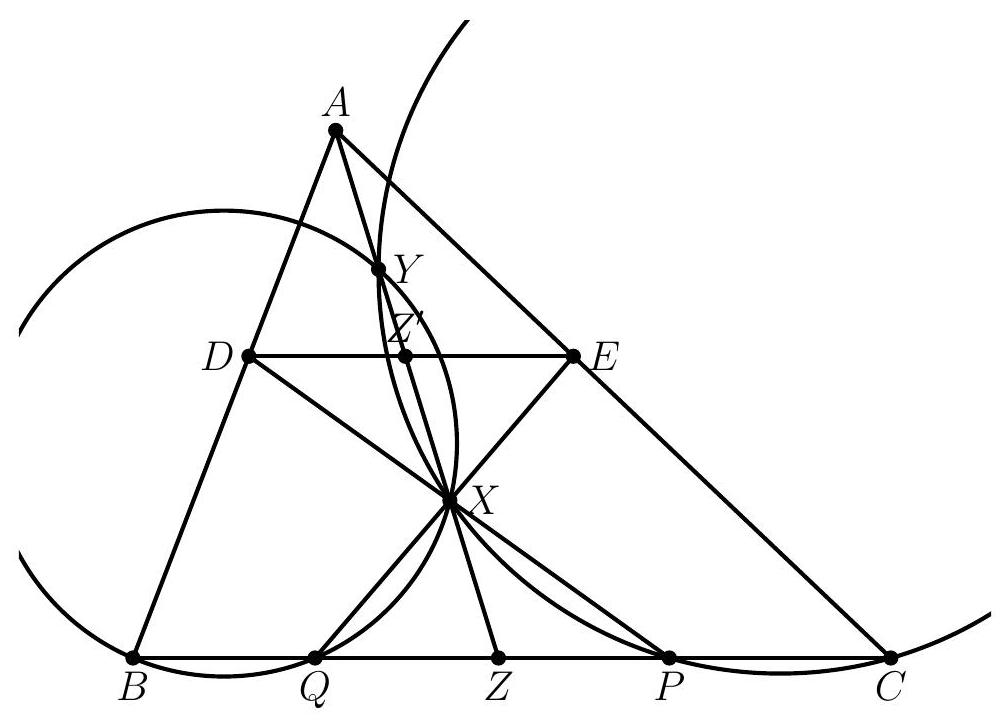
Let $\ell$ be the radical axis of circles $B Q X$ and $C P X$. Since $X$ and $Y$ are on $\ell$, it is sufficient to show that $A$ is on $\ell$. Let line $A X$ intersect segments $B C$ and $D E$ at $Z$ and $Z^{\prime}$, respectively. Then it is sufficient to show that $Z$ is on $\ell$. By $B C | D E$, we obtain
thus $B Z \cdot Q Z=C Z \cdot P Z$, which implies that $Z$ is on $\ell$.
Solution 2
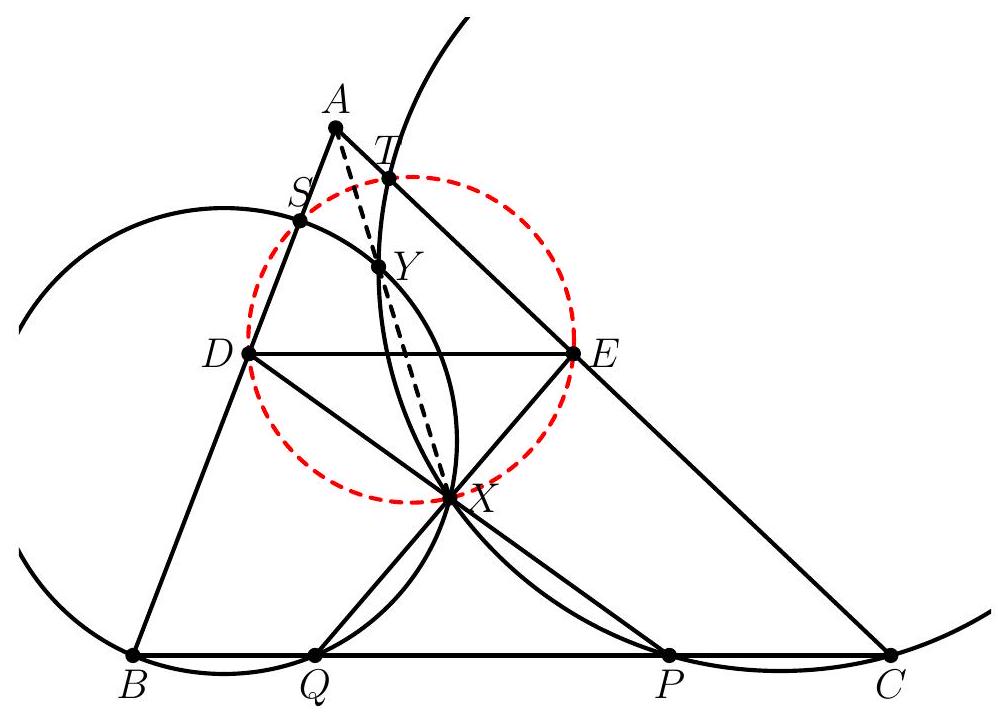
Let circle $B Q X$ intersect line $A B$ at a point $S$ which is different from $B$. Then $\angle D E X=$ $\angle X Q C=\angle B S X$, thus $S$ is on circle $D E X$. Similarly, let circle $C P X$ intersect line $A C$ at a point $T$ which is different from $C$. Then $T$ is on circle $D E X$. The power of $A$ with respect to the circle $D E X$ is $A S \cdot A D=A T \cdot A E$. Since $\frac{A D}{A B}=\frac{A E}{A C}, A S \cdot A B=A T \cdot A C$. Then $A$ is in the radical axis of circles $B Q X$ and $C P X$, which implies that three points $A, X$ and $Y$ are collinear.
Solution 3
Consider the (direct) homothety that takes triangle $A D E$ to triangle $A B C$, and let $Y^{\prime}$ be the image of $Y$ under this homothety; in other words, let $Y^{\prime}$ be the intersection of the line parallel to $B Y$ through $D$ and the line parallel to $C Y$ through $E$.
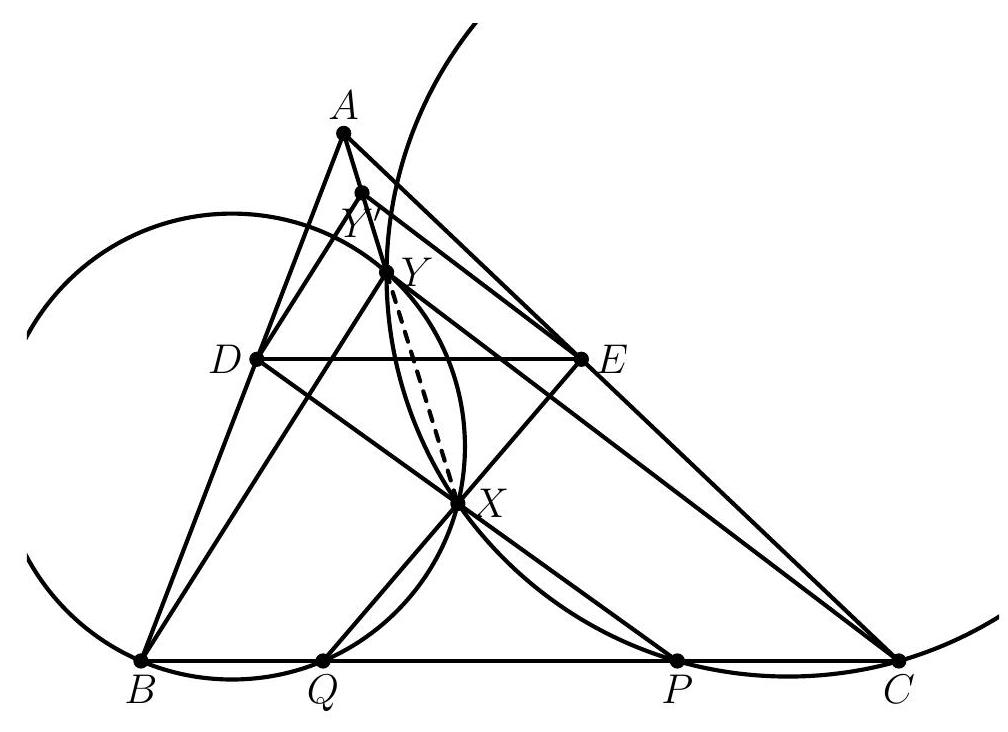
The homothety implies that $A, Y$, and $Y^{\prime}$ are collinear, and that $\angle D Y^{\prime} E=\angle B Y C$. Since $B Q X Y$ and $C P X Y$ are cyclic, $\angle D Y^{\prime} E=\angle B Y C=\angle B Y X+\angle X Y C=\angle X Q P+\angle X P Q=180^{\circ}-\angle P X Q=180^{\circ}-\angle D X E$, which implies that $D Y^{\prime} E X$ is cyclic. Therefore
which, combined with $D Y^{\prime} | B Y$, implies $Y^{\prime} X | Y X$. This proves that $X, Y$, and $Y^{\prime}$ are collinear, which in turn shows that $A, X$, and $Y$ are collinear.
Problem 2
Consider a $100 \times 100$ table, and identify the cell in row $a$ and column $b, 1 \leq a, b \leq 100$, with the ordered pair $(a, b)$. Let $k$ be an integer such that $51 \leq k \leq 99$. A $k$-knight is a piece that moves one cell vertically or horizontally and $k$ cells to the other direction; that is, it moves from $(a, b)$ to $(c, d)$ such that $(|a-c|,|b-d|)$ is either $(1, k)$ or $(k, 1)$. The $k$-knight starts at cell $(1,1)$, and performs several moves. A sequence of moves is a sequence of cells $\left(x_{0}, y_{0}\right)=(1,1)$, $\left(x_{1}, y_{1}\right),\left(x_{2}, y_{2}\right), \ldots,\left(x_{n}, y_{n}\right)$ such that, for all $i=1,2, \ldots, n, 1 \leq x_{i}, y_{i} \leq 100$ and the $k$-knight can move from $\left(x_{i-1}, y_{i-1}\right)$ to $\left(x_{i}, y_{i}\right)$. In this case, each cell $\left(x_{i}, y_{i}\right)$ is said to be reachable. For each $k$, find $L(k)$, the number of reachable cells.
Answer: $L(k)=\left{\begin{array}{ll}100^{2}-(2 k-100)^{2} & \text { if } k \text { is even } \ \frac{100^{2}-(2 k-100)^{2}}{2} & \text { if } k \text { is odd }\end{array}\right.$.
Solution
Cell $(x, y)$ is directly reachable from another cell if and only if $x-k \geq 1$ or $x+k \leq 100$ or $y-k \geq 1$ or $y+k \leq 100$, that is, $x \geq k+1$ or $x \leq 100-k$ or $y \geq k+1$ or $y \leq 100-k()$. Therefore the cells $(x, y)$ for which $101-k \leq x \leq k$ and $101-k \leq y \leq k$ are unreachable. Let $S$ be this set of unreachable cells in this square, namely the square of cells $(x, y), 101-k \leq x, y \leq k$. If condition $()$ is valid for both $(x, y)$ and $(x \pm 2, y \pm 2)$ then one can move from $(x, y)$ to $(x \pm 2, y \pm 2)$, if they are both in the table, with two moves: either $x \leq 50$ or $x \geq 51$; the same is true for $y$. In the first case, move $(x, y) \rightarrow(x+k, y \pm 1) \rightarrow(x, y \pm 2)$ or $(x, y) \rightarrow$ $(x \pm 1, y+k) \rightarrow(x \pm 2, y)$. In the second case, move $(x, y) \rightarrow(x-k, y \pm 1) \rightarrow(x, y \pm 2)$ or $(x, y) \rightarrow(x \pm 1, y-k) \rightarrow(x \pm 2, y)$. Hence if the table is colored in two colors like a chessboard, if $k \leq 50$, cells with the same color as $(1,1)$ are reachable. Moreover, if $k$ is even, every other move changes the color of the occupied cell, and all cells are potentially reachable; otherwise, only cells with the same color as $(1,1)$ can be visited. Therefore, if $k$ is even then the reachable cells consists of all cells except the center square defined by $101-k \leq x \leq k$ and $101-k \leq y \leq k$, that is, $L(k)=100^{2}-(2 k-100)^{2}$; if $k$ is odd, then only half of the cells are reachable: the ones with the same color as $(1,1)$, and $L(k)=\frac{1}{2}\left(100^{2}-(2 k-100)^{2}\right)$.
Problem 3
Let $n$ be a positive integer and $a_{1}, a_{2}, \ldots, a_{n}$ be positive real numbers. Prove that
Solution
We first prove the following lemma: Lemma 1. For $k$ positive integer and $x, y>0$,
The proof goes by induction. For $k=1$, we have
which reduces to
For $k>1$, by the inequality $2\left(A^{2}+B^{2}\right) \geq(A+B)^{2}$ applied at $A=\left(\frac{2}{1+x}\right)^{2^{k-1}}$ and $B=\left(\frac{2}{1+y}\right)^{2^{k-1}}$ followed by the induction hypothesis
from which the lemma follows. The problem now can be deduced from summing the following applications of the lemma, multiplied by the appropriate factor:
Comment: Equality occurs if and only if $a_{1}=a_{2}=\cdots=a_{n}=1$.
Comment: The main motivation for the lemma is trying to "telescope" the sum
that is,
to obtain an expression larger than or equal to
It seems reasonable to obtain a inequality that can be applied from right to left, decreases the exponent of the factor $1 / 2^{k}$ by 1 , and multiplies the variables in the denominator. Given that, the lemma is quite natural:
or
Problem 4
Prove that for every positive integer $t$ there is a unique permutation $a_{0}, a_{1}, \ldots, a_{t-1}$ of $0,1, \ldots, t-$ 1 such that, for every $0 \leq i \leq t-1$, the binomial coefficient $\binom{t+i}{2 a_{i}}$ is odd and $2 a_{i} \neq t+i$.
Solution
We constantly make use of Kummer's theorem which, in particular, implies that $\binom{n}{k}$ is odd if and only if $k$ and $n-k$ have ones in different positions in binary. In other words, if $S(x)$ is the set of positions of the digits 1 of $x$ in binary (in which the digit multiplied by $2^{i}$ is in position $i),\binom{n}{k}$ is odd if and only if $S(k) \subseteq S(n)$. Moreover, if we set $k<n, S(k)$ is a proper subset of $S(n)$, that is, $|S(k)|<|S(n)|$. We start with a lemma that guides us how the permutation should be set.
Lemma 1.
The proof is just realizing that $S(2 i)={1+x, x \in S(i)}$ and $S(2 i+1)={0} \cup{1+x, x \in S(i)}$, because $2 i$ in binary is $i$ followed by a zero and $2 i+1$ in binary is $i$ followed by a one. Therefore
The lemma has an immediate corollary: since $t+i>2 a_{i}$ and $\binom{t+i}{2 a_{i}}$ is odd for all $i, 0 \leq i \leq t-1$, $S\left(2 a_{i}\right) \subset S(t+i)$ with $\left|S\left(2 a_{i}\right)\right| \leq|S(t+i)|-1$. Since the sum of $\left|S\left(2 a_{i}\right)\right|$ is $t$ less than the sum of $|S(t+i)|$, and there are $t$ values of $i$, equality must occur, that is, $\left|S\left(2 a_{i}\right)\right|=|S(t+i)|-1$, which in conjunction with $S\left(2 a_{i}\right) \subset S(t+i)$ means that $t+i-2 a_{i}=2^{k_{i}}$ for every $i, 0 \leq i \leq t-1$, $k_{i} \in S(t+i)$ (more precisely, $\left{k_{i}\right}=S(t+i) \backslash S\left(2 a_{i}\right)$.) In particular, for $t+i$ odd, this means that $t+i-2 a_{i}=1$, because the only odd power of 2 is 1. Then $a_{i}=\frac{t+i-1}{2}$ for $t+i$ odd, which takes up all the numbers greater than or equal to $\frac{t-1}{2}$. Now we need to distribute the numbers that are smaller than $\frac{t-1}{2}$ (call these numbers small). If $t+i$ is even then by Lucas' Theorem $\binom{t+i}{2 a_{i}} \equiv\binom{\frac{t+i}{2}}{a_{i}}(\bmod 2)$, so we pair numbers from $\lceil t / 2\rceil$ to $t-1$ (call these numbers big) with the small numbers. Say that a set $A$ is paired with another set $B$ whenever $|A|=|B|$ and there exists a bijection $\pi: A \rightarrow B$ such that $S(a) \subset S(\pi(a))$ and $|S(a)|=|S(\pi(a))|-1$; we also say that $a$ and $\pi(a)$ are paired. We prove by induction in $t$ that $A_{t}={0,1,2, \ldots,\lfloor t / 2\rfloor-1}$ (the set of small numbers) and $B_{t}={\lceil t / 2\rceil, \ldots, t-2, t-1}$ (the set of big numbers) can be uniquely paired. The claim is immediate for $t=1$ and $t=2$. For $t>2$, there is exactly one power of two in $B_{t}$, since $t / 2 \leq 2^{a}<t \Longleftrightarrow a=\left\lceil\log {2}(t / 2)\right\rceil$. Let $2^{a}$ be this power of two. Then, since $2^{a} \geq t / 2$, no number in $A{t}$ has a one in position $a$ in binary. Since for every number $x, 2^{a} \leq x<t, a \in S(x)$ and $a \notin S(y)$ for all $y \in A_{t}, x$ can only be paired with $x-2^{a}$, since $S(x)$ needs to be stripped of exactly one position. This takes cares of $x \in B_{t}, 2^{a} \leq x<t$, and $y \in A_{t}, 0 \leq y<t-2^{a}$. Now we need to pair the numbers from $A^{\prime}=\left{t-2^{a}, t-2^{a}+1, \ldots,\lfloor t / 2\rfloor-1\right} \subset A$ with the numbers from $B^{\prime}=\left{\lceil t / 2\rceil,\lceil t / 2\rceil+1, \ldots, 2^{a}-1\right} \subset B$. In order to pair these $t-2\left(t-2^{a}\right)=$ $2^{a+1}-t<t$ numbers, we use the induction hypothesis and a bijection between $A^{\prime} \cup B^{\prime}$ and $B_{2^{a+1}-t} \cup A_{2^{a+1}-t}$. Let $S=S\left(2^{a}-1\right)={0,1,2, \ldots, a-1}$. Then take a pair $x, y, x \in A_{2^{a+1}-t}$ and $y \in B_{2^{a+1}-t}$ and biject it with $2^{a}-1-x \in B^{\prime}$ and $2^{a}-1-y \in A^{\prime}$. In fact,
and
Moreover, $S\left(2^{a}-1-x\right)=S \backslash S(x)$ and $S\left(2^{a}-1-y\right)=S \backslash S(y)$ are complements with respect to $S$, and $S(x) \subset S(y)$ and $|S(x)|=|S(y)|-1$ implies $S\left(2^{a}-1-y\right) \subset S\left(2^{a}-1-x\right)$ and $\left|S\left(2^{a}-1-y\right)\right|=\left|S\left(2^{a}-1-x\right)\right|-1$. Therefore a pairing between $A^{\prime}$ and $B^{\prime}$ corresponds to a pairing between $A_{2^{a+1}-t}$ and $B_{2^{a+1}-t}$. Since the latter pairing is unique, the former pairing is also unique, and the result follows. We illustrate the bijection by showing the case $t=23$ :
The pairing is
in which the bijection is between
Problem 5
Line $\ell$ intersects sides $B C$ and $A D$ of cyclic quadrilateral $A B C D$ in its interior points $R$ and $S$ respectively, and intersects ray $D C$ beyond point $C$ at $Q$, and ray $B A$ beyond point $A$ at $P$. Circumcircles of the triangles $Q C R$ and $Q D S$ intersect at $N \neq Q$, while circumcircles of the triangles $P A S$ and $P B R$ intersect at $M \neq P$. Let lines $M P$ and $N Q$ meet at point $X$, lines $A B$ and $C D$ meet at point $K$ and lines $B C$ and $A D$ meet at point $L$. Prove that point $X$ lies on line $K L$.
Solution 1
We start with the following lemma. Lemma 1. Points $M, N, P, Q$ are concyclic. Point $M$ is the Miquel point of lines $A P=A B, P S=\ell, A S=A D$, and $B R=B C$, and point $N$ is the Miquel point of lines $C Q=C D, R C=B C, Q R=\ell$, and $D S=A D$. Both points $M$ and $N$ are on the circumcircle of the triangle determined by the common lines $A D, \ell$, and $B C$, which is $L R S$. Then, since quadrilaterals $Q N R C, P M A S$, and $A B C D$ are all cyclic, using directed angles (modulo $180^{\circ}$ )
which implies that $M N Q P$ is a cyclic quadrilateral.
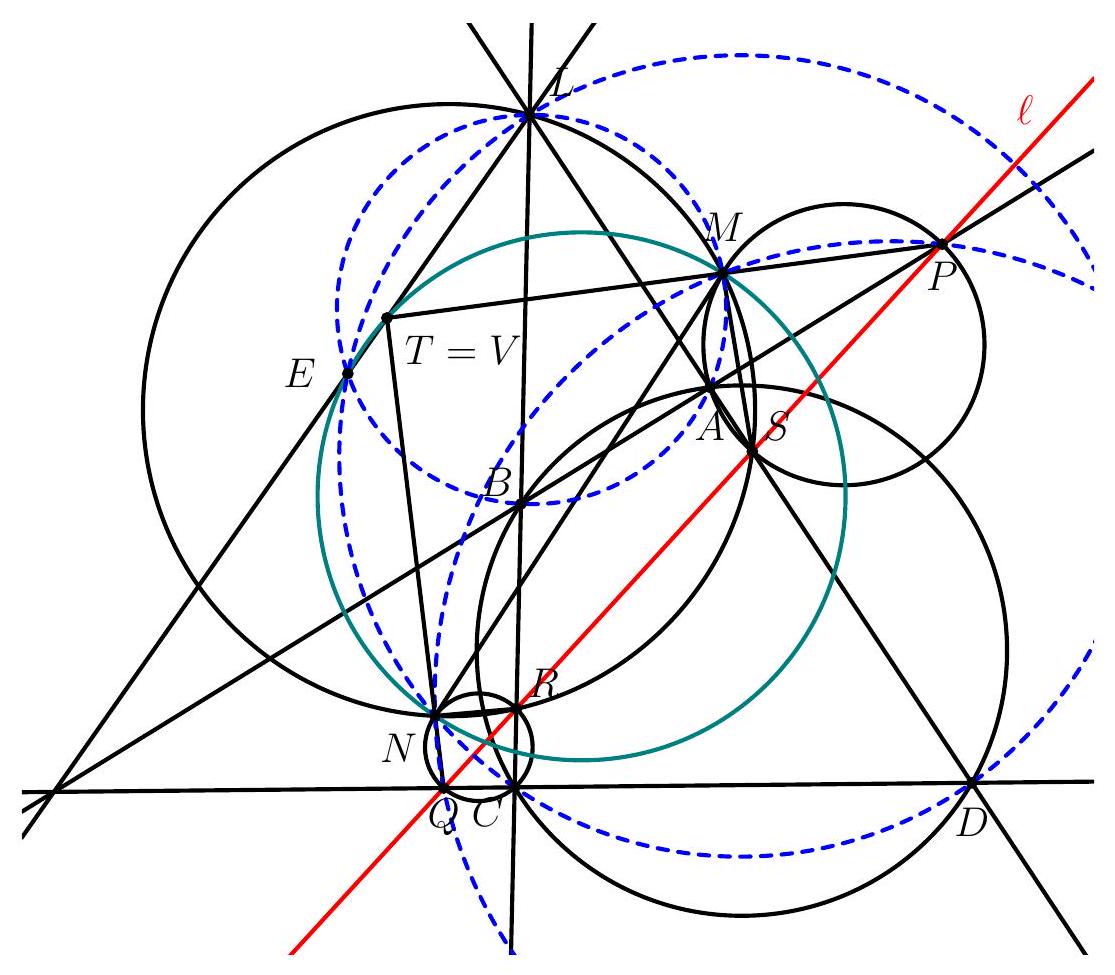
Let $E$ be the Miquel point of $A B C D$ (that is, of lines $A B, B C, C D, D A$ ). It is well known that $E$ lies in the line $t$ connecting the intersections of the opposite lines of $A B C D$. Let lines $N Q$ and $t$ meet at $T$. If $T \neq E$, using directed angles, looking at the circumcircles of $L A B$ (which contains, by definition, $E$ and $M$ ), $A P S$ (which also contains $M$ ), and $M N Q P$,
that is, $T$ lies in the circumcircle $\omega$ of $E M N$. If $T=E$, the same computation shows that $\measuredangle L E M=\measuredangle E N M$, which means that $t$ is tangent to $\omega$.
Now let lines $M P$ and $t$ meet at $V$. An analogous computation shows, by looking at the circumcircles of $L C D$ (which contains $E$ and $N$ ), $C Q R$, and $M N Q P$, that $V$ lies in $\omega$ as well, and that if $V=E$ then $t$ is tangent to $\omega$. Therefore, since $\omega$ meet $t$ at $T, V$, and $E$, either $T=V$ if both $T \neq E$ and $V \neq E$ or $T=V=E$. At any rate, the intersection of lines $M P$ and $N Q$ lies in $t$.
Solution 2
Barycentric coordinates are a viable way to solve the problem, but even the solution we have found had some clever computations. Here is an outline of this solution.
Lemma 2. Denote by $\operatorname{pow}{\omega} X$ the power of point $X$ with respect to circle $\omega$. Let $\Gamma{1}$ and $\Gamma_{2}$ be circles with different centers. Considering $A B C$ as the reference triangle in barycentric coordinates, the radical axis of $\Gamma_{1}$ and $\Gamma_{2}$ is given by
Proof: Let $\Gamma_{i}$ have the equation $\Gamma_{i}(x, y, z)=-a^{2} y z-b^{2} z x-c^{2} x y+(x+y+z)\left(r_{i} x+s_{i} y+t_{i} z\right)$. Then $\operatorname{pow}{\Gamma{i}} P=\Gamma_{i}(P)$. In particular, $\operatorname{pow}{\Gamma{i}} A=\Gamma_{i}(1,0,0)=r_{i}$ and, similarly, $\operatorname{pow}{\Gamma{i}} B=s_{i}$ and $\operatorname{pow}{\Gamma{i}} C=t_{i}$. Finally, the radical axis is
We still use the Miquel point $E$ of $A B C D$. Notice that the problem is equivalent to proving that lines $M P, N Q$, and $E K$ are concurrent. The main idea is writing these three lines as radical axes. In fact, by definition of points $M, N$, and $E$ :
- $M P$ is the radical axis of the circumcircles of $P A S$ and $P B R$;
- $N Q$ is the radical axis of the circumcircles of $Q C R$ and $Q D S$;
- $E K$ is the radical axis of the circumcircles of $K B C$ and $K A D$.
Looking at these facts and the diagram, it makes sense to take triangle $K Q P$ the reference triangle. Because of that, we do not really need to draw circles nor even points $M$ and $N$, as all powers can be computed directly from points in lines $K P, K Q$, and $P Q$.
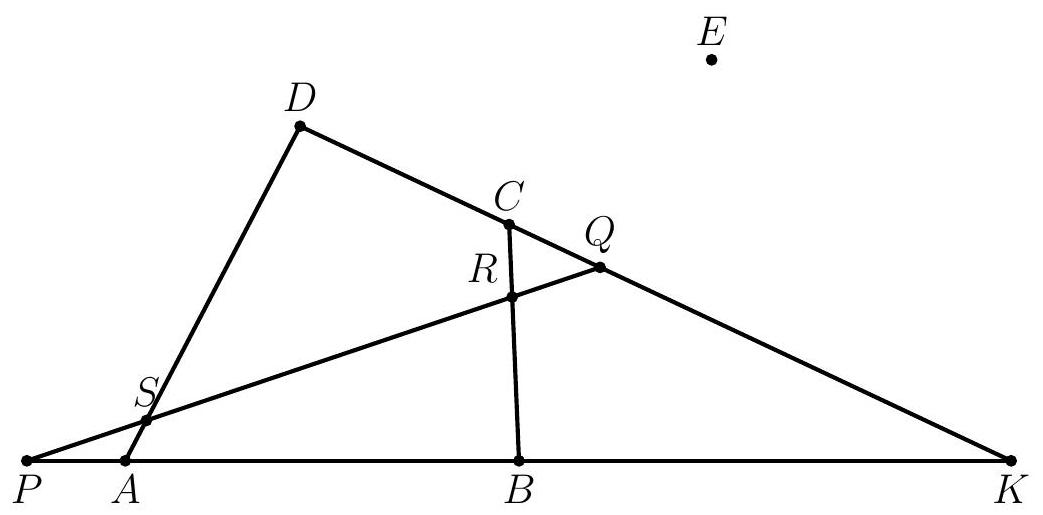
Associate $P$ with the $x$-coordinate, $Q$ with the $y$-coordinate, and $K$ with the $z$-coordinate. Applying the lemma, the equations of lines $P M, Q N$, and $E K$ are
- MP: $(K A \cdot K P-K B \cdot K P) x+(Q S \cdot Q P-Q R \cdot Q P) y=0$
- $N Q:(K C \cdot K Q-K D \cdot K Q) x+(P R \cdot P Q-P S \cdot P Q) z=0$
- MP: $(-Q C \cdot Q K+Q D \cdot Q K) y+(P B \cdot P K-P A \cdot P K) z=0$
These equations simplify to
- $M P:(A B \cdot K P) x+(P Q \cdot R S) y=0$
- $N Q:(-C D \cdot K Q) x+(P Q \cdot R S) z=0$
- $M P:(C D \cdot K Q) y+(A B \cdot K P) z=0$
Now, if $u=A B \cdot K P, v=P Q \cdot R S$, and $w=C D \cdot K Q$, it suffices to show that
which is a straightforward computation.