| # USAMO 2017 Solution Notes |
|
|
| Evan Chen《陳誼廷》 |
|
|
| 15 April 2024 |
|
|
| This is a compilation of solutions for the 2017 USAMO. The ideas of the solution are a mix of my own work, the solutions provided by the competition organizers, and solutions found by the community. However, all the writing is maintained by me. |
|
|
| These notes will tend to be a bit more advanced and terse than the "official" solutions from the organizers. In particular, if a theorem or technique is not known to beginners but is still considered "standard", then I often prefer to use this theory anyways, rather than try to work around or conceal it. For example, in geometry problems I typically use directed angles without further comment, rather than awkwardly work around configuration issues. Similarly, sentences like "let $\mathbb{R}$ denote the set of real numbers" are typically omitted entirely. |
|
|
| Corrections and comments are welcome! |
|
|
| ## Contents |
|
|
| 0 Problems ..... 2 |
| 1 Solutions to Day 1 ..... 3 |
| 1.1 USAMO 2017/1, proposed by Gregory Galperin ..... 3 |
| 1.2 USAMO 2017/2, proposed by Maria Monks ..... 4 |
| 1.3 USAMO 2017/3, proposed by Evan Chen |
| 2 Solutions to Day 2 ..... 9 |
| 2.1 USAMO 2017/4, proposed by Maria Monks ..... 9 |
| 2.2 USAMO 2017/5, proposed by Ricky Liu ..... 12 |
| 2.3 USAMO 2017/6, proposed by Titu Andreescu ..... 14 |
|
|
| ## §0 Problems |
|
|
| 1. Prove that there exist infinitely many pairs of relatively prime positive integers $a, b>1$ for which $a+b$ divides $a^{b}+b^{a}$. |
| 2. Let $m_{1}, m_{2}, \ldots, m_{n}$ be a collection of $n$ positive integers, not necessarily distinct. For any sequence of integers $A=\left(a_{1}, \ldots, a_{n}\right)$ and any permutation $w=w_{1}, \ldots, w_{n}$ of $m_{1}, \ldots, m_{n}$, define an $A$-inversion of $w$ to be a pair of entries $w_{i}, w_{j}$ with $i<j$ for which one of the following conditions holds: |
| |
| - $a_{i} \geq w_{i}>w_{j}$, |
| - $w_{j}>a_{i} \geq w_{i}$, or |
| - $w_{i}>w_{j}>a_{i}$. |
|
|
| Show that, for any two sequences of integers $A=\left(a_{1}, \ldots, a_{n}\right)$ and $B=\left(b_{1}, \ldots, b_{n}\right)$, and for any positive integer $k$, the number of permutations of $m_{1}, \ldots, m_{n}$ having exactly $k A$-inversions is equal to the number of permutations of $m_{1}, \ldots, m_{n}$ having exactly $k B$-inversions. |
| 3. Let $A B C$ be a scalene triangle with circumcircle $\Omega$ and incenter $I$. Ray $A I$ meets $\overline{B C}$ at $D$ and $\Omega$ again at $M$; the circle with diameter $\overline{D M}$ cuts $\Omega$ again at $K$. Lines $M K$ and $B C$ meet at $S$, and $N$ is the midpoint of $\overline{I S}$. The circumcircles of $\triangle K I D$ and $\triangle M A N$ intersect at points $L_{1}$ and $L_{2}$. Prove that $\Omega$ passes through the midpoint of either $\overline{I L_{1}}$ or $\overline{I L_{2}}$. |
| 4. Let $P_{1}, P_{2}, \ldots, P_{2 n}$ be $2 n$ distinct points on the unit circle $x^{2}+y^{2}=1$, other than $(1,0)$. Each point is colored either red or blue, with exactly $n$ red points and $n$ blue points. Let $R_{1}, R_{2}, \ldots, R_{n}$ be any ordering of the red points. Let $B_{1}$ be the nearest blue point to $R_{1}$ traveling counterclockwise around the circle starting from $R_{1}$. Then let $B_{2}$ be the nearest of the remaining blue points to $R_{2}$ travelling counterclockwise around the circle from $R_{2}$, and so on, until we have labeled all of the blue points $B_{1}, \ldots, B_{n}$. Show that the number of counterclockwise arcs of the form $R_{i} \rightarrow B_{i}$ that contain the point $(1,0)$ is independent of the way we chose the ordering $R_{1}, \ldots, R_{n}$ of the red points. |
| 5. Find all real numbers $c>0$ such that there exists a labeling of the lattice points in $\mathbb{Z}^{2}$ with positive integers for which: |
|
|
| - only finitely many distinct labels occur, and |
| - for each label $i$, the distance between any two points labeled $i$ is at least $c^{i}$. |
|
|
| 6. Find the minimum possible value of |
|
|
| $$ |
| \frac{a}{b^{3}+4}+\frac{b}{c^{3}+4}+\frac{c}{d^{3}+4}+\frac{d}{a^{3}+4} |
| $$ |
|
|
| given that $a, b, c, d$ are nonnegative real numbers such that $a+b+c+d=4$. |
|
|
| ## §1 Solutions to Day 1 |
|
|
| ## §1.1 USAMO 2017/1, proposed by Gregory Galperin |
|
|
| Available online at https://aops.com/community/p8108366. |
|
|
| ## Problem statement |
|
|
| Prove that there exist infinitely many pairs of relatively prime positive integers $a, b>1$ for which $a+b$ divides $a^{b}+b^{a}$. |
|
|
| One construction: let $d \equiv 1(\bmod 4), d>1$. Let $x=\frac{d^{d}+2^{d}}{d+2}$. Then set |
|
|
| $$ |
| a=\frac{x+d}{2}, \quad b=\frac{x-d}{2} . |
| $$ |
|
|
| To see this works, first check that $b$ is odd and $a$ is even. Let $d=a-b$ be odd. Then: |
|
|
| $$ |
| \begin{aligned} |
| a+b \mid a^{b}+b^{a} & \Longleftrightarrow(-b)^{b}+b^{a} \equiv 0 \quad(\bmod a+b) \\ |
| & \Longleftrightarrow b^{a-b} \equiv 1 \quad(\bmod a+b) \\ |
| & \Longleftrightarrow b^{d} \equiv 1 \quad(\bmod d+2 b) \\ |
| & \Longleftrightarrow(-2)^{d} \equiv d^{d}(\bmod d+2 b) \\ |
| & \Longleftrightarrow d+2 b \mid d^{d}+2^{d} . |
| \end{aligned} |
| $$ |
|
|
| So it would be enough that |
|
|
| $$ |
| d+2 b=\frac{d^{d}+2^{d}}{d+2} \Longrightarrow b=\frac{1}{2}\left(\frac{d^{d}+2^{d}}{d+2}-d\right) |
| $$ |
|
|
| which is what we constructed. Also, since $\operatorname{gcd}(x, d)=1$ it follows $\operatorname{gcd}(a, b)=\operatorname{gcd}(d, b)=$ 1. |
|
|
| Remark. Ryan Kim points out that in fact, $(a, b)=(2 n-1,2 n+1)$ is always a solution. |
|
|
| ## §1.2 USAMO 2017/2, proposed by Maria Monks |
|
|
| Available online at https://aops.com/community/p8108658. |
|
|
| ## Problem statement |
|
|
| Let $m_{1}, m_{2}, \ldots, m_{n}$ be a collection of $n$ positive integers, not necessarily distinct. For any sequence of integers $A=\left(a_{1}, \ldots, a_{n}\right)$ and any permutation $w=w_{1}, \ldots, w_{n}$ of $m_{1}, \ldots, m_{n}$, define an $A$-inversion of $w$ to be a pair of entries $w_{i}, w_{j}$ with $i<j$ for which one of the following conditions holds: |
| |
| - $a_{i} \geq w_{i}>w_{j}$, |
| - $w_{j}>a_{i} \geq w_{i}$, or |
| - $w_{i}>w_{j}>a_{i}$. |
|
|
| Show that, for any two sequences of integers $A=\left(a_{1}, \ldots, a_{n}\right)$ and $B=\left(b_{1}, \ldots, b_{n}\right)$, and for any positive integer $k$, the number of permutations of $m_{1}, \ldots, m_{n}$ having exactly $k A$-inversions is equal to the number of permutations of $m_{1}, \ldots, m_{n}$ having exactly $k B$-inversions. |
|
|
| The following solution was posted by Michael Ren, and I think it is the most natural one (since it captures all the combinatorial ideas using a $q$-generating function that is easier to think about, and thus makes the problem essentially a long computation). |
|
|
| Denote by $M$ our multiset of $n$ positive integers. Define an inversion of a permutation to be pair $i<j$ with $w_{i}<w_{j}$ (which is a $(0, \ldots, 0)$-inversion in the problem statement); this is the usual definition (see https://en.wikipedia.org/wiki/Inversion_(discrete_ mathematics)). So we want to show the number of $A$-inversions is equal to the number of usual inversions. In what follows we count permutations on $M$ with multiplicity: so $M=\{1,1,2\}$ still has $3!=6$ permutations. |
| |
| We are going to do what is essentially recursion, but using generating functions in a variable $q$ to do our book-keeping. (Motivation: there's no good closed form for the number of inversions, but there's a great generating function known - which is even better for us, since we're only trying to show two numbers are equal!) First, we prove two claims. |
| |
| Claim - For any positive integer $n$, the generating function for the number of permutations of $(1,2, \ldots, n)$ with exactly $k$ inversions is |
| |
| $$ |
| n!!_{q}:=1 \cdot(1+q) \cdot\left(1+q+q^{2}\right) \cdot \ldots\left(1+q+\cdots+q^{n-1}\right) |
| $$ |
| |
| Here we mean that the coefficient of $q^{S}$ above gives the number of permutations with exactly $s$ inversions. |
| |
| Proof. This is an induction on $n$, with $n=1$ being trivial. Suppose we choose the first element to be $i$, with $1 \leq i \leq n$. Then there will always be exactly $i-1$ inversions using the first element, so this contributes $q^{i} \cdot(n-1)!q$. Summing $1 \leq i \leq n$ gives the result. |
| |
| Unfortunately, the main difficulty of the problem is that there are repeated elements, which makes our notation much more horrific. |
| |
| Let us define the following. We take our given multiset $M$ of $n$ positive integers, we suppose the distinct numbers are $\theta_{1}<\theta_{2}<\cdots<\theta_{m}$. We let $e_{i}$ be the number of times $\theta_{i}$ appears. Therefore the multiplicities $e_{i}$ should have sums |
| |
| $$ |
| e_{1}+\cdots+e_{m}=n |
| $$ |
| |
| and $m$ denotes the number of distinct elements. Finally, we let |
| |
| $$ |
| F\left(e_{1}, \ldots, e_{m}\right)=\sum_{\text {permutations } \sigma} q^{\text {number inversions of } \sigma} |
| $$ |
| |
| be the associated generating function for the number of inversions. For example, the first claim we proved says that $F(1, \ldots, 1)=n!{ }_{q}$. |
| |
| Claim - We have the explicit formula |
| |
| $$ |
| F\left(e_{1}, \ldots, e_{m}\right)=n!{ }_{q} \cdot \prod_{i=1}^{m} \frac{e_{i}!}{e_{i}!_{q}} |
| $$ |
| |
| Proof. First suppose we perturb all the elements slightly, so that they are no longer equal. Then the generating function would just be $n!{ }_{q}$. |
| |
| Then, we undo the perturbations for each group, one at a time, and claim that we get the above $e_{i}!_{q}$ factor each time. Indeed, put the permutations into classes of $e_{1}$ ! each where permutations in the same classes differ only in the order of the perturbed $\theta_{1}$ 's (with the other $n-e_{1}$ elements being fixed). Then there is a factor of $e_{1}!_{q}$ from each class, owing to the slightly perturbed inversions we added within each class. So we remove that factor and add $e_{1}!\cdot q^{0}$ instead. This accounts for the first term of the product. |
| |
| Repeating this now with each term of the product implies the claim. |
| Thus we have the formula for the number of inversions in general. We wish to show this also equals the generating function the number of $A$-inversions, for any fixed choice of $A$. This will be an induction by $n$, with the base case being immediate. |
| |
| For the inductive step, fix $A$, and assume the first element satisfies $\theta_{k} \leq a_{1}<\theta_{k+1}$ (so $0 \leq k \leq m$; we for convenience set $\theta_{0}=-\infty$ and $\left.\theta_{m}=+\infty\right)$. We count the permutations based on what the first element $\theta_{i}$ of the permutation is. Then: |
| |
| - Consider permutations starting with $\theta_{i} \in\left\{\theta_{1}, \ldots, \theta_{k}\right\}$. Then the number of inversions which will use this first term is $\left(e_{1}+\cdots+e_{i-1}\right)+\left(e_{k+1}+\cdots+e_{m}\right)$. Also, there are $e_{i}$ ways to pick which $\theta_{i}$ gets used as the first term. So we get a contribution of |
| |
| $$ |
| q^{e_{1}+\cdots+e_{i-1}+\left(e_{k+1}+\cdots+e_{m}\right)} \cdot e_{i} \cdot F\left(e_{1}, \ldots, e_{i}-1, \ldots, e_{m}\right) |
| $$ |
| |
| in this case (with inductive hypothesis to get the last $F$-term). |
| |
| - Now suppose $\theta_{i} \in\left\{\theta_{k+1}, \ldots, \theta_{m}\right\}$. Then the number of inversions which will use this first term is $e_{k+1}+\cdots+e_{i-1}$. Thus by a similar argument the contribution is |
| |
| $$ |
| q^{e_{k+1}+\cdots+e_{i-1}} \cdot e_{i} \cdot F\left(e_{1}, \ldots, e_{i}-1, \ldots, e_{m}\right) |
| $$ |
| |
| Therefore, to complete the problem it suffices to prove |
| |
| $$ |
| \sum_{i=1}^{k} q^{\left(e_{1}+\cdots+e_{i-1}\right)+\left(e_{k+1}+\cdots+e_{m}\right)} \cdot e_{i} \cdot F\left(e_{1}, \ldots, e_{i}-1, \ldots, e_{m}\right) |
| $$ |
| |
| $$ |
| \begin{aligned} |
| & +\sum_{i=k+1}^{m} q^{e_{k+1}+\cdots+e_{i-1}} \cdot e_{i} \cdot F\left(e_{1}, \ldots, e_{i}-1, \ldots, e_{m}\right) \\ |
| & =F\left(e_{1}, \ldots, e_{m}\right) . |
| \end{aligned} |
| $$ |
| |
| Now, we see that |
| |
| $$ |
| \frac{e_{i} \cdot F\left(e_{1}, \ldots, e_{i}-1, \ldots, e_{m}\right)}{F\left(e_{1}, \ldots, e_{m}\right)}=\frac{1+\cdots+q^{e_{i}-1}}{1+q+\cdots+q^{n-1}}=\frac{1-q^{e_{i}}}{1-q^{n}} |
| $$ |
| |
| so it's equivalent to show |
| |
| $$ |
| 1-q^{n}=q^{e_{k+1}+\cdots+e_{m}} \sum_{i=1}^{k} q^{e_{1}+\cdots+e_{i-1}}\left(1-q^{e_{i}}\right)+\sum_{i=k+1}^{m} q^{e_{k+1}+\cdots+e_{i-1}}\left(1-q^{e_{i}}\right) |
| $$ |
| |
| which is clear, since the left summand telescopes to $q^{e_{k+1}+\cdots+e_{m}}-q^{n}$ and the right summand telescopes to $1-q^{e_{k+1}+\cdots+e_{m}}$. |
| |
| Remark. Technically, we could have skipped straight to the induction, without proving the first two claims. However I think the solution reads more naturally this way. |
| |
| ## §1.3 USAMO 2017/3, proposed by Evan Chen |
| |
| Available online at https://aops.com/community/p8108375. |
| |
| ## Problem statement |
| |
| Let $A B C$ be a scalene triangle with circumcircle $\Omega$ and incenter $I$. Ray $A I$ meets $\overline{B C}$ at $D$ and $\Omega$ again at $M$; the circle with diameter $\overline{D M}$ cuts $\Omega$ again at $K$. Lines $M K$ and $B C$ meet at $S$, and $N$ is the midpoint of $\overline{I S}$. The circumcircles of $\triangle K I D$ and $\triangle M A N$ intersect at points $L_{1}$ and $L_{2}$. Prove that $\Omega$ passes through the midpoint of either $\overline{I L_{1}}$ or $\overline{I L_{2}}$. |
| |
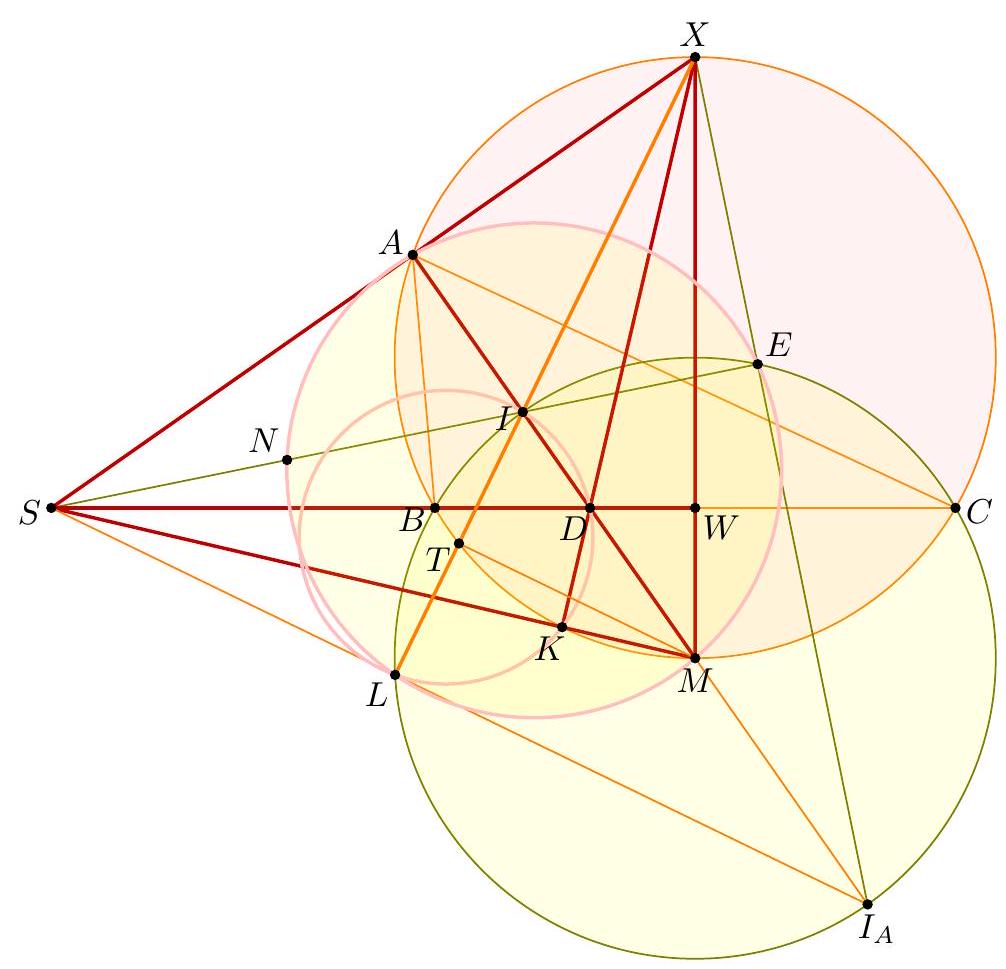
| Let $W$ be the midpoint of $\overline{B C}$, let $X$ be the point on $\Omega$ opposite $M$. Observe that $\overline{K D}$ passes through $X$, and thus lines $B C, M K, X A$ concur at the orthocenter of $\triangle D M X$, which we call $S$. Denote by $I_{A}$ the $A$-excenter of $A B C$. |
| |
| Next, let $E$ be the foot of the altitude from $I$ to $\overline{X I_{A}}$; observe that $E$ lies on the circle centered at $M$ through $I, B, C, I_{A}$. Then, $S$ is the radical center of $\Omega$ and the circles with diameter $\overline{I X}$ and $\overline{I I_{A}}$; hence line $S I$ passes through $E$; accordingly $I$ is the orthocenter of $\triangle X S I_{A}$; denote by $L$ the foot from $X$ to $\overline{S I_{A}}$. |
|  |
| |
| We claim that this $L$ lies on both the circumcircle of $\triangle K I D$ and $\triangle M A N$. It lies on the circumcircle of $\triangle M A N$ since this circle is the nine-point circle of $\triangle X S I_{A}$. Also, $X D \cdot X K=X W \cdot X M=X A \cdot X S=X I \cdot X L$, so $K D I L$ are concyclic. |
| All that remains to show is that the midpoint $T$ of $\overline{I L}$ lies on $\Omega$. But this follows from the fact that $\overline{T M} \| \overline{L I_{A}} \Longrightarrow \angle M T X=90^{\circ}$, thus the problem is solved. |
| |
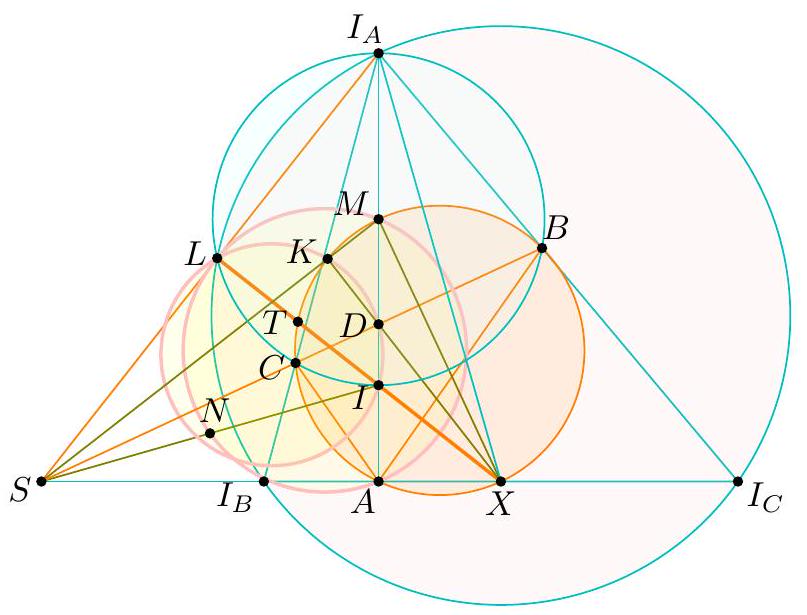
| Remark. Some additional facts about this picture: the point $T$ is the contact point of the $A$-mixtilinear incircle (since it is collinear with $X$ and $I$ ), while the point $K$ is such that $\overline{A K}$ is an $A$-symmedian (since $\overline{K D}$ and $\overline{A D}$ bisect $\angle A$ and $\angle K$, say). |
|  |
| |
| Remark. In fact, the point $L$ is the Miquel point of cyclic quadrilateral $I_{B} I_{C} B C$ (inscribed in the circle with diameter $\overline{I_{B} I_{C}}$ ). This implies many of the properties that $L$ has above. For example, it directly implies that $L$ lies on the circumcircles of triangles $I_{A} I_{B} I_{C}$ and $B C I_{A}$, and that the point $L$ lies on $\overline{S I_{A}}$ (since $S=\overline{B C} \cap \overline{I_{B} I_{C}}$ ). For this reason, many students found it easier to think about the problem in terms of $\triangle I_{A} I_{B} I_{C}$ rather than $\triangle A B C$. |
| |
| ## §2 Solutions to Day 2 |
| |
| ## §2.1 USAMO 2017/4, proposed by Maria Monks |
| |
| Available online at https://aops.com/community/p8117190. |
| |
| ## Problem statement |
| |
| Let $P_{1}, P_{2}, \ldots, P_{2 n}$ be $2 n$ distinct points on the unit circle $x^{2}+y^{2}=1$, other than $(1,0)$. Each point is colored either red or blue, with exactly $n$ red points and $n$ blue points. Let $R_{1}, R_{2}, \ldots, R_{n}$ be any ordering of the red points. Let $B_{1}$ be the nearest blue point to $R_{1}$ traveling counterclockwise around the circle starting from $R_{1}$. Then let $B_{2}$ be the nearest of the remaining blue points to $R_{2}$ travelling counterclockwise around the circle from $R_{2}$, and so on, until we have labeled all of the blue points $B_{1}$, $\ldots, B_{n}$. Show that the number of counterclockwise arcs of the form $R_{i} \rightarrow B_{i}$ that contain the point $(1,0)$ is independent of the way we chose the ordering $R_{1}, \ldots, R_{n}$ of the red points. |
| |
| We present two solutions, one based on swapping and one based on an invariant. |
| \ First "local" solution by swapping two points. Let $1 \leq i<n$ be any index and consider the two red points $R_{i}$ and $R_{i+1}$. There are two blue points $B_{i}$ and $B_{i+1}$ associated with them. |
| |
| Claim - If we swap the locations of points $R_{i}$ and $R_{i+1}$ then the new $\operatorname{arcs} R_{i} \rightarrow B_{i}$ and $R_{i+1} \rightarrow B_{i+1}$ will cover the same points. |
| |
| Proof. Delete all the points $R_{1}, \ldots, R_{i-1}$ and $B_{1}, \ldots, B_{i-1}$; instead focus on the positions of $R_{i}$ and $R_{i+1}$. |
| |
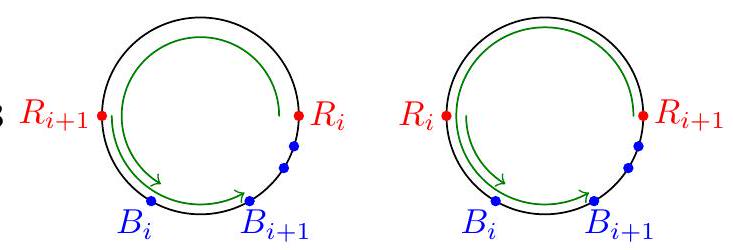
| The two blue points can then be located in three possible ways: either 0,1 , or 2 of them lie on the $\operatorname{arc} R_{i} \rightarrow R_{i+1}$. For each of the cases below, we illustrate on the left the locations of $B_{i}$ and $B_{i+1}$ and the corresponding arcs in green; then on the right we show the modified picture where $R_{i}$ and $R_{i+1}$ have swapped. (Note that by hypothesis there are no other blue points in the green arcs). |
| 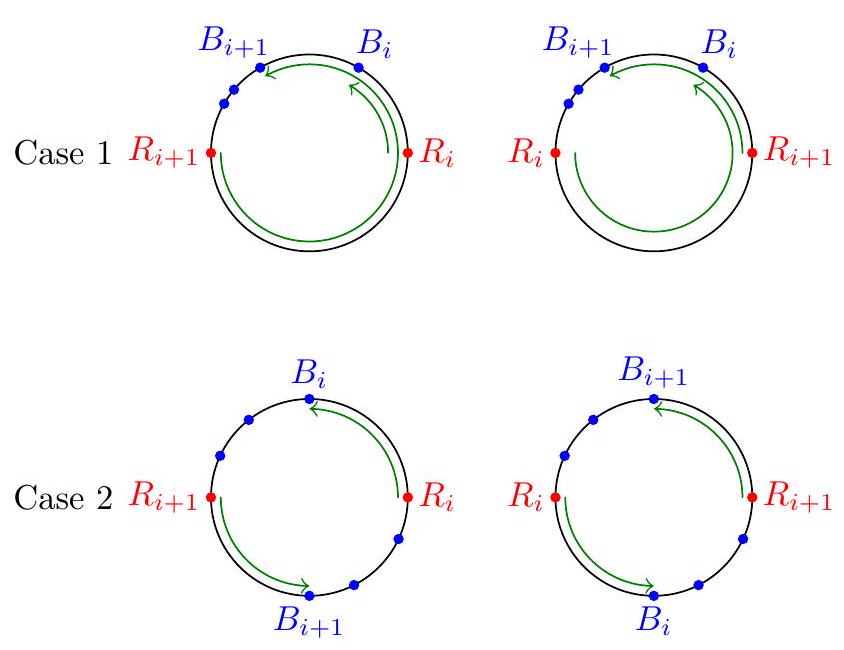 |
| |
| Case $3 R_{i}$ |
|  |
| |
| Observe that in all cases, the number of arcs covering any given point on the circumference is not changed. Consequently, this proves the claim. |
| |
| Finally, it is enough to recall that any permutation of the red points can be achieved by swapping consecutive points (put another way: $(i i+1)$ generates the permutation group $S_{n}$ ). This solves the problem. |
| |
| Remark. This proof does not work if one tries to swap $R_{i}$ and $R_{j}$ if $|i-j| \neq 1$. For example if we swapped $R_{i}$ and $R_{i+2}$ then there are some issues caused by the possible presence of the blue point $B_{i+1}$ in the green $\operatorname{arc} R_{i+2} \rightarrow B_{i+2}$. |
| |
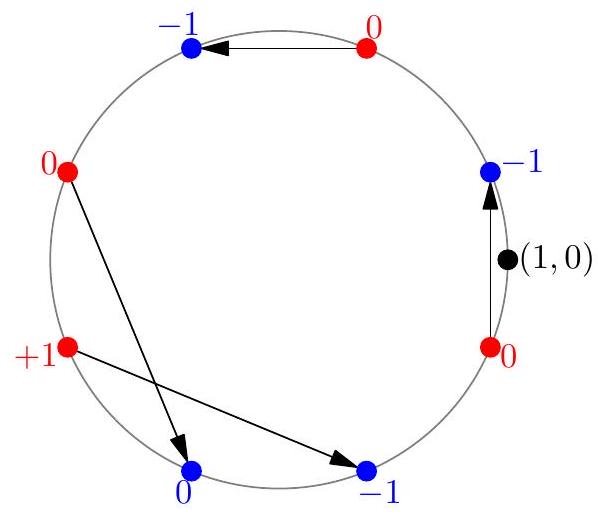
| II Second longer solution using an invariant. Visually, if we draw all the segments $R_{i} \rightarrow B_{i}$ then we obtain a set of $n$ chords. Say a chord is inverted if satisfies the problem condition, and stable otherwise. The problem contends that the number of stable/inverted chords depends only on the layout of the points and not on the choice of chords. |
|  |
| |
| In fact we'll describe the number of inverted chords explicitly. Starting from $(1,0)$ we keep a running tally of $R-B$; in other words we start the counter at 0 and decrement |
| by 1 at each blue point and increment by 1 at each red point. Let $x \leq 0$ be the lowest number ever recorded. Then: |
| |
| Claim - The number of inverted chords is $-x$ (and hence independent of the choice of chords). |
| |
| This is by induction on $n$. I think the easiest thing is to delete chord $R_{1} B_{1}$; note that the arc cut out by this chord contains no blue points. So if the chord was stable certainly no change to $x$. On the other hand, if the chord is inverted, then in particular the last point before $(1,0)$ was red, and so $x<0$. In this situation one sees that deleting the chord changes $x$ to $x+1$, as desired. |
| |
| ## §2.2 USAMO 2017/5, proposed by Ricky Liu |
| |
| Available online at https://aops.com/community/p8117096. |
| |
| ## Problem statement |
| |
| Find all real numbers $c>0$ such that there exists a labeling of the lattice points in $\mathbb{Z}^{2}$ with positive integers for which: |
|
|
| - only finitely many distinct labels occur, and |
| - for each label $i$, the distance between any two points labeled $i$ is at least $c^{i}$. |
|
|
| The answer is $c<\sqrt{2}$. Here is a solution with Calvin Deng. |
| The construction for any $c<\sqrt{2}$ can be done as follows. Checkerboard color the lattice points and label the black ones with 1 . The white points then form a copy of $\mathbb{Z}^{2}$ again scaled up by $\sqrt{2}$ so we can repeat the procedure with 2 on half the resulting points. Continue this dyadic construction until a large $N$ for which $c^{N}<2^{\frac{1}{2}(N-1)}$, at which point we can just label all the points with $N$. |
|
|
| I'll now prove that $c=\sqrt{2}$ (and hence $c \geq \sqrt{2}$ ) can't be done. |
| Claim - It is impossible to fill a $2^{n} \times 2^{n}$ square with labels not exceeding $2 n$. |
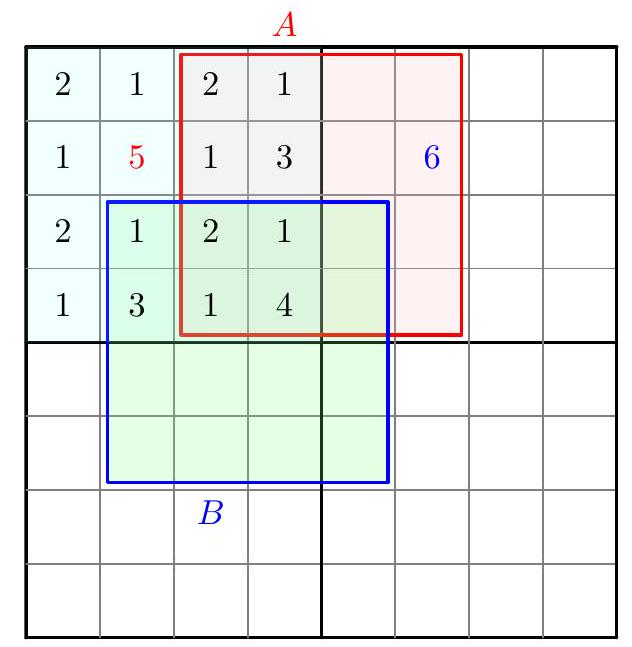
| The case $n=1$ is clear. So now assume it's true up to $n-1$; and assume for contradiction a $2^{n} \times 2^{n}$ square $S$ only contains labels up to $2 n$. (Of course every $2^{n-1} \times 2^{n-1}$ square contains an instance of a label at least $2 n-1$.) |
|  |
|
|
| Now, we contend there are fewer than four copies of $2 n$ : |
|
|
| ## Lemma |
|
|
| In a unit square, among any four points, two of these points have distance $\leq 1$ apart. |
|
|
| Proof. Look at the four rays emanating from the origin and note that two of them have included angle $\leq 90^{\circ}$. |
|
|
| So WLOG the northwest quadrant has no $2 n$ 's. Take a $2 n-1$ in the northwest and draw a square of size $2^{n-1} \times 2^{n-1}$ directly right of it (with its top edge coinciding with the top of $S$ ). Then $A$ can't contain $2 n-1$, so it must contain a $2 n$ label; that $2 n$ label must be in the northeast quadrant. |
|
|
| Then we define a square $B$ of size $2^{n-1} \times 2^{n-1}$ as follows. If $2 n-1$ is at least as high $2 n$, let $B$ be a $2^{n-1} \times 2^{n-1}$ square which touches $2 n-1$ north and is bounded east by $2 n$. Otherwise let $B$ be the square that touches $2 n-1$ west and is bounded north by $2 n$. We then observe $B$ can neither have $2 n-1$ nor $2 n$ in it, contradiction. |
|
|
| Remark. To my knowledge, essentially all density arguments fail because of hexagonal lattice packing. |
|
|
| ## §2.3 USAMO 2017/6, proposed by Titu Andreescu |
|
|
| Available online at https://aops.com/community/p8117097. |
|
|
| ## Problem statement |
|
|
| Find the minimum possible value of |
|
|
| $$ |
| \frac{a}{b^{3}+4}+\frac{b}{c^{3}+4}+\frac{c}{d^{3}+4}+\frac{d}{a^{3}+4} |
| $$ |
|
|
| given that $a, b, c, d$ are nonnegative real numbers such that $a+b+c+d=4$. |
|
|
| The minimum $\frac{2}{3}$ is achieved at $(a, b, c, d)=(2,2,0,0)$ and cyclic permutations. |
| The problem is an application of the tangent line trick: we observe the miraculous identity |
|
|
| $$ |
| \frac{1}{b^{3}+4} \geq \frac{1}{4}-\frac{b}{12} |
| $$ |
|
|
| since $12-(3-b)\left(b^{3}+4\right)=b(b+1)(b-2)^{2} \geq 0$. Moreover, |
|
|
| $$ |
| a b+b c+c d+d a=(a+c)(b+d) \leq\left(\frac{(a+c)+(b+d)}{2}\right)^{2}=4 |
| $$ |
|
|
| Thus |
|
|
| $$ |
| \sum_{\mathrm{cyc}} \frac{a}{b^{3}+4} \geq \frac{a+b+c+d}{4}-\frac{a b+b c+c d+d a}{12} \geq 1-\frac{1}{3}=\frac{2}{3} |
| $$ |
| |
| Remark. The main interesting bit is the equality at $(a, b, c, d)=(2,2,0,0)$. This is the main motivation for trying tangent line trick, since a lower bound of the form $\sum a(1-\lambda b)$ preserves the unusual equality case above. Thus one takes the tangent at $b=2$ which miraculously passes through the point $(0,1 / 4)$ as well. |
| |
| |


