


$34^{\text {th }}$ Indian National Mathematical Olympiad-2019
Problems and Solutions
- Let $A B C$ be a triangle with $\angle B A C>90^{\circ}$. Let $D$ be a point on the segment $B C$ and $E$ be a point on the line $A D$ such that $A B$ is tangent to the circumcircle of triangle $A C D$ at $A$ and $B E$ is perpendicular to $A D$. Given that $C A=C D$ and $A E=C E$, determine $\angle B C A$ in degrees.
Solution: Let $\angle C=2 \alpha$. Then $\angle C A D=\angle C D A=90^{\circ}-\alpha$. Moreover $\angle B A D=2 \alpha$ as $B A$ is tangent to the circumcircle of $\triangle C A D$. Since $A E=A D$, it gives $\angle A E C=2 \alpha$. Thus $\triangle A E C$ is similar to $\triangle A C D$. Hence
But the condition that $B E \perp A D$ gives $A E=A B \cos 2 \alpha=c \cos 2 \alpha$. It is easy to see that $\angle B=90^{\circ}-3 \alpha$. Using sine rule in triangle $A D C$, we get
This gives $A D=2 b \sin \alpha$. Thus we get
Using $b=2 R \sin B$ and $c=2 R \sin C$, this leads to
Writing $\cos 3 \alpha=\cos (4 \alpha-\alpha)$ and expanding, we get $\cos 4 \alpha \cos \alpha=0$. Therefore $\alpha=90^{\circ}$ or $4 \alpha=90^{\circ}$. But $\alpha=90^{\circ}$ is not possible as $\angle C=2 \alpha$. Therefore $4 \alpha=90^{\circ}$ which gives $\angle C=2 \alpha=45^{\circ}$.
- Let $A_{1} B_{1} C_{1} D_{1} E_{1}$ be a regular pentagon. For $2 \leq n \leq 11$,
let $A_{n} B_{n} C_{n} D_{n} E_{n}$ be the pentagon whose vertices are the midpoints of the sides of the pentagon $A_{n-1} B_{n-1} C_{n-1} D_{n-1} E_{n-1}$. All the 5 vertices of each of the 11 pentagons are arbitrarily coloured red or blue. Prove that four points among these 55 points have the same colour and form the vertices of a cyclic quadrilateral.
Solution: We first observe that all the eleven pentagons are regular. Moreover, there are 5 fixed directions and all the 55 sides are in one of these directions. If we consider any two sides which are parallel, they are the parallel sides of an isosceles trapezium, which is cyclic.
If we consider any pentagon, its two adjacent vertices have the same colour. Consider all such 11 sides whose end points are of the same colour. These are in 5 fixed directions. By pigeon-hole principle, there are 3 sides which are in the same directions and therefore parallel to each other. Among these three sides, two must have end points having one colour (again by $\mathrm{P}-\mathrm{H}$ principle). Thus there are two parallel sides among the 55 and the end points of these have one fixed colour. But these two sides are parallel sides of an isosceles trapezium. Hence the four end points are concyclic.
- Let $m, n$ be distinct positive integers. Prove that
Further, determine when equality holds.
Solution: Observe that
for $j=0,1,2$. Hence we can find positive integers $a, b, c$ such that
It follows that $|m-n|$ divides $m a,(m+1) b$ and $(m+2) c$. Hence we can see that $|m-n|$ divides $a b$ and $b c$. We get $|m-n| \leq a b$ and $|m-n| \leq b c$. This leads to
Thus
We have to prove that
Taking $|m-n|=K$, we have to show that $2 b^{2}+K \leq b(2 K+1)$. This reduces to $(b-K)(2 b-1) \leq 0$. However
Equality holds only when $(m, n)=(k, k+1)$ or $(2 k, 2 k+2)$ or permutations of these for some $k$.
- Let $n$ and $M$ be positive integers such that $M>n^{n-1}$. Prove that there are $n$ distinct primes $p_{1}, p_{2}, p_{3}, \ldots, p_{n}$ such that $p_{j}$ divides $M+j$ for $1 \leq j \leq n$.
Solution: If some number $M+k, 1 \leq k \leq n$, has at least $n$ distinct prime factors, then we can associate a prime factor of $M+k$ with the number $M+k$ which is not associated with any of the remaining $n-1$ numbers.
Suppose $m+j$ has less than $n$ distinct prime factors. Write
But $M+j>n^{n-1}$. Hence there exist $t, 1 \leq t \leq r$ such that $p_{t}^{\alpha_{t}}>n$. Associate $p_{t}$ with this $M+j$. Suppose $p_{t}$ is associated with some $M+l$. Let $p_{t}^{\beta_{t}}$ be the largest power of $p_{t}$ dividing $M+l$. Then $p_{t}^{\beta_{t}}>n$. Let $T=\operatorname{gcd}\left(p_{t}^{\alpha_{t}}, p_{t}^{\beta_{t}}\right)$. Then $T>n$. Since $T \mid(M+j)$ and $T \mid(M+l)$, it follows that $T \mid(|j-l|)$. But $|j-l|<n$ and $T>n$, and we get a contradiction. This shows that $p_{t}$ cannot be associated with any other $M+l$. Thus each $M+j$ is associated with different primes.
- Let $A B$ be a diameter of a circle $\Gamma$ and let $C$ be a point on $\Gamma$ different from $A$ and $B$. Let $D$ be the foot of perpendicular from $C$ on to $A B$. Let $K$ be a point of the segment $C D$ such that $A C$ is equal to the semiperimeter of the triangle $A D K$. Show that the excircle of triangle $A D K$ opposite $A$ is tangent to $\Gamma$.
Solution: Draw another diameter $P Q \perp A B$. Let $E$ be the point at which the excircle $\Gamma_{1}$ touches the line $A D$. Join $Q E$ and extend it to meet $\Gamma$ in $L$. Draw the diameter $E N$ of $\Gamma_{1}$ and draw $Q S \perp N E$ (extended). See the figure. We also observe that $D E=E M=E N / 2$.
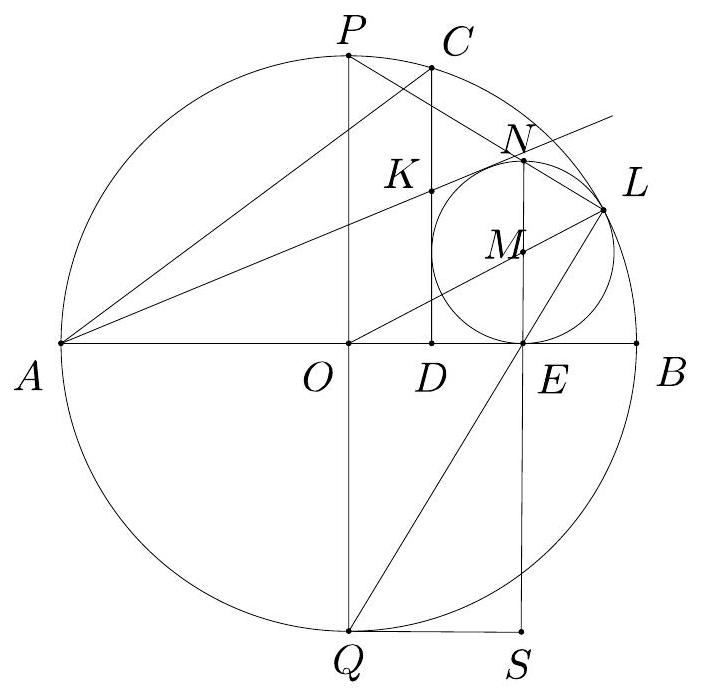
Since $A E$ is equal to the semiperimeter of $\triangle A D K$, we have $A C=A E$. Hence $A E^{2}=A C^{2}=$ $A D \cdot A B$ (as $A C B$ is a right-angle triangle). Thus
Simplification gives
Therefore
But
and $E B \cdot A E=Q E \cdot E L$. Therefore we get
It follows that $Q, S, L, N$ are concyclic. Since $\angle Q S E=90^{\circ}$, we get $\angle E L N=90^{\circ}$. Since $E N$ is a diameter, this implies that $L$ also lies on $\Gamma_{1}$. But $\angle Q L P=90^{\circ}$. Therefore $L, N, P$ are collinear. Since $N M | P O$ and
it follows that $L, M, O$ are collinear. Hence $\Gamma_{1}$ is tangent to $\Gamma$ at $L$.
Alternate solution: Let $R$ be the radius the circle $\Gamma$ and $r$ be that of the circle $\Gamma_{1}$. Let $O$ be the centre of $\Gamma$ and $M$ be that of the circle $\Gamma_{1}$. Let $E$ be the point of contact of $\Gamma_{1}$ with $A B$. Then $M E=D E=r$. Observe that $A E$ is the semiperimeter of $\triangle A D E$. We are given that $A C=A E$. Using that $\angle A C B=90^{\circ}$, we also get $A C^{2}=A D \cdot A B$. Hence $A E^{2}=A D \cdot A B$. We have to show that $R-r=O M$ for proving that $\Gamma_{1}$ is tangent to $\Gamma$. We have
Hence $O M=R-r$ and therefore $\Gamma_{1}$ is tangent to $\Gamma$.
- Let $f$ be function defined from the set ${(x, y): x, y$ reals, $x y \neq 0}$ in to the set of all positive real numbers such that
(i) $\quad f(x y, z)=f(x, z) f(y, z)$, for all $x, y \neq 0$;
(ii) $\quad f(x, y z)=f(x, y) f(x, z)$, for all $x, y \neq 0$;
(iii) $\quad f(x, 1-x)=1$, for all $x \neq 0,1$.
Prove that
(a) $\quad f(x, x)=f(x,-x)=1$, for all $x \neq 0$;
(b) $\quad f(x, y) f(y, x)=1$, for all $x, y \neq 0$.
Solution: (The condition (ii) was inadvertently left out in the paper. We give the solution with condition (ii).)
Taking $x=y=1$ in (ii), weget $f(1, z)^{2}=f(1, z)$ so that $f(1, z)=1$ for all $z \neq 0$. Similarly, $x=y=-1$ gives $f(-1, z)=1$ for all $z \neq 0$. Using the second condition, we also get $f(z, 1)=$ $f(z,-1)=1$ for all $z \neq 0$. Observe
Therefore
for all $x, y \neq 0$. Now for $x \neq 0,1$, condition (iii) gives
Multiplying by $1=f(x, 1-x)$, we get
for all $x \neq 0,1$. But $f(x,-1)=1$ for all $x \neq 0$ gives
for all $x \neq 0,1$. Observe $f(1,1)=f(1,-1)=1$. Hence
for all $x \neq 0$, which proves (a).
We have
for all $x, y \neq 0$, which proves (b).