


INMO-2016 problems and solutions
- Let $A B C$ be triangle in which $A B=A C$. Suppose the orthocentre of the triangle lies on the in-circle. Find the ratio $A B / B C$.
Solution: Since the triangle is isosceles, the orthocentre lies on the perpendicular $A D$ from $A$ on to $B C$. Let it cut the in-circle at $H$. Now we are given that $H$ is the orthocentre of the triangle. Let $A B=A C=b$ and $B C=2 a$. Then $B D=a$. Observe that $b>a$ since $b$ is the hypotenuse and $a$ is a leg of a right-angled triangle. Let $B H$ meet $A C$ in $E$ and $C H$ meet $A B$ in $F$. By Pythagoras theorem applied to $\triangle B D H$, we get
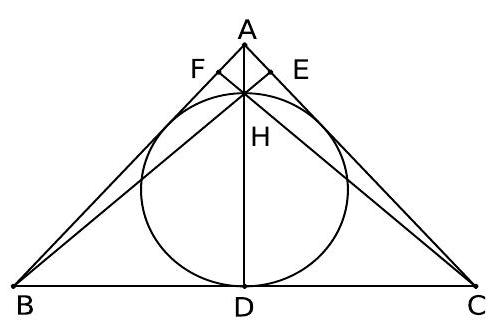
where $r$ is the in-radius of $A B C$. We want to compute $B H$ in another way. Since $A, F, H, E$ are con-cyclic, we have
But $B F \cdot B A=B D \cdot B C=2 a^{2}$, since $A, F, D, C$ are con-cyclic. Hence $B H^{2}=4 a^{4} / B E^{2}$. But
This leads to
Thus we get
This simplifies to $\left(a^{4} /\left(b^{2}-a^{2}\right)\right)=4 r^{2}$. Now we relate $a, b, r$ in another way using area. We know that $[A B C]=r s$, where $s$ is the semi-perimeter of $A B C$. We have $s=(b+b+2 a) / 2=b+a$. On the other hand area can be calculated using Heron's formula::
Hence
Using this we get
Therefore $a^{2}=4(b-a)^{2}$, which gives $a=2(b-a)$ or $2 b=3 a$. Finally,
Alternate Solution 1:
We use the known facts $B H=2 R \cos B$ and $r=4 R \sin (A / 2) \sin (B / 2) \sin (C / 2)$, where $R$ is the circumradius of $\triangle A B C$ and $r$ its in-radius. Therefore
since $\angle C=\angle B$. But $\angle B=(\pi-\angle A) / 2$, since $A B C$ is isosceles. Thus we obtain
However $H D$ is also the diameter of the in circle. Therefore $H D=2 r$. Thus we get
This reduces to
Therefore $\sin (A / 2)=2 / 3$. We also observe that $\sin (A / 2)=B D / A B$. Finally
Alternate Solution 2:
Let $D$ be the mid-point of $B C$. Extend $A D$ to meet the circumcircle in $L$. Then we know that $H D=D L$. But $H D=2 r$. Thus $D L=2 r$. Therefore $I L=I D+D L=r+2 r=3 r$. We also know that $L B=L I$. Therefore $L B=3 r$. This gives
But $\triangle B L D$ is similar to $\triangle A B D$. So
Finally,
Alternate Solution 3:
Let $D$ be the mid-point of $B C$ and $E$ be the mid-point of $D C$. Since $D I=I H(=r)$ and $D E=E C$, the mid-point theorem implies that $I E | C H$. But $C H \perp A B$. Therefore $E I \perp A B$. Let $E I$ meet $A B$ in $F$. Then $F$ is the point of tangency of the incircle of $\triangle A B C$ with $A B$. Since the incircle is also tangent to $B C$ at $D$, we have $B F=B D$. Observe that $\triangle B F E$ is similar to $\triangle B D A$. Hence
This gives
- For positive real numbers $a, b, c$, which of the following statements necessarily implies $a=b=c$ : (I) $a\left(b^{3}+c^{3}\right)=b\left(c^{3}+a^{3}\right)=c\left(a^{3}+b^{3}\right)$, (II) $a\left(a^{3}+b^{3}\right)=b\left(b^{3}+c^{3}\right)=c\left(c^{3}+a^{3}\right)$ ? Justify your answer.
Solution: We show that (I) need not imply that $a=b=c$ where as (II) always implies $a=b=c$.
Observe that $a\left(b^{3}+c^{3}\right)=b\left(c^{3}+a^{3}\right)$ gives $c^{3}(a-b)=a b\left(a^{2}-b^{2}\right)$. This gives either $a=b$ or $a b(a+b)=c^{3}$. Similarly, $b=c$ or $b c(b+c)=a^{3}$. If $a \neq b$ and $b \neq c$, we obtain
Therefore
This gives $(a-c)\left(a^{2}+b^{2}+c^{2}+a b+b c+c a\right)=0$. Since $a, b, c$ are positive, the only possibility is $a=c$. We have therefore 4 possibilities: $a=b=c ; a \neq b, b \neq c$ and $c=a ; b \neq c, c \neq a$ and $a=b$; $c \neq a, a \neq b$ and $b=c$.
Suppose $a=b$ and $b, a \neq c$. Then $b\left(c^{3}+a^{3}\right)=c\left(a^{3}+b^{3}\right)$ gives $a c^{3}+a^{4}=2 c a^{3}$. This implies that $a(a-c)\left(a^{2}-a c-c^{2}\right)=0$. Therefore $a^{2}-a c-c^{2}=0$. Putting $a / c=x$, we get the quadratic equation $x^{2}-x-1=0$. Hence $x=(1+\sqrt{5}) / 2$. Thus we get
Similarly, we get other two cases:
And $a=b=c$ is the fourth possibility.
Consider (II): $a\left(a^{3}+b^{3}\right)=b\left(b^{3}+c^{3}\right)=c\left(c^{3}+a^{3}\right)$. Suppose $a, b, c$ are mutually distinct. We may assume $a=\max {a, b, c}$. Hence $a>b$ and $a>c$. Using $a>b$, we get from the first relation that $a^{3}+b^{3}<b^{3}+c^{3}$. Therefore $a^{3}<c^{3}$ forcing $a<c$. This contradicts $a>c$. We conclude that $a, b, c$ cannot be mutually distinct. This means some two must be equal. If $a=b$, the equality of the first two expressions give $a^{3}+b^{3}=b^{3}+c^{3}$ so that $a=c$. Similarly, we can show that $b=c$ implies $b=a$ and $c=a$ gives $c=b$.
Alternate for (II) by a contestant: We can write
Adding, we get
Using C-S inequality, we have
Thus we obtain
However this implies $(a-b)^{2}+(b-c)^{2}+(c-a)^{2} \leq 0$ and hence $a=b=c$.
- Let $\mathbb{N}$ denote the set of all natural numbers. Define a function $T: \mathbb{N} \rightarrow \mathbb{N}$ by $T(2 k)=k$ and $T(2 k+1)=2 k+2$. We write $T^{2}(n)=T(T(n))$ and in general $T^{k}(n)=T^{k-1}(T(n))$ for any $k>1$.
(i) Show that for each $n \in \mathbb{N}$, there exists $k$ such that $T^{k}(n)=1$.
(ii) For $k \in \mathbb{N}$, let $c_{k}$ denote the number of elements in the set $\left{n: T^{k}(n)=1\right}$. Prove that $c_{k+2}=c_{k+1}+c_{k}$, for $k \geq 1$.
Solution:
(i) For $n=1$, we have $T(1)=2$ and $T^{2}(1)=T(2)=1$. Hence we may assume that $n>1$.
Suppose $n>1$ is even. Then $T(n)=n / 2$. We observe that $(n / 2) \leq n-1$ for $n>1$.
Suppose $n>1$ is odd so that $n \geq 3$. Then $T(n)=n+1$ and $T^{2}(n)=(n+1) / 2$. Again we see that $(n+1) / 2 \leq(n-1)$ for $n \geq 3$.
Thus we see that in at most $2(n-1)$ steps $T$ sends $n$ to 1 . Hence $k \leq 2(n-1)$. (Here $2(n-1)$ is only a bound. In reality, less number of steps will do.)
(ii) We show that $c_{n}=f_{n+1}$, where $f_{n}$ is the $n$-th Fibonacci number.
Let $n \in \mathbb{N}$ and let $k \in \mathbb{N}$ be such that $T^{k}(n)=1$. Here $n$ can be odd or even. If $n$ is even, it can be either of the form $4 d+2$ or of the form $4 d$.
If $n$ is odd, then $1=T^{k}(n)=T^{k-1}(n+1)$. (Observe that $k>1$; otherwise we get $n+1=1$ which is impossible since $n \in \mathbb{N}$.) Here $n+1$ is even.
If $n=4 d+2$, then again $1=T^{k}(4 d+2)=T^{k-1}(2 d+1)$. Here $2 d+1=n / 2$ is odd.
Thus each solution of $T^{k-1}(m)=1$ produces exactly one solution of $T^{k}(n)=1$ and $n$ is either odd or of the form $4 d+2$.
If $n=4 d$, we see that $1=T^{k}(4 d)=T^{k-1}(2 d)=T^{k-2}(d)$. This shows that each solution of $T^{k-2}(m)=1$ produces exactly one solution of $T^{k}(n)=1$ of the form $4 d$.
Thus the number of solutions of $T^{k}(n)=1$ is equal to the number of solutions of $T^{k-1}(m)=1$ and the number of solutions of $T^{k-2}(l)=1$ for $k>2$. This shows that $c_{k}=c_{k-1}+c_{k-2}$ for $k>2$. We also observe that 2 is the only number which goes to 1 in one step and 4 is the only number which goes to 1 in two steps. Hence $c_{1}=1$ and $c_{2}=2$. This proves that $c_{n}=f_{n+1}$ for all $n \in \mathbb{N}$.
- Suppose 2016 points of the circumference of a circle are coloured red and the remaining points are coloured blue. Given any natural number $n \geq 3$, prove that there is a regular $n$-sided polygon all of whose vertices are blue.
Solution: Let $A_{1}, A_{2}, \ldots, A_{2016}$ be 2016 points on the circle which are coloured red and the remain- ing blue. Let $n \geq 3$ and let $B_{1}, B_{2}, \ldots, B_{n}$ be a regular $n$-sided polygon inscribed in this circle with the vertices chosen in anti-clock-wise direction. We place $B_{1}$ at $A_{1}$. (It is possible, in this position, some other $B$ 's also coincide with some other $A$ 's.) Rotate the polygon in anti-clock-wise direction gradually till some $B$ 's coincide with (an equal number of) $A$ 's second time. We again rotate the polygon in the same direction till some $B$ 's coincide with an equal number of $A$ 's third time, and so on until we return to the original position, i.e., $B_{1}$ at $A_{1}$. We see that the number of rotations will not be more than $2016 \times n$, that is, at most these many times some $B$ 's would have coincided with an equal number of $A$ 's. Since the interval $\left(0,360^{\circ}\right)$ has infinitely many points, we can find a value $\alpha^{\circ} \in\left(0,360^{\circ}\right)$ through which the polygon can be rotated from its initial position such that no $B$ coincides with any $A$. This gives a $n$-sided regular polygon having only blue vertices.
Alternate Solution: Consider a regular $2017 \times n$-gon on the circle; say, $A_{1} A_{2} A_{3} \cdots A_{2017 n}$. For each $j, 1 \leq j \leq 2017$, consider the points $\left{A_{k}: k \equiv j(\bmod 2017)\right}$. These are the vertices of a regular $n$-gon, say $S_{j}$. We get 2017 regular $n$-gons; $S_{1}, S_{2}, \ldots, S_{2017}$. Since there are only 2016 red points, by pigeon-hole principle there must be some $n$-gon among these 2017 which does not contain any red point. But then it is a blue $n$-gon.
- Let $A B C$ be a right-angled triangle with $\angle B=90^{\circ}$. Let $D$ be a point on $A C$ such that the in-radii of the triangles $A B D$ and $C B D$ are equal. If this common value is $r^{\prime}$ and if $r$ is the in-radius of triangle $A B C$, prove that
Solution: Let $E$ and $F$ be the incentres of triangles $A B D$ and $C B D$ respectively. Let the incircles of triangles $A B D$ and $C B D$ touch $A C$ in $P$ and $Q$ respectively. If $\angle B D A=\theta$, we see that
Hence
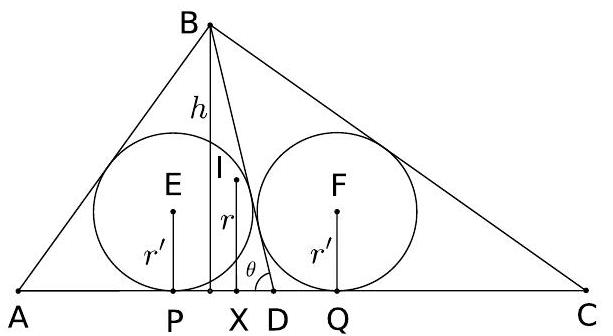
But we observe that
Thus $P Q=(b-c-a+2 B D) / 2$. We also have
But
where $h$ is the altitude from $B$ on to $A C$. But we know that $h=a c / b$. Thus we get
Thus we get
This gives $B D^{2}=s(s-b)$. Since $A B C$ is a right-angled triangle $r=s-b$. Thus we get $B D^{2}=r s$. On the other hand, we also have $[A B C]=r^{\prime}(s+B D)$. Thus we get
Hence
Alternate Solution 1: Observe that
where $X$ is the point at which the incircle of $A B C$ touches the side $A C$. If $s_{1}$ and $s_{2}$ are respectively the semi-perimeters of triangles $A B D$ and $C B D$, we know $A P=s_{1}-B D$ and $C Q=s_{2}-B D$. Therefore
But
This gives
We also have
This implies that
Comparing the two expressions for $r^{\prime} / r$, we see that
Therefore $s^{2}-B D^{2}=b s$, or $B D^{2}=s(s-b)$. Thus we get $B D=\sqrt{s(s-b)}$.
We know now that
Therefore
This gives
But
If $\angle B=90^{\circ}$, we know that $r=s-b$. Therfore we get
Alternate Solution 2 by a contestant: Observe that $\angle E D F=90^{\circ}$. Hence $\triangle E D P$ is similar to $\triangle D F Q$. Therefore $D P \cdot D Q=E P \cdot F Q$. Taking $D P=y_{1}$ and $D Q=x_{1}$, we get $x_{1} y_{1}=\left(r^{\prime}\right)^{2}$. We also observe that $B D=x_{1}+x_{2}=y_{1}+y_{2}$. Since $\angle E B F=45^{\circ}$, we get
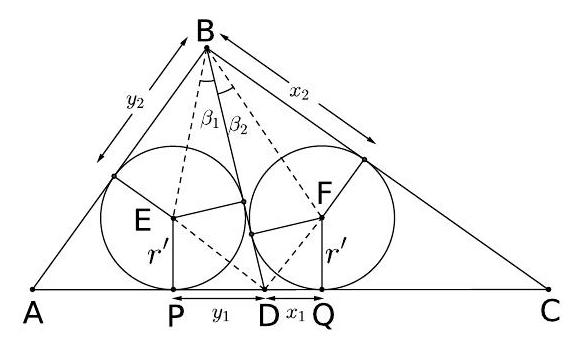
But $\tan \beta_{1}=r^{\prime} / y_{2}$ and $\tan \beta_{2}=r^{\prime} / x_{2}$. Hence we obtain
Solving for $r^{\prime}$, we get
We also know
Finally,
But we can write
and
Therefore
Remark: One can also choose $B=(0,0), A=(0, a)$ and $C=(1,0)$ and the coordinate geometry proof gets reduced considerbly.
- Consider a non-constant arithmetic progression $a_{1}, a_{2}, \ldots, a_{n}, \ldots$ Suppose there exist relatively prime positive integers $p>1$ and $q>1$ such that $a_{1}^{2}, a_{p+1}^{2}$ and $a_{q+1}^{2}$ are also the terms of the same arithmetic progression. Prove that the terms of the arithmetic progression are all integers.
Solution: Let us take $a_{1}=a$. We have
Thus we have
Since we have non-constant AP, we see that $d \neq 0$. Hence we obtain $2 p a+p^{2} d=l-k$. Similarly, we get $2 q a+q^{2} d=m-k$. Observe that $p^{2} q-p q^{2} \neq 0$. Otherwise $p=q$ and $\operatorname{gcd}(p, q)=p>1$ which is a contradiction to the given hypothesis that $\operatorname{gcd}(p, q)=1$. Hence we can solve the two equations for $a, d$ :
It follows that $a, d$ are rational numbers. We also have
But $p^{2} d=l-k-2 p a$. Thus we get
This shows that pa satisfies the equation
Since $a$ is rational, we see that $p a$ is rational. Write $p a=w / z$, where $w$ is an integer and $z$ is a natural numbers such that $\operatorname{gcd}(w, z)=1$. Substituting in the equation, we obtain
This shows $z$ divides $w$. Since $\operatorname{gcd}(w, z)=1$, it follows that $z=1$ and $p a=w$ an integer. (In fact any rational solution of a monic polynomial with integer coefficients is necessarily an integer.) Similarly, we can prove that $q a$ is an integer. Since $\operatorname{gcd}(p, q)=1$, there are integers $u$ and $v$ such that $p u+q v=1$. Therefore $a=(p a) u+(q a) v$. It follows that $a$ is an integer.
But $p^{2} d=l-k-2 p a$. Hence $p^{2} d$ is an integer. Similarly, $q^{2} d$ is also an integer. Since $\operatorname{gcd}\left(p^{2}, q^{2}\right)=1$, it follows that $d$ is an integer. Combining these two, we see that all the terms of the AP are integers.
Alternatively, we can prove that $a$ and $d$ are integers in another way. We have seen that $a$ and $d$ are rationals; and we have three relations:
where $n_{1}=l-k$ and $n_{2}=m-k$. Let $a=u / v$ and $d=x / y$ where $u, x$ are integers and $v, y$ are natural numbers, and $\operatorname{gcd}(u, v)=1, \operatorname{gcd}(x, y)=1$. Putting this in these relations, we obtain
Now (1) shows that $v \mid u^{2} y$. Since $\operatorname{gcd}(u, v)=1$, it follows that $v \mid y$. Similarly (2) shows that $y \mid p^{2} v x$. Using $\operatorname{gcd}(y, x)=1$, we get that $y \mid p^{2} v$. Similarly, (3) shows that $y \mid q^{2} v$. Therefore $y$ divides $\operatorname{gcd}\left(p^{2} v, q^{2} v\right)=v$. The two results $v \mid y$ and $y \mid v$ imply $v=y$, since both $v, y$ are positive.
Substitute this in (1) to get
This shows that $v \mid u^{2}$. Since $\operatorname{gcd}(u, v)=1$, it follows that $v=1$. This gives $v=y=1$. Finally $a=u$ and $d=x$ which are integers.