


$32^{\text {nd }}$ Indian National Mathematical Olympiad-2017
Problems and Solutions
- In the given figure, $A B C D$ is a square paper. It is folded along $E F$ such that $A$ goes to a point $A^{\prime} \neq C, B$ on the side $B C$ and $D$ goes to $D^{\prime}$. The line $A^{\prime} D^{\prime}$ cuts $C D$ in $G$. Show that the inradius of the triangle $G C A^{\prime}$ is the sum of the inradii of the triangles $G D^{\prime} F$ and $A^{\prime} B E$.
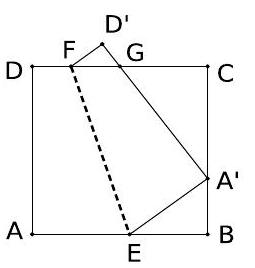
Solution: Observe that the triangles $G C A^{\prime}$ and $A^{\prime} B E$ are similar to the triangle $G D^{\prime} F$. If $G F=u, G D^{\prime}=v$ and $D^{\prime} F=w$, then we have
If $r$ is the inradius of $\triangle G D^{\prime} F$, then $p r$ and $q r$ are respectively the inradii of triangles $G C A^{\prime}$ and $A^{\prime} B E$. We have to show that $p r=r+q r$. We also observe that
Therefore
The last two equalities give $(p-1)(u-v)=w$. The first two equalities give $(p-q) w=q(u-v)$. Hence
This simplifies to $p(p-q-1)=0$. Since $p \neq 0$, we get $p=q+1$. This implies that $p r=q r+r$.
- Suppose $n \geq 0$ is an integer and all the roots of $x^{3}+\alpha x+4-\left(2 \times 2016^{n}\right)=0$ are integers. Find all possible values of $\alpha$.
Solution 1: Let $u, v, w$ be the roots of $x^{3}+\alpha x+4-\left(2 \times 2016^{n}\right)=0$. Then $u+v+w=0$ and $u v w=-4+\left(2 \times 2016^{n}\right)$. Therefore we obtain
Suppose $n \geq 1$. Then we see that $u v(u+v) \equiv 4\left(\bmod 2016^{n}\right)$. Therefore $u v(u+v) \equiv 1$ $(\bmod 3)$ and $u v(u+v) \equiv 1(\bmod 9)$. This implies that $u \equiv 2(\bmod 3)$ and $v \equiv 2(\bmod 3)$. This shows that modulo 9 the pair $(u, v)$ could be any one of the following:
In each case it is easy to check that $u v(u+v) \not \equiv 4(\bmod 9)$. Hence $n=0$ and $u v(u+v)=2$. It follows that $(u, v)=(1,1),(1,-2)$ or $(-2,1)$. Thus
for every pair $(u, v)$.
Solution 2: Let $a, b, c \in \mathbb{Z}$ be the roots of the given equation for some $n \in \mathbb{N}_{0}$. By Vieta Theorem, we know that
If possible, let us have $n \geq 1$. Since $7 \mid 2016$, we have that
Since we have $a+b+c=0$, we get that $3 a b c=a^{3}+b^{3}+c^{3}$. Substituting this in the earlier expression, we get that
Consider below, a table calculating the residues of cubes modulo 7 .
| $x$ | 0 | 1 | 2 | 3 | 4 | 5 | 6 |
|---|---|---|---|---|---|---|---|
| $x^{3}$ | 0 | 1 | 1 | -1 | 1 | -1 | -1 |
Hence, we know that if $x \in \mathbb{N}$, then we have $x^{3} \equiv 0,1,-1(\bmod 7)$. Since $a^{3}+b^{3}+c^{3} \equiv 2$ $(\bmod 7)$, we see that we must have one of the numbers divisible by 7 and the other two numbers, when cubed, must leave 1 as remainder modulo 7. Without of generality, let us assume that
Hence, we have $b, c \equiv 1,2,4(\bmod 7)$. We will consider all possible values of $b+c$ modulo 7 . Since the expression is symmetric in $b, c$, modulo 7 , we will consider $b \leq c$.
| $b$ | 1 | 1 | 1 | 2 | 2 | 4 |
|---|---|---|---|---|---|---|
| $c$ | 1 | 2 | 4 | 2 | 4 | 4 |
| $b+c$ | 2 | 3 | 5 | 4 | 6 | 1 |
We see that, in all the above cases, we get $7 \nmid\langle b+c$. But this is a contradiction, since 7$| a+b+c$ and $7 \mid a$ together imply that $7 \mid b+c$. Hence, we cannot have $n \geq 1$. Hence, the only possible value is $n=0$. Substituting this value in the original equation, the equation becomes
Solving the equations $a+b+c=0$ and $a b c=-2$ in integers, we see that the only possible solutions $(a, b, c)$ are permutations of $(1,1,-2)$. In case of any permutation, $\alpha=-3$. Substituting this value of $\alpha$ back in the equation, we see that we indeed, get integer roots. Hence, the only possible value for $\alpha$ is -3 .
- Find the number of triples $(x, a, b)$ where $x$ is a real number and $a, b$ belong to the set ${1,2,3,4,5,6,7,8,9}$ such that
where ${x}$ denotes the fractional part of the real number $x$. (For example ${1.1}=0.1=$ ${-0.9}$.
Solution: Let us write $x=n+f$ where $n=[x]$ and $f={x}$. Then
Observe that the product of the roots of (1) is $n^{2}+b \geq 1$. If this equation has to have a solution $0 \leq f<1$, the larger root of (1) is greater 1 . We conclude that the equation (1) has a real root less than 1 only if $P(1)<0$ where $P(y)=y^{2}+(2 n-a) y+n^{2}+2 b$. This gives
Therefore we have $(n+1)^{2}+b<a$. If $n \geq 2$, then $(n+1)^{2}+b \geq 10>a$. Hence $n \leq 1$. If $n \leq-4$, then again $(n+1)^{2}+b \geq 10>a$. Thus we have the range for $n:-3,-2,-1,0,1$. If $n=-3$ or $n=1$, we have $(n+1)^{2}=4$. Thus we must have $4+b<a$. If $a=9$, we must have $b=4,3,2,1$ giving 4 values. For $a=8$, we must have $b=3,2,1$ giving 3 values. Similarly, for $a=7$ we get 2 values of $b$ and $a=6$ leads to 1 value of $b$. In each case we get a real value of $f<1$ and this leads to a solution for $x$. Thus we get totally $2(4+3+2+1)=20$ values of the triple $(x, a, b)$.
For $n=-2$ and $n=0$, we have $(n+1)^{2}=1$. Hence we require $1+b<a$. We again count pairs $(a, b)$ such that $a-b>1$. For $a=9$, we get 7 values of $b$; for $a=8$ we get 6 values of $b$ and so on. Thus we get $2(7+6+5+4+3+2+1)=56$ values for the triple $(x, a, b)$.
Suppose $n=-1$ so that $(n+1)^{2}=0$. In this case we require $b<a$. We get $8+7+6+5+$ $4+3+2+1=36$ values for the triple $(x, a, b)$.
Thus the total number of triples $(x, a, b)$ is $20+56+36=112$.
- Let $A B C D E$ be a convex pentagon in which $\angle A=\angle B=\angle C=\angle D=120^{\circ}$ and whose side lengths are 5 consecutive integers in some order. Find all possible values of $A B+B C+C D$.
Solution 1: Let $A B=a, B C=b$, and $C D=c$. By symmetry, we may assume that $c<a$. We show that $D E=a+b$ and $E A=b+c$.
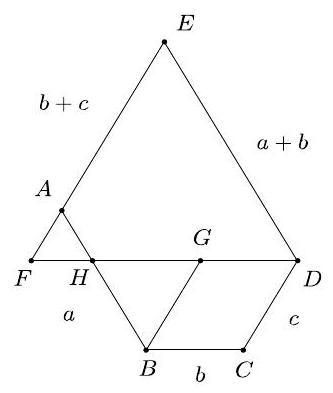
Draw a line parallel to $B C$ through $D$. Extend $E A$ to meet this line at $F$. Draw a line parallel to $C D$ through $B$ and let it intersect $D F$ in $G$. Let $A B$ intersect $D F$ in $H$. We have $\angle F D E=60^{\circ}$ and $\angle E=60^{\circ}$. Hence $E F D$ is an equilateral triangle. Similarly $A F H$ and $B G H$ are also equilateral triangles. Hence $H G=G B=c$. Moreover, $D G=b$. Therefore $H D=b+c$. But $H D=A E$ since $F H=F A$ and $F D=F E$. Also $A H=a-B H=$ $a-B G=a-c$. Hence $E D=E F=E A+A F=b+c+A H=(b+c)+(a-c)=b+a$.
We have five possibilities:
(1) $b<c<a<b+c<a+b$;
(2) $c<b<a<b+c<a+b$;
(3) $c<a<b<b+c<a+b$;
(4) $b<c<b+c<a<a+b$;
(5) $c<b<b+c<a<a+b$.
In (1), we see that $c<a<b+c$ are three consecutive integers provided $b=2$. Hence we get $c=3$ and $a=4$. In this case $b+c=5$ and $a+b=6$ so that we have five consecutive integrs $2,3,4,5,6$ as side lengths. In (2), $b<a<b+c$ form three consecutive integrs only when $c=2$. Hence $b=3, a=4$. But then $b+c=5$ and $a+b=7$. Thus the side lengths are $2,3,4,6,7$ which are not consecutive integers. In case (3), $b<b+c$ are two consecutive integrs so that $c=1$. Hence $a=2$ and $b=3$. We get $b+c=4$ and $a+b=5$ so that the consecutive integers $1,2,3,4,5$ form the side lengths. In case (4), we have $c<b+c$ as two consecutive integers and hence $b=1$. Therefore $c=2, b+c=3, a=4$ and $a+b=5$ which is admissible. Finally, in case (5) we have $b<b+c$ as two consecutive integers, so that $c=1$. Thus $b=2, b+c=3, a=4$ and $a+b=6$. We do not get consecutive integers.
Therefore the only possibilities are $(a, b, c)=(4,2,3),(2,3,1)$ and $(4,1,2)$. This shows that $a+b+c=9,6$ or 7 . Thus there are three possible sums $A B+B C+C A$, namely, 6,7 or 9 .
Solution 2: As in the earlier solution, $E D=d=a+b$ and $E A=e=b+c$. Let the sides be $x-2, x-1, x, x+1, x+2$. Then $x \geq 3$. We also have $x+2 \geq x-1+x-2$ so that $x \leq 5$. Thus $x=3,4$ or 5 . If $x=5$, the sides are ${3,4,5,6,7}$ and here we do not have two pairs which add to a number in the set. Hence $x=3$ or 4 and we get the sets as ${1,2,3,4,5}$ or ${2,3,4,5,6}$. With the set ${1,2,3,4,5}$ we get
From the set ${2,3,4,5,6}$, we get $(a, b, c, d, e)=(4,2,3,6,5)$. Thus we see that $a+b+c=6,7$ or 9 .
Solution 3: We use the same notations and we get $d=a+b$ and $e=b+c$. If $a \geq 5$, we see that $d-b \geq 5$. But the maximum difference in a set of 5 consecutive integers is 4 . Hence $a \leq 4$. Similarly, we see $b \leq 4$ and $c \leq 4$. Thus we see that $a+b+c \leq 2+3+4=9$. But $a+b+c \geq 1+2+3=6$. It follows that $a+b+c=6,7,8$ or 9 . If we take $(a, b, c, d, e)=(1,3,2,4,5)$, we get $a+b+c=6$. Similarly, $(a, b, c, d, e)=(2,1,4,3,5)$ gives $a+b+c=7$, For $a+b+c=8$, the only we we can get $1+3+4=8$. Here we cannot accommodate 2 and consecutiveness is lost. For 9 , we can have $(a, b, c, d, e)=(3,2,4,5,6)$ and $a+b+c=9$.
- Let $A B C$ be a triangle with $\angle A=90^{\circ}$ and $A B<A C$. Let $A D$ be the altitude from $A$ on to $B C$. Let $P, Q$ and $I$ denote respectively the incentres of triangles $A B D, A C D$ and $A B C$. Prove that $A I$ is perpendicular to $P Q$ and $A I=P Q$.
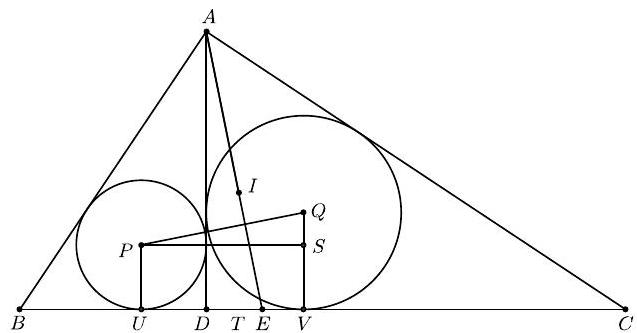
Solution: Draw $P S | B C$ and $Q S | A D$. Then $P S Q$ is a right-angled triangle with $\angle P S Q=90^{\circ}$. Observe that $P S=r_{1}+r_{2}$ and $S Q=r_{2}-r_{1}$, where $r_{1}$ and $r_{2}$ are the inradii of triangles $A B D$ and $A C D$, respectively. We observe that triangles $D A B$ and $D C A$ are similar to triangle $A C B$.
Hence
where $r$ is the inradius of triangle $A B C$. Thus we get
On the otherhand $A D=h=b c / a$. We also have $B E=c a /(b+c)$ and
Hence $B D=c^{2} / a$. Therefore
Thus we get
Since $\angle A D E=90^{\circ}=\angle P S Q$, we conclude that $\triangle A D E \sim \triangle P S Q$. Since $A D \perp P S$, it follows that $A E \perp P Q$.
We also observe that
However
Hence $P Q=\sqrt{2} r$. We also observe that $A I=r \operatorname{cosec}(A / 2)=r \operatorname{cosec}\left(45^{\circ}\right)=\sqrt{2} r$. Thus $P Q=A I$.
Solution 2: In the figure, we have made the construction as mentioned in the hint. Since $P, Q$ are the incentres of $\triangle A B D, \triangle A C D, D P, D Q$ are the internal angle bisectors of $\angle A D B, \angle A D C$ respectively. Since $A D$ is the altitude on the hypotenuse $B C$ in $\triangle A B C$, we have that $\angle P D Q=45^{\circ}+45^{\circ}=90^{\circ}$. It also implies that
This implies that all corresponding length in the above mentioned triangles have the same ratio.
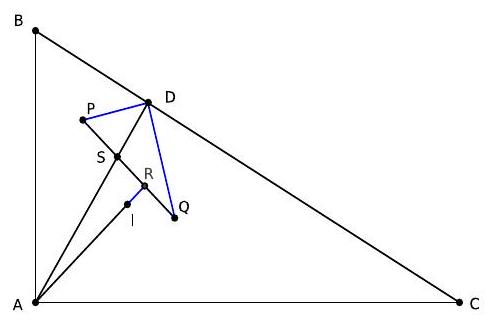
In particular,
as required.
For the second, part, we note that from the above relations, we have $\triangle A B C \sim \triangle D P Q$. Let us take $\angle A C B=\theta$. Then, we get
This gives us that
as required. Hence, we get that $A I=P Q$ and $A I \perp P Q$.
Solution 3: We know that the angle bisector of $\angle B$ passes through $P, I$ which implies that $B, P, I$ are collinear. Similarly, $C, Q, I$ are also collinear. Since $I$ is the incentre of $\triangle A B C$, we know that
Join $A P, A Q$. We know that $\angle B A P=\frac{1}{2} \angle B A D=\frac{1}{2} \angle C$. Also, $\angle A B P=\frac{1}{2} \angle B$. Hence by Exterior Angle Theorem in $\triangle A B P$, we get that
Similarly in $\triangle A D C$, we get that $\angle A Q I=45^{\circ}$. Also, we have
Similarly, we get $\angle Q A I=\frac{\angle C}{2}$.
Now applying Sine Rule in $\triangle A P I$, we get
Similarly, applying Sine Rule in $\triangle A Q I$, we get
Applying Cosine Rule in $\triangle P I Q$ gives us that
We will prove that $\left(\sin ^{2} \frac{B}{2}+\sin ^{2} \frac{C}{2}+\sqrt{2} \sin \frac{B}{2} \sin \frac{C}{2}\right)=\frac{1}{2}$. In any $\triangle X Y Z$, we have that
Using this in $\triangle A B C$, and using the fact that $\angle A=90^{\circ}$, we get
which was to be proved. Hence we get $P Q=A I$.
The second part of the problem can be obtained by angle-chasing as outlined in Solution 2 .
Solution 4: Observe that $\angle A P B=\angle A Q C=135^{\circ}$. Thus $\angle A P I=\angle A Q I=45^{\circ}$ (since $B-P-I$ and $C-Q-I)$. Note $\angle P A Q=1 / 2 \angle A=45^{\circ}$. Let $X=B I \cap A Q$ and $Y=C I \cap A P$. Therefore $\angle A X P=180-\angle A P I-\angle P A Q=90^{\circ}$. Similarly $\angle A Y Q=90^{\circ}$. Hence $I$ is the orthocentre of triangle $P A Q$. Therefore $A I$ is perpendicular to $P Q$. Also $A I=2 R_{P A Q} \cos 45^{\circ}=2 R_{P A Q} \sin 45^{\circ}=P Q$.
- Let $n \geq 1$ be an integer and consider the sum
Show that $2 x-1,2 x, 2 x+1$ form the sides of a triangle whose area and inradius are also integers.
Solution: Consider the binomial expansion of $(2+\sqrt{3})^{n}$. It is easy to check that
where $y$ is also an integer. We also have
Multiplying these two relations, we obtain $x^{2}-3 y^{2}=1$.
Since all the terms of the expansion of $(2+\sqrt{3})^{n}$ are positive, we see that
Thus $x \geq 2$. Hence $2 x+1<2 x+(2 x-1)$ and therefore $2 x-1,2 x, 2 x+1$ are the sides of a triangle. By Heron's formula we have
Hence $\Delta=3 x y$ which is an integer. Finally, its inradius is
which is also an integer.
Solution 2: We will first show that the numbers $2 x_{n}-1,2 x_{n}, 2 x_{n}+1$ form the sides of a triangle. To show that, it suffices to prove that $2 x_{n}-1+2 x_{n}>2 x_{n}+1$. If possible, let the converse hold. Then, we see that we must have $4 x_{n}-1 \leq 2 x_{n}+1$, which implies that $x_{n} \leq 1$. But we see that even for the smallest value of $n=1$, we have that $x_{n}>1$. Hence, the numbers are indeed sides of a triangle.
Let $\Delta_{n}, r_{n}, s_{n}$ denote respectively, the area, inradius and semiperimeter of the triangle with sides $2 x_{n}-1,2 x_{n}, 2 x_{n}+1$. By Heron's Formula for the area of a triangle, we see that
If possible, let $\Delta_{n}$ be an integer for all $n \in \mathbb{N}$. We see that due to the presence of the first term $\binom{n}{0} 2^{n}$, we have $3 \nmid x_{n}, \forall n \in \mathbb{N}$. Hence, we get that $3 \mid x_{n}^{2}-1$. Hence, we can write $x_{n}^{2}-1$ as $3 m$ for some $m \in \mathbb{N}$. Then, we can also write
Note that we have assumed that $\Delta_{n}$ is an integer. Hence, we see that we must have $m$ to be a perfect square. Consequently, we get that
Hence, it only remains to show that $\Delta_{n} \in \mathbb{Z}, \forall n \in \mathbb{N}$. In other words, it suffices to show that $3\left(x_{n}^{2}-1\right)$ is a perfect square for all $n \in \mathbb{N}$.
We see that we can write $x_{n}$ as
We are left to show that the quantity obtained in the above equation is an integer. But we see that if we define
the sequence $\left\langle a_{k}\right\rangle_{k=1}^{\infty}$ thus obtained is exactly the solution for the recursion given by
Hence, clearly, each $a_{n}$ is obviously an integer, thus completing the proof. $\qquad$