


USA TSTST 2017 Solutions
United States of America - TST Selection Test
Evan Chen《陳誼廷》
$59^{\text {th }}$ IMO 2018 Romania and $7^{\text {th }}$ EGMO 2018 Italy
Contents
0 Problems ..... 2 1 Solutions to Day 1 ..... 3 1.1 TSTST 2017/1, proposed by Ray Li ..... 3 1.2 TSTST 2017/2, proposed by Kevin Sun ..... 5 1.3 TSTST 2017/3, proposed by Calvin Deng, Linus Hamilton ..... 7 2 Solutions to Day 2 ..... 9 2.1 TSTST 2017/4, proposed by Mark Sellke ..... 9 2.2 TSTST 2017/5, proposed by Ray Li ..... 10 2.3 TSTST 2017/6, proposed by Ivan Borsenco ..... 12
§0 Problems
- Let $A B C$ be a triangle with circumcircle $\Gamma$, circumcenter $O$, and orthocenter $H$. Assume that $A B \neq A C$ and $\angle A \neq 90^{\circ}$. Let $M$ and $N$ be the midpoints of $\overline{A B}$ and $\overline{A C}$, respectively, and let $E$ and $F$ be the feet of the altitudes from $B$ and $C$ in $\triangle A B C$, respectively. Let $P$ be the intersection point of line $M N$ with the tangent line to $\Gamma$ at $A$. Let $Q$ be the intersection point, other than $A$, of $\Gamma$ with the circumcircle of $\triangle A E F$. Let $R$ be the intersection point of lines $A Q$ and $E F$. Prove that $\overline{P R} \perp \overline{O H}$.
- Ana and Banana are playing a game. First Ana picks a word, which is defined to be a nonempty sequence of capital English letters. Then Banana picks a nonnegative integer $k$ and challenges Ana to supply a word with exactly $k$ subsequences which are equal to Ana's word. Ana wins if she is able to supply such a word, otherwise she loses. For example, if Ana picks the word "TST", and Banana chooses $k=4$, then Ana can supply the word "TSTST" which has 4 subsequences which are equal to Ana's word. Which words can Ana pick so that she can win no matter what value of $k$ Banana chooses?
- Consider solutions to the equation
where $f$ and $g$ are nonzero polynomials with nonnegative real coefficients. For each $c>0$, determine the minimum possible degree of $f$, or show that no such $f, g$ exist. 4. Find all nonnegative integer solutions to
- Let $A B C$ be a triangle with incenter $I$. Let $D$ be a point on side $B C$ and let $\omega_{B}$ and $\omega_{C}$ be the incircles of $\triangle A B D$ and $\triangle A C D$, respectively. Suppose that $\omega_{B}$ and $\omega_{C}$ are tangent to segment $B C$ at points $E$ and $F$, respectively. Let $P$ be the intersection of segment $A D$ with the line joining the centers of $\omega_{B}$ and $\omega_{C}$. Let $X$ be the intersection point of lines $B I$ and $C P$ and let $Y$ be the intersection point of lines $C I$ and $B P$. Prove that lines $E X$ and $F Y$ meet on the incircle of $\triangle A B C$.
- A sequence of positive integers $\left(a_{n}\right){n \geq 1}$ is of Fibonacci type if it satisfies the recursive relation $a{n+2}=a_{n+1}+a_{n}$ for all $n \geq 1$. Is it possible to partition the set of positive integers into an infinite number of Fibonacci type sequences?
§1 Solutions to Day 1
§1.1 TSTST 2017/1, proposed by Ray Li
Available online at https://aops.com/community/p8526098.
Problem statement
Let $A B C$ be a triangle with circumcircle $\Gamma$, circumcenter $O$, and orthocenter $H$. Assume that $A B \neq A C$ and $\angle A \neq 90^{\circ}$. Let $M$ and $N$ be the midpoints of $\overline{A B}$ and $\overline{A C}$, respectively, and let $E$ and $F$ be the feet of the altitudes from $B$ and $C$ in $\triangle A B C$, respectively. Let $P$ be the intersection point of line $M N$ with the tangent line to $\Gamma$ at $A$. Let $Q$ be the intersection point, other than $A$, of $\Gamma$ with the circumcircle of $\triangle A E F$. Let $R$ be the intersection point of lines $A Q$ and $E F$. Prove that $\overline{P R} \perp \overline{O H}$.
【 First solution (power of a point). Let $\gamma$ denote the nine-point circle of $A B C$.
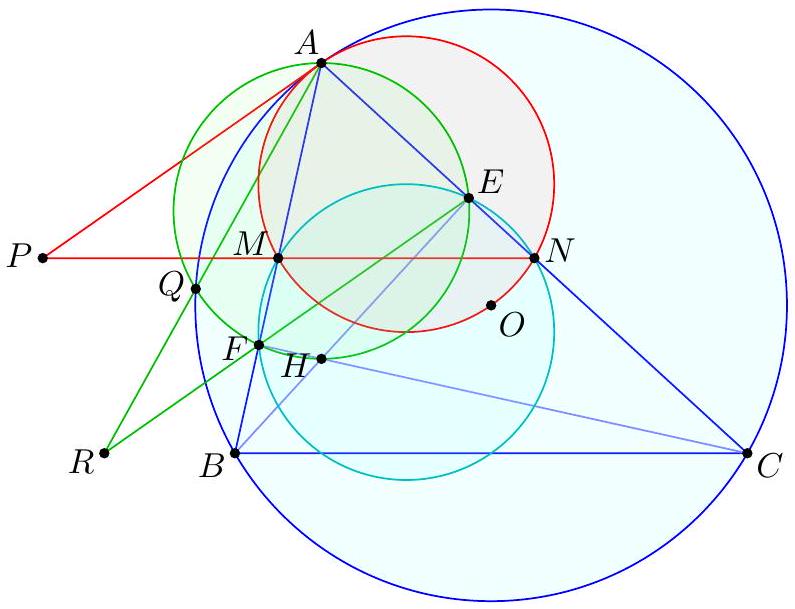
Note that
- $P A^{2}=P M \cdot P N$, so $P$ lies on the radical axis of $\Gamma$ and $\gamma$.
- $R A \cdot R Q=R E \cdot R F$, so $R$ lies on the radical axis of $\Gamma$ and $\gamma$.
Thus $\overline{P R}$ is the radical axis of $\Gamma$ and $\gamma$, which is evidently perpendicular to $\overline{O H}$. Remark. In fact, by power of a point one may also observe that $R$ lies on $\overline{B C}$, since it is on the radical axis of $(A Q F H E),(B F E C),(A B C)$. Ironically, this fact is not used in the solution.
II Second solution (barycentric coordinates). Again note first $R \in \overline{B C}$ (although this can be avoided too). We compute the points in much the same way as before. Since $\overline{A P} \cap \overline{B C}=\left(0: b^{2}:-c^{2}\right)$ we have
(since $x=y+z$ is the equation of line $\overline{M N}$ ). Now in Conway notation we have
Hence
On the other hand, we have $\overrightarrow{O H}=\vec{A}+\vec{B}+\vec{C}$. So it suffices to check that
which is immediate.
『 Third solution (complex numbers). Let $A B C$ be the unit circle. We first compute $P$ as the midpoint of $A$ and $\overline{A A} \cap \overline{B C}$ :
Using the remark above, $R$ is the inverse of $D$ with respect to the circle with diameter $\overline{B C}$, which has radius $\left|\frac{1}{2}(b-c)\right|$. Thus
Expanding and subtracting gives
which is visibly equal to the negation of its conjugate once the factor of $a+b+c$ is deleted. (Actually, one can guess this factorization ahead of time by noting that if $A=B$, then $P=B=R$, so $a-b$ must be a factor; analogously $a-c$ must be as well.)
§1.2 TSTST 2017/2, proposed by Kevin Sun
Available online at https://aops.com/community/p8526115.
Problem statement
Ana and Banana are playing a game. First Ana picks a word, which is defined to be a nonempty sequence of capital English letters. Then Banana picks a nonnegative integer $k$ and challenges Ana to supply a word with exactly $k$ subsequences which are equal to Ana's word. Ana wins if she is able to supply such a word, otherwise she loses. For example, if Ana picks the word "TST", and Banana chooses $k=4$, then Ana can supply the word "TSTST" which has 4 subsequences which are equal to Ana's word. Which words can Ana pick so that she can win no matter what value of $k$ Banana chooses?
First we introduce some notation. Define a block of letters to be a maximal contiguous subsequence of consecutive letters. For example, the word $A A B B B C A A A$ has four blocks, namely $A A, B B B, C, A A A$. Throughout the solution, we fix the word $A$ that Ana picks, and introduce the following notation for its $m$ blocks:
A rainbow will be a subsequence equal to Ana's initial word $A$ (meaning Ana seeks words with exactly $k$ rainbows). Finally, for brevity, let $A_{i}=\underbrace{a_{i} \ldots a_{i}}{x{i}}$, so $A=A_{1} \ldots A_{m}$.
We prove two claims that resolve the problem. Claim - If $x_{i}=1$ for some $i$, then for any $k \geq 1$, the word
obtained by repeating the $i$ th letter $k$ times has exactly $k$ rainbows. Proof. Obviously there are at least $\binom{k}{k-1}=k$ rainbows, obtained by deleting $k-1$ choices of the letter $a_{i}$ in the repeated block. We show they are the only ones.
Given a rainbow, consider the location of this singleton block in $W$. It cannot occur within the first $\left|A_{1}\right|+\cdots+\left|A_{i-1}\right|$ letters, nor can it occur within the final $\left|A_{i+1}\right|+\cdots+\left|A_{m}\right|$ letters. So it must appear in the $i$ th block of $W$. That implies that all the other $a_{i}$ 's in the $i$ th block of $W$ must be deleted, as desired. (This last argument is actually nontrivial, and has some substance; many students failed to realize that the upper bound requires care.)
Claim - If $x_{i} \geq 2$ for all $i$, then no word $W$ has exactly two rainbows. Proof. We prove if there are two rainbows of $W$, then we can construct at least three rainbows.
Let $W=w_{1} \ldots w_{n}$ and consider the two rainbows of $W$. Since they are not the same, there must be a block $A_{p}$ of the rainbow, of length $\ell \geq 2$, which do not occupy the same locations in $W$.
Assume the first rainbow uses $w_{i_{1}}, \ldots, w_{i_{\ell}}$ for this block and the second rainbow uses $w_{j_{1}}, \ldots, w_{j_{\ell}}$ for this block. Then among the letters $w_{q}$ for $\min \left(i_{1}, j_{1}\right) \leq q \leq \max \left(i_{\ell}, j_{\ell}\right)$, there must be at least $\ell+1$ copies of the letter $a_{p}$. Moreover, given a choice of $\ell$ copies of the letter $a_{p}$ in this range, one can complete the subsequence to a rainbow. So the number of rainbows is at least $\binom{\ell+1}{\ell} \geq \ell+1$.
Since $\ell \geq 2$, this proves $W$ has at least three rainbows. In summary, Ana wins if and only if $x_{i}=1$ for some $i$, since she can duplicate the isolated letter $k$ times; but if $x_{i} \geq 2$ for all $i$ then Banana only needs to supply $k=2$.
§1.3 TSTST 2017/3, proposed by Calvin Deng, Linus Hamilton
Available online at https://aops.com/community/p8526130.
Problem statement
Consider solutions to the equation
where $f$ and $g$ are nonzero polynomials with nonnegative real coefficients. For each $c>0$, determine the minimum possible degree of $f$, or show that no such $f, g$ exist.
First, if $c \geq 2$ then we claim no such $f$ and $g$ exist. Indeed, one simply takes $x=1$ to get $f(1) / g(1) \leq 0$, impossible.
For $c<2$, let $c=2 \cos \theta$, where $0<\theta<\pi$. We claim that $f$ exists and has minimum degree equal to $n$, where $n$ is defined as the smallest integer satisfying $\sin n \theta \leq 0$. In other words
First we show that this is necessary. To see it, write explicitly
with each $a_{i} \geq 0$, and $a_{n-2} \neq 0$. Assume that $n$ is such that $\sin (k \theta) \geq 0$ for $k=1, \ldots, n-1$. Then, we have the following system of inequalities:
Now, multiply the first equation by $\sin \theta$, the second equation by $\sin 2 \theta$, et cetera, up to $\sin ((n-1) \theta)$. This choice of weights is selected since we have
so that summing the entire expression cancels nearly all terms and leaves only
and so by dividing by $a_{n-2}$ and using the same identity gives us $\sin (n \theta) \leq 0$, as claimed. This bound is best possible, because the example
makes all inequalities above sharp, hence giving a working pair $(f, g)$.
Remark. Calvin Deng points out that a cleaner proof of the lower bound is to take $\alpha=\cos \theta+i \sin \theta$. Then $f(\alpha)=0$, but by condition the imaginary part of $f(\alpha)$ is apparently strictly positive, contradiction.
Remark. Guessing that $c<2$ works at all (and realizing $c \geq 2$ fails) is the first part of the problem.
The introduction of trigonometry into the solution may seem magical, but is motivated in one of two ways:
- Calvin Deng points out that it's possible to guess the answer from small cases: For $c \leq 1$ we have $n=3$, tight at $\frac{x^{3}+1}{x+1}=x^{2}-x+1$, and essentially the "sharpest $n=3$ example". A similar example exists at $n=4$ with $\frac{x^{4}+1}{x^{2}+\sqrt{2} x+1}=x^{2}-\sqrt{2} x+1$ by the Sophie-Germain identity. In general, one can do long division to extract an optimal value of $c$ for any given $n$, although $c$ will be the root of some polynomial. The thresholds $c \leq 1$ for $n=3, c \leq \sqrt{2}$ for $n=4, c \leq \frac{1+\sqrt{5}}{2}$ for $n=5$, and $c \leq 2$ for $n<\infty$ suggest the unusual form of the answer via trigonometry.
- One may imagine trying to construct a polynomial recursively / greedily by making all inequalities above hold (again the "sharpest situation" in which $f$ has few coefficients). If one sets $c=2 t$, then we have
which are the Chebyshev polynomials of the second type. This means that trigonometry is essentially mandatory. (One may also run into this when by using standard linear recursion techniques, and noting that the characteristic polynomial has two conjugate complex roots.)
Remark. Mitchell Lee notes that an IMO longlist problem from 1997 shows that if $P(x)$ is any polynomial satisfying $P(x)>0$ for $x>0$, then $(x+1)^{n} P(x)$ has nonnegative coefficients for large enough $n$. This show that $f$ and $g$ at least exist for $c \leq 2$, but provides no way of finding the best possible $\operatorname{deg} f$.
Meghal Gupta also points out that showing $f$ and $g$ exist is possible in the following way:
and so on, repeatedly multiplying by the "conjugate" until all coefficients become positive. To my best knowledge, this also does not give any way of actually minimizing $\operatorname{deg} f$, although Ankan Bhattacharya points out that this construction is actually optimal in the case where $n$ is a power of 2 .
Remark. It's pointed out that Matematicheskoe Prosveshchenie, issue 1, 1997, page 194 contains a nearly analogous result, available at https://mccme.ru/free-books/matpros/ pdf/mp-01.pdf with solutions presented in https://mccme.ru/free-books/matpros/pdf/ mp-05.pdf, pages 221-223; and https://mccme.ru/free-books/matpros/pdf/mp-10.pdf, page 274.
§2 Solutions to Day 2
§2.1 TSTST 2017/4, proposed by Mark Sellke
Available online at https://aops.com/community/p8526131.
Problem statement
Find all nonnegative integer solutions to
For $n \leq 4$, one can check the only solutions are:
Now we prove there are no solutions for $n \geq 5$. A tricky way to do this is to take modulo 120 , since
and by inspection one notes that no three elements have vanishing sum modulo 120 . I expect most solutions to instead use casework. Here is one possible approach with cases (with $n \geq 5$ ). First, we analyze the cases where $a<3$ :
- $a=0$ : No solutions for parity reasons.
- $a=1$ : since $3^{b}+5^{c} \equiv 6(\bmod 8)$, we find $b$ even and $c$ odd (hence $\left.c \neq 0\right)$. Now looking modulo 5 gives that $3^{b}+5^{c} \equiv 3(\bmod 5)$,
- $a=2$ : From $3^{b}+5^{c} \equiv 4(\bmod 8)$, we find $b$ is odd and $c$ is even. Now looking modulo 5 gives a contradiction, even if $c=0$, since $3^{b} \in{2,3(\bmod 5)}$ but $3^{b}+5^{c} \equiv 1(\bmod 5)$.
Henceforth assume $a \geq 3$. Next, by taking modulo 8 we have $3^{b}+5^{c} \equiv 0(\bmod 8)$, which forces both $b$ and $c$ to be odd (in particular, $b, c>0$ ). We now have
The first equation implies $a$ is even, but the second equation requires $a$ to be odd, contradiction. Hence no solutions with $n \geq 5$.
§2.2 TSTST 2017/5, proposed by Ray Li
Available online at https://aops.com/community/p8526136.
Problem statement
Let $A B C$ be a triangle with incenter $I$. Let $D$ be a point on side $B C$ and let $\omega_{B}$ and $\omega_{C}$ be the incircles of $\triangle A B D$ and $\triangle A C D$, respectively. Suppose that $\omega_{B}$ and $\omega_{C}$ are tangent to segment $B C$ at points $E$ and $F$, respectively. Let $P$ be the intersection of segment $A D$ with the line joining the centers of $\omega_{B}$ and $\omega_{C}$. Let $X$ be the intersection point of lines $B I$ and $C P$ and let $Y$ be the intersection point of lines $C I$ and $B P$. Prove that lines $E X$ and $F Y$ meet on the incircle of $\triangle A B C$.
『 First solution (homothety). Let $Z$ be the diametrically opposite point on the incircle. We claim this is the desired intersection.
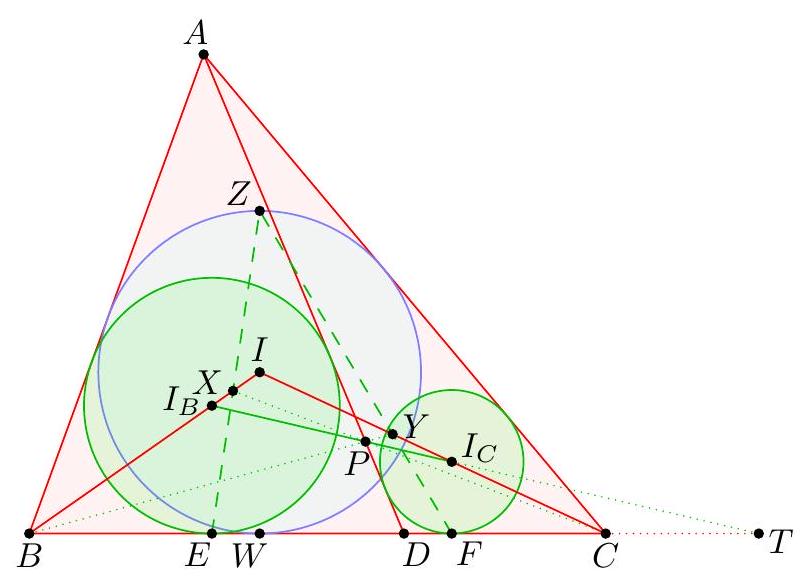
Note that:
- $P$ is the insimilicenter of $\omega_{B}$ and $\omega_{C}$
- $C$ is the exsimilicenter of $\omega$ and $\omega_{C}$.
Thus by Monge theorem, the insimilicenter of $\omega_{B}$ and $\omega$ lies on line $C P$. This insimilicenter should also lie on the line joining the centers of $\omega$ and $\omega_{B}$, which is $\overline{B I}$, hence it coincides with the point $X$. So $X \in \overline{E Z}$ as desired.
【 Second solution (harmonic). Let $T=\overline{I_{B} I_{C}} \cap \overline{B C}$, and $W$ the foot from $I$ to $\overline{B C}$. Define $Z=\overline{F Y} \cap \overline{I W}$. Because $\angle I_{B} D I_{C}=90^{\circ}$, we have
So $I$ is the midpoint of $\overline{Z W}$ as desired. 【 Third solution (outline, barycentric, Andrew Gu). Let $A D=t, B D=x, C D=y$, so $a=x+y$ and by Stewart's theorem we have
We then have $D=(0: y: x)$ and so
hence intersection with $B I$ gives
Similarly,
Then, we can compute
since $P \in \overline{I_{B} I_{C}}$, and clearly $P \in \overline{A D}$. Intersection now gives
Finally, we have $B E=\frac{1}{2}(c+x-t)$, and similarly for $C F$. Now if we reflect $D=$ $\left(0, \frac{s-c}{a}, \frac{s-b}{a}\right)$ over $I=\left(\frac{a}{2 s}, \frac{b}{2 s}, \frac{c}{2 s}\right)$, we get the antipode
We may then check $Q$ lies on each of lines $E X$ and $F Y$ (by checking $\operatorname{det}(Q, E, X)=0$ using the equation (1)).
§2.3 TSTST 2017/6, proposed by Ivan Borsenco
Available online at https://aops.com/community/p8526142.
Problem statement
A sequence of positive integers $\left(a_{n}\right){n \geq 1}$ is of Fibonacci type if it satisfies the recursive relation $a{n+2}=a_{n+1}+a_{n}$ for all $n \geq 1$. Is it possible to partition the set of positive integers into an infinite number of Fibonacci type sequences?
Yes, it is possible. The following solutions were written for me by Kevin Sun and Mark Sellke. We let $F_{1}=F_{2}=1, F_{3}=2, F_{4}=3, F_{5}=5, \ldots$ denote the Fibonacci numbers.
【 First solution (Kevin Sun). We are going to appeal to the so-called Zeckendorf theorem:
Theorem (Zeckendorf) Every positive integer can be uniquely expressed as the sum of nonconsecutive Fibonacci numbers.
This means every positive integer has a Zeckendorf ("Fibonacci-binary") representation where we put 1 in the $i$ th digit from the right if $F_{i+1}$ is used. The idea is then to take the following so-called Wythoff array:
- Row 1: 1, 2, 3, 5, ...
- Row 101: $1+3,2+5,3+8, \ldots$
- Row 1001: $1+5,2+8,3+13, \ldots$
- Row 10001: $1+8,2+13,3+21, \ldots$
- Row 10101: $1+3+8,2+5+13,3+8+21, \ldots$
- . . .et cetera.
More concretely, the array has the following rows to start:
| 1 | 2 | 3 | 5 | 8 | 13 | 21 | $\ldots$ |
|---|---|---|---|---|---|---|---|
| 4 | 7 | 11 | 18 | 29 | 47 | 76 | $\ldots$ |
| 6 | 10 | 16 | 26 | 42 | 68 | 110 | $\ldots$ |
| 9 | 15 | 24 | 39 | 63 | 102 | 165 | $\ldots$ |
| 12 | 20 | 32 | 52 | 84 | 136 | 220 | $\ldots$ |
| 14 | 23 | 37 | 60 | 97 | 157 | 254 | $\ldots$ |
| 17 | 28 | 45 | 73 | 118 | 191 | 309 | $\ldots$ |
| $\vdots$ | $\vdots$ | $\vdots$ | $\vdots$ | $\vdots$ | $\vdots$ | $\vdots$ | $\ddots$ |
Here are the full details. We begin by outlining a proof of Zeckendorf's theorem, which implies the representation above is unique. Note that if $F_{k}$ is the greatest Fibonacci number at most $n$, then
In particular, repeatedly subtracting off the largest $F_{k}$ from $n$ will produce one such representation with no two consecutive Fibonacci numbers. On the other hand, this $F_{k}$ must be used, as
This shows, by a simple inductive argument, that such a representation exists and unique. We write $n={\bar{a} k \ldots a_{1}}{\text {Fib }}$ for the Zeckendorf representation as we described (where $a{i}=1$ if $F_{i+1}$ is used). Now for each ${\bar{a} k \ldots a_{1}}^{\text {Fib }}$ with $a_{1}=1$, consider the sequence
These sequences are Fibonacci-type by definition, and partition the positive integers since each positive integer has exactly one Fibonacci base representation. \I Second solution. Call an infinite set of integers $S$ sandwiched if there exist increasing sequences $\left{a_{i}\right}{i=0}^{\infty},\left{b{i}\right}_{i=0}^{\infty}$ such that the following are true:
- $a_{i}+a_{i+1}=a_{i+2}$ and $b_{i}+b_{i+1}=b_{i+2}$.
- The intervals $\left[a_{i}+1, b_{i}-1\right]$ are disjoint and are nondecreasing in length.
- $S=\bigcup_{i=0}^{\infty}\left[a_{i}+1, b_{i}-1\right]$.
We claim that if $S$ is any nonempty sandwiched set, then $S$ can be partitioned into a Fibonacci-type sequence (involving the smallest element of $S$ ) and two smaller sandwiched sets. If this claim is proven, then we can start with $\mathbb{N} \backslash{1,2,3,5, \ldots}$, which is a sandwiched set, and repeatedly perform this partition, which will eventually sort each natural number into a Fibonacci-type sequence.
Let $S$ be a sandwiched set given by $\left{a_{i}\right}{i=0}^{\infty},\left{b{i}\right}{i=0}^{\infty}$, so the smallest element in $S$ is $x=a{0}+1$. Note that $y=a_{1}+1$ is also in $S$ and $x<y$. Then consider the Fibonaccitype sequence given by $f_{0}=x, f_{1}=y$, and $f_{k+2}=f_{k+1}+f_{k}$. We can then see that $f_{i} \in\left[a_{i}+1, b_{i}-1\right]$, as the sum of numbers in the intervals $\left[a_{k}+1, b_{k}-1\right],\left[a_{k+1}+1, b_{k+1}-1\right]$ lies in the interval
Therefore, this gives a natural partition of $S$ into this sequence and two sets:
(For convenience, $[x, x-1]$ will be treated as the empty set.) We now show that $S_{1}$ and $S_{2}$ are sandwiched. Since $\left{a_{i}\right},\left{f_{i}\right}$, and $\left{b_{i}\right}$ satisfy the Fibonacci recurrence, it is enough to check that the intervals have nondecreasing lengths. For $S_{1}$, that is equivalent to $f_{k+1}-a_{k+1} \geq f_{k}-a_{k}$ for each $k$. Fortunately, for $k \geq 1$, the difference is $f_{k-1}-a_{k-1} \geq 0$, and for $k=0, f_{1}-a_{1}=1=f_{0}-a_{0}$. Similarly for $S_{2}$, checking $b_{k+1}-f_{k+1} \geq b_{k}-f_{k}$ is easy for $k \geq 1$ as $b_{k-1}-f_{k-1} \geq 0$, and
which is nonnegative since the lengths of intervals in $S$ are nondecreasing. Therefore we have shown that $S_{1}$ and $S_{2}$ are sandwiched. (Note that some of the $\left[a_{i}+1, f_{i}-1\right]$ may be empty, which would shift some indices back.) Since this gives us a procedure to take a set $S$ and produce a Fibonacci-type sequence with its smallest element, along which two other sandwiched types, we can partition $\mathbb{N}$ into an infinite number of Fibonacci-type sequences. \l Third solution. We add Fibonacci-type sequences one-by-one. At each step, let $x$ be the smallest number that has not been used in any previous sequence. We generate a new Fibonacci-type sequence as follows. Set $a_{0}=x$ and for $i \geq 1$, set
Equivalently, $a_{i}$ is the closest integer to $\varphi a_{i-1}$. It suffices to show that this sequence is Fibonacci-type and that no two sequences generated in this way overlap. We first show that for a positive integer $n$,
Indeed,
Note that $\left\lfloor\varphi n+\frac{1}{2}\right\rfloor=\varphi n+c$ for some $|c| \leq \frac{1}{2}$; this implies that $\varphi^{-1}\left\lfloor\varphi n+\frac{1}{2}\right\rfloor$ is within $\varphi^{-1} \cdot \frac{1}{2}<\frac{1}{2}$ of $n$, so its closest integer is $n$, proving the claim.
Therefore these sequences are Fibonacci-type. Additionally, if $a \neq b$, then $|\varphi a-\varphi b| \geq$ $\varphi>1$. Then
and since the first term of each sequence is chosen to not overlap with any previous sequences, these sequences are disjoint.
Remark. Ankan Bhattacharya points out that the same sequence essentially appears in IMO 1993, Problem 5 - in other words, a strictly increasing function $f: \mathbb{Z}{>0} \rightarrow \mathbb{Z}{>0}$ with $f(1)=2$, and $f(f(n))=f(n)+n$.
Nikolai Beluhov sent us an older reference from March 1977, where Martin Gardner wrote in his column about Wythoff's Nim. The relevant excerpt goes: "Imagine that we go through the infinite sequence of safe pairs (in the manner of Eratosthenes' sieve for sifting out primes) and cross out the infinite set of all safe pairs that are pairs in the Fibonacci sequence. The smallest pair that is not crossed out is $4 / 7$. We can now cross out a second infinite set of safe pairs, starting with $4 / 7$, that are pairs in the Lucas sequence. An infinite number of safe pairs, of which the lowest is now $6 / 10$, remain. This pair too begins another infinite Fibonacci sequence, all of whose pairs are safe. The process continues forever. Robert Silber, a mathematician at North Carolina State University, calls a safe pair "primitive" if it is the first safe pair that generates a Fibonacci sequence."
The relevant article by Robert Silber is A Fibonacci Property of Wythoff Pairs, from The Fibonacci Quarterly 11/1976.
I Fourth solution (Mark Sellke). For later reference let
denote the ordinary Fibonacci numbers. We will denote the Fibonacci-like sequences by $F^{i}$ and the elements with subscripts; hence $F_{1}^{2}$ is the first element of the second sequence. Our construction amounts to just iteratively add new sequences; hence the following claim is the whole problem.
Lemma
For any disjoint collection of Fibonacci-like sequences $F^{1}, \ldots, F^{k}$ and any integer $m$ contained in none of them, there is a new Fibonacci-like sequence $F^{k+1}$ beginning with $F_{1}^{k+1}=m$ which is disjoint from the previous sequences.
Observe first that for each sequence $F^{j}$ there is $c^{j} \in \mathbb{R}^{n}$ such that
where
Collapse the group $\left(\mathbb{R}^{+}, \times\right)$into the half-open interval $J={x \mid 1 \leq x<\phi}$ by defining $T(x)=y$ for the unique $y \in J$ with $x=y \phi^{n}$ for some integer $n$.
Fix an interval $I=[a, b] \subseteq[1.2,1.3]$ (the last condition is to avoid wrap-around issues) which contains none of the $c^{j}$, and take $\varepsilon<0.001$ to be small enough that in fact each $c^{j}$ has distance at least $10 \varepsilon$ from $I$; this means any $c_{j}$ and element of $I$ differ by at least a $(1+10 \varepsilon)$ factor. The idea will be to take $F_{1}^{k+1}=m$ and $F_{2}^{k+1}$ to be a large such that the induced values of $F_{j}^{k+1}$ grow like $k \phi^{j}$ for $j \in T^{-1}(I)$, so that $F_{n}^{k+1}$ is separated from the $c^{j}$ after applying $T$. What's left to check is the convergence.
Now let
and take $M$ large enough that for $n>M$ we have
Now $\frac{T^{-1}(I)}{c}$ contains arbitrarily large integers, so there are infinitely many $N$ with $c N \in T^{-1}(I)$ with $N>\frac{10 m}{\varepsilon}$. We claim that for any such $N$, the sequence $F^{(N)}$ defined by
will be very multiplicatively similar to the normal Fibonacci numbers up to rescaling; indeed for $j=2, j=3$ we have $\frac{F_{2}^{(N)}}{f_{2}}=N, \frac{F_{3}^{(N)}}{f_{3}}=N+m$ and so by induction we will have
for $j \geq 2$. Therefore, up to small multiplicative errors, we have
From this we see that for $j>M$ we have
In particular, since $T(c N) \in I$ and $I$ is separated from each $c_{j}$ by a factor of $(1+10 \varepsilon)$, we get that $F_{j}^{(N)}$ is not in any of $F^{1}, F^{2}, \ldots, F^{k}$.
Finishing is easy, since we now have a uniform estimate on how many terms we need to check for a new element before the exponential growth takes over. We will just use pigeonhole to argue that there are few possible collisions among those early terms, so we can easily pick a value of $N$ which avoids them all. We write it out below.
For large $L$, the set
contains at least $k_{I} \phi^{L}$ elements. As $N$ ranges over $S_{L}$, for each fixed $j$, the value of $F_{j}^{(N)}$ varies by at most a factor of 1.1 because we imposed $I \subseteq[1.2,1.3]$ and so this is true for the first two terms, hence for all subsequent terms by induction. Now suppose $L$ is very large, and consider a fixed pair $(i, j)$ with $i \leq k$ and $j \leq M$. We claim there is at most 1 possible value $k$ such that the term $F_{k}^{i}$ could equal $F_{j}^{(N)}$ for some $N \in S_{L}$; indeed, the terms of $F^{i}$ are growing at exponential rate with factor $\phi>1.1$, so at most one will be in a given interval of multiplicative width at most 1.1.
Hence, of these $k_{I} \phi^{L}$ values of $N$, at most $k M$ could cause problems, one for each pair $(i, j)$. However by monotonicity of $F_{j}^{(N)}$ in $N$, at most 1 value of $N$ causes a collision for each pair $(i, j)$. Hence for large $L$ so that $k_{I} \phi^{L}>10 k M$ we can find a suitable $N \in S_{L}$ by pigeonhole and the sequence $F^{(N)}$ defined by $(m, N, N+m, \ldots)$ works.