| Problem 1. The real numbers $a, b, c, d$ satisfy simultaneously the equations |
|
|
| $$ |
| a b c-d=1, b c d-a=2, c d a-b=3, d a b-c=-6 |
| $$ |
|
|
| Prove that $a+b+c+d \neq 0$. |
|
|
| Solution. Suppose that $a+b+c+d=0$. Then |
|
|
| $$ |
| a b c+b c d+c d a+d a b=0 |
| $$ |
|
|
| If $a b c d=0$, then one of numbers, say $d$, must be 0 . In this case $a b c=0$, and so at least two of the numbers $a, b, c, d$ will be equal to 0 , making one of the given equations impossible. Hence $a b c d \neq 0$ and, from (1), |
|
|
| $$ |
| \frac{1}{a}+\frac{1}{b}+\frac{1}{c}+\frac{1}{d}=0 |
| $$ |
|
|
| implying |
|
|
| $$ |
| \frac{1}{a}+\frac{1}{b}+\frac{1}{c}=\frac{1}{a+b+c} |
| $$ |
|
|
| It follows that $(a+b)(b+c)(c+a)=0$, which is impossible (for instance, if $a+b=0$, then adding the second and third given equations would lead to $0=2+3$, a contradiction). Thus $a+b+c+d \neq 0$. |
|
|
| Problem 2. Find all integers $n, n \geqslant 1$, such that $n \cdot 2^{n+1}+1$ is a perfect square. Solution. Answer: $n=0$ and $n=3$. |
|
|
| Clearly $n 2^{n+1}+1$ is odd, so, if this number is a perfect square, then $n 2^{n+1}+1=$ $(2 x+1)^{2}, x \in \mathbb{N}$, whence $n 2^{n-1}=x(x+1)$. |
|
|
| The integers $x$ and $x+1$ are coprime, so one of them must divisible by $2^{n-1}$, which means that the other must be at most $n$. This shows that $2^{n-1} \leqslant n+1$. |
|
|
| An easy induction shows that the above inequality is false for all $n \geqslant 4$, and a direct inspection confirms that the only convenient values in the case $n \leqslant 3$ are 0 and 3 . |
|
|
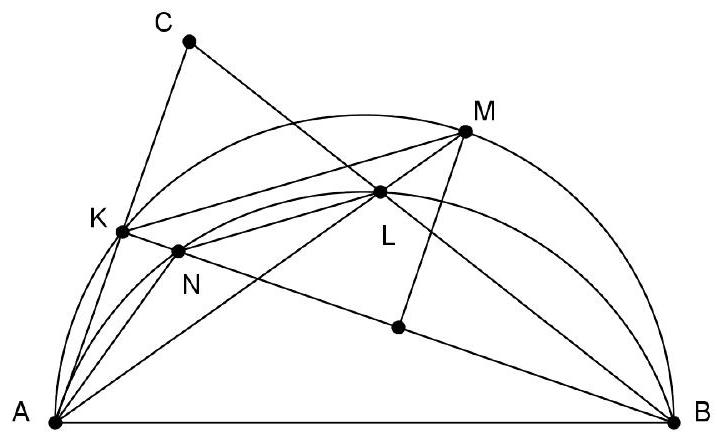
| Problem 3. Let $A L$ and $B K$ be angle bisectors in the non-isosceles triangle $A B C$ ( $L$ lies on the side $B C, K$ lies on the side $A C$ ). The perpendicular bisector of $B K$ intersects the line $A L$ at point $M$. Point $N$ lies on the line $B K$ such that $L N$ is parallel to $M K$. Prove that $L N=N A$. |
|
|
| Solution. The point $M$ lies on the circumcircle of $\triangle A B K$ (since both $A L$ and the perpendicular bisector of $B K$ bisect the arc $B K$ of this circle). Then $\angle C B K=$ $\angle A B K=\angle A M K=\angle N L A$. Thus $A B L N$ is cyclic, whence $\angle N A L=\angle N B L=$ $\angle C B K=\angle N L A$. Now it follows that $L N=N A$. |
|
|
|  |
|
|
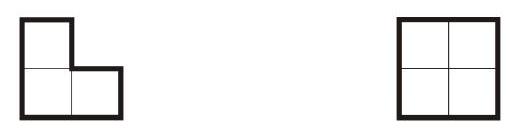
| Problem 4. A $9 \times 7$ rectangle is tiled with tiles of the two types shown in the picture below (the tiles are composed by three, respectively four unit squares and the L-shaped tiles can be rotated repeatedly with $90^{\circ}$ ). |
|  |
|
|
| Let $n \geqslant 0$ be the number of the $2 \times 2$ tiles which can be used in such a tiling. Find all the values of $n$. |
|
|
| Solution. Answer: 0 or 3 . |
|
|
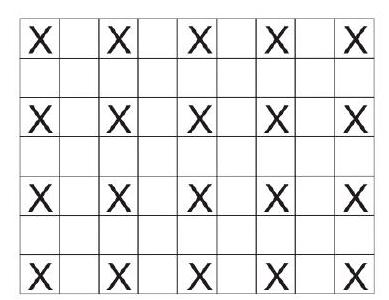
| Denote by $x$ the number of the pieces of the type ornerănd by $y$ the number of the pieces of the type of $2 \times 2$. Mark 20 squares of the rectangle as in the figure below. |
|
|
|  |
|
|
| Obviously, each piece covers at most one marked square. |
|
|
| Thus, $x+y \geq 20$ (1) and consequently $3 x+3 y \geq 60(2)$. On the other hand $3 x+4 y=63$ (3). From (2) and (3) it follows $y \leq 3$ and from (3), $3 \mid y$. |
|
|
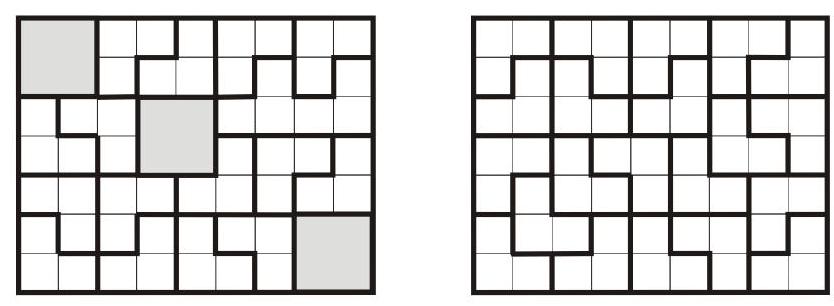
| The proof is finished if we produce tilings with 3 , respectively $0,2 \times 2$ tiles: |
|  |
|
|
|
|


