



$19^{\text {th }}$ Junior Balkan Mathematical Olympiad June 24-29, 2015, Belgrade, Serbia
Problem 1. Find all prime numbers $a, b, c$ and positive integers $k$ which satisfy the equation
Solution:
The relation $9 \cdot k^{2}+1 \equiv 1(\bmod 3)$ implies
Since $a^{2} \equiv 0,1(\bmod 3), \quad b^{2} \equiv 0,1(\bmod 3), c^{2} \equiv 0,1(\bmod 3)$, we have:
| $a^{2}$ | 0 | 0 | 0 | 0 | 1 | 1 | 1 | 1 |
|---|---|---|---|---|---|---|---|---|
| $b^{2}$ | 0 | 0 | 1 | 1 | 0 | 0 | 1 | 1 |
| $c^{2}$ | 0 | 1 | 0 | 1 | 0 | 1 | 0 | 1 |
| $a^{2}+b^{2}+c^{2}$ | 0 | 1 | 1 | 2 | 1 | 2 | 2 | 0 |
From the previous table it follows that two of three prime numbers $a, b, c$ are equal to 3 .
Case 1. $a=b=3$
We have
Case 2. $c=3$
If $\left(3, b_{0}, c, k\right)$ is a solution of the given equation, then $\left(b_{0}, 3, c, k\right)$ is a solution too.
Let $a=3$. We have
Both factors shall have the same parity and we obtain only 2 cases:
- $\left{\begin{array}{l}3 k-b=2, \ 3 k+b=76,\end{array} \Leftrightarrow\left{\begin{array}{l}b=37, \ k=13,\end{array}\right.\right.$ and $(a, b, c, k)=(3,37,3,13)$;
- $\left{\begin{array}{l}3 k-b=4, \ 3 k+b=38,\end{array} \Leftrightarrow\left{\begin{array}{l}b=17, \ k=7,\end{array}\right.\right.$ and $(a, b, c, k)=(3,17,3,7)$.
So, the given equation has 5 solutions:
${(37,3,3,13),(17,3,3,7),(3,37,3,13),(3,17,3,7),(3,3,2,3)}$.
Problem 2. Let $a, b, c$ be positive real numbers such that $a+b+c=3$. Find the minimum value of the expression
$19^{\text {th }}$ Junior Balkan Mathematical Olympiad June 24-29, 2015, Belgrade, Serbia
Solution:
We can rewrite $A$ as follows:
Recall now the well-known inequality $(x+y+z)^{2} \geq 3(x y+y z+z x)$ and set $x=a b, y=b c, z=c a$, to obtain $(a b+b c+c a)^{2} \geq 3 a b c(a+b+c)=9 a b c$, where we have used $a+b+c=3$. By taking the square roots on both sides of the last one we obtain:
Also by using AM-GM inequality we get that
Multiplication of (1) and (2) gives:
So $A \geq 2 \cdot 6-9=3$ and the equality holds if and only if $a=b=c=1$, so the minimum value is 3.
Problem 3. Let $\triangle A B C$ be an acute triangle. The lines $l_{1}, l_{2}$ are perpendicular to $A B$ at the points $A, B$ respectively. The perpendicular lines from the midpoint $M$ of $A B$ to the sides of the triangle $A C, B C$ intersect the lines $l_{1}, l_{2}$ at the points $E, F$, respectively. If $D$ is the intersection point of $E F$ and $M C$, prove that
Solution:
Let $H, G$ be the points of intersection of $M E, M F$ with $A C, B C$ respectively. From the similarity of triangles $\triangle M H A$ and $\triangle M A E$ we get $\frac{M H}{M A}=\frac{M A}{M E}$, thus
Similarly, from the similarity of triangles $\triangle M B G$ and $\triangle M F B$ we get $\frac{M B}{M F}=\frac{M G}{M B}$, thus
Since $M A=M B$, from (1), (2), we conclude that the points $E, H, G, F$ are concyclic.
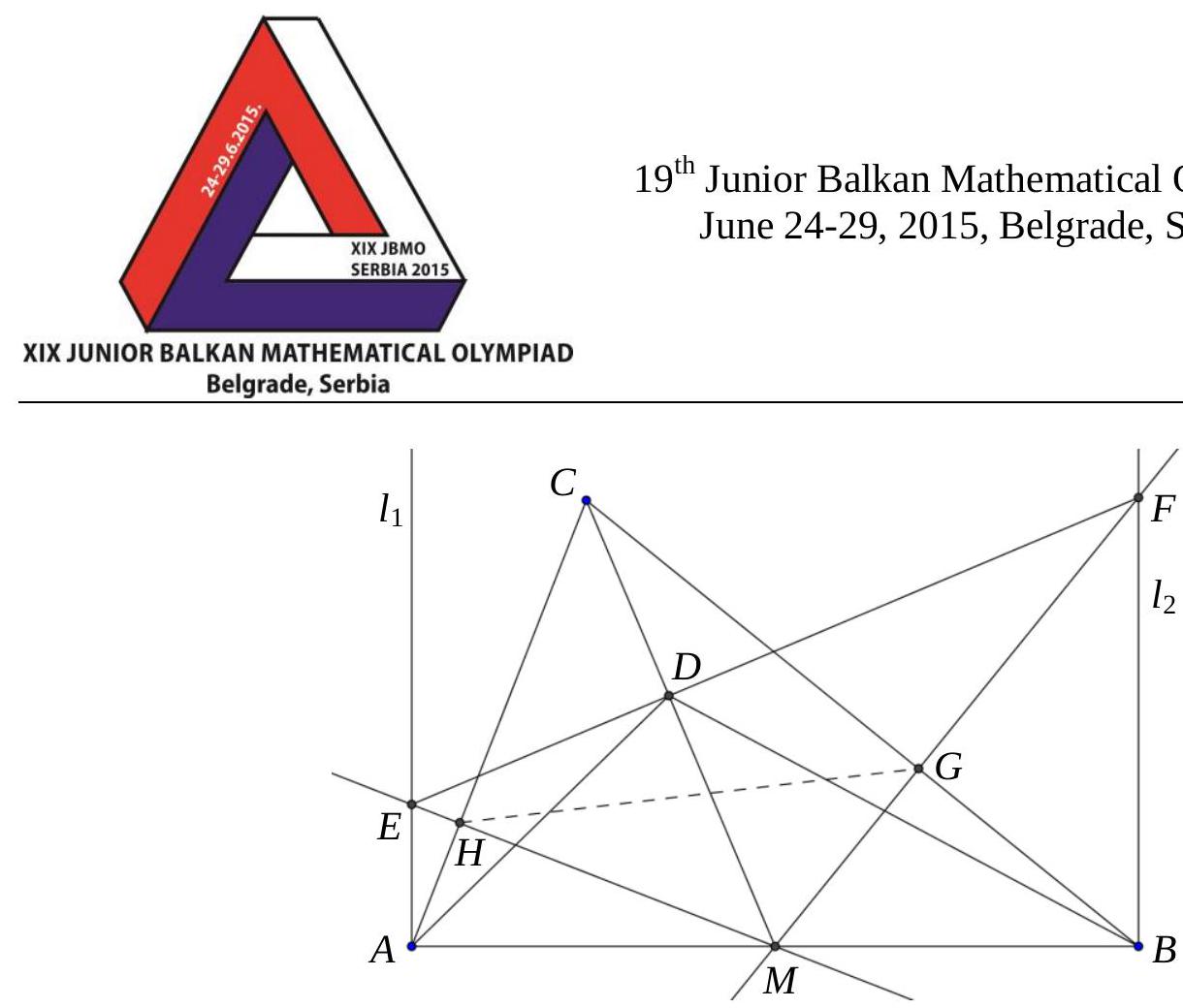
Therefore, we get that $\angle F E H=\angle F E M=\angle H G M$. Also, the quadrilateral $C H M G$ is cyclic, so $\angle C M H=\angle H G C$. We have
thus $C M \perp E F$. Now, from the cyclic quadrilaterals $F D M B$ and $E A M D$, we get that $\angle D F M=\angle D B M$ and $\angle D E M=\angle D A M$. Therefore, the triangles $\triangle E M F$ and $\triangle A D B$ are similar, so $\angle A D B=\angle E M F$.
Problem 4.
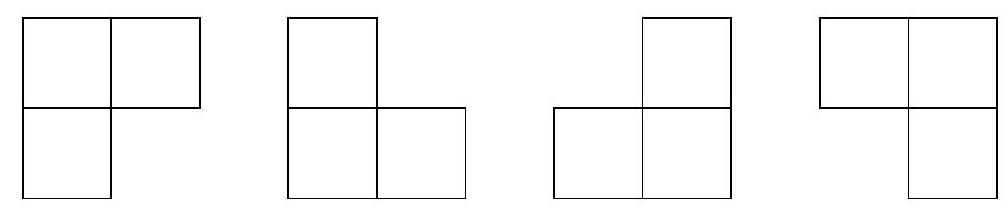
An $L$-figure is one of the following four pieces, each consisting of three unit squares:
A $5 \times 5$ board, consisting of 25 unit squares, a positive integer $k \leq 25$ and an unlimited supply $L$-figures are given. Two players, $\boldsymbol{A}$ and $\boldsymbol{B}$, play the following game: starting with $\boldsymbol{A}$ they alternatively mark a previously unmarked unit square until they marked a total of $k$ unit squares.
We say that a placement of $L$-figures on unmarked unit squares is called good if the $L$-figure do not overlap and each of them covers exactly three unmarked unit squares of the board. $\boldsymbol{B}$ wins if every $\boldsymbol{g o o d}$ placement of $L$-figures leaves uncovered at least three unmarked unit squares. Determine the minimum value of $k$ for which $\boldsymbol{B}$ has a winning strategy.
Solution:
We will show that player $\boldsymbol{A}$ wins if $k=1,2,3$, but player $\boldsymbol{B}$ wins if $k=4$. Thus the smallest $k$ for which $\boldsymbol{B}$ has a winning strategy exists and is equal to 4 .
If $k=1$, player $\boldsymbol{A}$ marks the upper left corner of the square and then fills it as follows.
$19^{\text {th }}$ Junior Balkan Mathematical Olympiad
June 24-29, 2015, Belgrade, Serbia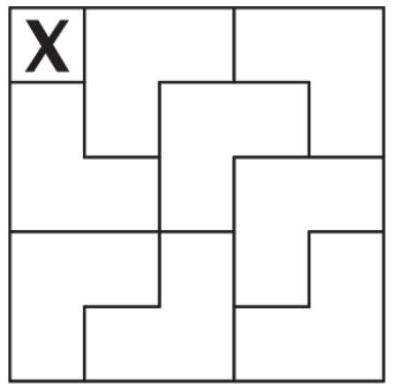
If $k=2$, player $\boldsymbol{A}$ marks the upper left corner of the square. Whatever square player $\boldsymbol{B}$ marks, then player $\boldsymbol{A}$ can fill in the square in exactly the same pattern as above except that he doesn't put the $L$-figure which covers the marked square of $\boldsymbol{B}$. Player $\boldsymbol{A}$ wins because he has left only two unmarked squares uncovered.
For $k=3$, player $\boldsymbol{A}$ wins by following the same strategy. When he has to mark a square for the second time, he marks any yet unmarked square of the $L$-figure that covers the marked square of $\boldsymbol{B}$.
Let us now show that for $k=4$ player $\boldsymbol{B}$ has a winning strategy. Since there will be 21 unmarked squares, player $\boldsymbol{A}$ will need to cover all of them with seven $L$-figures. We can assume that in his first move, player $\boldsymbol{A}$ does not mark any square in the bottom two rows of the chessboard (otherwise just rotate the chessboard). In his first move player $\boldsymbol{B}$ marks the square labeled 1 in the following figure.
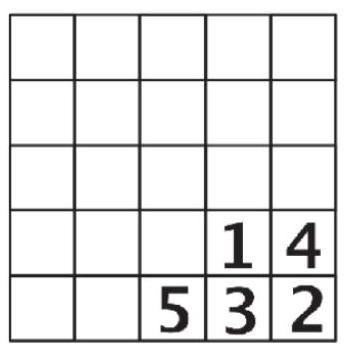
If player $\boldsymbol{A}$ in his next move does not mark any of the squares labeled 2,3 and 4 then player $\boldsymbol{B}$ marks the square labeled 3 . Player $\boldsymbol{B}$ wins as the square labeled 2 is left unmarked but cannot be covered with an $L$-figure.
If player $\boldsymbol{A}$ in his next move marks the square labeled 2, then player $\boldsymbol{B}$ marks the square labeled 5. Player $\boldsymbol{B}$ wins as the square labeled 3 is left unmarked but cannot be covered with an $L$-figure.
Finally, if player $\boldsymbol{A}$ in his next move marks one of the squares labeled 3 or 4, player $\boldsymbol{B}$ marks the other of these two squares. Player $\boldsymbol{B}$ wins as the square labeled 2 is left unmarked but cannot be covered with an $L$-figure.
Since we have covered all possible cases, player $\boldsymbol{B}$ wins when $k=4$.