


$10^{\text {th }}$ Annual Harvard-MIT Mathematics Tournament Saturday 24 February 2007
Guts Round
$10^{\text {th }}$ HARVARD-MIT MATHEMATICS TOURNAMENT, 24 FEBRUARY 2007 - GUTS ROUND Note that there are just 36 problems in the Guts round this year.
- [5] Define the sequence of positive integers $a_{n}$ recursively by $a_{1}=7$ and $a_{n}=7^{a_{n-1}}$ for all $n \geq 2$. Determine the last two digits of $a_{2007}$. Answer: 43. Note that the last two digits of $7^{4}$ are 01. Also, $a_{2006}=7^{a_{2005}}=(-1)^{a_{2005}}=-1=3$ $(\bmod 4)$ since $a_{2005}$ is odd. Therefore, $a_{2007}=7^{a_{2006}}=7^{3}=43(\bmod 100)$.
- [5] A candy company makes 5 colors of jellybeans, which come in equal proportions. If I grab a random sample of 5 jellybeans, what is the probability that I get exactly 2 distinct colors? Answer: $\frac{\mathbf{1 2}}{\mathbf{1 2 5}}$. There are $\binom{5}{2}=10$ possible pairs of colors. Each pair of colors contributes $2^{5}-2=30$ sequences of beans that use both colors. Thus, the answer is $10 \cdot 30 / 5^{5}=12 / 125$.
- [5] The equation $x^{2}+2 x=i$ has two complex solutions. Determine the product of their real parts.
Answer: $\frac{1-\sqrt{2}}{\mathbf{2}}$. Complete the square by adding 1 to each side. Then $(x+1)^{2}=1+i=e^{\frac{i \pi}{4}} \sqrt{2}$, so $x+1= \pm e^{\frac{i \pi}{8}} \sqrt[4]{2}$. The desired product is then
$10^{\text {th }}$ HARVARD-MIT MATHEMATICS TOURNAMENT, 24 FEBRUARY 2007 - GUTS ROUND 4. [6] A sequence consists of the digits $122333444455555 \ldots$ such that the each positive integer $n$ is repeated $n$ times, in increasing order. Find the sum of the 4501 st and 4052 nd digits of this sequence. Answer: 13. Note that $n$ contributes $n \cdot d(n)$ digits, where $d(n)$ is the number of digits of $n$. Then because $1+\cdots+99=4950$, we know that the digits of interest appear amongst copies of two digit numbers. Now for $10 \leq n \leq 99$, the number of digits in the subsequence up to the last copy of $n$ is
Since $67^{2}+67-45=4511$, the two digits are 6 and 7 in some order, so have sum 13 . 5. [6] Compute the largest positive integer such that $\frac{2007!}{2007^{n}}$ is an integer.
Answer: 9. Note that $2007=3^{2} \cdot 223$. Using the fact that the number of times a prime $p$ divides $n$ ! is given by
it follows that the answer is 9 . 6. [6] There are three video game systems: the Paystation, the WHAT, and the ZBoz2 $\pi$, and none of these systems will play games for the other systems. Uncle Riemann has three nephews: Bernoulli, Galois, and Dirac. Bernoulli owns a Paystation and a WHAT, Galois owns a WHAT and a ZBoz2r, and Dirac owns a ZBoz2 $\pi$ and a Paystation. A store sells 4 different games for the Paystation, 6 different games for the WHAT, and 10 different games for the ZBoz2 $\pi$. Uncle Riemann does not understand the difference between the systems, so he walks into the store and buys 3 random games (not necessarily distinct) and randomly hands them to his nephews. What is the probability that each nephew receives a game he can play? Answer: $\frac{\mathbf{7}}{\mathbf{2 5}}$. Since the games are not necessarily distinct, probabilities are independent. Multiplying the odds that each nephew receives a game he can play, we get $10 / 20 \cdot 14 / 20 \cdot 16 / 20=7 / 25$. $10^{\text {th }}$ HARVARD-MIT MATHEMATICS TOURNAMENT, 24 FEBRUARY 2007 - GUTS ROUND 7. [7] A student at Harvard named Kevin
Was counting his stones by 11 He messed up $n$ times And instead counted 9s And wound up at 2007.
How many values of $n$ could make this limerick true? Answer: 21. The mathematical content is that $9 n+11 k=2007$, for some nonnegative integers $n$ and $k$. As $2007=9 \cdot 223, k$ must be divisible by 9 . Using modulo 11 , we see that $n$ is 3 more than a multiple of 11 . Thus, the possibilities are $n=223,212,201, \ldots, 3$, which are 21 in number. 8. [7] A circle inscribed in a square,
Has two chords as shown in a pair.
It has radius 2,
And $P$ bisects $T U$.
The chords' intersection is where?
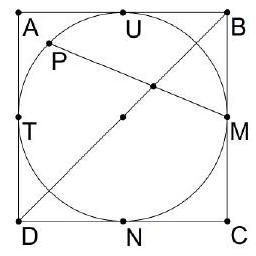
Answer the question by giving the distance of the point of intersection from the center of the circle. Answer: $\sqrt[2]{\mathbf{2} \sqrt{\mathbf{2}}-\mathbf{2} .}$ Let $O B$ intersect the circle at $X$ and $Y$, and the chord $P M$ at $Q$, such that $O$ lies between $X$ and $Q$. Then $M N X Q$ is a parallelogram. For, $O B | N M$ by homothety at $C$ and $P M | N X$ because $M N X P$ is an isoceles trapezoid. It follows that $Q X=M N$. Considering that the center of the circle together with points $M, C$, and $N$ determines a square of side length 2 , it follows that $M N=2 \sqrt{2}$, so the answer is $2 \sqrt{2}-2$. 9. [7] I ponder some numbers in bed,
All products of three primes I've said, Apply $\phi$ they're still fun: now Elev'n cubed plus one.
What numbers could be in my head? Answer: 2007, 2738,3122. The numbers expressible as a product of three primes are each of the form $p^{3}, p^{2} q$, or $p q r$, where $p, q$, and $r$ are distinct primes. Now, $\phi\left(p^{3}\right)=p^{2}(p-1), \phi\left(p^{2} q\right)=$ $p(p-1)(q-1)$, and $\phi(p q r)=(p-1)(q-1)(r-1)$. We require $11^{3}+1=12 \cdot 111=2^{2} 3^{2} 37$. The first case is easy to rule out, since necessarily $p=2$ or $p=3$, which both fail. The second case requires $p=2, p=3$, or $p=37$. These give $q=667,223$, and 2 , respectively. As $667=23 \cdot 29$, we reject $2^{2} \cdot 667$, but $3^{2} 233=2007$ and $37^{2} 2=2738$. In the third case, exactly one of the primes is 2 , since all other primes are odd. So say $p=2$. There are three possibilities for $(q, r):\left(2 \cdot 1+1,2 \cdot 3^{2} \cdot 37+1\right),(2 \cdot 3+1,2 \cdot 3 \cdot 37+1)$, and $\left(2 \cdot 3^{2}+1,2 \cdot 37+1\right)$. Those are $(3,667),(7,223)$, and $(19,75)$, respectively, of which only $(7,223)$ is a pair of primes. So the third and final possibility is $2 \cdot 7 \cdot 223=3122$. $10^{\text {th }}$ HARVARD-MIT MATHEMATICS TOURNAMENT, 24 FEBRUARY 2007 - GUTS ROUND 10. [8] Let $A_{12}$ denote the answer to problem 12. There exists a unique triple of digits $(B, C, D)$ such that $10>A_{12}>B>C>D>0$ and
where $\overline{A_{12} B C D}$ denotes the four digit base 10 integer. Compute $B+C+D$.
Answer: 11. Since $D<A_{12}$, when $A$ is subtracted from $D$ we must carry over from $C$. Thus, $D+10-\overline{A_{12}}=C$. Next, since $C-1<C<B$, we must carry over from the tens digit, so that $(C-1+10)-B=A_{12}$. Now $B>C$ so $B-1 \geq C$, and $(B-1)-C=D$. Similarly, $A_{12}-D=B$. Solving this system of four equations produces $\left(A_{12}, B, C, D\right)=(7,6,4,1)$.
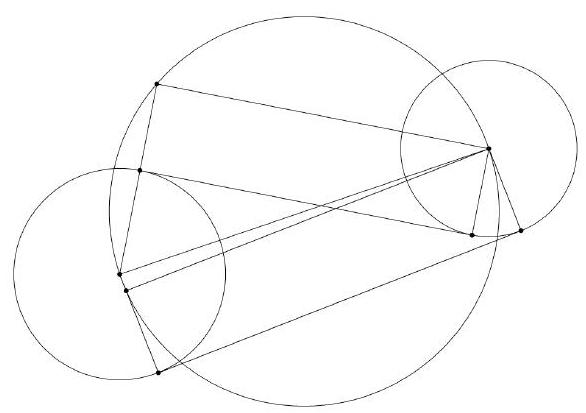
11. [8] Let $A_{10}$ denote the answer to problem 10. Two circles lie in the plane; denote the lengths of the internal and external tangents between these two circles by $x$ and $y$, respectively. Given that the product of the radii of these two circles is $15 / 2$, and that the distance between their centers is $A_{10}$, determine $y^{2}-x^{2}$.
Answer: 30. Suppose the circles have radii $r_{1}$ and $r_{2}$. Then using the tangents to build right triangles, we have $x^{2}+\left(r_{1}+r_{2}\right)^{2}=A_{10}^{2}=y^{2}+\left(r_{1}-r_{2}\right)^{2}$. Thus, $y^{2}-x^{2}=\left(r_{1}+r_{2}\right)^{2}-\left(r_{1}-r_{2}\right)^{2}=$ $4 r_{1} r_{2}=30$.
 12. [8] Let $A_{11}$ denote the answer to problem 11. Determine the smallest prime $p$ such that the arithmetic sequence $p, p+A_{11}, p+2 A_{11}, \ldots$ begins with the largest possible number of primes.
Answer: 7. First, note that the maximal number of initial primes is bounded above by the smallest prime not dividing $A_{11}$, with equality possible only if $p$ is this prime. For, if $q$ is the smallest prime not dividing $A_{11}$, then the first $q$ terms of the arithmetic sequence determine a complete residue class modulo $q$, and the multiple of $q$ is nonprime unless it equals $q$. If $q<A_{11}$, then $q$ must appear first in the sequence, and thus divide the $(q+1)$ st term. If $q>A_{11}$, then $A_{11}=2$ and $q=3$ by Bertrand's postulate, so $q$ must appear first by inspection.
Now since $A_{11}=30$, the bound is 7 . In fact, $7,37,67,97,127$, and 157 are prime, but 187 is not. Then on the one hand, our bound of seven initial primes is not realizable. On the other hand, this implies an upper bound of six, and this bound is achieved by $p=7$. Smaller primes $p$ yield only one initial prime, so 7 is the answer.
12. [8] Let $A_{11}$ denote the answer to problem 11. Determine the smallest prime $p$ such that the arithmetic sequence $p, p+A_{11}, p+2 A_{11}, \ldots$ begins with the largest possible number of primes.
Answer: 7. First, note that the maximal number of initial primes is bounded above by the smallest prime not dividing $A_{11}$, with equality possible only if $p$ is this prime. For, if $q$ is the smallest prime not dividing $A_{11}$, then the first $q$ terms of the arithmetic sequence determine a complete residue class modulo $q$, and the multiple of $q$ is nonprime unless it equals $q$. If $q<A_{11}$, then $q$ must appear first in the sequence, and thus divide the $(q+1)$ st term. If $q>A_{11}$, then $A_{11}=2$ and $q=3$ by Bertrand's postulate, so $q$ must appear first by inspection.
Now since $A_{11}=30$, the bound is 7 . In fact, $7,37,67,97,127$, and 157 are prime, but 187 is not. Then on the one hand, our bound of seven initial primes is not realizable. On the other hand, this implies an upper bound of six, and this bound is achieved by $p=7$. Smaller primes $p$ yield only one initial prime, so 7 is the answer.
Remarks. A number of famous theorems are concerned with the distribution of prime numbers. For two relatively prime positive integers $a$ and $b$, the arithmetic progression $a, a+b, a+2 b, \ldots$ contains infinitely many primes, a result known as Dirichlet's theorem. It was shown recently (c. 2004) that there exist arbitrarily long arithmetic progressions consisting of primes only. Bertrand's postulate states that for any positive integer $n$, there exists a prime $p$ such that $n<p \leq 2 n$. This is an unfortunate misnomer, as the statement is known to be true. As with many theorems concerning the distributions of primes, these results are easily stated in elementary terms, concealing elaborate proofs.
There is just one triple of possible $\left(A_{10}, A_{11}, A_{12}\right)$ of answers to these three problems. Your team will receive credit only for answers matching these. (So, for example, submitting a wrong answer for problem 11 will not alter the correctness of your answer to problem 12.) 13. [9] Determine the largest integer $n$ such that $7^{2048}-1$ is divisible by $2^{n}$.
Answer: 14. We have
In the expansion, the eleven terms other than $7+1$ are divisible by 2 exactly once, as can be checked easily with modulo 4 .
14. [9] We are given some similar triangles. Their areas are $1^{2}, 3^{2}, 5^{2} \ldots$, and $49^{2}$. If the smallest triangle has a perimeter of 4 , what is the sum of all the triangles' perimeters?
Answer: 2500. Because the triangles are all similar, they all have the same ratio of perimeter squared to area, or, equivalently, the same ratio of perimeter to the square root of area. Because the latter ratio is 4 for the smallest triangle, it is 4 for all the triangles, and thus their perimeters are $4 \cdot 1,4 \cdot 3,4 \cdot 5, \ldots, 4 \cdot 49$, and the sum of these numbers is $\left[4(1+3+5+\cdots+49)=4\left(25^{2}\right)=2500\right.$.
15. [9] Points $A, B$, and $C$ lie in that order on line $\ell$, such that $A B=3$ and $B C=2$. Point $H$ is such that $C H$ is perpendicular to $\ell$. Determine the length $C H$ such that $\angle A H B$ is as large as possible.
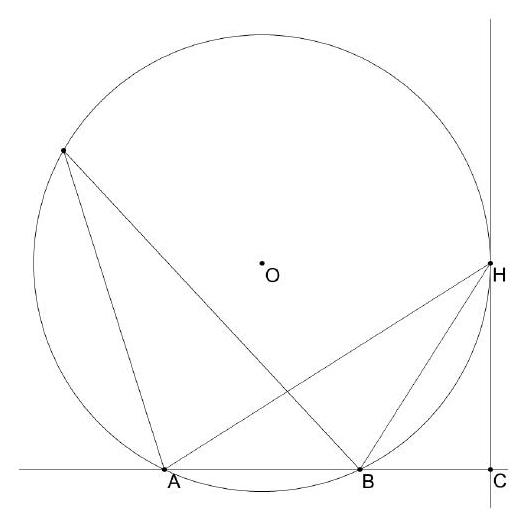
Answer: $\sqrt{\sqrt{\mathbf{1 0}}}$. Let $\omega$ denote the circumcircle of triangle $A B H$. Since $A B$ is fixed, the smaller the radius of $\omega$, the bigger the angle $A H B$. If $\omega$ crosses the line $C H$ in more than one point, then there exists a smaller circle that goes through $A$ and $B$ that crosses $C H$ at a point $H^{\prime}$. But angle $A H^{\prime} B$ is greater than $A H B$, contradicting our assumption that $H$ is the optimal spot. Thus the circle $\omega$ crosses the line $C H$ at exactly one spot: ie, $\omega$ is tangent to $C H$ at $H$. By Power of a Point, $C H^{2}=C A C B=5 \cdot 2=10$, so $C H=\sqrt{10}$.
$10^{\text {th }}$ HARVARD-MIT MATHEMATICS TOURNAMENT, 24 FEBRUARY 2007 - GUTS ROUND
16. [10] Let $A B C$ be a triangle with $A B=7, B C=9$, and $C A=4$. Let $D$ be the point such that $A B | C D$ and $C A | B D$. Let $R$ be a point within triangle $B C D$. Lines $\ell$ and $m$ going through $R$ are parallel to $C A$ and $A B$ respectively. Line $\ell$ meets $A B$ and $B C$ at $P$ and $P^{\prime}$ respectively, and $m$ meets $C A$ and $B C$ at $Q$ and $Q^{\prime}$ respectively. If $S$ denotes the largest possible sum of the areas of triangles $B P P^{\prime}, R P^{\prime} Q^{\prime}$, and $C Q Q^{\prime}$, determine the value of $S^{2}$.
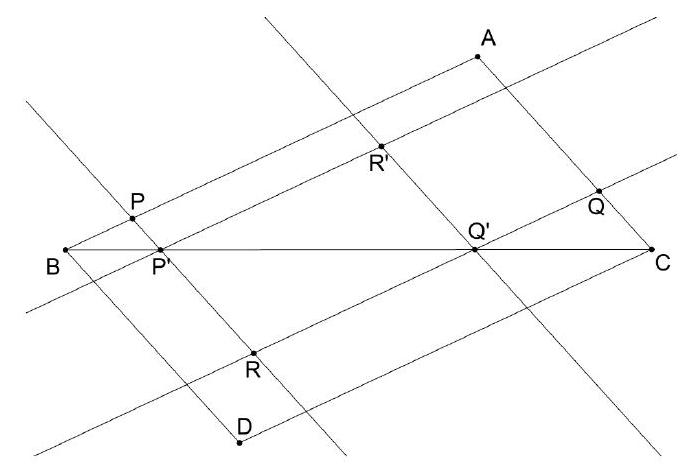
Answer: 180. Let $R^{\prime}$ denote the intersection of the lines through $Q^{\prime}$ and $P^{\prime}$ parallel to $\ell$ and $m$ respectively. Then $\left[R P^{\prime} Q^{\prime}\right]=\left[R^{\prime} P^{\prime} Q^{\prime}\right]$. Triangles $B P P^{\prime}, R^{\prime} P^{\prime} Q^{\prime}$, and $C Q Q^{\prime}$ lie in $A B C$ without overlap, so that on the one hand, $S \leq A B C$. On the other, this bound is realizable by taking $R$ to be a vertex of triangle $B C D$. We compute the square of the area of $A B C$ to be $10 \cdot(10-9) \cdot(10-7) \cdot(10-4)=$ 180. 17. [10] During the regular season, Washington Redskins achieve a record of 10 wins and 6 losses. Compute the probability that their wins came in three streaks of consecutive wins, assuming that all possible arrangements of wins and losses are equally likely. (For example, the record LLWWWWWLWWLWWWLL contains three winning streaks, while WWWWWWWLLLLLLWWW has just two.)
Answer: ( \frac{45}{286} ). Suppose the winning streaks consist of ( w_1, w_2, ) and ( w_3 ) wins, in chronological order, where the first winning streak is preceded by $l_{0}$ consecutive losses and the $i$ winning streak is immediately succeeded by $l_{i}$ losses. Then $w_{1}, w_{2}, w_{3}, l_{1}, l_{2}>0$ are positive and $l_{0}, l_{3} \geq 0$ are nonnegative. The equations
are independent, and have $\binom{9}{2}$ and $\binom{7}{3}$ solutions, respectively. It follows that the answer is
- [10] Convex quadrilateral $A B C D$ has right angles $\angle A$ and $\angle C$ and is such that $A B=B C$ and $A D=C D$. The diagonals $A C$ and $B D$ intersect at point $M$. Points $P$ and $Q$ lie on the circumcircle of triangle $A M B$ and segment $C D$, respectively, such that points $P, M$, and $Q$ are collinear. Suppose that $m \angle A B C=160^{\circ}$ and $m \angle Q M C=40^{\circ}$. Find $M P \cdot M Q$, given that $M C=6$.
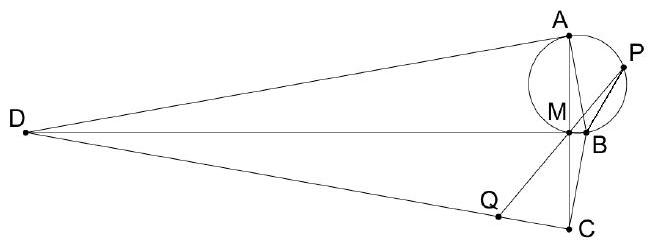
Answer: 36. Note that $m \angle Q P B=m \angle M P B=m \angle M A B=m \angle C A B=\angle B C A=\angle C D B$. Thus, $M P \cdot M Q=M B \cdot M D$. On the other hand, segment $C M$ is an altitude of right triangle $B C D$, so $M B \cdot M D=M C^{2}=36$. $10^{\text {th }}$ HARVARD-MIT MATHEMATICS TOURNAMENT, 24 FEBRUARY 2007 - GUTS ROUND 19. [10] Define $x \star y=\frac{\sqrt{x^{2}+3 x y+y^{2}-2 x-2 y+4}}{x y+4}$. Compute
Answer: $\frac{\sqrt{\mathbf{1 5}}}{\mathbf{9}}$. Note that $x \star 2=\frac{\sqrt{x^{2}+6 x+4-2 x-4+4}}{2 x+4}=\frac{\sqrt{(x+2)^{2}}}{2(x+2)}=\frac{1}{2}$ for $x>-2$. Because $x \star y>0$ if $x, y>0$, we need only compute $\frac{1}{2} \star 1=\frac{\sqrt{\frac{1}{4}+\frac{3}{2}+1-3+4}}{\frac{1}{2}+4}=\frac{\sqrt{15}}{9}$. 20. [10] For $a$ a positive real number, let $x_{1}, x_{2}, x_{3}$ be the roots of the equation $x^{3}-a x^{2}+a x-a=0$. Determine the smallest possible value of $x_{1}^{3}+x_{2}^{3}+x_{3}^{3}-3 x_{1} x_{2} x_{3}$. Answer: -4 . Note that $x_{1}+x_{2}+x_{3}=x_{1} x_{2}+x_{2} x_{3}+x_{3} x_{1}=a$. Then
The expression is negative only where $0<a<3$, so we need only consider these values of $a$. Finally, AM-GM gives $\sqrt[3]{(6-2 a)(a)(a)} \leq \frac{(6-2 a)+a+a}{3}=2$, with equality where $a=2$, and this rewrites as $(a-3) a^{2} \geq-4$. 21. [10] Bob the bomb-defuser has stumbled upon an active bomb. He opens it up, and finds the red and green wires conveniently located for him to cut. Being a seasoned member of the bomb-squad, Bob quickly determines that it is the green wire that he should cut, and puts his wirecutters on the green wire. But just before he starts to cut, the bomb starts to count down, ticking every second. Each time the bomb ticks, starting at time $t=15$ seconds, Bob panics and has a certain chance to move his wirecutters to the other wire. However, he is a rational man even when panicking, and has a $\frac{1}{2 t^{2}}$ chance of switching wires at time $t$, regardless of which wire he is about to cut. When the bomb ticks at $t=1$, Bob cuts whatever wire his wirecutters are on, without switching wires. What is the probability that Bob cuts the green wire? Answer: $\frac{\mathbf{2 3}}{\mathbf{3 0}}$. Suppose Bob makes $n$ independent decisions, with probabilities of switching $p_{1}, p_{2}, \ldots, p_{n}$. Then in the expansion of the product
the sum of the coefficients of even powers of $x$ gives the probability that Bob makes his original decision. This is just $(P(1)+P(-1)) / 2$, so the probability is just
$10^{\text {th }}$ HARVARD-MIT MATHEMATICS TOURNAMENT, 24 FEBRUARY 2007 - GUTS ROUND 22. [12] The sequence $\left{a_{n}\right}{n \geq 1}$ is defined by $a{n+2}=7 a_{n+1}-a_{n}$ for positive integers $n$ with initial values $a_{1}=1$ and $a_{2}=8$. Another sequence, $\left{b_{n}\right}$, is defined by the rule $b_{n+2}=3 b_{n+1}-b_{n}$ for positive integers $n$ together with the values $b_{1}=1$ and $b_{2}=2$. Find $\operatorname{gcd}\left(a_{5000}, b_{501}\right)$. Answer: 89. We show by induction that $a_{n}=F_{4 n-2}$ and $b_{n}=F_{2 n-1}$, where $F_{k}$ is the $k$ th Fibonacci number. The base cases are clear. As for the inductive steps, note that
and
We wish to compute the greatest common denominator of $F_{19998}$ and $F_{1001}$. The Fibonacci numbers satisfy the property that $\operatorname{gcd}\left(F_{m}, F_{n}\right)=F_{\operatorname{gcd}(m, n)}$, which can be proven by noting that they are periodic modulo any positive integer. So since $\operatorname{gcd}(19998,1001)=11$, the answer is $F_{11}=89$.
23. [12] In triangle $A B C, \angle A B C$ is obtuse. Point $D$ lies on side $A C$ such that $\angle A B D$ is right, and point $E$ lies on side $A C$ between $A$ and $D$ such that $B D$ bisects $\angle E B C$. Find $C E$, given that $A C=35, B C=7$, and $B E=5$.

Answer: 10. Reflect $A$ and $E$ over $B D$ to $A^{\prime}$ and $E^{\prime}$ respectively. Note that the angle conditions show that $A^{\prime}$ and $E^{\prime}$ lie on $A B$ and $B C$ respectively. $B$ is the midpoint of segment $A A^{\prime}$ and $C E^{\prime}=$ $B C-B E^{\prime}=2$. Menelaus' theorem now gives
from which $D A=5 C D$ or $C D=A C / 6$. By the angle bisector theorem, $D E=5 C D / 7$, so that $C E=12 C D / 7=10$. 24. [12] Let $x, y, n$ be positive integers with $n>1$. How many ordered triples $(x, y, n)$ of solutions are there to the equation $x^{n}-y^{n}=2^{100}$ ? Answer: 49. Break all possible values of $n$ into the four cases: $n=2, n=4, n>4$ and $n$ odd. By Fermat's theorem, no solutions exist for the $n=4$ case because we may write $y^{4}+\left(2^{25}\right)^{4}=x^{4}$. We show that for $n$ odd, no solutions exist to the more general equation $x^{n}-y^{n}=2^{k}$ where $k$ is a positive integer. Assume otherwise for contradiction's sake, and suppose on the grounds of well ordering that $k$ is the least exponent for which a solution exists. Clearly $x$ and $y$ must both be even or both odd. If both are odd, we have $(x-y)\left(x^{n-1}+\ldots+y^{n-1}\right)$. The right factor of this expression contains an odd number of odd terms whose sum is an odd number greater than 1 , impossible. Similarly if $x$ and $y$ are even, write $x=2 u$ and $y=2 v$. The equation becomes $u^{n}-v^{n}=2^{k-n}$. If $k-n$ is greater than 0 , then our choice $k$ could not have been minimal. Otherwise, $k-n=0$, so that two consecutive positive integers are perfect $n$th powers, which is also absurd. For the case that $n$ is even and greater than 4, consider the same generalization and hypotheses. Writing $n=2 m$, we find $\left(x^{m}-y^{m}\right)\left(x^{m}+y^{m}\right)=2^{k}$. Then $x^{m}-y^{m}=2^{a}<2^{k}$. By our previous work, we see that $m$ cannot be an odd integer greater than 1 . But then $m$ must also be even, contrary to the minimality of $k$. Finally, for $n=2$ we get $x^{2}-y^{2}=2^{100}$. Factoring the left hand side gives $x-y=2^{a}$ and $x+y=2^{b}$, where implicit is $a<b$. Solving, we get $x=2^{b-1}+2^{a-1}$ and $y=2^{b-1}-2^{a-1}$, for a total of 49 solutions. Namely, those corresponding to $(a, b)=(1,99),(2,98), \cdots,(49,51)$. $10^{\text {th }}$ HARVARD-MIT MATHEMATICS TOURNAMENT, 24 FEBRUARY 2007 - GUTS ROUND 25. [12] Two real numbers $x$ and $y$ are such that $8 y^{4}+4 x^{2} y^{2}+4 x y^{2}+2 x^{3}+2 y^{2}+2 x=x^{2}+1$. Find all possible values of $x+2 y^{2}$. Answer: $\frac{\mathbf{1}}{\mathbf{2}}$. Writing $a=x+2 y^{2}$, the given quickly becomes $4 y^{2} a+2 x^{2} a+a+x=x^{2}+1$. We can rewrite $4 y^{2} a$ for further reduction to $a(2 a-2 x)+2 x^{2} a+a+x=x^{2}+1$, or
The quadratic formula produces the discriminant
an identity that can be treated with the difference of squares, so that $a=\frac{-2 x^{2}+2 x-1 \pm\left(2 x^{2}-2 x+3\right)}{4}=$ $\frac{1}{2},-x^{2}+x-1$. Now $a$ was constructed from $x$ and $y$, so is not free. Indeed, the second expression flies in the face of the trivial inequality: $a=-x^{2}+x-1<-x^{2}+x \leq x+2 y^{2}=a$. On the other hand, $a=1 / 2$ is a bona fide solution to $\left(^{*}\right)$, which is identical to the original equation.
26. [12] $A B C D$ is a cyclic quadrilateral in which $A B=4, B C=3, C D=2$, and $A D=5$. Diagonals $A C$ and $B D$ intersect at $X$. A circle $\omega$ passes through $A$ and is tangent to $B D$ at $X$. $\omega$ intersects $A B$ and $A D$ at $Y$ and $Z$ respectively. Compute $Y Z / B D$.
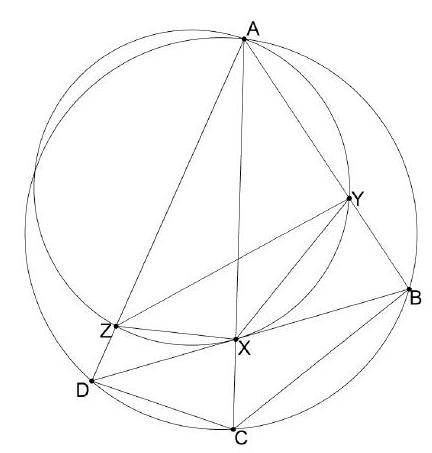
Answer: $\frac{\mathbf{1 1 5}}{\mathbf{1 4 3}}$. Denote the lengths $A B, B C, C D$, and $D A$ by $a, b, c$, and $d$ respectively. Because $A B C D$ is cyclic, $\triangle A B X \sim \triangle D C X$ and $\triangle A D X \sim \triangle B C X$. It follows that $\frac{A X}{D X}=\frac{B X}{C X}=\frac{a}{c}$ and $\frac{A X}{B X}=\frac{D X}{C X}=\frac{d}{b}$. Therefore we may write $A X=a d k, B X=a b k, C X=b c k$, and $D X=c d k$ for some $k$. Now, $\angle X D C=\angle B A X=\angle Y X B$ and $\angle D C X=\angle X B Y$, so $\triangle B X Y \sim \triangle C D X$. Thus, $X Y=$ $D X \cdot \frac{B X}{C D}=c d k \cdot \frac{a b k}{c}=a b d k^{2}$. Analogously, $X Y=a c d k^{2}$. Note that $X Y / X Z=C B / C D$. Since $\angle Y X Z=\pi-\angle Z A \stackrel{c}{Y}=\angle B C D$, we have that $\triangle X Y Z \sim \triangle C B D$. Thus, $Y Z / B D=X Y / C B=a d k^{2}$. Finally, Ptolemy's theorem applied to $A B C D$ gives
It follows that the answer is
- [12] Find the number of 7 -tuples $\left(n_{1}, \ldots, n_{7}\right)$ of integers such that
Answer: 2688. Consider the equation in modulo 9. All perfect 6 th powers are either 0 or 1 . Since 9 divides 96957 , it must be that each $n_{i}$ is a multiple of 3 . Writing $3 a_{i}=n_{i}$ and dividing both sides by $3^{6}$, we have $a_{1}^{6}+\cdots+a_{7}^{6}=133$. Since sixth powers are nonnegative, $\left|a_{i}\right| \leq 2$. Again considering modulo 9 , we see that $a_{i} \neq 0$. Thus, $a_{i}^{6} \in{1,64}$. The only possibility is $133=64+64+1+1+1+1+1$, so $\left|a_{1}\right|, \ldots,\left|a_{7}\right|$ consists of 22 's and 51 's. It follows that the answer is $\binom{7}{2} \cdot 2^{7}=2688$.
$10^{\text {th }}$ HARVARD-MIT MATHEMATICS TOURNAMENT, 24 FEBRUARY 2007 - GUTS ROUND
28. [15] Compute the circumradius of cyclic hexagon $A B C D E F$, which has side lengths $A B=B C=$ $2, C D=D E=9$, and $E F=F A=12$.
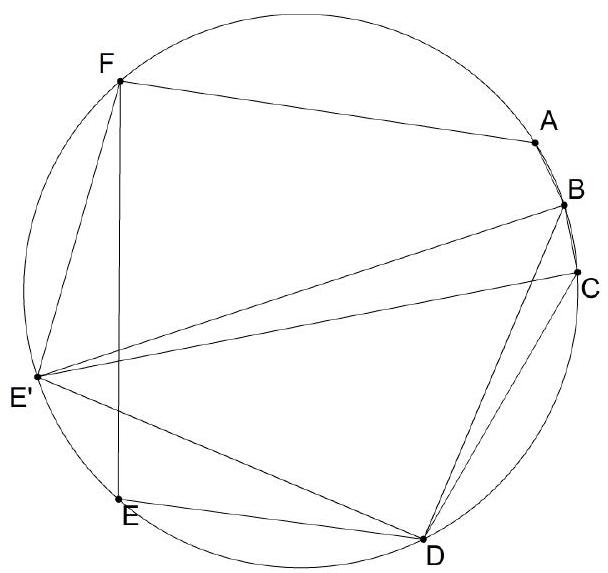
Answer: 8. Construct point $E^{\prime}$ on the circumcircle of $A B C D E F$ such that $D E^{\prime}=E F=12$ and $E^{\prime} F=D E=9$; then $\overline{B E^{\prime}}$ is a diameter. Let $B E^{\prime}=d$. Then $C E^{\prime}=\sqrt{B E^{\prime 2}-B C^{2}}=\sqrt{d^{2}-4}$ and $B D=\sqrt{B E^{\prime 2}-D E^{\prime 2}}=\sqrt{d^{2}-144}$. Applying Ptolemy's theorem to $B C D E^{\prime}$ now yields
Squaring and rearranging, we find $0=d^{4}-229 d^{2}-432 d=d(d-16)\left(d^{2}+16 d+27\right)$. Since $d$ is a positive real number, $d=16$, and the circumradius is 8 . 29. [15] A sequence $\left{a_{n}\right}{n \geq 1}$ of positive reals is defined by the rule $a{n+1} a_{n-1}^{5}=a_{n}^{4} a_{n-2}^{2}$ for integers $n>2$ together with the initial values $a_{1}=8$ and $a_{2}=64$ and $a_{3}=1024$. Compute
Answer: $\mathbf{3} \sqrt{\mathbf{2}}$. Taking the base- $2 \log$ of the sequence $\left{a_{n}\right}$ converts the multiplicative rule to a more familiar additive rule: $\log {2}\left(a{n+1}\right)-4 \log {2}\left(a{n}\right)+5 \log {2}\left(a{n-1}\right)-2 \log {2}\left(a{n-2}\right)=0$. The characteristic equation is $0=x^{3}-4 x^{2}+5 x-2=(x-1)^{2}(x-2)$, so $\log {2}\left(a{n}\right)$ is of the form $a \cdot n+b+c \cdot 2^{n}$ and we find $a_{n}=2^{2 n+2^{n-1}}$. Now,
We can estimate the new nested radical expression as 3 , which expands thus
As a rigorous confirmation, we have $2^{k}+1=\sqrt{4^{k}+\left(2^{k+1}+1\right)}$, as desired. It follows that the answer is $3 \sqrt{2}$.
30. [15] $A B C D$ is a cyclic quadrilateral in which $A B=3, B C=5, C D=6$, and $A D=10 . M, I$, and $T$ are the feet of the perpendiculars from $D$ to lines $A B, A C$, and $B C$ respectively. Determine the value of $M I / I T$.
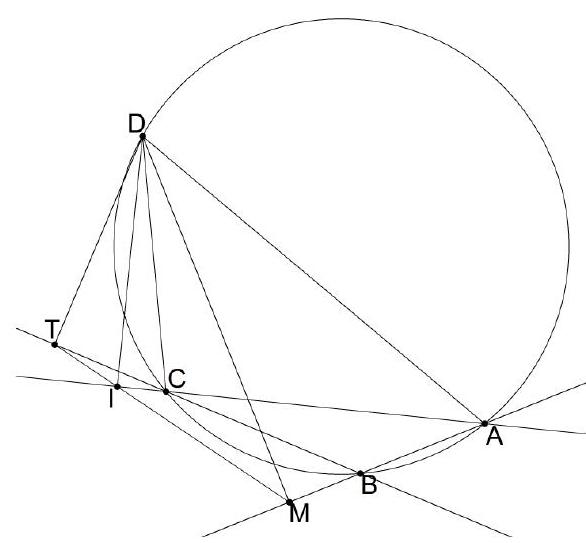
Answer: $\frac{\mathbf{2 5}}{\mathbf{9}}$. Quadrilaterals $A M I D$ and $D I C T$ are cyclic, having right angles $\angle A M D, \angle A I D$, and $\angle C I D, \angle C T D$ respectively. We see that $M, I$, and $T$ are collinear. For, $m \angle M I D=\pi-m \angle D A M=$ $\pi-m \angle D A B=m \angle B C D=\pi-m \angle D C T=\pi-m \angle D I T$. Therefore, Menelaus' theorem applied to triangle $M T B$ and line $I C A$ gives
On the other hand, triangle $A D M$ is similar to triangle $C D T$ since $\angle A M D \cong \angle C T D$ and $\angle D A M \cong$ $\angle D C T$ and thus $A M / C T=A D / C D$. It follows that
Remarks. The line MIT, constructed in this problem by taking perpendiculars from a point on the circumcircle of $A B C$, is known as the Simson line. It is often helpful for us to use directed angles while angle chasing to avoid supplementary configuration issues, such as those arising while establishing the collinearity of $M, I$, and $T$.
$10^{\text {th }}$ HARVARD-MIT MATHEMATICS TOURNAMENT, 24 FEBRUARY 2007 - GUTS ROUND
- [18] A sequence $\left{a_{n}\right}{n \geq 0}$ of real numbers satisfies the recursion $a{n+1}=a_{n}^{3}-3 a_{n}^{2}+3$ for all positive integers $n$. For how many values of $a_{0}$ does $a_{2007}=a_{0}$ ? Answer: $\mathbf{3}^{\mathbf{2 0 0 7}}$. If $x$ appears in the sequence, the next term $x^{3}-3 x^{2}+3$ is the same if and only if $0=x^{3}-3 x^{2}-x+3=(x-3)(x-1)(x+1)$. Moreover, that next term is strictly larger if $x>3$ and strictly smaller if $x<-1$. It follows that no values of $a_{0}$ with $\left|a_{0}-1\right|>2$ yield $a_{0}=a_{2007}$. Now suppose $a_{0}=a_{2007}$ and write $a_{0}=1+e^{\alpha i}+e^{-\alpha i}$; the values $a_{0}$ we seek will be in bijective correspondence with solutions $\alpha$ where $0 \leq \alpha \leq \pi$. Then
and an easy inductive argument gives $a_{2007}=e^{3^{2007} \alpha i}+e^{-3^{2007} \alpha i}+1$. It follows that $a_{0}=a_{2007}$ is equivalent to $\cos (\alpha)=\cos \left(3^{2007} \alpha\right)$. Now,
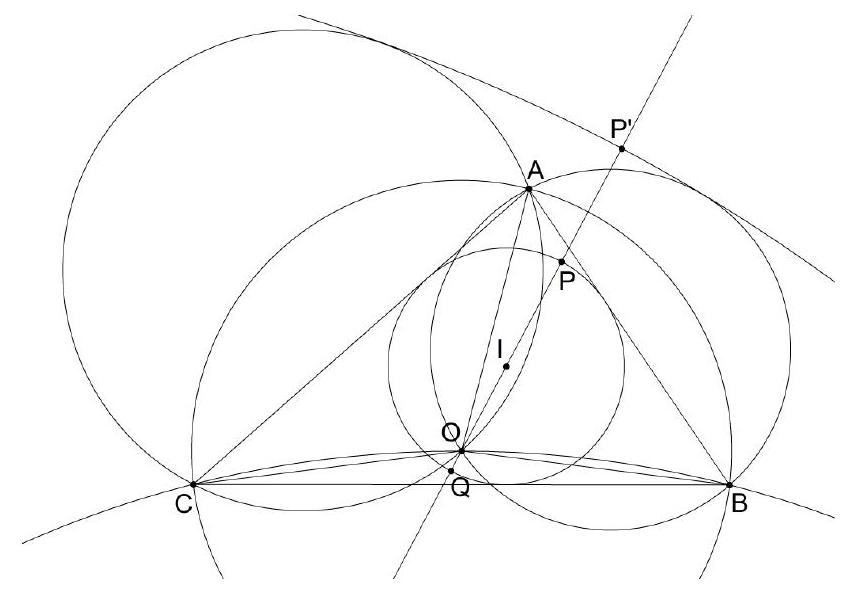
so $\operatorname{since} \sin (k x)=0$ for a positive integer $k$ if and only if $x$ is a multiple of $\frac{\pi}{k}$, the solutions $\alpha$ are $\left{0, \frac{2 \pi}{3^{2007}-1}, \frac{4 \pi}{3^{2007}-1}, \ldots, \pi\right} \cup\left{0, \frac{2 \pi}{3^{2007}+1}, \ldots, \pi\right}$. Because our values $k$ are consecutive, these sets overlap only at 0 and $\pi$, so there are $3^{2007}$ distinct $\alpha$. 32. [18] Triangle $A B C$ has $A B=4, B C=6$, and $A C=5$. Let $O$ denote the circumcenter of $A B C$. The circle $\Gamma$ is tangent to and surrounds the circumcircles of triangles $A O B, B O C$, and $A O C$. Determine the diameter of $\Gamma$. Answer: $\frac{\mathbf{2 5 6} \sqrt{\mathbf{7}}}{\mathbf{1 7}}$. Denote by $\omega, \Gamma_{1}, \Gamma_{2}$, and $\Gamma_{3}$ the circumcenters of triangles $A B C, B O C, C O A$, and $A O B$, respectively. An inversion about $\omega$ interchanges $\Gamma_{1}$ and line $B C, \Gamma_{2}$ and line $C A$, and $\Gamma_{3}$ and line $A B$. This inversion also preserves tangency between generalized circles, so the image of $\Gamma$ is a circle tangent to $A B, B C$, and $C A$. It is the incircle of $A B C$ because it is closer to $O$ than these lines and $A B C$ is acute. Now we run a few standard calculations. Where $s, r$, and $R$ denote the semiperimeter, inradius, and circumradius of $A B C$, respectively, we have the following:
Let $O I$ intersect the incircle of $A B C$ at $P$ and $Q$, with $I$ between $P$ and $O$. Then $O P=r+O I$ and $O Q=r-O I$, and $\overline{P Q}$ is a diameter. Under the inversion, $P$ and $Q$ map to $P^{\prime}$ and $Q^{\prime}$ respectively. Because $P, I, O$, and $Q$ are collinear in that order, $P^{\prime}$ and $Q^{\prime}$ are diametrically opposed on $\Gamma$. It follows that the diameter of $\Gamma$ is
We plug in the values found above to arrive at $\frac{256 \sqrt{7}}{17}$.
 33. [18] Compute
(No, your TI-89 doesn't know how to do this one. Yes, the end is near.) Answer: $\ln \frac{\mathbf{8 0}}{\mathbf{2 3}}$. We break the given integral into two pieces:
These two new integrals are easily computed; for, the first integrand reduces to $1 / x$ and the second is of the form $f^{\prime}(x) / f(x)$. We obtain
Motivation. Writing $f(x)=9 x+4$ and $g(x)=x^{5}+3 x^{2}+x=x\left(x^{4}+3 x+1\right)$, we wish to find the antiderivative of $f(x) / g(x)$. It makes sense to consider other rational functions with denominator $g(x)$ that have an exact antiderivative. Clearly, if the numerator were $f_{1}(x)=x^{4}+3 x+1$ or a constant multiple, then we can integrate the function. Another trivial case is if the numerator were $f_{2}(x)=g^{\prime}(x)=5 x^{4}+6 x+1$ or a constant multiple. Guessing that $f(x)$ is a linear combination of $f_{1}(x)$ and $f_{2}(x)$, we easily find that $f(x)=9 x+4=5 f_{1}(x)-f_{2}(x)$. $10^{\text {th }}$ HARVARD-MIT MATHEMATICS TOURNAMENT, 24 FEBRUARY 2007 - GUTS ROUND 34. [?] The Game. Eric and Greg are watching their new favorite TV show, The Price is Right. Bob Barker recently raised the intellectual level of his program, and he begins the latest installment with bidding on following question: How many Carmichael numbers are there less than 100,000? Each team is to list one nonnegative integer not greater than 100,000. Let $X$ denote the answer to Bob's question. The teams listing $N$, a maximal bid (of those submitted) not greater than $X$, will receive $N$ points, and all other teams will neither receive nor lose points. (A Carmichael number is an odd composite integer $n$ such that $n$ divides $a^{n-1}-1$ for all integers $a$ relatively prime to $n$ with $1<a<n$.) Answer: 16? There are 16 such numbers: 561, 1105, 1729, 2465, 2821, 6601, 8911, 10585, 15841, $29341,41041,46657,52633,62745,63973$, and 75361 . The next, 101101 , is too large to be counted. Their distribution is considerably more subtle than that of the primes, and it was only recently proven that there are infinitely many Carmichael numbers. For sufficiently large $n, C(n)>n^{2 / 7}$, although this bound has been subsequently improved. (For details, see Alford, W. R.; Granville, A.; and Pomerance, C. "There are Infinitely Many Carmichael Numbers." Annals of Mathematics. 139 (1994), 703-722.) The expectation is that teams are unable to determine that $X=16$; otherwise, the obvious dominant play is listing 16. The Problem Czar, anticipating that teams will attempt to deduce $X$ by considering the point values of the other problems in the triplet, has chosen a value $X$ that is considerably lower. Teams may of course speculate whether this action has been taken, and to what extent, etc... On the actual TV show, many contestants win by guessing prices of 1 , or other numbers dramatically lower than the actual price. This strategy is enhanced because of the show's ordered bidding, and will be more difficult here. It will be interesting to see the submissions. 35. [ $\leq \mathbf{2 5}]$ The Algorithm. There are thirteen broken computers situated at the following set $S$ of thirteen points in the plane:
At time $t=0$, a repairman begins moving from one computer to the next, traveling continuously in straight lines at unit speed. Assuming the repairman begins and $A$ and fixes computers instantly, what path does he take to minimize the total downtime of the computers? List the points he visits in order. Your score will be $\left\lfloor\frac{N}{40}\right\rfloor$, where
or 0 , whichever is greater. By total downtime we mean the sum
where $t_{P}$ is the time at which the repairman reaches $P$.
Answer: ADHIKLEFGBCJM. This is an instance of the minimum-latency problem, which is at least NP-hard. There is an easy $O(n!)$ algorithm, but this is unavailable to teams on computational grounds ( 100 MHz calculators used to seem fast...) The best strategy may be drawing an accurate picture and exercising geometric intuition. The distribution of the points somewhat resembles a short, four-pronged fork with its outermost prongs bent apart; it is plausible to assume that the optimal order respects this shape. The optimal downtime is 24113.147907 , realized by ADHIKLEFGBCJM, though a number of others also receive positive marks.
36. [25] The Marathon. Let $\omega$ denote the incircle of triangle $A B C$. The segments $B C, C A$, and $A B$ are tangent to $\omega$ at $D, E$, and $F$, respectively. Point $P$ lies on $E F$ such that segment $P D$ is perpendicular to $B C$. The line $A P$ intersects $B C$ at $Q$. The circles $\omega_{1}$ and $\omega_{2}$ pass through $B$ and $C$, respectively, and are tangent to $A Q$ at $Q$; the former meets $A B$ again at $X$, and the latter meets $A C$ again at $Y$. The line $X Y$ intersects $B C$ at $Z$. Given that $A B=15, B C=14$, and $C A=13$, find $\lfloor X Z \cdot Y Z\rfloor$.
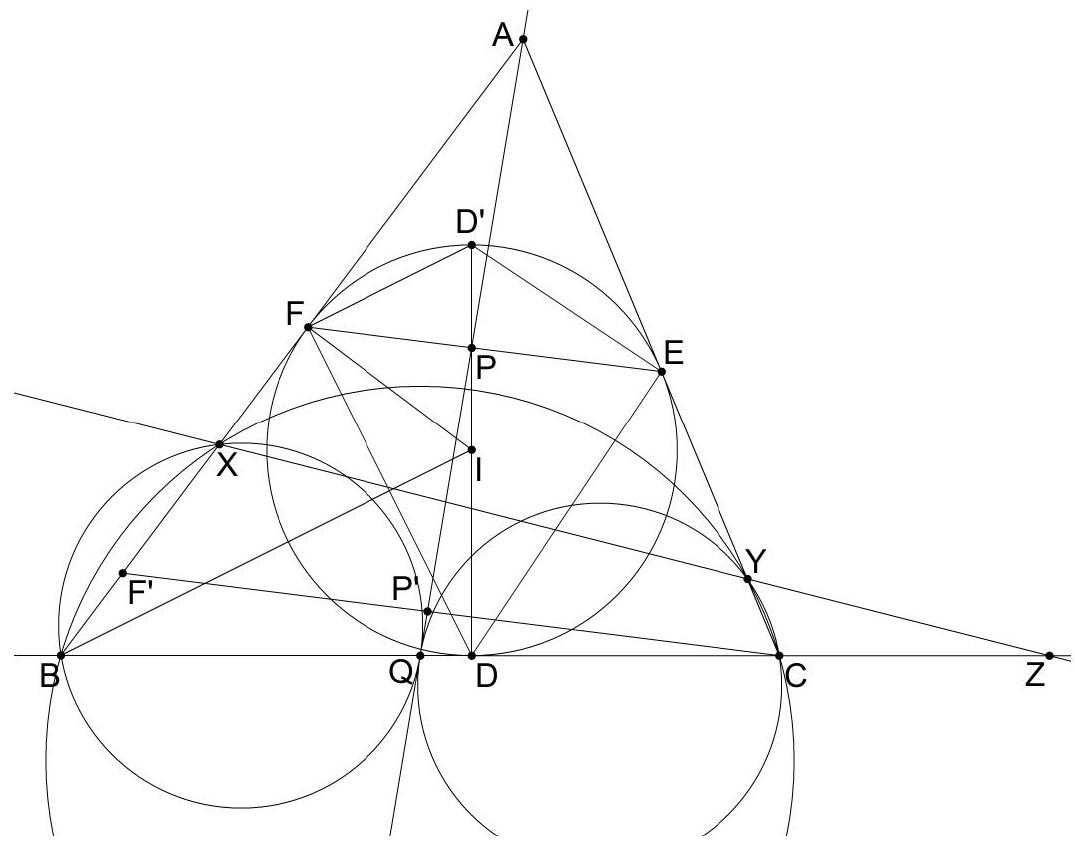
Answer: 101. Construct $D^{\prime}$ diametrically opposed to $D$, so that $\angle D F D^{\prime}$ and $\angle D E D^{\prime}$ are right, and note that $P$ lies on $D D^{\prime}$. By standard angle chasing, $m \angle F D D^{\prime}=\beta$ (half angle $B$ ) and $m \angle D^{\prime} D E=\gamma$. Thus, $m \angle D D^{\prime} F=90^{\circ}-\beta$ and $m \angle E D^{\prime} D=90^{\circ}-\gamma$. Then by the law of sines, $D E: E D^{\prime}: D^{\prime} F$ : $F D=\cos (\gamma): \sin (\gamma): \sin (\beta): \sin (\gamma)$. Now using $\triangle D E P \sim \triangle F D^{\prime} P$ and $\triangle D F P \sim \triangle E D^{\prime} P$, we have
Let the dilation centered at $A$ sending $E$ to $C$ map $P$ and $F$ to $P^{\prime}$ and $F^{\prime}$, respectively. Note that $A F^{\prime}=A C$ as $A E$ and $A F$ are equal tangents, and $C P^{\prime}: P^{\prime} F^{\prime}=E P: P F=c: b$ by similarity. Then by Menelaus' theorem,
so that $B Q=Q C$ and $A Q$ is actually a median. So, $A Q^{2}=\frac{1}{4}\left(2 b^{2}+2 c^{2}-a^{2}\right)=148$. Now by Power of a Point, $A B \cdot A X=A Q^{2}=A C \cdot A Y$, so $A X=148 / 15$ and $A Y=148 / 13$. Moreover, $B X C Y$ is cyclic as $\triangle A B C \sim \triangle A Y X$. Thus, $X Z \cdot Y Z=B Z \cdot C Z$, and it suffices to compute $B Z / C Z$. Menelaus once more gives
whence, $B Z / C Z=(A Y / A X)(B X / C Y)=(15 / 13)((77 \cdot 13) /(21 \cdot 15))=11 / 3$. We write $C Z=3 d$ and $B Z=11 d$. Because $A X<A B$ and $A Y<A C, Z$ does not lie on segment $B C$. Given the configuration information, $B C=8 d=14$, so $d=7 / 4$, and finally $\lfloor B Z \cdot C Z\rfloor=\left\lfloor 33 d^{2}\right\rfloor=\left\lfloor\frac{1617}{16}\right\rfloor=101$.