


USAMO 1997 Solution Notes
Evan ChEn《陳誼廷》
15 April 2024
This is a compilation of solutions for the 1997 USAMO. The ideas of the solution are a mix of my own work, the solutions provided by the competition organizers, and solutions found by the community. However, all the writing is maintained by me.
These notes will tend to be a bit more advanced and terse than the "official" solutions from the organizers. In particular, if a theorem or technique is not known to beginners but is still considered "standard", then I often prefer to use this theory anyways, rather than try to work around or conceal it. For example, in geometry problems I typically use directed angles without further comment, rather than awkwardly work around configuration issues. Similarly, sentences like "let $\mathbb{R}$ denote the set of real numbers" are typically omitted entirely.
Corrections and comments are welcome!
Contents
0 Problems ..... 2 1 Solutions to Day 1 ..... 3 1.1 USAMO 1997/1 ..... 3 1.2 USAMO 1997/2 ..... 4 1.3 USAMO 1997/3 ..... 5 2 Solutions to Day 2 ..... 7 2.1 USAMO 1997/4 ..... 7 2.2 USAMO 1997/5 ..... 8 2.3 USAMO 1997/6 ..... 9
§0 Problems
- Let $p_{1}, p_{2}, p_{3}, \ldots$ be the prime numbers listed in increasing order, and let $0<x_{0}<1$ be a real number between 0 and 1 . For each positive integer $k$, define
where ${x}$ denotes the fractional part of $x$. Find, with proof, all $x_{0}$ satisfying $0<x_{0}<1$ for which the sequence $x_{0}, x_{1}, x_{2}, \ldots$ eventually becomes 0 . 2. Let $A B C$ be a triangle. Take noncollinear points $D, E, F$ on the perpendicular bisectors of $B C, C A, A B$ respectively. Show that the lines through $A, B, C$ perpendicular to $E F, F D, D E$ respectively are concurrent. 3. Prove that for any integer $n$, there exists a unique polynomial $Q$ with coefficients in ${0,1, \ldots, 9}$ such that $Q(-2)=Q(-5)=n$. 4. To clip a convex $n$-gon means to choose a pair of consecutive sides $A B, B C$ and to replace them by the three segments $A M, M N$, and $N C$, where $M$ is the midpoint of $A B$ and $N$ is the midpoint of $B C$. In other words, one cuts off the triangle $M B N$ to obtain a convex $(n+1)$-gon. A regular hexagon $\mathcal{P}_{6}$ of area 1 is clipped to obtain a heptagon $\mathcal{P}_{7}$. Then $\mathcal{P}_{7}$ is clipped (in one of the seven possible ways) to obtain an octagon $\mathcal{P}_{8}$, and so on. Prove that no matter how the clippings are done, the area of $\mathcal{P}_{n}$ is greater than $\frac{1}{3}$, for all $n \geq 6$. 5. If $a, b, c>0$ prove that
- Suppose the sequence of nonnegative integers $a_{1}, a_{2}, \ldots, a_{1997}$ satisfies
for all $i, j \geq 1$ with $i+j \leq 1997$. Show that there exists a real number $x$ such that $a_{n}=\lfloor n x\rfloor$ for all $1 \leq n \leq 1997$.
§1 Solutions to Day 1
§1.1 USAMO 1997/1
Available online at https://aops.com/community/p343871.
Problem statement
Let $p_{1}, p_{2}, p_{3}, \ldots$ be the prime numbers listed in increasing order, and let $0<x_{0}<1$ be a real number between 0 and 1 . For each positive integer $k$, define
where ${x}$ denotes the fractional part of $x$. Find, with proof, all $x_{0}$ satisfying $0<x_{0}<1$ for which the sequence $x_{0}, x_{1}, x_{2}, \ldots$ eventually becomes 0 .
The answer is $x_{0}$ rational.
If $x_{0}$ is irrational, then all $x_{i}$ are irrational by induction. So the sequence cannot become zero.
If $x_{0}$ is rational, then all are. Now one simply observes that the denominators of $x_{n}$ are strictly decreasing, until we reach $0=\frac{0}{1}$. This concludes the proof.
Remark. The sequence $p_{k}$ could have been any sequence of integers.
§1.2 USAMO 1997/2
Available online at https://aops.com/community/p210283.
Problem statement
Let $A B C$ be a triangle. Take noncollinear points $D, E, F$ on the perpendicular bisectors of $B C, C A, A B$ respectively. Show that the lines through $A, B, C$ perpendicular to $E F, F D, D E$ respectively are concurrent.
The three lines are the radical axii of the three circles centered at $D, E, F$, so they concur.
§1.3 USAMO 1997/3
Available online at https://aops.com/community/p343873.
Problem statement
Prove that for any integer $n$, there exists a unique polynomial $Q$ with coefficients in ${0,1, \ldots, 9}$ such that $Q(-2)=Q(-5)=n$.
If we let
then $a_{k}$ is uniquely determined by $n\left(\bmod 2^{k}\right)$ and $n\left(\bmod 5^{k}\right)$. Indeed, we can extract the coefficients of $Q$ exactly by the following algorithm:
- Define $b_{0}=c_{0}=n$.
- For $i \geq 0$, let $a_{i}$ be the unique digit satisfying $a_{i} \equiv b_{i}(\bmod 2), a_{i} \equiv c_{i}(\bmod 5)$. Then, define
The proof is automatic by Chinese remainder theorem, so this shows uniqueness already. The tricky part is to show that all $a_{i}$ are eventually zero (i.e. the "existence" step is nontrivial because a polynomial may only have finitely many nonzero terms).
In fact, we will prove the following claim: Claim - Suppose $b_{0}$ and $c_{0}$ are any integers such that
Then defining $b_{i}$ and $c_{i}$ as above, we have $b_{i} \equiv c_{i}(\bmod 3)$ for all $i$, and $b_{N}=c_{N}=0$ for large enough $N$.
Proof. Dropping the subscripts for ease of notation, we are looking at the map
for some $0 \leq a \leq 9$ (a function in $b$ and $c$ ). The $b \equiv c(\bmod 3)$ is clearly preserved. Also, examining the size,
- If $|c|>2$, we have $\left|\frac{c-a}{-5}\right| \leq \frac{|c|+9}{5}<|c|$. Thus, we eventually reach a pair with $|c| \leq 2$.
- Similarly, if $|b|>9$, we have $\left|\frac{b-a}{-2}\right| \leq \frac{|b|+9}{2}<|b|$, so we eventually reach a pair with $|b| \leq 9$. this leaves us with $5 \cdot 19=95$ ordered pairs to check (though only about one third have $b \equiv c(\bmod 3))$. This can be done by the following code:
import functools
@functools.lru_cache()
def f(x0, yO):
    if x0 == 0 and y0 == 0:
        return 0
    if x0 % 2 == (y0 % 5) % 2:
        d = y0 % 5
    else:
        d = (y0 % 5) + 5
    x1 = (x0 - d) // (-2)
    y1 = (y0 - d) // (-5)
    return 1 + f(x1, y1)
for x in range(-9, 10):
for y in range(-2, 3):
    if (x % 3 == y % 3):
        print(f"({x:2d}, {y:2d}) finished in {f(x,y)} moves")
As this gives the output
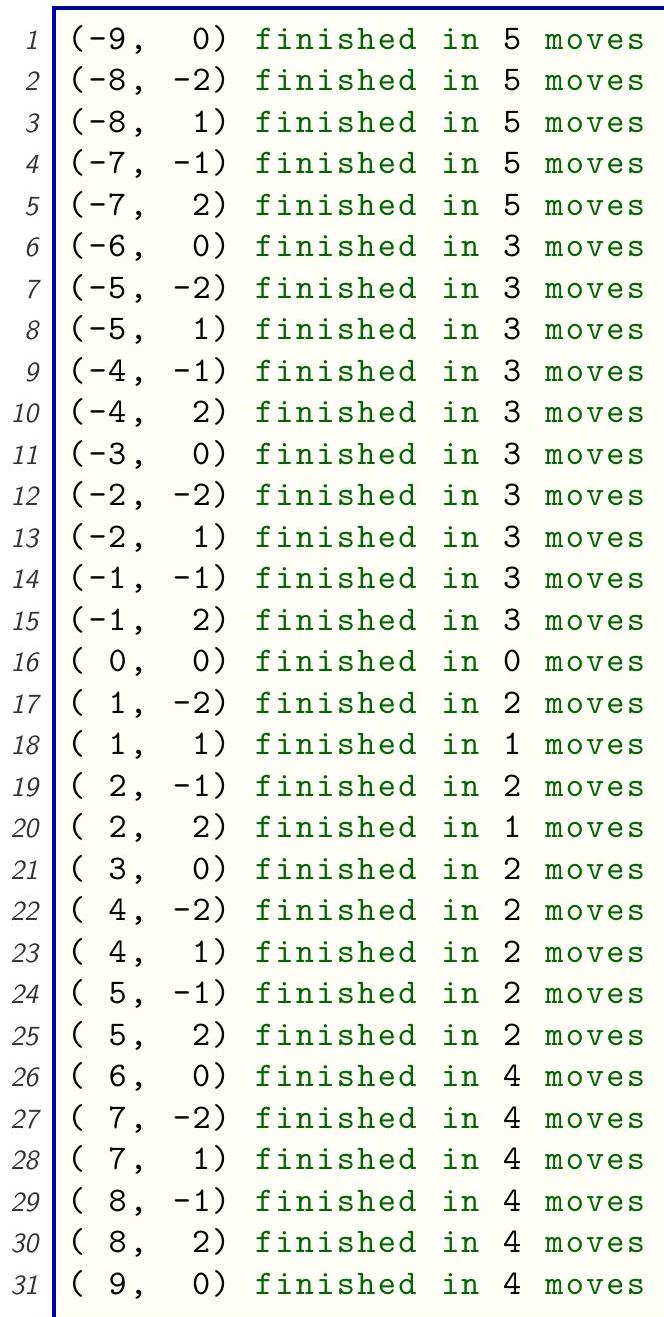 we are done.
§2 Solutions to Day 2
§2.1 USAMO 1997/4
Available online at https://aops.com/community/p343875.
Problem statement
To clip a convex $n$-gon means to choose a pair of consecutive sides $A B, B C$ and to replace them by the three segments $A M, M N$, and $N C$, where $M$ is the midpoint of $A B$ and $N$ is the midpoint of $B C$. In other words, one cuts off the triangle $M B N$ to obtain a convex $(n+1)$-gon. A regular hexagon $\mathcal{P}{6}$ of area 1 is clipped to obtain a heptagon $\mathcal{P}{7}$. Then $\mathcal{P}{7}$ is clipped (in one of the seven possible ways) to obtain an octagon $\mathcal{P}{8}$, and so on. Prove that no matter how the clippings are done, the area of $\mathcal{P}_{n}$ is greater than $\frac{1}{3}$, for all $n \geq 6$.
Call the original hexagon $A B C D E F$. We show the area common to triangles $A C E$ and $B D F$ is in every $\mathcal{P}_{n}$; this solves the problem since the area is $1 / 3$.
For every side of a clipped polygon, we define its foundation recursively as follows:
- $A B, B C, C D, D E, E F, F A$ are each their own foundation (we also call these original sides).
- When a new clipped edge is added, its foundation is the union of the foundations of the two edges it touches.
Hence, any foundations are nonempty subsets of original sides. Claim - All foundations are in fact at most two-element sets of adjacent original sides.
Proof. It's immediate by induction that any two adjacent sides have at most two elements in the union of their foundations, and if there are two, they are two adjacent original sides.
Now, if a side has foundation contained in ${A B, B C}$, say, then the side should be contained within triangle $A B C$. Hence the side does not touch $A C$. This proves the problem.
§2.2 USAMO 1997/5
Available online at https://aops.com/community/p2971.
Problem statement
If $a, b, c>0$ prove that
From $a^{3}+b^{3} \geq a b(a+b)$, the left-hand side becomes
§2.3 USAMO 1997/6
Available online at https://aops.com/community/p343876.
Problem statement
Suppose the sequence of nonnegative integers $a_{1}, a_{2}, \ldots, a_{1997}$ satisfies
for all $i, j \geq 1$ with $i+j \leq 1997$. Show that there exists a real number $x$ such that $a_{n}=\lfloor n x\rfloor$ for all $1 \leq n \leq 1997$.
We are trying to show there exists an $x \in \mathbb{R}$ such that
This means we need to show
Replace 1997 by $N$. We will prove this by induction, but we will need some extra hypotheses on the indices $i, j$ which are used above.
Claim - Suppose that
- Integers $a_{1}, a_{2}, \ldots, a_{N}$ satisfy the given conditions.
- Let $i=\operatorname{argmax}{n} \frac{a{n}}{n}$; if there are ties, pick the smallest $i$.
- Let $j=\operatorname{argmin}{n} \frac{a{n}+1}{n}$; if there are ties, pick the smallest $j$.
Then
Moreover, these two fractions are in lowest terms, and are adjacent in the Farey sequence of order $\max (i, j)$.
Proof. By induction on $N \geq 1$ with the base case clear. So suppose we have the induction hypothesis with numbers $a_{1}, \ldots, a_{N-1}$, with $i$ and $j$ as promised.
Now, consider the new number $a_{N}$. We have two cases:
- Suppose $i+j>N$. Then, no fraction with denominator $N$ can lie strictly inside the interval; so we may write for some integer $b$
For purely algebraic reasons we have
Now,
Thus $a_{N} \in{b, b+1}$. This proves that $\frac{a_{N}}{N} \leq \frac{a_{i}}{i}$ while $\frac{a_{N}+1}{N} \geq \frac{a_{j}+1}{j}$. Moreover, the pair $(i, j)$ does not change, so all inductive hypotheses carry over.
- On the other hand, suppose $i+j=N$. Then we have
Now, we know $a_{N}$ could be either $a_{i}+a_{j}$ or $a_{i}+a_{j}+1$. If it's the former, then $(i, j)$ becomes $(i, N)$. If it's the latter, then $(i, j)$ becomes $(N, j)$. The properties of Farey sequences ensure that the $\frac{a_{i}+a_{j}+1}{N}$ is reduced, either way.