


USAMO 2009 Solution Notes
Evan Chen《陳誼廷》
15 April 2024
This is a compilation of solutions for the 2009 USAMO. The ideas of the solution are a mix of my own work, the solutions provided by the competition organizers, and solutions found by the community. However, all the writing is maintained by me.
These notes will tend to be a bit more advanced and terse than the "official" solutions from the organizers. In particular, if a theorem or technique is not known to beginners but is still considered "standard", then I often prefer to use this theory anyways, rather than try to work around or conceal it. For example, in geometry problems I typically use directed angles without further comment, rather than awkwardly work around configuration issues. Similarly, sentences like "let $\mathbb{R}$ denote the set of real numbers" are typically omitted entirely.
Corrections and comments are welcome!
Contents
0 Problems ..... 2 1 Solutions to Day 1 ..... 3 1.1 USAMO 2009/1, proposed by Ian Le ..... 3 1.2 USAMO 2009/2, proposed by Kiran Kedlaya, Tewordos Amdeberhan ..... 4 1.3 USAMO 2009/3, proposed by Sam Vandervelde 2 Solutions to Day 2 ..... 7 2.1 USAMO 2009/4, proposed by Titu Andreescu ..... 7 2.2 USAMO 2009/5, proposed by Zuming Feng ..... 8 2.3 USAMO 2009/6, proposed by Gabriel Carroll ..... 9
§0 Problems
- Given circles $\omega_{1}$ and $\omega_{2}$ intersecting at points $X$ and $Y$, let $\ell_{1}$ be a line through the center of $\omega_{1}$ intersecting $\omega_{2}$ at points $P$ and $Q$ and let $\ell_{2}$ be a line through the center of $\omega_{2}$ intersecting $\omega_{1}$ at points $R$ and $S$. Prove that if $P, Q, R$, and $S$ lie on a circle then the center of this circle lies on line $X Y$.
- Let $n$ be a positive integer. Determine the size of the largest subset of ${-n,-n+$ $1, \ldots, n-1, n}$ which does not contain three elements $a, b, c$ (not necessarily distinct) satisfying $a+b+c=0$.
- We define a chessboard polygon to be a simple polygon whose sides are situated along lines of the form $x=a$ or $y=b$, where $a$ and $b$ are integers. These lines divide the interior into unit squares, which are shaded alternately grey and white so that adjacent squares have different colors. To tile a chessboard polygon by dominoes is to exactly cover the polygon by non-overlapping $1 \times 2$ rectangles. Finally, a tasteful tiling is one which avoids the two configurations of dominoes and colors shown on the left below. Two tilings of a $3 \times 4$ rectangle are shown; the first one is tasteful, while the second is not, due to the vertical dominoes in the upper right corner.
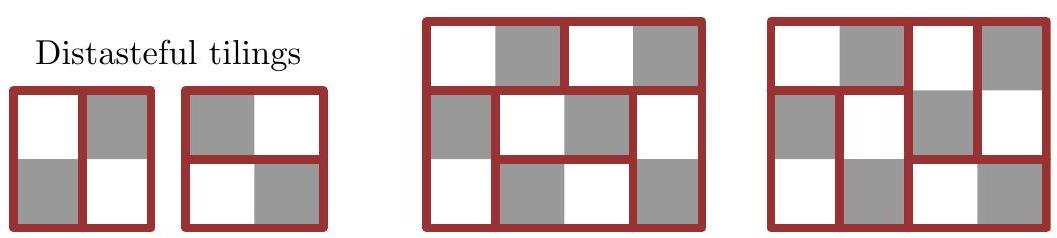
Prove that (a) if a chessboard polygon can be tiled by dominoes, then it can be done so tastefully, and (b) such a tasteful tiling is unique. 4. For $n \geq 2$, let $a_{1}, a_{2}, \ldots, a_{n}$ be positive real numbers such that
Prove that $\max \left(a_{1}, \ldots, a_{n}\right) \leq 4 \min \left(a_{1}, \ldots, a_{n}\right)$. 5. Trapezoid $A B C D$, with $\overline{A B} | \overline{C D}$, is inscribed in circle $\omega$ and point $G$ lies inside triangle $B C D$. Rays $A G$ and $B G$ meet $\omega$ again at points $P$ and $Q$, respectively. Let the line through $G$ parallel to $\overline{A B}$ intersect $\overline{B D}$ and $\overline{B C}$ at points $R$ and $S$, respectively. Prove that quadrilateral $P Q R S$ is cyclic if and only if $\overline{B G}$ bisects $\angle C B D$. 6. Let $s_{1}, s_{2}, s_{3}, \ldots$ be an infinite, nonconstant sequence of rational numbers, meaning it is not the case that $s_{1}=s_{2}=s_{3}=\ldots$ Suppose that $t_{1}, t_{2}, t_{3}, \ldots$ is also an infinite, nonconstant sequence of rational numbers with the property that $\left(s_{i}-s_{j}\right)\left(t_{i}-t_{j}\right)$ is an integer for all $i$ and $j$. Prove that there exists a rational number $r$ such that $\left(s_{i}-s_{j}\right) r$ and $\left(t_{i}-t_{j}\right) / r$ are integers for all $i$ and $j$.
§1 Solutions to Day 1
§1.1 USAMO 2009/1, proposed by lan Le
Available online at https://aops.com/community/p1485133.
Problem statement
Given circles $\omega_{1}$ and $\omega_{2}$ intersecting at points $X$ and $Y$, let $\ell_{1}$ be a line through the center of $\omega_{1}$ intersecting $\omega_{2}$ at points $P$ and $Q$ and let $\ell_{2}$ be a line through the center of $\omega_{2}$ intersecting $\omega_{1}$ at points $R$ and $S$. Prove that if $P, Q, R$, and $S$ lie on a circle then the center of this circle lies on line $X Y$.
Let $r_{1}, r_{2}, r_{3}$ denote the circumradii of $\omega_{1}, \omega_{2}$, and $\omega_{3}$, respectively.
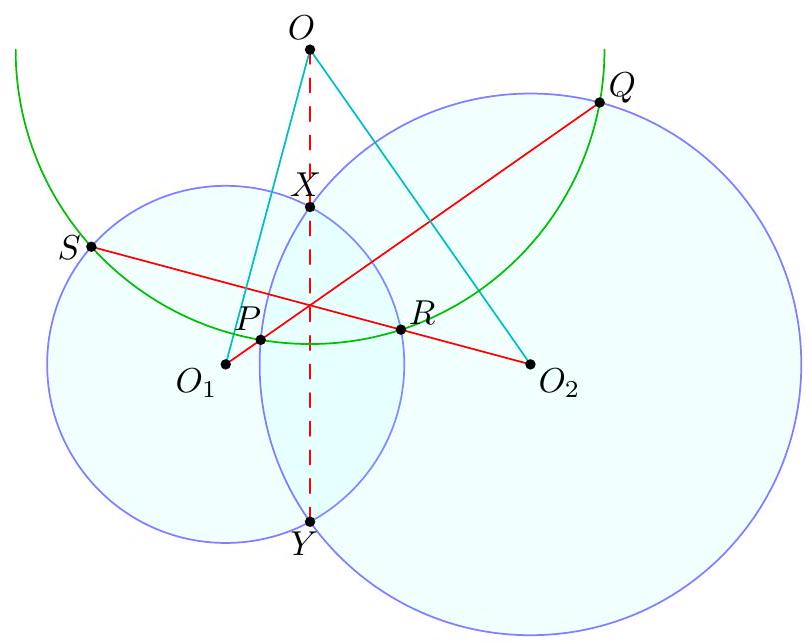
We wish to show that $O_{3}$ lies on the radical axis of $\omega_{1}$ and $\omega_{2}$. Let us encode the conditions using power of a point. Because $O_{1}$ is on the radical axis of $\omega_{2}$ and $\omega_{3}$,
Similarly, because $O_{2}$ is on the radical axis of $\omega_{1}$ and $\omega_{3}$, we have
Subtracting the two gives
as desired.
§1.2 USAMO 2009/2, proposed by Kiran Kedlaya, Tewordos Amdeberhan
Available online at https://aops.com/community/p1485139.
Problem statement
Let $n$ be a positive integer. Determine the size of the largest subset of ${-n,-n+$ $1, \ldots, n-1, n}$ which does not contain three elements $a, b, c$ (not necessarily distinct) satisfying $a+b+c=0$.
The answer is $n$ with $n$ even and $n+1$ with $n$ odd; the construction is to take all odd numbers.
To prove this is maximal, it suffices to show it for $n$ even; we do so by induction on even $n \geq 2$ with the base case being trivial. Letting $A$ be the subset, we consider three cases: (i) If $|A \cap{-n,-n+1, n-1, n}| \leq 2$, then by the hypothesis for $n-2$ we are done. (ii) If both $n \in A$ and $-n \in A$, then there can be at most $n-2$ elements in $A \backslash{ \pm n}$, one from each of the pairs $(1, n-1),(2, n-2), \ldots$ and their negations. (iii) If $n, n-1,-n+1 \in A$ and $-n \notin A$, and at most $n-3$ more can be added, one from each of $(1, n-2),(2, n-3), \ldots$ and $(-2,-n+2),(-3,-n+3), \ldots$ (In particular $-1 \notin A$. Analogous case for $-A$ if $n \notin A$.)
Thus in all cases, $|A| \leq n$ as needed. Remark. A few examples of equality cases:
- All odd numbers
- All numbers with absolute value at least $n / 2$
- For $n$ even, the set ${1,2, \ldots, n}$
This list isn't exhaustive e.g. for $n=4$, the set ${-3,2,3,4}$ achieves the optimum.
§1.3 USAMO 2009/3, proposed by Sam Vandervelde
Available online at https://aops.com/community/p1485321.
Problem statement
We define a chessboard polygon to be a simple polygon whose sides are situated along lines of the form $x=a$ or $y=b$, where $a$ and $b$ are integers. These lines divide the interior into unit squares, which are shaded alternately grey and white so that adjacent squares have different colors. To tile a chessboard polygon by dominoes is to exactly cover the polygon by non-overlapping $1 \times 2$ rectangles. Finally, a tasteful tiling is one which avoids the two configurations of dominoes and colors shown on the left below. Two tilings of a $3 \times 4$ rectangle are shown; the first one is tasteful, while the second is not, due to the vertical dominoes in the upper right corner.

Prove that (a) if a chessboard polygon can be tiled by dominoes, then it can be done so tastefully, and (b) such a tasteful tiling is unique.
【 Proof of (a). This is easier, and by induction. Let $\mathcal{P}$ denote the chessboard polygon which can be tiled by dominoes.
Consider a lower-left square $s$ of the polygon, and WLOG is it white (other case similar). Then we have two cases:
- If there exists a domino tiling of $\mathcal{P}$ where $s$ is covered by a vertical domino, then delete this domino and apply induction on the rest of $\mathcal{P}$. This additional domino will not cause any distasteful tilings.
- Otherwise, assume $s$ is covered by a horizontal domino in every tiling. Again delete this domino and apply induction on the rest of $\mathcal{P}$. The resulting tasteful tiling should not have another horizontal domino adjacent to the one covering $s$, because otherwise we could have replaced that $2 \times 2$ square with two vertical dominoes to arrive in the first case. So this additional domino will not cause any distasteful tilings.
Remark. The second case can actually arise, for example in the following picture.
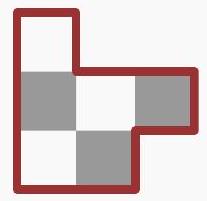
Thus one cannot just try to cover $s$ with a vertical domino and claim the rest of $\mathcal{P}$ is tile-able. So the induction is not as easy as one might hope.
One can phrase the solution algorithmically too, in the following way: any time we see a distasteful tiling, we rotate it to avoid the bad pattern. The bottom-left corner eventually becomes stable, and an induction shows the termination of the algorithm.
【 Proof of (b). We now turn to proving uniqueness. Suppose for contradiction there are two distinct tasteful tilings. Overlaying the two tilings on top of each other induces several cycles of overlapping dominoes at positions where the tilings differ.
Henceforth, it will be convenient to work with the lattice $\mathbb{Z}^{2}$, treating the squares as black/white points, and we do so. Let $\gamma$ be any such cycle and let $s$ denote a lower left point, and again WLOG it is black. Orient $\gamma$ counterclockwise henceforth. Restrict attention to the lattice polygon $\mathcal{Q}$ enclosed by $\gamma$ (we consider points of $\gamma$ as part of $\mathcal{Q}$ ).
In one of the two tilings of (lattice points of) $\mathcal{Q}$, the point $s$ will be covered by a horizontal domino; in the other tiling $s$ will be covered by a vertical domino. From now on we will focus only on the latter one. Observe that we now have a set of dominoes along $\gamma$, such that $\gamma$ points from the white point to the black point within each domino.
Now impose coordinates so that $s=(0,0)$. Consider the stair-case sequence of points $p_{0}=s=(0,0), p_{1}=(1,0), p_{2}=(1,1), p_{3}=(2,1)$, and so on. By hypothesis, $p_{0}$ is covered by a vertical domino. Then $p_{1}$ must be covered by a horizontal domino, to avoid a distasteful tiling. Then if $p_{2}$ is in $\mathcal{Q}$, then it must be covered by a vertical domino to avoid a distasteful tiling, and so on. We may repeat this argument as long the points $p_{i}$ lie inside $\mathcal{Q}$. (See figure below; the staircase sequence is highlighted by red halos.)
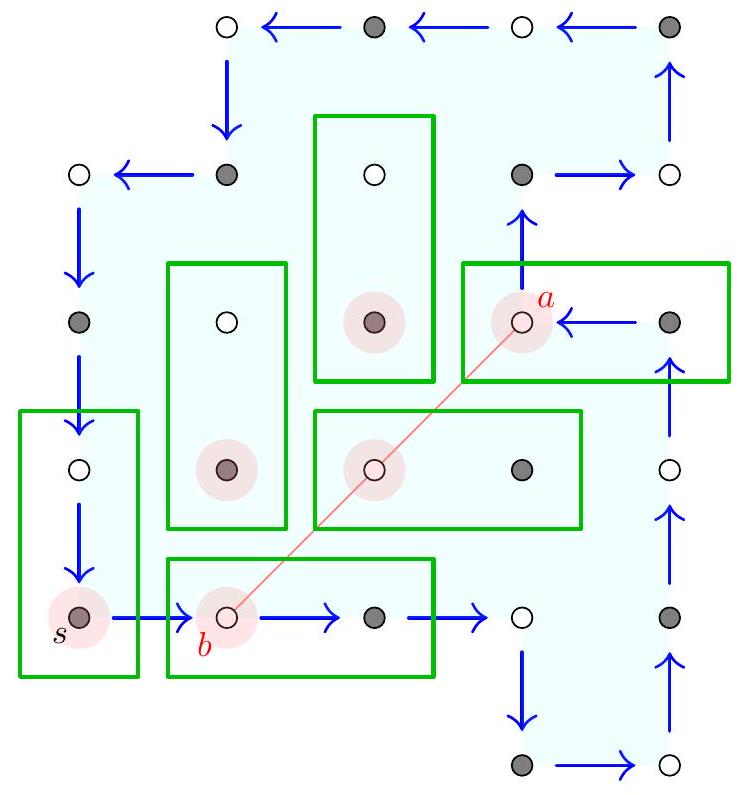
The curve $\gamma$ by definition should cross $y=x-1$ at the point $b=(1,0)$. Let $a$ denote the first point of this sequence after $p_{1}$ for which $\gamma$ crosses $y=x-1$ again.
Now $a$ is tiled by a vertical domino whose black point is to the right of $\ell$. But the line segment $\ell$ cuts $\mathcal{Q}$ into two parts, and the orientation of $\gamma$ has this path also entering from the right. This contradicts the fact that the orientation of $\gamma$ points only from white to black within dominoes. This contradiction completes the proof.
Remark. Note the problem is false if you allow holes (consider a $3 \times 3$ with the middle square deleted).
§2 Solutions to Day 2
§2.1 USAMO 2009/4, proposed by Titu Andreescu
Available online at https://aops.com/community/p1485147.
Problem statement
For $n \geq 2$, let $a_{1}, a_{2}, \ldots, a_{n}$ be positive real numbers such that
Prove that $\max \left(a_{1}, \ldots, a_{n}\right) \leq 4 \min \left(a_{1}, \ldots, a_{n}\right)$.
Assume $a_{1}$ is the largest and $a_{2}$ is the smallest. Let $M=a_{1} / a_{2}$. We wish to show $M \leq 4$. In left-hand side of given, write as $a_{2}+a_{1}+\cdots+a_{n}$. By Cauchy Schwarz, one obtains
Expanding and solving for $M$ gives $1 / 4 \leq M \leq 4$ as needed.
§2.2 USAMO 2009/5, proposed by Zuming Feng
Available online at https://aops.com/community/p1485200.
Problem statement
Trapezoid $A B C D$, with $\overline{A B} | \overline{C D}$, is inscribed in circle $\omega$ and point $G$ lies inside triangle $B C D$. Rays $A G$ and $B G$ meet $\omega$ again at points $P$ and $Q$, respectively. Let the line through $G$ parallel to $\overline{A B}$ intersect $\overline{B D}$ and $\overline{B C}$ at points $R$ and $S$, respectively. Prove that quadrilateral $P Q R S$ is cyclic if and only if $\overline{B G}$ bisects $\angle C B D$.
Perform an inversion around $B$ with arbitrary radius, and denote the inverse of a point $Z$ with $Z^{*}$.
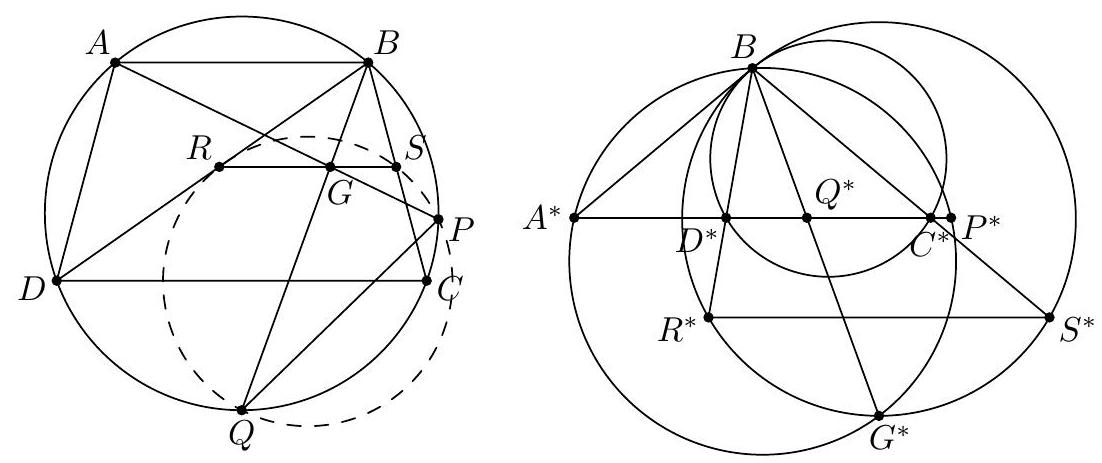
After inversion, we obtain a cyclic quadrilateral $B S^{} G^{} R^{}$ and points $C^{}, D^{}$ on $\overline{B S^{}}$, $\overline{B R^{}}$, such that $\left(B C^{} D^{}\right)$ is tangent to $\left(B S^{} G^{} R^{}\right)-$ in other words, so that $\overline{C^{} D^{}}$ is parallel to $\overline{S^{} R^{}}$. Point $A^{}$ lies on line $\overline{C^{} D^{}}$ so that $\overline{A^{} B}$ is tangent to $\left(B S^{} G^{} R^{}\right)$. Points $P^{}$ and $Q^{}$ are the intersections of $\left(A^{} B G^{}\right)$ and $\overline{B G^{}}$ with line $C^{} D^{}$.
Observe that $P^{} Q^{} R^{} S^{}$ is a trapezoid, so it is cyclic if and only if it isosceles. Let $X$ be the second intersection of line $G^{} P^{}$ with $\left(B S^{} R^{}\right)$. Because
we find that $B X S^{} R^{}$ is an isosceles trapezoid. If $G^{}$ is indeed the midpoint of the arc then everything is clear by symmetry now. Conversely, if $P^{} R^{}=Q^{} S^{}$ then that means $P^{} Q^{} R^{} S^{}$ is a cyclic trapezoid, and hence that the perpendicular bisectors of $\overline{P^{} Q^{}}$ and $\overline{R^{} S^{}}$ are the same. Hence $B, X, P^{}, Q^{}$ are symmetric around this line. This forces $G^{}$ to be the midpoint of $\operatorname{arc} R^{} S^{}$ as desired.
§2.3 USAMO 2009/6, proposed by Gabriel Carroll
Available online at https://aops.com/community/p1485204.
Problem statement
Let $s_{1}, s_{2}, s_{3}, \ldots$ be an infinite, nonconstant sequence of rational numbers, meaning it is not the case that $s_{1}=s_{2}=s_{3}=\ldots$ Suppose that $t_{1}, t_{2}, t_{3}, \ldots$ is also an infinite, nonconstant sequence of rational numbers with the property that $\left(s_{i}-s_{j}\right)\left(t_{i}-t_{j}\right)$ is an integer for all $i$ and $j$. Prove that there exists a rational number $r$ such that $\left(s_{i}-s_{j}\right) r$ and $\left(t_{i}-t_{j}\right) / r$ are integers for all $i$ and $j$.
First we eliminate the silly edge case: Claim - For some $i$ and $j$, we have $\left(s_{i}-s_{j}\right)\left(t_{i}-t_{j}\right) \neq 0$.
Proof. Assume not. WLOG $s_{1} \neq s_{2}$, then $t_{1}=t_{2}$. Now select $i$ such that $t_{i} \neq t_{1}=t_{2}$. Then either $t_{i}-s_{1} \neq 0$ or $t_{i}-s_{2} \neq 0$, contradiction.
So, WLOG (by permutation) that $n=\left(s_{1}-s_{2}\right)\left(t_{1}-t_{2}\right) \neq 0$. By shifting and scaling appropriately, we may assume
Thus we deduce
Claim - For any index $i, t_{i} \in \mathbb{Z}, s_{i} \in \frac{1}{n} \mathbb{Z}$.
Proof. We have $s_{i} t_{i} \in \mathbb{Z}$ and $t_{i}+n s_{i} \in \mathbb{Z}$ by problem condition. By looking at $\nu_{p}$ of this, we conclude $n s_{i}, t_{i} \in \mathbb{Z}$ (since if either as negative $p$-adic value, so does the other, and then $\left.s_{i} t_{i} \notin \mathbb{Z}\right)$.
Last claim: Claim - If $d=\operatorname{gcd} t_{\bullet}$, then $d s_{i} \in \mathbb{Z}$ for all $i$.
Proof. Consider a prime $p \mid n$, and let $e=\nu_{p}\left(t_{j}\right)$. We will show $\nu_{p}\left(s_{i}\right) \geq-e$ for any $i$. This is already true for $i=j$, so assume $i \neq j$. Assume for contradiction $\nu_{p}\left(s_{i}\right)<-e$. Then $\nu_{p}\left(t_{i}\right)>e=\nu_{p}\left(t_{k}\right)$. Since $\nu_{p}\left(s_{k}\right) \geq-e$ we deduce $\nu_{p}\left(s_{i} t_{k}\right)<\nu_{p}\left(s_{k} t_{i}\right)$; so $\nu_{p}\left(s_{i} t_{k}\right) \geq$ 0 and $\nu_{p}\left(s_{i}\right) \geq-e$ as desired.