


USAMO 2018 Solution Notes
Evan ChEn《陳誼廷》
23 April 2024
This is a compilation of solutions for the 2018 USAMO. The ideas of the solution are a mix of my own work, the solutions provided by the competition organizers, and solutions found by the community. However, all the writing is maintained by me.
These notes will tend to be a bit more advanced and terse than the "official" solutions from the organizers. In particular, if a theorem or technique is not known to beginners but is still considered "standard", then I often prefer to use this theory anyways, rather than try to work around or conceal it. For example, in geometry problems I typically use directed angles without further comment, rather than awkwardly work around configuration issues. Similarly, sentences like "let $\mathbb{R}$ denote the set of real numbers" are typically omitted entirely.
Corrections and comments are welcome!
Contents
0 Problems ..... 2 1 Solutions to Day 1 ..... 3 1.1 USAMO 2018/1, proposed by Titu Andreescu ..... 3 1.2 USAMO 2018/2, proposed by Titu Andreescu, Nikolai Nikolov ..... 4 1.3 USAMO 2018/3, proposed by Ivan Borsenco ..... 6 2 Solutions to Day 2 ..... 9 2.1 USAMO 2018/4, proposed by Ankan Bhattacharya ..... 9 2.2 USAMO 2018/5, proposed by Kada Williams ..... 10 2.3 USAMO 2018/6, proposed by Richard Stong ..... 13
§0 Problems
- Let $a, b, c$ be positive real numbers such that $a+b+c=4 \sqrt[3]{a b c}$. Prove that
- Find all functions $f:(0, \infty) \rightarrow(0, \infty)$ such that
for all $x, y, z>0$ with $x y z=1$. 3. Let $n \geq 2$ be an integer, and let $\left{a_{1}, \ldots, a_{m}\right}$ denote the $m=\varphi(n)$ integers less than $n$ and relatively prime to $n$. Assume that every prime divisor of $m$ also divides $n$. Prove that $m$ divides $a_{1}^{k}+\cdots+a_{m}^{k}$ for every positive integer $k$. 4. Let $p$ be a prime, and let $a_{1}, \ldots, a_{p}$ be integers. Show that there exists an integer $k$ such that the numbers
produce at least $\frac{1}{2} p$ distinct remainders upon division by $p$. 5. Let $A B C D$ be a convex cyclic quadrilateral with $E=\overline{A C} \cap \overline{B D}, F=\overline{A B} \cap \overline{C D}$, $G=\overline{D A} \cap \overline{B C}$. The circumcircle of $\triangle A B E$ intersects line $C B$ at $B$ and $P$, and the circumcircle of $\triangle A D E$ intersects line $C D$ at $D$ and $Q$. Assume $C, B, P, G$ and $C$, $Q, D, F$ are collinear in that order. Let $M=\overline{F P} \cap \overline{G Q}$. Prove that $\angle M A C=90^{\circ}$. 6. Let $a_{n}$ be the number of permutations $\left(x_{1}, \ldots, x_{n}\right)$ of $(1, \ldots, n)$ such that the ratios $x_{k} / k$ are all distinct. Prove that $a_{n}$ is odd for all $n \geq 1$.
§1 Solutions to Day 1
§1.1 USAMO 2018/1, proposed by Titu Andreescu
Available online at https://aops.com/community/p10226140.
Problem statement
Let $a, b, c$ be positive real numbers such that $a+b+c=4 \sqrt[3]{a b c}$. Prove that
WLOG let $c=\min (a, b, c)=1$ by scaling. The given inequality becomes equivalent to
Now, let $t=(a b)^{1 / 3}$ and eliminate $a+b$ using the condition, to get
which solves the problem. Equality occurs only if $t=2$, meaning $a b=8$ and $a+b=7$, which gives
with the assumption $c=1$. Scaling gives the curve of equality cases.
§1.2 USAMO 2018/2, proposed by Titu Andreescu, Nikolai Nikolov
Available online at https://aops.com/community/p10226145.
Problem statement
Find all functions $f:(0, \infty) \rightarrow(0, \infty)$ such that
for all $x, y, z>0$ with $x y z=1$.
The main part of the problem is to show all solutions are linear. As always, let $x=b / c$, $y=c / a, z=a / b$ (classical inequality trick). Then the problem becomes
Let $f(t)=g\left(\frac{1}{t+1}\right)$, equivalently $g(s)=f(1 / s-1)$. Thus $g:(0,1) \rightarrow(0,1)$ which satisfies $\sum_{\mathrm{cyc}} g\left(\frac{a}{a+b+c}\right)=1$, or equivalently
The rest of the solution is dedicated to solving this equivalent functional equation in $g$. It is a lot of technical details and I will only outline them (with apologies to the contestants who didn't have that luxury).
Claim - The function $g$ is linear. Proof. This takes several steps, all of which are technical. We begin by proving $g$ is linear over $[1 / 8,3 / 8]$.
- First, whenever $a+b \leq 1$ we have
Hence $g$ obeys Jensen's functional equation over $(0,1 / 2)$.
- Define $h:[0,1] \rightarrow \mathbb{R}$ by $h(t)=g\left(\frac{2 t+1}{8}\right)-(1-t) \cdot g(1 / 8)-t \cdot g(3 / 8)$, then $h$ satisfies Jensen's functional equation too over $[0,1]$. We have also arranged that $h(0)=h(1)=0$, hence $h(1 / 2)=0$ as well.
- Since
for any $t<1 / 2$, we find $h$ is periodic modulo $1 / 2$. It follows one can extend $\widetilde{h}$ by
and still satisfy Jensen's functional equation. Because $\widetilde{h}(0)=0$, it's well-known this implies $\widetilde{h}$ is additive (because $\widetilde{h}(x+y)=2 \widetilde{h}((x+y) / 2)=\widetilde{h}(x)+\widetilde{h}(y)$ for any real numbers $x$ to $y$ ).
But $\widetilde{h}$ is bounded below on $[0,1]$ since $g \geq 0$, and since $\widetilde{h}$ is also additive, it follows (well-known) that $\widetilde{h}$ is linear. Thus $h$ is the zero function. So, the function $g$ is linear over $[1 / 8,3 / 8]$; thus we may write $g(x)=k x+\ell$, valid for $1 / 8 \leq x \leq 3 / 8$.
Since $3 g(1 / 3)=1$, it follows $k+3 \ell=1$. For $0<x<1 / 8$ we have $g(x)=2 g(0.15)-g(0.3-x)=2(0.15 k+\ell)-(k(0.3-x)+\ell)=$ $k x+\ell$, so $g$ is linear over $(0,3 / 8)$ as well. Finally, for $3 / 8<x<1$, we use the given equation
since $\frac{1-x}{2}<\frac{5}{16}<\frac{3}{8}$. Thus $g$ is linear over all. Putting this back in, we deduce that $g(x)=k x+\frac{1-k}{3}$ for some $k \in[-1 / 2,1]$, and so
for some $k \in[-1 / 2,1]$. All such functions work.
§1.3 USAMO 2018/3, proposed by Ivan Borsenco
Available online at https://aops.com/community/p10226222.
Problem statement
Let $n \geq 2$ be an integer, and let $\left{a_{1}, \ldots, a_{m}\right}$ denote the $m=\varphi(n)$ integers less than $n$ and relatively prime to $n$. Assume that every prime divisor of $m$ also divides $n$. Prove that $m$ divides $a_{1}^{k}+\cdots+a_{m}^{k}$ for every positive integer $k$.
For brevity, given any $n$, we let $A(n)={1 \leq x \leq n, \operatorname{gcd}(x, n)=1}$ (thus $|A(n)|=\varphi(n)$ ). Also, let $S(n, k)=\sum_{a \in A(n)} a^{k}$.
We will prove the stronger statement (which eliminates the hypothesis on $n$ ). Claim - Let $n \geq 2$ be arbitrary (and $k \geq 0$ ). If $p \mid n$, then
We start with the special case where $n$ is a prime power.
Lemma
Let $p$ be prime, $e \geq 1, k \geq 0$. We always have
Proof. For $p$ odd, this follows by taking a primitive root $g$ modulo $p^{e}$. We will have
If $p-1 \nmid k$, then the denominator is not divisible by $p$ and hence the entire expression is $0\left(\bmod p^{e}\right)$. In the other case where $p-1 \mid k$, since $\nu_{p}\left(\varphi\left(p^{e}\right)\right)=e-1$, the exponent lifting lemma implies
and so the conclusion is true here too. In the annoying case $p=2$, the proof is broken into two cases: for $k$ odd it follows by pairing $x$ with $2^{e}-x$ and when $k$ is even one can take 5 as a generator of all the quadratic residues as in the $p>2$ case.
Corollary
We have $\nu_{p}\left(1^{k}+\cdots+t^{k}\right) \geq \nu_{p}(t)-1$ for any $k, t, p$.
Proof. Assume $p \mid t$. Handle the terms in that sum divisible by $p$ (by induction) and apply the lemma a bunch of times.
Now the idea is to add primes $q$ one at a time to $n$, starting from the base case $n=p^{e}$. So, formally we proceed by induction on the number of prime divisors of $n$. We'll also assume $k \geq 1$ in what follows since the base case $k=0$ is easy.
- First, suppose we want to go from $n$ to $n q$ where $q \nmid n$. In that case $\varphi(n q)$ gained $\nu_{p}(q-1)$ factors of $p$ and then we need to show $\nu_{p}(S(n q, k)) \geq \nu_{p}(\varphi(n))+\nu_{p}(q-1)$. The trick is to write
and then expand using binomial theorem:
We claim every term here has enough powers of $p$. For the first term, $S(n, k)$ has at least $\nu_{p}(\varphi(n))$ factors of $p$; and we have the $q-q^{k}$ multiplier out there. For the other terms, we apply induction to $S(n, k-j)$; moreover $\sum_{h=1}^{q-1} h^{j}$ has at least $\nu_{p}(q-1)-1$ factors of $p$ by corollary, and we get one more factor of $p$ (at least) from $n^{j}$.
- On the other hand, if $q$ already divides $n$, then this time
and we have no additional burden of $p$ to deal with; the same calculation gives
which certainly has enough factors of $p$ already.
Remark. A curious bit about the problem is that $\nu_{p}(\varphi(n))$ can exceed $\nu_{p}(n)$, and so it is not true that the residues of $A(n)$ are well-behaved modulo $\varphi(n)$.
As an example, let $n=2 \cdot 3 \cdot 7 \cdot 13=546$, so $m=\varphi(n)=1 \cdot 2 \cdot 6 \cdot 12=144$. Then $A(n)$ contains 26 elements which are $1 \bmod 9$ and 23 elements which are $4 \bmod 9$.
Remark. The converse of the problem is true too (but asking both parts would make this too long for exam).
§2 Solutions to Day 2
§2.1 USAMO 2018/4, proposed by Ankan Bhattacharya
Available online at https://aops.com/community/p10232389.
Problem statement
Let $p$ be a prime, and let $a_{1}, \ldots, a_{p}$ be integers. Show that there exists an integer $k$ such that the numbers
produce at least $\frac{1}{2} p$ distinct remainders upon division by $p$.
For each $k=0, \ldots, p-1$ let $G_{k}$ be the graph on ${1, \ldots, p}$ where we join ${i, j}$ if and only if
So we want a graph $G_{k}$ with at least $\frac{1}{2} p$ connected components. However, each ${i, j}$ appears in exactly one graph $G_{k}$, so some graph has at most $\frac{1}{p}\binom{p}{2}=\frac{1}{2}(p-1)$ edges (by "pigeonhole"). This graph has at least $\frac{1}{2}(p+1)$ connected components, as desired.
Remark. Here is an example for $p=5$ showing equality can occur:
Ankan Bhattacharya points out more generally that $a_{i}=i^{2}$ is sharp in general.
§2.2 USAMO 2018/5, proposed by Kada Williams
Available online at https://aops.com/community/p10232392.
Problem statement
Let $A B C D$ be a convex cyclic quadrilateral with $E=\overline{A C} \cap \overline{B D}, F=\overline{A B} \cap \overline{C D}$, $G=\overline{D A} \cap \overline{B C}$. The circumcircle of $\triangle A B E$ intersects line $C B$ at $B$ and $P$, and the circumcircle of $\triangle A D E$ intersects line $C D$ at $D$ and $Q$. Assume $C, B, P, G$ and $C$, $Q, D, F$ are collinear in that order. Let $M=\overline{F P} \cap \overline{G Q}$. Prove that $\angle M A C=90^{\circ}$.
We present three general routes. (The second route, using the fact that $\overline{A C}$ is an angle bisector, has many possible variations.) \l First solution (Miquel points). This is indeed a Miquel point problem, but the main idea is to focus on the self-intersecting cyclic quadrilateral $P B Q D$ as the key player, rather than on the given $A B C D$.
Indeed, we will prove that $A$ is its Miquel point; this follows from the following two claims.
Claim - The self-intersecting quadrilateral $P Q D B$ is cyclic.
Proof. By power of a point from $C: C Q \cdot C D=C A \cdot C E=C B \cdot C P$.
Claim - Point $E$ lies on line $P Q$.
Proof. $\measuredangle A E P=\measuredangle A B P=\measuredangle A B C=\measuredangle A D C=\measuredangle A D Q=\measuredangle A E Q$.
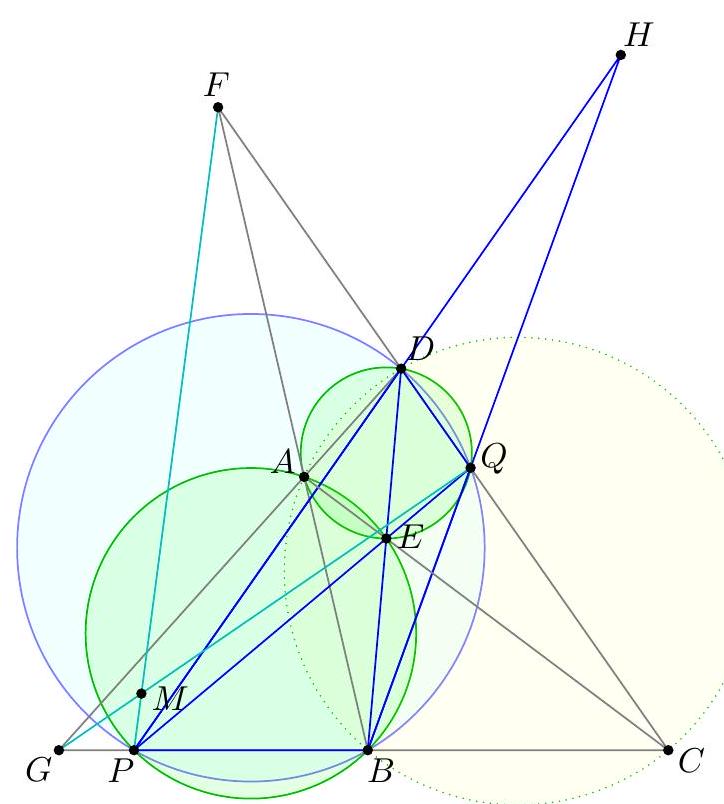
To finish, let $H=\overline{P D} \cap \overline{B Q}$. By properties of the Miquel point, we have $A$ is the foot from $H$ to $\overline{C E}$. But also, points $M, A, H$ are collinear by Pappus theorem on $\overline{B P G}$ and $\overline{D Q F}$, as desired.
【 Second solution (projective). We start with a synthetic observation. Claim - The line $\overline{A C}$ bisects $\angle P A D$ and $\angle B A Q$.
Proof. Angle chase: $\measuredangle P A C=\measuredangle P A E=\measuredangle P B E=\measuredangle C B D=\measuredangle C A D$. There are three ways to finish from here:
- (Michael Kural) Suppose the external bisector of $\angle P A D$ and $\angle B A Q$ meet lines $B C$ and $D C$ at $X$ and $Y$. Then
which is enough to imply that $\overline{X Y}, \overline{G Q}, \overline{P F}$ are concurrent (by so-called prism lemma).
- (Daniel Liu) Alternatively, apply the dual Desargues involution theorem to complete quadrilateral GQFPCM, through the point $A$. This gives that an involutive pairing of
This is easier to see if we project it onto the line $\ell$ through $C$ perpendicular to $\overline{A C}$; if we let $P^{\prime}, Q^{\prime}, G^{\prime}, F^{\prime}$ be the images of the last four lines, we find the involution coincides with negative inversion through $C$ with power $\sqrt{C P^{\prime} \cdot C Q^{\prime}}$ which implies that $\overline{A M} \cap \ell$ is an infinity point, as desired.
- (Kada Williams) The official solution instead shows the external angle bisector by a long trig calculation.
【 Third solution (inversion, Andrew Wu). Noting that $C E \cdot C A=C P \cdot C B=C Q \cdot C D$, we perform an inversion at $C$ swapping these pairs of points. The point $G$ is mapped to a point $G^{}$ ray $C B$ for which $Q E G^{} C$ is cyclic, but then
and so we conclude $E B=E G^{}$. Similarly, $E D=E F^{}$.
Finally, $M^{}=\left(C G^{} D\right) \cap\left(C F^{} B\right) \neq C$, and we wish to show that $\angle E M^{} C=90^{\circ}$.
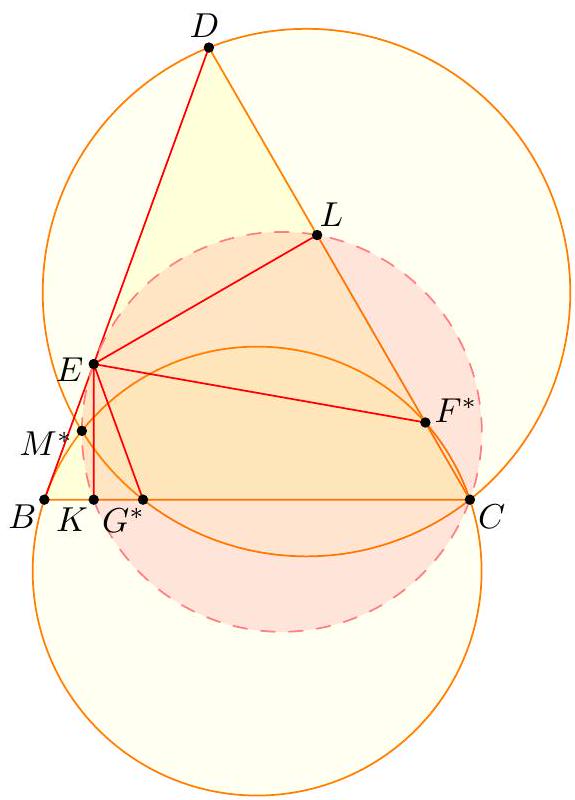
Note that $M^{}$ is the center of the spiral similarity sending $\overline{B G^{}}$ to $\overline{F^{} D}$. Hence it also maps the midpoint $K$ of $B G^{}$ to the midpoint $L$ of $\overline{F^{} E}$. Consequently, $M^{}$ lies on the circumcircle $K L C$ as well. In other words, $E L C K M^{*}$ is a cyclic pentagon with circumdiameter $\overline{C E}$, as desired.
§2.3 USAMO 2018/6, proposed by Richard Stong
Available online at https://aops.com/community/p10232388.
Problem statement
Let $a_{n}$ be the number of permutations $\left(x_{1}, \ldots, x_{n}\right)$ of $(1, \ldots, n)$ such that the ratios $x_{k} / k$ are all distinct. Prove that $a_{n}$ is odd for all $n \geq 1$.
This is the official solution; the proof has two main insights. The first idea:
Lemma
If a permutation $x$ works, so does the inverse permutation. Thus it suffices to consider permutations $x$ in which all cycles have length at most 2 . Of course, there can be at most one fixed point (since that gives the ratio 1 ), and hence exactly one if $n$ is odd, none if $n$ is even.
We consider the graph $K_{n}$ such that the edge ${i, j}$ is labeled with $i / j$ (for $i<j$ ). The permutations we're considering are then equivalent to maximal matchings of this $K_{n}$. We call such a matching fantastic if it has an all of distinct edge labels.
Now the second insight is that if edges $a b$ and $c d$ have the same label for $a<b$ and $c<d$, then so do edges $a c$ and $b d$. Thus:
Definition. Given a matching $\mathcal{M}$ as above we say the neighbors of $\mathcal{M}$ are those other matchings obtained as follows: for each label $\ell$, we take some disjoint pairs of edges (possibly none) with label $\ell$ and apply the above switching operation (in which we replace $a b$ and $c d$ with $a c$ and $b d)$.
This neighborship relation is reflexive, and most importantly it is symmetric (because one can simply reverse the moves). But it is not transitive.
The second observation is that: Claim - The matching $\mathcal{M}$ has an odd number of neighbors (including itself) if and only if it is fantastic.
Proof. Consider the label $\ell$, and assume it appears $n_{\ell} \geq 1$ times. If we pick $k$ disjoint pairs and swap them, the number of ways to do this is $\binom{n_{e}}{2 k}(2 k-1)!!$, and so the total number of ways to perform operations on the edges labeled $\ell$ is
This is even if and only if $n_{\ell}>1$. Finally, note that the number of neighbors of $\mathcal{M}$ is the product across all $\ell$ of the above. So it is odd if and only if each factor is odd, if and only if $n_{\ell}=1$ for every $\ell$.
To finish, consider a huge simple graph $\Gamma$ on all the maximal matchings, with edge relations given by neighbor relation (we don't consider vertices to be connected to themselves). Observe that:
- Fantastic matchings correspond to isolated vertices (of degree zero, with no other neighbors) of $\Gamma$.
- The rest of the vertices of $\Gamma$ have odd degrees (one less than the neighbor count)
- The graph $\Gamma$ has an even number of vertices of odd degree (this is true for any simple graph, see "handshake lemma").
- The number of vertices of $\Gamma$ is odd, namely $(2\lceil n / 2\rceil-1)!!$
This concludes the proof.