


USAMO 2020 Solution Notes
Evan Chen《陳誼廷》
15 April 2024
This is a compilation of solutions for the 2020 USAMO. The ideas of the solution are a mix of my own work, the solutions provided by the competition organizers, and solutions found by the community. However, all the writing is maintained by me.
These notes will tend to be a bit more advanced and terse than the "official" solutions from the organizers. In particular, if a theorem or technique is not known to beginners but is still considered "standard", then I often prefer to use this theory anyways, rather than try to work around or conceal it. For example, in geometry problems I typically use directed angles without further comment, rather than awkwardly work around configuration issues. Similarly, sentences like "let $\mathbb{R}$ denote the set of real numbers" are typically omitted entirely.
Corrections and comments are welcome!
Contents
0 Problems ..... 2 1 Solutions to Day 1 ..... 3 1.1 USAMO 2020/1, proposed by Zuming Feng ..... 3 1.2 USAMO 2020/2, proposed by Alex Zhai ..... 5 1.3 USAMO 2020/3, proposed by Richard Stong, Toni Bluher ..... 7 2 Solutions to Day 2 ..... 9 2.1 USAMO 2020/4, proposed by Ankan Bhattacharya ..... 9 2.2 USAMO 2020/5, proposed by Carl Schildkraut ..... 11 2.3 USAMO 2020/6, proposed by David Speyer, Kiran Kedlaya ..... 13
§0 Problems
- Let $A B C$ be a fixed acute triangle inscribed in a circle $\omega$ with center $O$. A variable point $X$ is chosen on minor arc $A B$ of $\omega$, and segments $C X$ and $A B$ meet at $D$. Denote by $O_{1}$ and $O_{2}$ the circumcenters of triangles $A D X$ and $B D X$, respectively. Determine all points $X$ for which the area of triangle $O O_{1} O_{2}$ is minimized.
- An empty $2020 \times 2020 \times 2020$ cube is given, and a $2020 \times 2020$ grid of square unit cells is drawn on each of its six faces. A beam is a $1 \times 1 \times 2020$ rectangular prism. Several beams are placed inside the cube subject to the following conditions:
- The two $1 \times 1$ faces of each beam coincide with unit cells lying on opposite faces of the cube. (Hence, there are $3 \cdot 2020^{2}$ possible positions for a beam.)
- No two beams have intersecting interiors.
- The interiors of each of the four $1 \times 2020$ faces of each beam touch either a face of the cube or the interior of the face of another beam.
What is the smallest positive number of beams that can be placed to satisfy these conditions? 3. Let $p$ be an odd prime. An integer $x$ is called a quadratic non-residue if $p$ does not divide $x-t^{2}$ for any integer $t$. Denote by $A$ the set of all integers $a$ such that $1 \leq a<p$, and both $a$ and $4-a$ are quadratic non-residues. Calculate the remainder when the product of the elements of $A$ is divided by $p$. 4. Suppose that $\left(a_{1}, b_{1}\right),\left(a_{2}, b_{2}\right), \ldots,\left(a_{100}, b_{100}\right)$ are distinct ordered pairs of nonnegative integers. Let $N$ denote the number of pairs of integers $(i, j)$ satisfying $1 \leq i<j \leq 100$ and $\left|a_{i} b_{j}-a_{j} b_{i}\right|=1$. Determine the largest possible value of $N$ over all possible choices of the 100 ordered pairs. 5. A finite set $S$ of points in the coordinate plane is called overdetermined if $|S| \geq 2$ and there exists a nonzero polynomial $P(t)$, with real coefficients and of degree at most $|S|-2$, satisfying $P(x)=y$ for every point $(x, y) \in S$. For each integer $n \geq 2$, find the largest integer $k$ (in terms of $n$ ) such that there exists a set of $n$ distinct points that is not overdetermined, but has $k$ overdetermined subsets. 6. Let $n \geq 2$ be an integer. Let $x_{1} \geq x_{2} \geq \cdots \geq x_{n}$ and $y_{1} \geq y_{2} \geq \cdots \geq y_{n}$ be $2 n$ real numbers such that
Prove that
§1 Solutions to Day 1
§1.1 USAMO 2020/1, proposed by Zuming Feng
Available online at https://aops.com/community/p15952768.
Problem statement
Let $A B C$ be a fixed acute triangle inscribed in a circle $\omega$ with center $O$. A variable point $X$ is chosen on minor arc $A B$ of $\omega$, and segments $C X$ and $A B$ meet at $D$. Denote by $O_{1}$ and $O_{2}$ the circumcenters of triangles $A D X$ and $B D X$, respectively. Determine all points $X$ for which the area of triangle $O O_{1} O_{2}$ is minimized.
We prove $\left[O O_{1} O_{2}\right] \geq \frac{1}{4}[A B C]$, with equality if and only if $\overline{C X} \perp \overline{A B}$. đ First approach (Bobby Shen). We use two simultaneous inequalities:
- Let $M$ and $N$ be the midpoints of $C X$ and $D X$. Then $M N$ equals the length of the $O$-altitude of $\triangle O O_{1} O_{2}$, since $\overline{O_{1} O_{2}}$ and $\overline{D X}$ meet at $N$ at a right angle. Moreover, we have
where $h_{a}$ denotes the $A$-altitude.
- The projection of $O_{1} O_{2}$ onto line $A B$ has length exactly $A B / 2$. Thus
So, we find
Note that equality occurs in both cases if and only if $\overline{C X} \perp \overline{A B}$. So the area is minimized exactly when this occurs.
『 Second approach (Evan's solution). We need two claims. Claim - We have $\triangle O O_{1} O_{2} \sim \triangle C B A$, with opposite orientation.
Proof. Notice that $\overline{O O_{1}} \perp \overline{A X}$ and $\overline{O_{1} O_{2}} \perp \overline{C X}$, so $\measuredangle O O_{1} O_{2}=\measuredangle A X C=\measuredangle A B C$. Similarly $\measuredangle O O_{2} O_{1}=\measuredangle B A C$.
Therefore, the problem is equivalent to minimizing $O_{1} O_{2}$.

Claim (Salmon theorem) - We have $\triangle X O_{1} O_{2} \sim \triangle X A B$. Proof. It follows from the fact that $\triangle A O_{1} X \sim \triangle B O_{2} X$ (since $\measuredangle A D X=\measuredangle X D B \Longrightarrow$ $\measuredangle X O_{1} A=\measuredangle X O_{2} B$ ) and that spiral similarities come in pairs.
Let $\theta=\angle A D X$. The ratio of similarity in the previous claim is equal to $\frac{X O_{1}}{X A}=\frac{1}{2 \sin \theta}$. In other words,
This is minimized when $\theta=90^{\circ}$, in which case $O_{1} O_{2}=A B / 2$ and $\left[O O_{1} O_{2}\right]=\frac{1}{4}[A B C]$. This completes the solution.
§1.2 USAMO 2020/2, proposed by Alex Zhai
Available online at https://aops.com/community/p15952773.
Problem statement
An empty $2020 \times 2020 \times 2020$ cube is given, and a $2020 \times 2020$ grid of square unit cells is drawn on each of its six faces. A beam is a $1 \times 1 \times 2020$ rectangular prism. Several beams are placed inside the cube subject to the following conditions:
- The two $1 \times 1$ faces of each beam coincide with unit cells lying on opposite faces of the cube. (Hence, there are $3 \cdot 2020^{2}$ possible positions for a beam.)
- No two beams have intersecting interiors.
- The interiors of each of the four $1 \times 2020$ faces of each beam touch either a face of the cube or the interior of the face of another beam.
What is the smallest positive number of beams that can be placed to satisfy these conditions?
【 A Answer. 3030 beams.
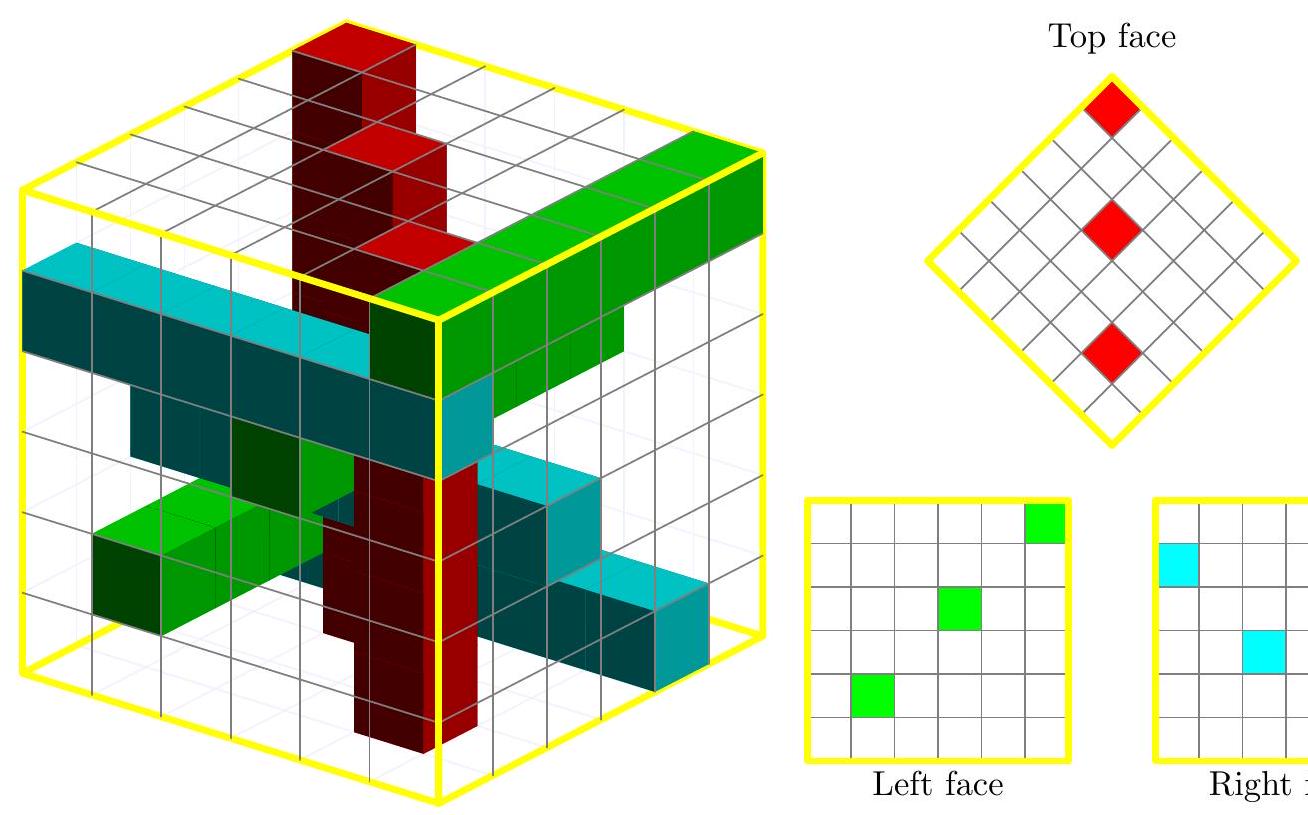
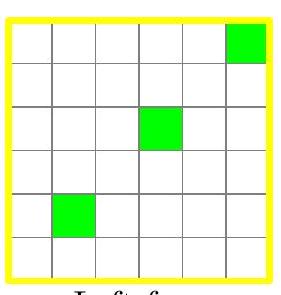
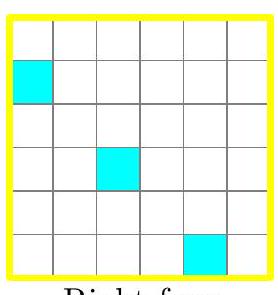
【 Construction. We first give a construction with $3 n / 2$ beams for any $n \times n \times n$ box, where $n$ is an even integer. Shown below is the construction for $n=6$, which generalizes. (The left figure shows the cube in 3 d ; the right figure shows a direct view of the three visible faces.)
Left face
Right face
To be explicit, impose coordinate axes such that one corner of the cube is the origin. We specify a beam by two opposite corners. The $3 n / 2$ beams come in three directions, $n / 2$ in each direction:
- $(0,0,0) \rightarrow(1,1, n),(2,2,0) \rightarrow(3,3, n),(4,4,0) \rightarrow(5,5, n)$, and so on;
- $(1,0,0) \rightarrow(2, n, 1),(3,0,2) \rightarrow(4, n, 3),(5,0,4) \rightarrow(6, n, 5)$, and so on;
- $(0,1,1) \rightarrow(n, 2,2),(0,3,3) \rightarrow(n, 4,4),(0,5,5) \rightarrow(n, 6,6)$, and so on.
This gives the figure we drew earlier and shows 3030 beams is possible.
Necessity. We now show at least $3 n / 2$ beams are necessary. Maintain coordinates, and call the beams $x$-beams, $y$-beams, $z$-beams according to which plane their long edges are perpendicular too. Let $N_{x}, N_{y}, N_{z}$ be the number of these.
Claim - If $\min \left(N_{x}, N_{y}, N_{z}\right)=0$, then at least $n^{2}$ beams are needed.
Proof. Assume WLOG that $N_{z}=0$. Orient the cube so the $z$-plane touches the ground. Then each of the $n$ layers of the cube (from top to bottom) must be completely filled, and so at least $n^{2}$ beams are necessary,
We henceforth assume $\min \left(N_{x}, N_{y}, N_{z}\right)>0$. Claim - If $N_{z}>0$, then we have $N_{x}+N_{y} \geq n$.
Proof. Again orient the cube so the z-plane touches the ground. We see that for each of the $n$ layers of the cube (from top to bottom), there is at least one $x$-beam or $y$-beam. (Pictorially, some of the $x$ and $y$ beams form a "staircase".) This completes the proof.
Proceeding in a similar fashion, we arrive at the three relations
Summing gives $N_{x}+N_{y}+N_{z} \geq 3 n / 2$ too. Remark. The problem condition has the following "physics" interpretation. Imagine the cube is a metal box which is sturdy enough that all beams must remain orthogonal to the faces of the box (i.e. the beams cannot spin). Then the condition of the problem is exactly what is needed so that, if the box is shaken or rotated, the beams will not move.
Remark. Walter Stromquist points out that the number of constructions with 3030 beams is actually enormous: not dividing out by isometries, the number is $(2 \cdot 1010!)^{3}$.
§1.3 USAMO 2020/3, proposed by Richard Stong, Toni Bluher
Available online at https://aops.com/community/p15952782.
Problem statement
Let $p$ be an odd prime. An integer $x$ is called a quadratic non-residue if $p$ does not divide $x-t^{2}$ for any integer $t$.
Denote by $A$ the set of all integers $a$ such that $1 \leq a<p$, and both $a$ and $4-a$ are quadratic non-residues. Calculate the remainder when the product of the elements of $A$ is divided by $p$.
The answer is that $\prod_{a \in A} a \equiv 2(\bmod p)$ regardless of the value of $p$. In the following solution, we work in $\mathbb{F}_{p}$ always and abbreviate "quadratic residue" and "non-quadratic residue" to "QR" and "non-QR", respectively.
We define
Notice that
We now present two approaches both based on the set $B$. 【 First approach (based on Holden Mui's presentation in Mathematics Magazine). The idea behind this approach is that $n(4-n)$ is itself an element of $B$ for $n \in A \cup B$, because $4-n(4-n)=(n-2)^{2}$. This motivates the following claim.
Claim - The map
is a well-defined two-to-one map, i.e. every $b \in B$ has exactly two pre-images. Proof. Since $n \notin{0,2,4}$, we have $n(4-n) \notin{0,4}$, so as discussed previously, $n(4-n) \in$ $B$. Thus this map is well-defined.
Choose $b \in B$. The quadratic equation $n(4-n)=b$ in $n$ rewrites as $n^{2}-4 n+b=0$, and has discriminant $4(4-b)$, which is a nonzero QR. Hence there are exactly two values of $n$, as desired.
Therefore, it follows that
by pairing $n$ with $4-n$ on the left-hand side. So, $\prod_{a \in A} a=2$. 『 Second calculation approach (along the lines of official solution). We now do the following magical calculation in $\mathbb{F}_{p}$ :
Note $z(4-z)$ is a nonzero QR if and only if $z \in A \cup B$. So the right-hand side is almost the product over $z \in A \cup B$, except it is missing the $z=2$ term. Adding it in gives
This gives $\prod_{a \in A} a=2$ as desired.
§2 Solutions to Day 2
§2.1 USAMO 2020/4, proposed by Ankan Bhattacharya
Available online at https://aops.com/community/p15952792.
Problem statement
Suppose that $\left(a_{1}, b_{1}\right),\left(a_{2}, b_{2}\right), \ldots,\left(a_{100}, b_{100}\right)$ are distinct ordered pairs of nonnegative integers. Let $N$ denote the number of pairs of integers $(i, j)$ satisfying $1 \leq i<j \leq 100$ and $\left|a_{i} b_{j}-a_{j} b_{i}\right|=1$. Determine the largest possible value of $N$ over all possible choices of the 100 ordered pairs.
The answer is 197. In general, if 100 is replaced by $n \geq 2$ the answer is $2 n-3$. The idea is that if we let $P_{i}=\left(a_{i}, b_{i}\right)$ be a point in the coordinate plane, and let $O=(0,0)$ then we wish to maximize the number of triangles $\triangle O P_{i} P_{j}$ which have area $1 / 2$. Call such a triangle good. \ Construction of 197 points. It suffices to use the points $(1,0),(1,1),(2,1),(3,1)$, $\ldots,(99,1)$ as shown. Notice that:
- There are 98 good triangles with vertices $(0,0),(k, 1)$ and $(k+1,1)$ for $k=1, \ldots, 98$.
- There are 99 good triangles with vertices $(0,0),(1,0)$ and $(k, 1)$ for $k=1, \ldots, 99$. This is a total of $98+99=197$ triangles.

I Proof that 197 points is optimal. We proceed by induction on $n$ to show the bound of $2 n-3$. The base case $n=2$ is evident.
For the inductive step, suppose (without loss of generality) that the point $P=P_{n}=$ $(a, b)$ is the farthest away from the point $O$ among all points.
Claim - This farthest point $P=P_{n}$ is part of at most two good triangles.
Proof. We must have $\operatorname{gcd}(a, b)=1$ for $P$ to be in any good triangles at all, since otherwise any divisor of $\operatorname{gcd}(a, b)$ also divides $2[O P Q]$. Now, we consider the locus of all points $Q$ for which $[O P Q]=1 / 2$. It consists of two parallel lines passing with slope $O P$, as shown.

Since $\operatorname{gcd}(a, b)=1$, see that only two lattice points on this locus actually lie inside the quarter-circle centered at $O$ with radius $O P$. Indeed if one of the points is $(u, v)$ then the others on the line are $(u \pm a, v \pm b)$ where the signs match. This proves the claim.
This claim allows us to complete the induction by simply deleting $P_{n}$.
§2.2 USAMO 2020/5, proposed by Carl Schildkraut
Available online at https://aops.com/community/p15952824.
Problem statement
A finite set $S$ of points in the coordinate plane is called overdetermined if $|S| \geq 2$ and there exists a nonzero polynomial $P(t)$, with real coefficients and of degree at most $|S|-2$, satisfying $P(x)=y$ for every point $(x, y) \in S$.
For each integer $n \geq 2$, find the largest integer $k$ (in terms of $n$ ) such that there exists a set of $n$ distinct points that is not overdetermined, but has $k$ overdetermined subsets.
We claim the answer is $k=2^{n-1}-n$. We denote the $n$ points by $A$. Throughout the solution we will repeatedly use the following fact:
Lemma
If $S$ is a finite set of points in the plane there is at most one polynomial with real coefficients and of degree at most $|S|-1$ whose graph passes through all points of $S$.
Proof. If any two of the points have the same $x$-coordinate then obviously no such polynomial may exist at all.
Otherwise, suppose $f$ and $g$ are two such polynomials. Then $f-g$ has degree at most $|S|-1$, but it has $|S|$ roots, so is the zero polynomial.
Remark. Actually Lagrange interpolation implies that such a polynomial exists as long as all the $x$-coordinates are different!
Construction: Consider the set $A={(1, a),(2, b),(3, b),(4, b), \ldots,(n, b)}$, where $a$ and $b$ are two distinct nonzero real numbers. Any subset of the latter $n-1$ points with at least one element is overdetermined, and there are $2^{n-1}-n$ such sets.
Bound: Say a subset $S$ of $A$ is flooded if it is not overdetermined. For brevity, an $m$-set refers simply to a subset of $A$ with $m$ elements.
Claim - If $S$ is an flooded $m$-set for $m \geq 3$, then at most one ( $m-1$ )-subset of $S$ is not flooded.
Proof. Let $S=\left{p_{1}, \ldots, p_{m}\right}$ be flooded. Assume for contradiction that $S-\left{p_{i}\right}$ and $S-\left{p_{j}\right}$ are both overdetermined. Then we can find polynomials $f$ and $g$ of degree at most $m-3$ passing through $S-\left{p_{i}\right}$ and $S-\left{p_{j}\right}$, respectively.
Since $f$ and $g$ agree on $S-\left{p_{i}, p_{j}\right}$, which has $m-2$ elements, by the lemma we have $f=g$. Thus this common polynomial (actually of degree at most $m-3$ ) witnesses that $S$ is overdetermined, which is a contradiction.
Claim - For all $m=2,3, \ldots, n$ there are at least $\binom{n-1}{m-1}$ flooded $m$-sets of $A$.
Proof. The proof is by downwards induction on $m$. The base case $m=n$ is by assumption. For the inductive step, suppose it's true for $m$. Each of the $\binom{n-1}{m-1}$ flooded $m$-sets has at least $m-1$ flooded $(m-1)$-subsets. Meanwhile, each $(m-1)$-set has exactly $n-(m-1)$ parent $m$-sets. We conclude the number of flooded sets of size $m-1$ is at least
as desired. This final claim completes the proof, since it shows there are at most
overdetermined sets, as desired. Remark (On repeated $x$-coordinates). Suppose $A$ has two points $p$ and $q$ with repeated $x$ coordinates. We can argue directly that $A$ satisfies the bound. Indeed, any overdetermined set contains at most one of $p$ and $q$. Moreover, given $S \subseteq A-{p, q}$, if $S \cup{p}$ is overdetermined then $S \cup{q}$ is not, and vice-versa. (Recall that overdetermined sets always have distinct $x$-coordinates.) This gives a bound $\left[2^{n-2}-(n-2)-1\right]+\left[2^{n-2}-1\right]=2^{n-1}-n$ already.
Remark (Alex Zhai). An alternative approach to the double-counting argument is to show that any overdetermined $m$-set has an flooded $m$-superset. Together with the first claim, this lets us pair overdetermined sets in a way that implies the bound.
§2.3 USAMO 2020/6, proposed by David Speyer, Kiran Kedlaya
Available online at https://aops.com/community/p15953303.
Problem statement
Let $n \geq 2$ be an integer. Let $x_{1} \geq x_{2} \geq \cdots \geq x_{n}$ and $y_{1} \geq y_{2} \geq \cdots \geq y_{n}$ be $2 n$ real numbers such that
Prove that
We present two approaches. In both approaches, it's helpful motivation that for even $n$, equality occurs at
【 First approach (expected value). For a permutation $\sigma$ on ${1,2, \ldots, n}$ we define
Claim - For random permutations $\sigma, \mathbb{E}\left[S_{\sigma}\right]=0$ and $\mathbb{E}\left[S_{\sigma}^{2}\right]=\frac{1}{n-1}$. Proof. The first one is clear. Since $\sum_{i<j} 2 x_{i} x_{j}=-1$, it follows that (for fixed $i$ and $j$ ), $\mathbb{E}\left[y_{\sigma(i)} y_{\sigma(j)}\right]=-\frac{1}{n(n-1)}$, Thus
the conclusion follows.
Claim (A random variable in $[0,1]$ has variance at most $1 / 4)$ - If $A$ is a random variable with mean $\mu$ taking values in the closed interval $[m, M]$ then
Proof. By shifting and scaling, we may assume $m=0$ and $M=1$, so $A \in[0,1]$ and hence $A^{2} \leq A$. Then
This concludes the proof. Thus the previous two claims together give
But $\sum_{i} x_{i} y_{i}=\max {\sigma} S{\sigma}$ and $\sum_{i} x_{i} y_{n+1-i}=\min {\sigma} S{\sigma}$ by rearrangement inequality and therefore we are done. \T Outline of second approach (by convexity, due to Alex Zhai). We will instead prove a converse result: given the hypotheses
- $x_{1} \geq \cdots \geq x_{n}$
- $y_{1} \geq \cdots \geq y_{n}$
- $\sum_{i} x_{i}=\sum_{i} y_{i}=0$
- $\sum_{i} x_{i} y_{i}-\sum_{i} x_{i} y_{n+1-i}=\frac{2}{\sqrt{n-1}}$ we will prove that $\sum x_{i}^{2} \sum y_{i}^{2} \leq 1$. Fix the choice of $y$ 's. We see that we are trying to maximize a convex function in $n$ variables $\left(x_{1}, \ldots, x_{n}\right)$ over a convex domain (actually the intersection of two planes with several half planes). So a maximum can only happen at the boundaries: when at most two of the $x$ 's are different.
An analogous argument applies to $y$. In this way we find that it suffices to consider situations where $x_{\bullet}$ takes on at most two different values. The same argument applies to $y$.
At this point the problem can be checked directly.