

GUI Odyssey: A Comprehensive Dataset for Cross-App GUI Navigation on Mobile Devices
Paper • 2406.08451 • Published • 26
Error code:   StreamingRowsError
Exception:    TypeError
Message:      Couldn't cast array of type
struct<click: int64, long_press: int64, swipe: int64, type: int64>
to
{'click': Value('int64'), 'swipe': Value('int64'), 'system_button': Value('int64'), 'type': Value('int64')}
Traceback:    Traceback (most recent call last):
                File "/src/services/worker/src/worker/utils.py", line 149, in get_rows_or_raise
                  return get_rows(
                      dataset=dataset,
                  ...<4 lines>...
                      column_names=column_names,
                  )
                File "/src/libs/libcommon/src/libcommon/utils.py", line 272, in decorator
                  return func(*args, **kwargs)
                File "/src/services/worker/src/worker/utils.py", line 129, in get_rows
                  rows_plus_one = list(itertools.islice(safe_iter(ds, dataset=dataset), rows_max_number + 1))
                File "/src/services/worker/src/worker/utils.py", line 489, in safe_iter
                  yield from ds.decode(False) if ds.features else ds
                File "/usr/local/lib/python3.14/site-packages/datasets/iterable_dataset.py", line 2818, in __iter__
                  for key, example in ex_iterable:
                                      ^^^^^^^^^^^
                File "/usr/local/lib/python3.14/site-packages/datasets/iterable_dataset.py", line 2355, in __iter__
                  for key, pa_table in self._iter_arrow():
                                       ~~~~~~~~~~~~~~~~^^
                File "/usr/local/lib/python3.14/site-packages/datasets/iterable_dataset.py", line 2380, in _iter_arrow
                  for key, pa_table in self.ex_iterable._iter_arrow():
                                       ~~~~~~~~~~~~~~~~~~~~~~~~~~~~^^
                File "/usr/local/lib/python3.14/site-packages/datasets/iterable_dataset.py", line 536, in _iter_arrow
                  for key, pa_table in iterator:
                                       ^^^^^^^^
                File "/usr/local/lib/python3.14/site-packages/datasets/iterable_dataset.py", line 419, in _iter_arrow
                  for key, pa_table in self.generate_tables_fn(**gen_kwags):
                                       ~~~~~~~~~~~~~~~~~~~~~~~^^^^^^^^^^^^^
                File "/usr/local/lib/python3.14/site-packages/datasets/packaged_modules/json/json.py", line 343, in _generate_tables
                  self._cast_table(pa_table, json_field_paths=json_field_paths),
                  ~~~~~~~~~~~~~~~~^^^^^^^^^^^^^^^^^^^^^^^^^^^^^^^^^^^^^^^^^^^^^
                File "/usr/local/lib/python3.14/site-packages/datasets/packaged_modules/json/json.py", line 132, in _cast_table
                  pa_table = table_cast(pa_table, self.info.features.arrow_schema)
                File "/usr/local/lib/python3.14/site-packages/datasets/table.py", line 2369, in table_cast
                  return cast_table_to_schema(table, schema)
                File "/usr/local/lib/python3.14/site-packages/datasets/table.py", line 2303, in cast_table_to_schema
                  cast_array_to_feature(
                  ~~~~~~~~~~~~~~~~~~~~~^
                      table[name] if name in table_column_names else pa.array([None] * len(table), type=schema.field(name).type),
                      ^^^^^^^^^^^^^^^^^^^^^^^^^^^^^^^^^^^^^^^^^^^^^^^^^^^^^^^^^^^^^^^^^^^^^^^^^^^^^^^^^^^^^^^^^^^^^^^^^^^^^^^^^^^
                      feature,
                      ^^^^^^^^
                  )
                  ^
                File "/usr/local/lib/python3.14/site-packages/datasets/table.py", line 1852, in wrapper
                  return pa.chunked_array([func(chunk, *args, **kwargs) for chunk in array.chunks])
                                           ~~~~^^^^^^^^^^^^^^^^^^^^^^^^
                File "/usr/local/lib/python3.14/site-packages/datasets/table.py", line 2149, in cast_array_to_feature
                  raise TypeError(f"Couldn't cast array of type\n{_short_str(array.type)}\nto\n{_short_str(feature)}")
              TypeError: Couldn't cast array of type
              struct<click: int64, long_press: int64, swipe: int64, type: int64>
              to
              {'click': Value('int64'), 'swipe': Value('int64'), 'system_button': Value('int64'), 'type': Value('int64')}
Need help to make the dataset viewer work? Make sure to review how to configure the dataset viewer, and open a discussion for direct support.
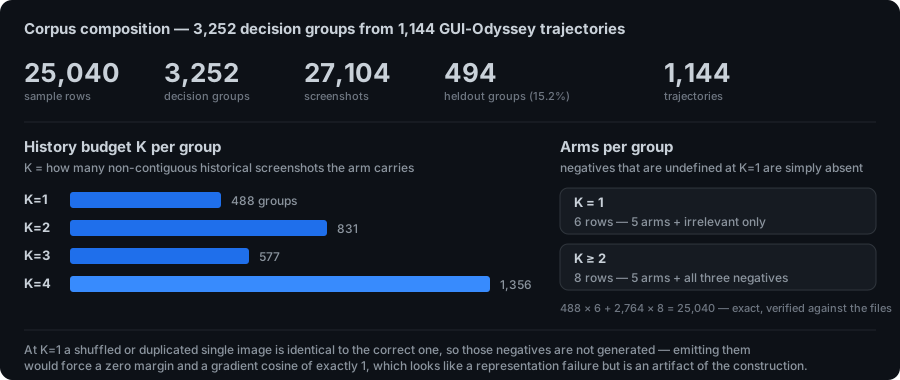
A controlled corpus for testing whether a GUI agent actually reads its visual history — or merely benefits from history being present.
Mobile GUI agents normally see a sliding window of the most recent screenshots. That is a poor fit for long-horizon tasks, where the screen you need to remember may be twenty steps back. This corpus lets you train and, more importantly, falsify adapters that claim to read a sparse, non-contiguous selection of historical screenshots.
The policy stays frozen throughout. Every row in a group shares one target action, so the objective is purely about relative teacher-forced log-probability between conditions — cross-entropy weight is zero.
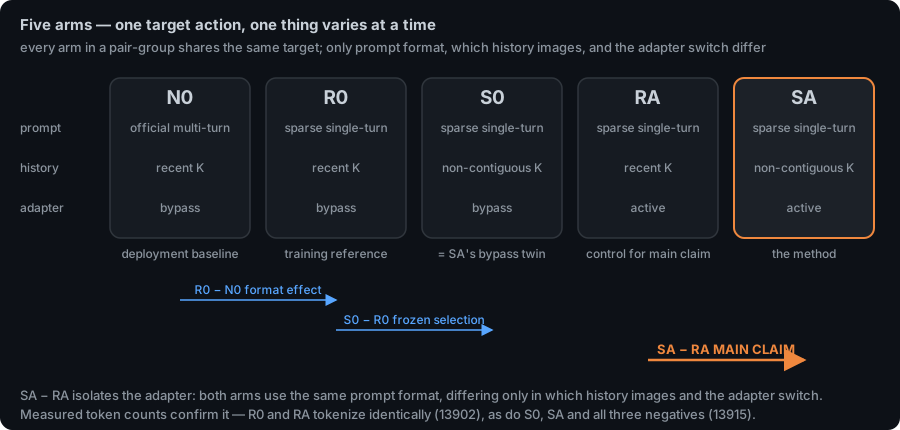
The trap in this kind of work is measuring a format effect or a history-presence effect and reporting it as a content effect. So each comparison changes exactly one thing:
| quantity | comparison | what it isolates |
|---|---|---|
format_effect |
R0 − N0 |
official multi-turn vs single-turn prompt |
frozen_selection_effect |
S0 − R0 |
sparse selection, with no adapter at all |
adapter_on_recent |
RA − R0 |
adapter's effect on a recent window |
adapter_on_sparse |
SA − S0 |
adapter's effect on a sparse window |
main_claim |
SA − RA |
the adapter's contribution, prompt held fixed |
deployment_delta |
SA − N0 |
end-to-end vs the deployed baseline |
Two properties make this checkable rather than merely asserted:
S0 is exactly SA's bypass twin — same messages, same images, only adapter_mode differs. So adapter_on_sparse needs no extra forward pass, and a zero-init adapter must reproduce SA − RA == frozen_selection_effect. That identity is a built-in correctness assertion for any scorer you write.R0 and RA tokenize to identical lengths, as do S0, SA and all three negatives. SA − RA therefore cannot be a prompt-length artifact.Three corrupted-history variants, all sparse + adapter-active, let you ask whether the model distinguishes correct history from plausible but wrong history:
| negative | corruption |
|---|---|
SA_neg_step_shuffled |
same images, cyclically shifted so every position is mismatched |
SA_neg_irrelevant |
images from a different episode in the same split, matched position-by-position on the age vector and preferring the same resolution |
SA_neg_duplicate |
one history image repeated K times |
A cyclic shift is used rather than a reversal because reversing an odd-length sequence leaves the middle image correctly paired.
import gzip, json, tarfile
from huggingface_hub import snapshot_download

root = snapshot_download(
    "gavinlaw/causalcache-sparse-history-guiodyssey-v5", repo_type="dataset"
)

with gzip.open(f"{root}/samples.jsonl.gz", "rt", encoding="utf-8") as fh:
    rows = [json.loads(line) for line in fh]

# images live in per-shard tars; each row's paths are relative to the shard root
with tarfile.open(f"{root}/shards/images-part00.tar") as tf:
    tf.extractall("part00/")

group = {}
for r in rows:
    if r["pair_group"] == rows[0]["pair_group"]:
        group[r["arm_slot"]] = r

assert group["SA"]["target_text"] == group["RA"]["target_text"]   # one target per group
assert group["S0"]["adapter_mode"] == "bypass"                    # SA's bypass twin
assert group["SA"]["selected_images"] == group["S0"]["selected_images"]
| field | meaning |
|---|---|
pair_group |
"{episode}:{decision_step}" — the unit of comparison |
arm_slot |
N0/R0/S0/RA/SA/SA_neg_* — the primary key within a group |
adapter_mode |
"bypass" or "active" — the sole authority on the adapter switch |
role |
deployment_baseline / reference / measurement / positive / negative |
budget |
K, the number of history images |
selected_steps |
1-based, strictly increasing, all < decision_step |
selected_images, current_image |
paths relative to the shard root |
target_text |
byte-identical across every arm in the group |
split |
train / heldout — read this field; do not recompute a hash |
negative_kind, negative_scale |
present only on negatives |
Read
adapter_mode; never infer it from a name. Consumers that pattern-match onarm_slotprefixes will silently break the moment an arm is renamed — that exact bug is why the field exists.
Everything is pinned. This corpus was rebuilt on a second machine from these public sources alone and produced a byte-identical result — the sorted samples.jsonl sha256 matched exactly, on both machines:
4f6f7065f2053ff0501a2767e98a3656046106c4042b0cc9cf97e9e1c494e063
| repo | revision | |
|---|---|---|
| trajectories | cua-lite/GUIOdyssey |
ea08072b30e523fb4492e4f4597505879ffcd63b |
| frozen policy used for scoring | mPLUG/GUI-Owl-1.5-8B-Instruct |
06d5faecff74840bab2be2425e9c42667a5d04fc |
Screenshots and action descriptions originate from GUI-Odyssey (OpenGVLab), released under CC BY 4.0; this derivative keeps the same license and attribution. Please cite GUI-Odyssey alongside this corpus.
Stated plainly, because they change how results must be analysed:
current_step=9, K=4 there are only 5 legal non-adjacent subsets, so those groups' S0/SA prompts repeat heavily and contribute almost no variance to S0 − R0 or SA − RA. This follows from the non-adjacency constraint, not from a defect — but report those strata separately.irrelevant donors are age-matched, not semantics-matched. They come from a different episode at a comparable task stage; they are not adversarially chosen to be confusable.@misc{causalcache_sparse_history_v5,
title = {CausalCache Sparse-History Corpus (GUI-Odyssey)},
author = {Luo, Jiaxuan},
year = {2026},
url = {https://huggingface.co/datasets/gavinlaw/causalcache-sparse-history-guiodyssey-v5}
}
Please also cite the upstream source:
@article{lu2024guiodyssey,
  title   = {GUIOdyssey: A Comprehensive Dataset for Cross-App GUI Navigation on Mobile Devices},
  author  = {Lu, Quanfeng and Shao, Wenqi and Liu, Zitao and Du, Lingxiao and Meng, Fanqing
             and Li, Boxuan and Chen, Botong and Huang, Siyuan and Zhang, Kaipeng and Luo, Ping},
  journal = {arXiv preprint arXiv:2406.08451},
  year    = {2024}
}