

VAE-GAN for Corridor Hazard Anomaly Detection
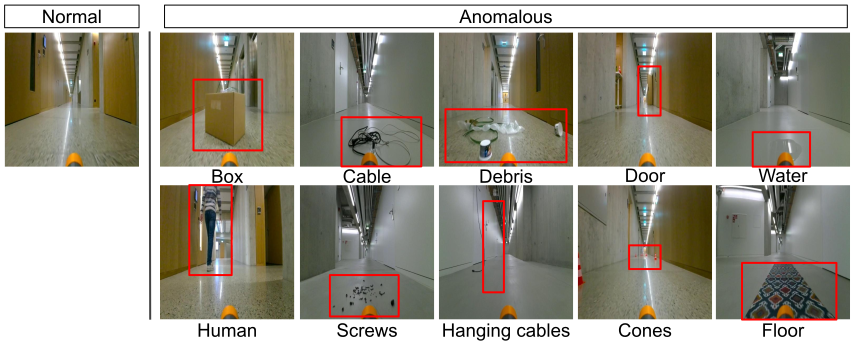
This repository contains trained VAE-GAN model checkpoints for visual anomaly detection in robotic environments. The models were trained using a one-class learning paradigm, where only normal operating conditions are observed during training and anomalous situations are detected during inference through reconstruction-based anomaly scoring.
Dataset
The models were trained on the Corridor scenario from the Hazards&Robots dataset.
Original Dataset
Hazards&Robots: A Dataset for Visual Anomaly Detection in Robotics
Authors:
- Dario Mantegazza
- Alind Xhyra
- Luca M. Gambardella
- Alessandro Giusti
- Jérôme Guzzi
Original resources:
- Zenodo: https://zenodo.org/records/7859211
- GitHub: https://github.com/idsia-robotics/hazard-detection
- IDSIA Robotics Lab: https://idsia-robotics.github.io/
Preprocessed Dataset
A preprocessed version of the Corridor dataset prepared for one-class anomaly detection experiments is available on Kaggle:
https://www.kaggle.com/datasets/rashidrao/robotics-hazards
The dataset has been reorganized into train, validation, and test splits following the standard anomaly detection protocol:
- Training set: normal samples only
- Validation set: normal samples for threshold calibration
- Test set: normal and anomalous samples
All credit for the original data belongs to the Hazards&Robots authors.
Model Architecture
The checkpoint is based on a VAE-GAN architecture consisting of:
- Encoder network
- Variational latent representation
- Decoder / Generator
- Adversarial discriminator
The model is trained to learn the distribution of normal robotic corridor scenes and identify anomalies through reconstruction discrepancies.
Source Code
The complete training and evaluation framework used to produce these checkpoints is available at:
https://github.com/rashidrao-pk/AD_MultiPointThreshold
The repository includes:
- VAE-GAN training pipeline
- Multi-point thresholding framework
- Threshold calibration utilities
- Reconstruction-based anomaly scoring
- Evaluation scripts
- Visualization tools
- Support for multiple anomaly detection baselines
- Reproducible experiments for visual anomaly detection
Users interested in retraining the models, reproducing the experiments, or extending the framework are encouraged to use the official repository.
Intended Use
This model is intended for:
- Visual anomaly detection
- One-class classification
- Explainable anomaly detection research
- Industrial safety monitoring
- Robotics safety applications
- Benchmarking anomaly detection algorithms
Citation
If you use this model, please cite both the original Hazards&Robots dataset paper and any associated publications describing this VAE-GAN implementation.
Original Dataset Citation
Mantegazza, D., Xhyra, A., Gambardella, L. M., Giusti, A., & Guzzi, J. (2023).
Hazards&Robots: A Dataset for Visual Anomaly Detection in Robotics.
Data in Brief, 49, 109264.
DOI: https://doi.org/10.1016/j.dib.2023.109264
Acknowledgements
This repository redistributes trained model weights only. The original dataset remains the intellectual property of the Hazards&Robots authors and is distributed under its original license. We gratefully acknowledge their contribution to the anomaly detection and robotics research community.