

Hand Tie Clips
Multi-hop MiniMax H3 video from one node. Write a shot plan, drop in your reference stills, queue. The pack's whole job is the join — the place where one generation ends and the next begins.

Six consecutive frames spanning the join between hop 1 and hop 2. One of these is the last frame the first generation produced and the next is the first frame of a second, separate generation. The pack exists so that you cannot tell which.
Each hop is native MiniMax H3 Reference-to-Video. Hops after the first are
guided by the previous hop's sampler AV latent through
ComfyUI-H3-Motion-Context
when it is installed; stock MiniMaxH3AddGuide is the fallback, and the console
says which one each hop took.
What it gives you
| One node, five tabs | SCRIPT, REFS, MEDIA, WRITE and SWAP on the node body. No Load Image chains, no JSON in a textarea. |
| A shot plan | One card per hop — the shot count is the hop count. Beat, duration, seed, and five directive axes compiled to vetted prose. |
| A reference register | Stable @tags for your stills, grouped per subject, each with a retention rule and its own pixel budget. Pulling one out of the middle no longer renumbers <Picture N>. |
| WRITE | A plan writer on the node. Point it at any OpenAI-compatible server, describe the scene in a sentence, and it fills the script and the reference rows — reading the pictures you already dropped in. |
| SWAP | One-hop identity swap from a reference clip. Four named modes, so what stays with the clip is stated rather than left to omission. |
| A lossless hop cache | Re-roll shot 5 of 8 and only 5–8 re-render. Resume after a crash. Hold about one hop in RAM instead of the whole film. |
| A lip-sync lock | master_audio_file — one continuous take every hop locks to, delivered as a passthrough. |
| Instruments | Dry run, contact sheet, seam report and a live preview panel, so you can find the hop that broke without scrubbing the file. |
Install
From your ComfyUI/custom_nodes/ folder:
git clone https://github.com/dntpi/ComfyUI-Hand-Tie-Clips.git
Or from the HuggingFace mirror, which is the same repository:
git clone https://huggingface.co/sandpies/ComfyUI-Hand-Tie-Clips
Cloning puts the folder at the right depth, which is the mistake the zip route
invites — one level too deep
(custom_nodes/ComfyUI-Hand-Tie-Clips/ComfyUI-Hand-Tie-Clips/) and the pack
simply will not appear. Updating later is git pull and a restart.
No dependencies to install. Everything it imports — torch, numpy,
PIL, av, aiohttp — already ships with ComfyUI, which is why
dependencies in pyproject.toml is empty.
Then restart ComfyUI (Python changed) and hard-refresh the browser
(Ctrl+Shift+R). The editor is served from
/extensions/ComfyUI-Hand-Tie-Clips/, and a stale cache is the single most
common reason the node mounts with no UI on a fresh install.
It is installed correctly when all three are true:
- the startup log carries a line beginning
[HandTieClips] - the browser console says
[HandTieClips] editor ui v2.0.0 loaded - node search shows a Hand Tie Clips category with five nodes, each once
Workflows saved before the 2026-08-29 rename keep loading — the old ids are registered as deprecated aliases. Nothing needs migrating.
Needs
- ComfyUI new enough to include Add Guide for MiniMax H3 (
MiniMaxH3AddGuide) - A ref2va (or hybrid ref2va) checkpoint — fl2va has no reference rows
- Video VAE + audio VAE + MiniMax text encoder
- Recommended: ComfyUI-H3-Motion-Context
for the latent join. Without it the node falls back to
MiniMaxH3AddGuide, which still works and still chains — it is a different join, so a seam you are comparing against someone else's render may not be the same code path.
The two shipped workflows wire the turbo stack this node is actually run with, because an example without it is not the graph anyone uses:
UNETLoader -> LoRA Loader Stack -> H3 AdaLN LoRA Fix -> MiniMax H3 Low VRAM
           -> H3 SLA Attention -> Model Preview Override -> Hand Tie Clips
| pack | nodes |
|---|---|
| ComfyUI-PlagueKind-Nodes | LoRA Loader Stack, H3 AdaLN LoRA Fix, H3 SLA Attention |
| ComfyUI-KJNodes | MiniMax H3 Low VRAM Attention (experimental), Model Preview Override |
CLIP reaches the node from the LoRA loader, not from the encoder — that is what makes the text half of every LoRA land. Do not rewire it back.
None of it is required by the node itself. Missing a pack, its nodes load as
red boxes: delete them, wire the loader straight into model and the encoder
into clip, and raise steps from 7 to around 20.
Both shipped workflows are saved pointing at the exact quantised files they were rendered with. These are not the only builds that work — any ref2va or hybrid ref2va set will do. Repoint the loaders at what you have; a loader showing an empty or red filename is naming a file you do not have, not a broken workflow.
The exact files the examples name
| loader | file |
|---|---|
UNETLoader |
minimax_h3_hybrid_fl2va_ref2va_b30-49-int8.safetensors |
CLIPLoader |
qwen3vl_32b_minimax_h3_int8_convrot.safetensors |
VAELoader (video) |
minimax_h3_video_vae_int8_convrot.safetensors |
VAELoader (audio) |
minimax_h3_audio_vae_fp32.safetensors |
| LoRA Loader Stack | minimax_h3_ref2v_turbo_4step_v0.1_comfyui_bf16.safetensors |
tiny_vae |
taeh3.safetensors (or none) |
Start here
- Load
workflows/HandTieClips_Starter.json— two hops, no references, runs as soon as the loaders point at your files. It carries a READ ME board on its own canvas, to the left of the loaders: the laws, the directive table, the reference rules and the failure table, where you need them rather than in another file. - Point the loaders at your ref2va DiT, encoder, and both VAEs.
- In REFS, add a row per identity still and drop a picture onto its
thumbnail. Give it a
@tag; group photos of the same person under one subject number. Files land inComfyUI/input/h3_refs— there is nothing to wire. - In SCRIPT, write one card per hop. Shot 1 is the whole opening; every later card is only the new beat.
- Optional: a first frame, up to three reference clips, up to three voices, a music bed, a master audio take — all in MEDIA.
- Queue. Wire
infoto a Preview Text node to read the fully assembled prompt for every hop.
workflows/HandTieClips_Showcase.json is the six-hop version and needs three
pictures of your own. Both carry the turbo stack above.
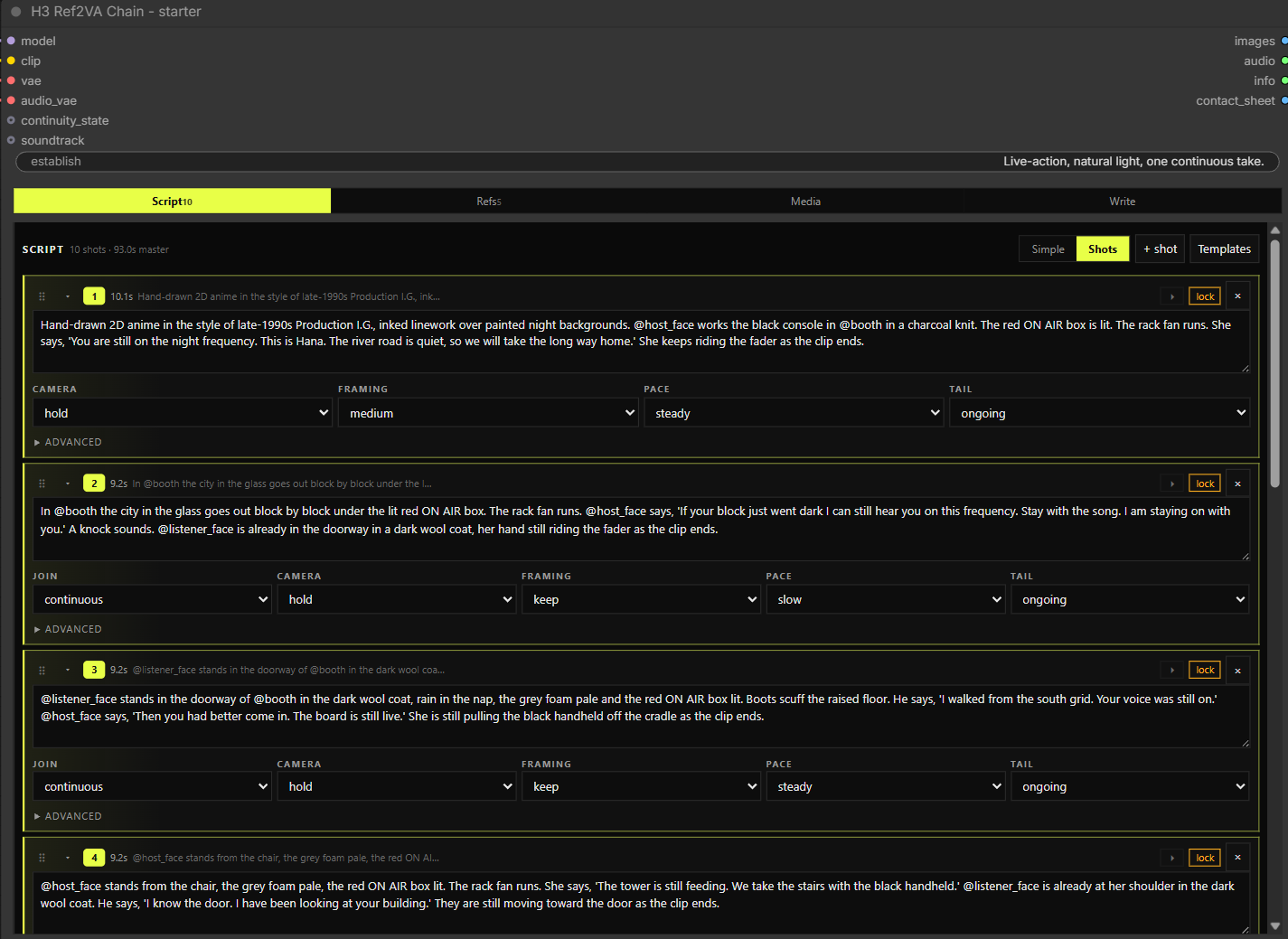
Each tab carries its count, and RUN stays pinned below them. SCRIPT is one
card per hop: the beat, its duration, and its own join, camera, framing, pace
and tail, with lock and the range button on the card header.
Under the script sits RUN, collapsed, holding everything that is not
per-shot: output size and length, sampling, the join and pin controls
(pin_mech, last_frame_guide, tone), and the hop cache. Its title line
summarises the run — 1344x768 · 10s ×3 · 14 steps res_multistep · cache off —
so you can read the setup without opening it.
Two script modes: Simple (one prompt box and a hop count, the way it always
worked) and Shots (one card per hop with directives; switching from Simple
carries your prompt over and splits it on ---). Only one is on screen at a
time, so no text box is ever quietly doing nothing.
Keep later-hop beats on what happens next. Do not re-describe the face; the photos, the register and the pin already carry it.
The one law
Sampling runs at cfg 1.0 with no negative branch, so the prompt is purely additive: anything you name is added, and nothing can be removed by mentioning it. Almost every rule in this pack is a consequence, and each of the rules below was confirmed against renders rather than reasoned from code.
Never name the thing you want to end. The cook stops talking keeps her
talking. Write the state you want as a pose plus a sound:
The cook leans back against the counter with her lips closed, and lets her eyes move slowly across the room. The kitchen is quiet apart from the hum of the refrigerator.
H3 generates audio for the whole hop no matter what, so silence has to be written as a sound. Written as an absence, you get speech. The ban is on the idea, not on a word list: fades, subsides, dies down all name an ending as surely as stops does.
Point the action line at the reference you want used. Describing a
reference in the register is not enough — the beat is what drives the frame.
Write the tag into the action: The cook stands at the counter in @kitchen, looks up…. Phrase a place as depicted, not as a container to be placed inside,
or you can get a literal composite of the photograph.
Put a state change at the end of the previous shot. Every hop after the first opens by holding the frames it was handed, and the audio pin carries the previous hop's tail across the join. If shot 2 ends mid-sentence, no wording in shot 3 will make it start quiet — arrive there before the previous shot ends.
Pick ambience that is narrowband and specific. "faint street noise through the window" is broadband and renders as a five-second hiss; "the low hum of the refrigerator" does not.
Set tail on your last shot. Left on ongoing, the model is told action is
still underway at the final frame and will invent something to satisfy it — a
stray gesture, or a stray line of dialogue in the closing second.
The full authoring guide is PROMPTING.md. Its rules come from what this model actually does, not from taste.
prompt_pack/is the same writer as a copy-paste prompt, for when you would rather work in a chat window.
Let a model write the plan
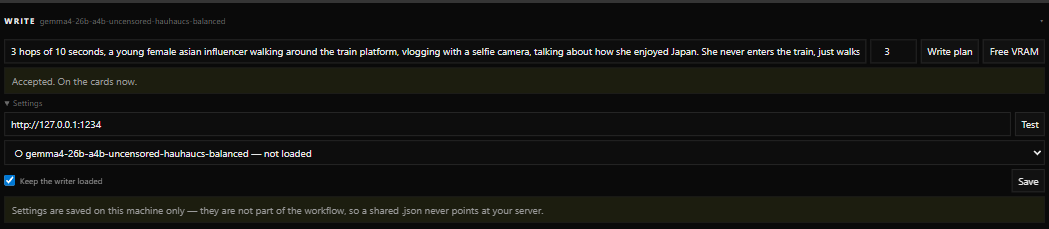
Open WRITE, point it at any OpenAI-compatible server, say what you want in one sentence, and press Write plan. It fills the SCRIPT cards and the REFERENCES rows together — and the pictures already on those rows go with the request, so the model describes what it is actually looking at rather than guessing from a filename.
- Context 32768. The system prompt alone is ~6,000 tokens, the reply another 1,000–2,000, and every reference picture costs ~260 on top.
- Reasoning off. Thinking tokens come out of the same budget; a reply that stops before the JSON closes is the tell.
- Temperature 0.3. Higher and the JSON grows trailing commas and smart quotes.
Server settings are saved on this machine only — a shared .json never points
at your server.
Treat what comes back as a strong draft, not a finished plan. It gets the
structure right — hop count, join types, which reference rides which hop, a
sound bed on every quiet hop — which is the part that is tedious by hand. Read
two things every time: each reference's desc, which can be confidently wrong
about its own photograph, and the spoken words in every beat. The node lints
both and prints what it finds before you render.
SWAP
A one-hop identity swap from a reference clip: the clip supplies the motion
and the scene, a still from your rail supplies the person. Trim the clip in
MEDIA, pick an identity, press Write, then Accept — which writes exactly
one shot and the clip's description, and never touches ref_plan. Your
register is not rewritten.
Four modes, because at cfg 1.0 a mode that merely omits the swap line does not keep the clip's person — the identity still is in front of the encoder either way and governs the subject anyway. Each mode states positively what stays:
| mode | what the photograph contributes |
|---|---|
replace_person |
Face, build, hairstyle and wardrobe. |
head_swap |
Face, hair and skin tone. The body stays with the clip: build, posture, hands and every garment. |
face_only |
Facial features only. Hair, ears, expression, build and clothes stay with the clip. |
keep_person |
Nobody is swapped; the clip is a scene and motion plate. The identity picker greys out. |
Alongside them: background (from the clip / from a picture @tag / free)
and an optional wardrobe plate — a @tag whose garment is worn, draping
on the body in frame and creasing where it bends, not pasted.
Two things to get right, both of which cost renders to find out:
- Do not run MEDIA's describe on the clip before a swap. That caption
reaches the encoder as what
<Video 1>is, and — being additive — a caption naming a person asks for the person you are about to replace. Four consecutive "head swap doesn't work" reports came down to that, a missing frame sequence and a weak citation; none of them was broken code. SWAP now warns when a caption names somebody. - Drop the clip to ~0.3 MP. A reference clip's decode area is its token count, and its token count is its influence. A full-size plate out-argues a single photograph.
Tested in public
Before 2.0 shipped, a tester ran ten controlled nine-hop chains — 65 s each, one variable per run, same model, LoRA, references, locked audio and seed — and measured them end to end with her own instruments rather than by eye. The results below are hers, used with permission.
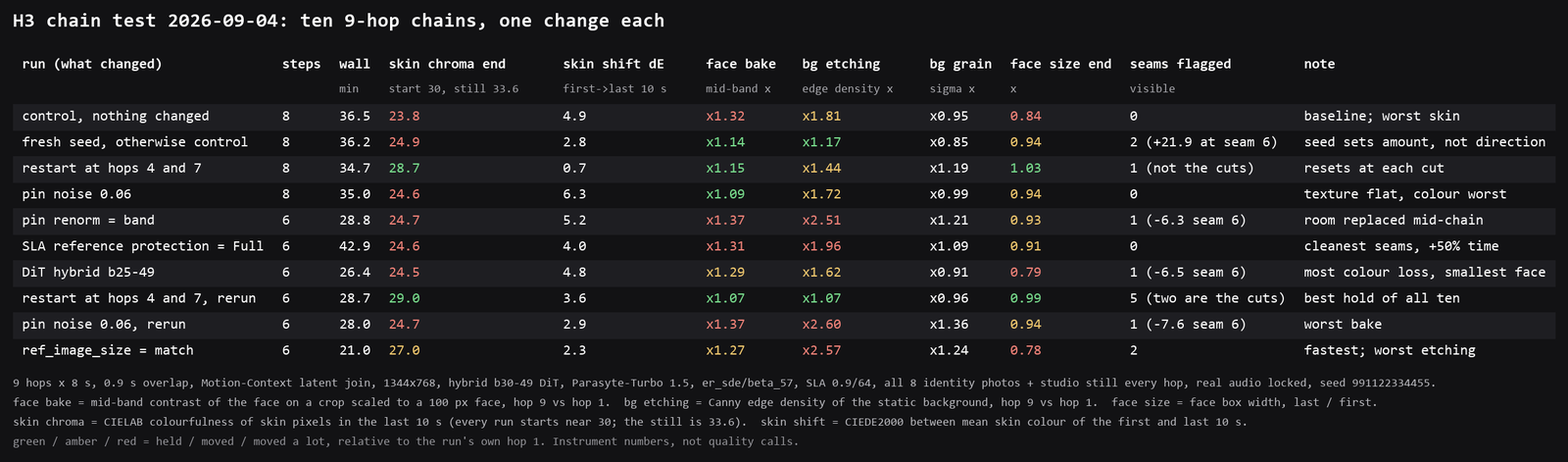
Her headline: anchor: "restart" won. It is the only run type whose last
ten seconds is still on the reference still's side of its own hop 1 — colour,
texture, background and framing all hold. The cost is that a restart is a hard
cut. Second best was a small pin_noise, one run each way. Nothing else moved
the needle — not pin_renorm=band, not reference protection, not a different
DiT, not ref_image_size=match, not a fresh seed — and the plain control was
the worst of the ten.
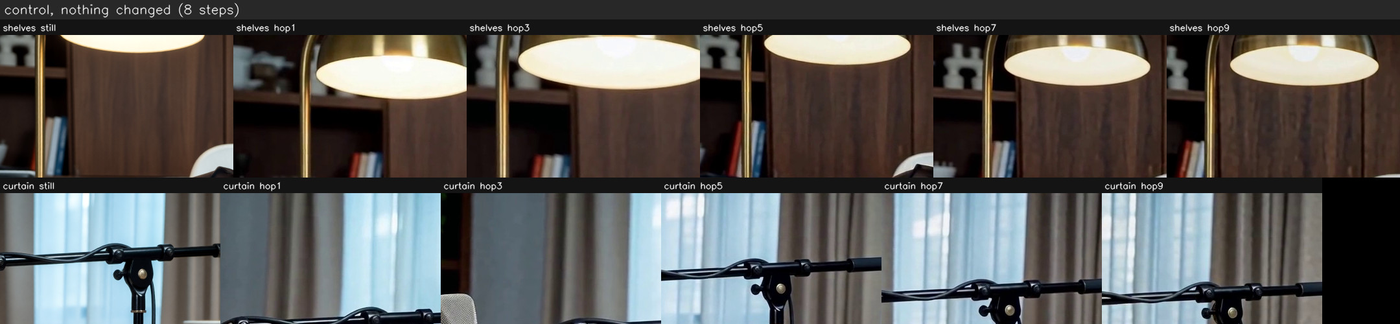
Her diagnosis is sharper than ours was: relay convergence with no content
anchor. Each hop inherits its predecessor's end state and nothing pulls it
back toward the reference. It also explains why the scale knobs did nothing —
the pin's statistics never drifted (sigma stayed within ±6% across nine hops)
while the picture lost a fifth of its chroma and doubled its background edges.
The drift is in the latent's content, not its scale, and pin_renorm and
pin_noise only rescale.
Three things in 2.0 come straight from that study:
- Restart hops write their full length. They used to drop 0.9 s of new content as though they were continuations.
last_frame_guide=before_restart, so both sides of a restart cut meet on the same photograph and it reads as a match cut rather than a jump.tone_anchor_ref=still. The anchor used to hold hop 1, on the reasoning that hop 1 is the one tone in the chain nothing has drifted into yet. Her measurements say that is false — hop 1 is the first casualty, already short of the still before any relay has happened:
| reference still | hop 1 | |
|---|---|---|
| chroma | 33.6 | 30 |
| b* (warmth) | 26.6 | 22 |
| fine detail | 1.00 | 0.72–0.99 |
A chain anchored on hop 1 converges on a target that already fell short.
What her study could not fix, this release does not claim to fix. Texture still ratchets on long chains, and 3–5 hops is still the honest limit.
Holding a chain together
The join
pin_mech chooses it. auto (default) is Motion-Context when the pack is
installed, the overlap has a matching context_length, and the previous hop
left a sampler latent; AddGuide pixels otherwise. Forcing motion_context or
addguide does not fall back — it fails with the reason, because a lever
that silently becomes the other setting cannot be compared against it.
motion_context is a latent join with no decode/re-encode; addguide
re-encodes decoded pixels, which is itself a VAE round trip. Switching
re-renders hops 2+ and leaves hop 1 on disk. A restart hop pins nothing.
Three more pin dials, all defaulting to their pre-existing behaviour
| widget | default | what it does |
|---|---|---|
audio_pin_frames |
24 |
Audio context handed to the pin, in frames; 24 is one second on the model's 40 Hz grid. Longer costs conditioning rows but no delivered frames, so it is the cheap lever on speech that breaks across a join — try 96 (4 s) for continuous dialogue. |
pin_renorm |
off |
Rescales each pinned latent back toward the first pinned hop's, against the texture ratchet — measured at +4.2% mid-band per join, flat inside each hop. Both modes are scalar rescales, so neither moves structure or can blur detail, and video and audio are corrected separately. band matches the high-band fraction, which is the statistic the ratchet actually moves: a 12.74% drift went to −0.04%. sigma is the original lever, kept for old workflows and measurably the wrong statistic — total sigma falls across a chain whose picture is baking, so it corrects the wrong way. Use band for 3+ hops. |
pin_noise |
0.0 |
Mixes seeded noise into the pin — the other half of the same fix. Small values only; measured gains reverse above 0.10, which is where the range stops. |
pin_to_qwen separately shows the incoming state to the text encoder: off,
last frame (default — the previous hop's last frame becomes <Picture 1>, and
identity stills shift to Picture 2+), pin clip (overlap frames as an extra
<Video> at ~2 fps, no soundtrack), or both. @tags in beats resolve per
hop, so stills shifting never breaks prose; a literal <Picture N> in a hop 2+
beat would.
Brightness drift — two different problems
The step at a join is the denoiser's tone bias on a fresh generation.
tone_compensate=frame_shift measures it on the overlap the hop regenerated and
cancels it, which is why the seams in a corrected chain read as invisible.
Measured on a 3-hop render: chain drift 5.6/255 without it, 0.3/255 with it.
All three modes remove the drift equally well, but gain_bias and lut pair
pixels between a frame and its regeneration, fitting a slope that is not
really there; frame_shift uses frame averages only, so it can shift but never
distort.
The slide across a whole chain is different. Each hop also darkens across its own frames, hands that darker tail to the next hop, and the next hop starts from there. Seam correction cannot see this — every individual join is exact while the film gets steadily dimmer. An 8×15 s chain slid from luma 46 to 11 across hops 2–6 with every seam already corrected.
tone_compensate=anchor is frame_shift plus a pull back toward a target,
matched in Lab — L*, a*, b* and L* spread — because chroma loss is the
largest measured drift and a per-channel RGB mean cannot restore it.
tone_anchor_ref picks the target: hop1 (default) or still, which holds
the photograph and is the only setting that ever closes the 33.6-against-30 gap
above. still needs start_image_file, and under the Motion-Context join the
correction still only reaches the delivered frames, not the next hop's pin —
pin_mech=addguide is what closes that loop.
Two things keep the pull from causing the problem it is fixing: it ramps in
across the first two seconds of each hop, so frame 0 still matches the previous
hop's last frame exactly and the seam stays as clean as frame_shift left it;
and it is capped per hop (tone_anchor, default 0.35 ≈ a third of the gap),
so a long slide is corrected over several hops instead of one hop snapping back
and pumping.
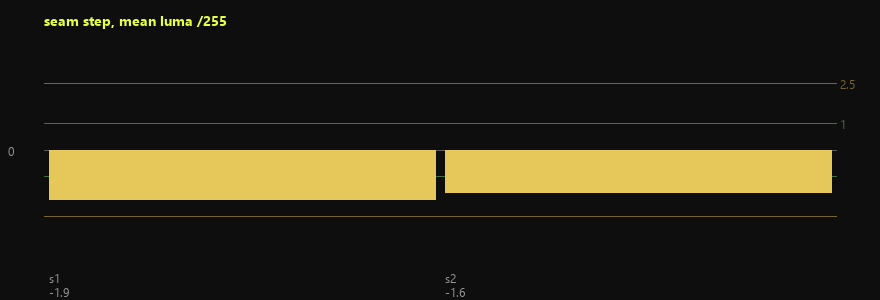
tone_anchor |
drift across the chain | worst seam |
|---|---|---|
| off | 13.5/255 | 2.1/255 |
| 0.15 | 7.4 | 1.3 |
| 0.35 | 5.1 | 1.9 |
| 0.60 | 2.9 | 2.6 |
Both columns are H3 Seam Report's own numbers, so what you measure matches
what this table says. Drift falls evenly — 45%, 62%, 78% of the uncorrected
slide. The seam does not: 0.15 pulls it tighter than the uncorrected chain
and it grows from there. Hop 1 is byte-identical in all four. 0.35 is the
default and stays — it halves the drift while every seam still reads as
marginal or better. Set tone_anchor to 0 for plain frame_shift.
A scene that is meant to get darker looks exactly like drift from the inside,
so a shot can opt out: "tone": "free" skips the pull for that hop,
"tone": "rebase" also moves the anchor onto it — which is how a scene that is
genuinely darker from here on stops being fought for the rest of the film.
Restarts, and the last-frame guide
anchor: "restart" on a shot makes that hop a chain start — the start image is
frame 0 and nothing is relayed. It is a cut, so it belongs where a cut is
motivated: a pause, a change of thought, a new beat, not on a hop interval.
Pair it with join: hard_cut or match_cut; continuous is refused. Name the
room in the beat, because a pin-less hop has nothing else telling it where it
is. Never on shot 1, and it needs a start image.
last_frame_guide plants start_image at a hop's last pixel frame
(AddGuide frame_idx=-1, not latent T-1). It does not become the next hop's
frame 0. Needs a start image. Ships off.
Reach for before_restart. It guides only a hop whose next shot is a
restart, so both sides of the cut meet on one image — hop 3 used to end tight
and smiling, hop 4 open wide and neutral; with the guide, hop 3 arrives at the
still's framing. Measured: the four hop endings of a 4-hop chain converge to
3.8/255 of each other against 39.1/255 unguided, while mid-hop frames stay as
varied as ever (65.8 against 61.1). Two people watched it in motion and could
not see the convergence.
still is the "I know what I am doing" setting. It plants the photograph on
every hop, unconditionally, which overrides an authored framing at every hop
ending — a shot set framing: close plays close for six seconds and then snaps
to the still's wider framing in about 0.6 s, and the next hop pushes back in. A
user watching this described it, unprompted, as "the camera kept cutting in and
out." Frame-by-frame from that run, hop 3, framing: close:
1.58s close 3.67s close 4.92s close 5.96s close-ish 6.58s WIDE 7.04s WIDE
Safe when no shot authors a framing; visibly wrong when they do.
Reference
Shot plan
The cards write this; you rarely see it. It is under JSON on the node if you want to copy a plan between workflows.
{
  "shots": [
    {
      "beat": "The cook stands at the counter, looks up, and speaks one short line.",
      "directives": {"camera": "hold", "framing": "medium", "pace": "steady", "tail": "ongoing"}
    },
    {
      "beat": "The cook sets the knife down and turns toward the window, still talking.",
      "directives": {"join": "continuous", "camera": "push_in", "framing": "close"}
    }
  ]
}
Shot 1 is the whole opening. Every later shot is only the new beat — the
node supplies the identity lock, the live-frame citation and the join itself.
Fields, all optional except beat:
beat |
What happens this hop. |
directives |
The five axes below. |
prose |
Free text appended verbatim, for anything the vocabulary lacks. |
seed, steps, duration |
Per-shot overrides. duration takes the widget's labels ("8 s"). |
refs |
Which register stills ride this hop, as tags. Omit for the register default; [] is none; a list is those tags only, in that order. Unknown tags fail on the queue. |
anchor |
"restart" makes this hop a chain start. See above. |
tone |
"free" skips the chain-wide tone pull once; "rebase" also moves the anchor. |
locked |
Reuse this shot's cached render even when its inputs changed. Needs cache_hops=on and a stable id. Not to be confused with subjects.N.locked, which is identity text. |
id |
Stable name, used as the cache pointer. Generated if absent. |
Hops can differ in length. duration is per shot and everything downstream
sizes itself around it. Labels are the widget's — 5 s, 7 s, 8 s, 10 s,
15 s — and that set is fixed, not arbitrary: every value has to land on H3's
frame grid (n % 17 == 5 at 24 fps), so there is no 6.5 s. Editing one shot's
length invalidates that hop and the hops after it, and nothing before it.
Short hops cut, long hops flow. Overlap is chain-wide — 0.9 s by default —
so a 5 s hop asking for join: continuous spends a fifth of itself on the
airlock, and the node prints a note saying so.
Directives
| axis | options |
|---|---|
join |
continuous, match_cut, hard_cut — ignored on shot 1, which has nothing to join to |
camera |
hold, pan_follow, push_in, pull_back, orbit, handheld |
framing |
keep, wide, medium, close |
pace |
slow, steady, brisk |
tail |
ongoing (default), settle, hold |
An unset axis emits nothing rather than asserting a default, so it costs no tokens. Everything is phrased affirmatively, for the reason in The one law.
join=continuous with a framing change and a held camera warns: with the camera
still, the only way to reach a new framing is a cut. Earn it on the move, or use
framing: keep. A camera move pointing the opposite way from the framing
(push_in with wide, pull_back with close) warns too. When continuous
and the camera is moving, the framing sentence compiles as a landing —
"The move settles into a close shot…" — so it does not fight the pin that still
holds the previous framing.
Reference register
{
  "refs": [
    {"tag": "hero_face",   "file": "cook_face.jpg",   "subject": 1, "retention": "fully_preserved"},
    {"tag": "hero_outfit", "file": "cook_apron.jpg",  "subject": 1, "retention": "partially_copy"},
    {"tag": "kitchen",     "file": "kitchen_wide.jpg", "retention": "reference", "mp": 0.3}
  ],
  "subjects": {
    "1": {"name": "the cook", "locked": "the same face, the same short dark hair"}
  }
}
file is a picture in ComfyUI/input/h3_refs, set by the rail. tag is what
you write in beats, and the node resolves it to the right <Picture N> per
hop, so pulling a still out of the middle no longer breaks every later
reference.
subject groups pictures per person. This matters: declaring every picture
as a photo of <Subject 1> makes the model render the average of two
different people.
retention says how much of a picture carries over — fully_preserved (face
and bone structure exactly), partially_copy (the garment and its cut),
reference (layout, surfaces and light, i.e. a place). Refs with a subject
default to fully_preserved; everything else defaults to reference.
mp caps one picture's pixel budget in megapixels. It is a token dial, not a
quality one: H3 turns every reference into pixel area ÷ 256 entries and
attends over all of them on every step of every hop, so a location plate costing
what a face costs is waste. A 0.3 MP place plate is ~1,170 tokens; a 2 MP
portrait is ~7,800.
The dial is inert at the default. On
ref_image_size=matchevery reference is first scaled down to the output's pixel area, andmponly ever caps further — so at 768p (~1.03 MP) the 1.5 and 2.0 settings change nothing. The real per-reference resolution control isref_image_size=maxplusmp, nevermpon its own.
Add "shots": [1, 2] to a ref to keep it out of the hops it does not belong in.
On a continuation chain, omitting shots means hop 1 only — right for a
place plate, which beats the pin if it rides a hop set somewhere else. Put
face plates on every hop: a hop with no face reference comes back a different
person and no later hop recovers. A shot's own refs overrides all of this for
that one hop.
Reference media: three clips, three voices
H3 takes 9 reference pictures, 3 reference videos and 3 standalone reference audios. Pictures go through REFS; the clips and voices are in MEDIA.
| slot | cited as | notes |
|---|---|---|
reference clip 1–3 |
<Video 1..3> |
motion/look plates the whole chain reads |
voice 1–3 |
<Audio 1..3> |
timbre references. Hop 1 only unless voice_every_hop (RUN) says otherwise |
Numbering is dense. Fill slots 1 and 3 and you get <Video 1> and
<Video 2> — there is no gap, so clearing a slot renumbers the ones after
it. Refer to media by what it is, not by its number.
Reference clips carry their own sound: each clip's audio track is decoded and handed to the model alongside its picture. A clip with no usable audio track passes silent and says so in the log.
Trim them. Every reference audio is attended on every step of every hop, and
H3 encodes the whole file, so a three-minute take is a large invisible tax on a
clip that only needed four seconds. Slots 2 and 3 share slot 1's reference video size, which is a decode budget rather than a creative setting — and, as
SWAP found the hard way, an influence dial.
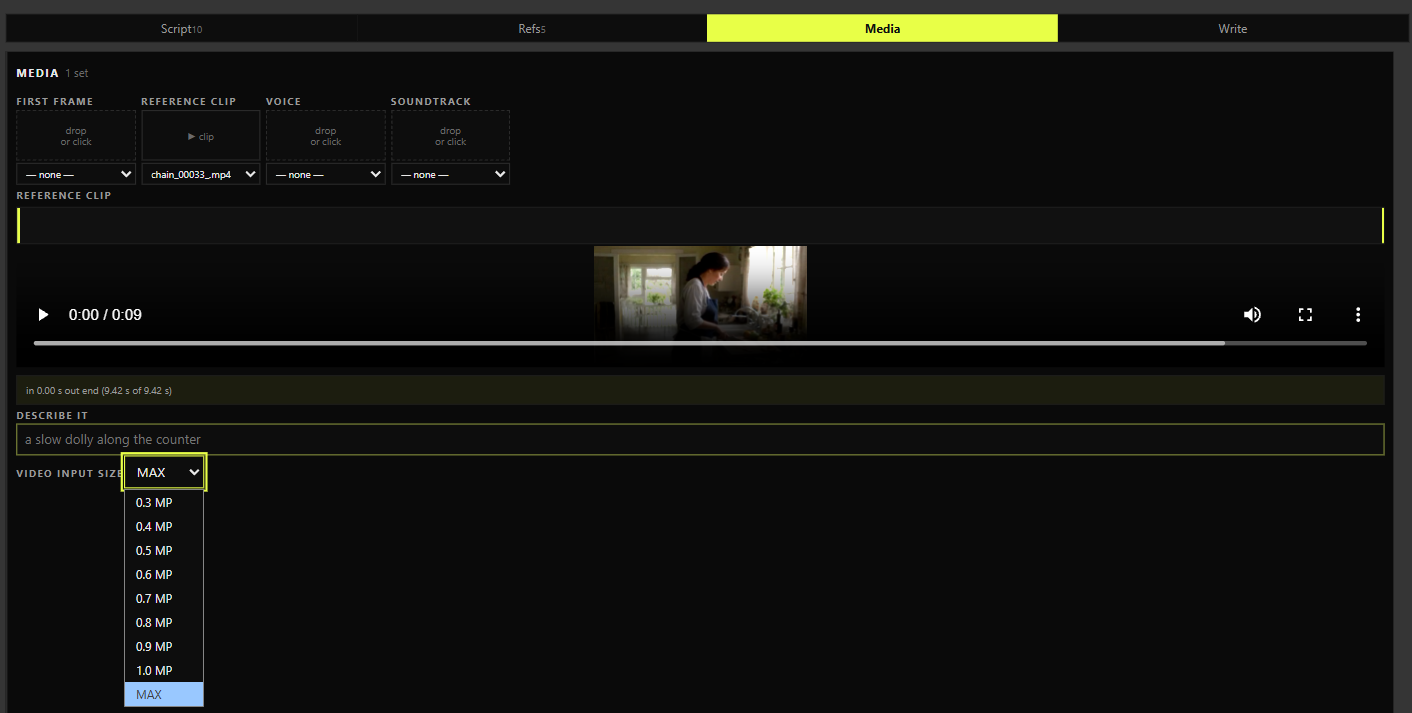
A reference clip with its in/out scrubber, the description that tells the
encoder what the clip is for, and video input size.
master_audio_file is the odd one out: one continuous take every hop lip-syncs
to, delivered as a passthrough with no VAE round trip. Empty is off and leaves
generated voice as before. The beat still needs the words in <d>[English] …</d> — the lock supplies the timing, not the script — and a take shorter than
the chain is refused on the queue rather than discovered as a mute final hop.
An end of 0 on any scrubber means to the end of the file, so a longer
replacement still plays out rather than being cropped to the old one.
Hop cache
cache_hops=on writes every rendered hop to ComfyUI's temp dir as lossless FFV1
video plus a float32 .npy waveform, evicting least-recently-used above
cache_budget_gb. The key chains — each hop's key includes the previous
hop's — because hops are causally dependent. So:
- edit shot 3 and re-queue → shots 1 and 2 load from cache, only 3 renders;
- edit shot 1 → all three re-render, which is correct, not a bug;
- change resolution, sampler, the checkpoint, a LoRA, or an attention setting → the whole chain re-renders;
- change
pin_to_qwenoroverlap→ only hops 2+ re-render, because neither can reach hop 1. A restart hop is a start, so overlap does not reach it either; - set
last_frame_guide=stillormaster_audio_file→ every hop re-renders (both reach hop 1).before_restartonly moves the hop that gets the guide; - change a reference picture → only the hops that picture rides re-render.
That last one is worth knowing about. The node cannot read the settings on your LoRA and attention nodes, so it fingerprints what they did to the model — which weight keys were patched, at what strengths, and the attention overrides — plus the base model's class, dtype and parameter count. Two remaining gaps: two different LoRAs touching exactly the same keys at exactly the same strengths, and two different builds of the same architecture at the same dtype and parameter count.
Set locked: true on a shot to pin it to its last render regardless.
Reading a plan before you render it
dry_run=on compiles every hop's prompt and stops. No model, no sampler,
seconds instead of minutes. The compiled text comes out on info, and as a
readable page on contact_sheet. This is the only way to see what the text
encoder will actually receive — the directive layer, the continuation
scaffolding, the identity lock and the <Picture N> citations are all assembled
at render time.
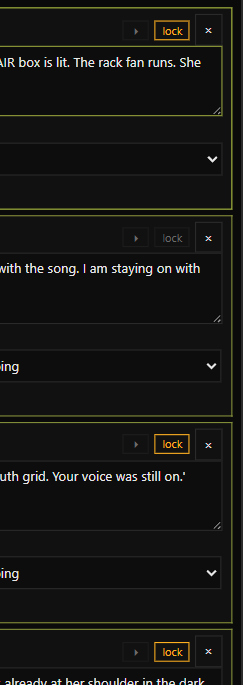
render_through=N stops after N hops; with cache_hops=on, 3 → 5 → 8 builds a
chain up in stages and only ever renders the new hops. The plan is not
truncated: shot 4 still knows it is shot 4 and keys the same way it will in the
full run.
quality=draft forces the 448p tier and 6 steps. Treat it as a fidelity
lever rather than a speed one — measured at ~42 s/hop against ~45 s/hop at 7
steps, so if you already render at 448p and 6–8 steps it saves almost nothing
and dry_run is the fast button. Draft earns its place when your final is
genuinely heavier, 768p at 14 steps.
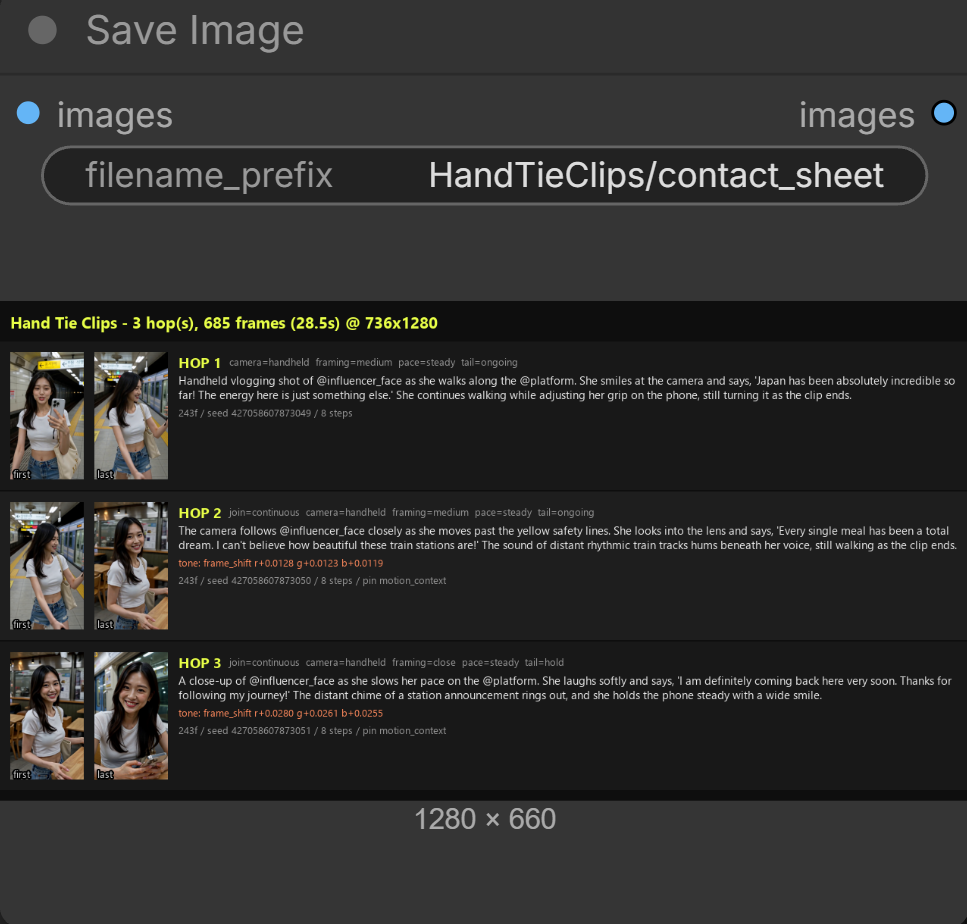
contact_sheet=on adds an image on the fourth output: one row per hop, that
hop's first and last delivered frame side by side, its beat, its directives,
and what actually happened to it. On a chain of any length this is the fastest
way to find the hop that broke.
Defaults
| resolution | 768p (1344×768 landscape) |
| duration | 10 s (243 frames) |
| overlap | 0.9 s (22 frames) |
| steps | 8, with a 4-step turbo LoRA — the regime this node targets |
| sampler / scheduler | res_multistep / beta |
| seed per hop | on |
| sigma shift | 12 / 3 |
| cache budget | 20 GB |
| tone_compensate | off (both shipped workflows set frame_shift) |
| tone_anchor | 0.35, used only by tone_compensate=anchor |
| tone_anchor_ref | hop1. still holds the photograph; needs a start image |
| pin_mech | auto |
| last_frame_guide | off. Recommended before_restart when the plan has a restart |
| master_audio_file | empty (generated voice) |
| voice_every_hop | off (voice 1–3 ride hop 1 only). Recommended speaking when one voice has to hold across the chain |
| quality | final |
Three shots at 10 s with a 0.9 s overlap is about 28 s of master.
Nodes
H3 Ref2VA Chain — images, audio, info, contact_sheet out. Wire
CreateVideo + SaveVideo as in the example workflow, info to a Preview Text
node, and contact_sheet to a Save Image.
H3 Chain Preview — a passthrough panel for the IMAGE (and optionally AUDIO)
wire, placed between the chain and CreateVideo. Images and audio come out
unchanged, so adding or removing it changes no pixels. It shows the live sample,
the seam, a chain-wide progress bar, cache hit / seed / steps per hop, which
pin mechanism each hop actually used, and end-of-run A/V drift.
H3 Tone Compensate — images out. For hand-built chains only. It cannot
fix H3 Ref2VA Chain's output: that node joins its hops internally and drops
each hop's first overlap frames at the seam, so the regenerated copies this
needs are already gone. Use the chain node's tone_compensate widget instead.
H3 Seam Report — report (STRING) + chart (IMAGE). Ships wired on the
Starter canvas. Wire the chain's info into it as well as images: with a
restart in the chain the hop lengths are no longer uniform, and the hops /
overlap widgets cannot describe that. It measures the brightness step at every
join, says whether each is invisible / marginal / visible, and totals the
chain's cumulative drift. A single reading includes whatever the scene did
across the cut, so treat one number as an upper bound.
H3 Continuity State — continuity_state (STRING) out. Setting only:
setting_locked / setting_context / setting_mutable. Characters belong in
ref_plan.
Limits
- Texture still ratchets on long chains. Stay around 3–5 hops until that is handled. Nine-hop chains have been measured; they converge.
- A workflow saved before 2026-08-28 loses its reference pictures. The old
ref_image_Nsockets carried tensors, so there is no filename to recover. The rail names each affected ref and asks you to pick its picture. - The reference
descand subjectlockedtext go to the encoder verbatim, every hop. A detail that is not in the photograph is asked for, not ignored. Describe what you actually wired. HTCContinuityStateis setting only; thecharacters_*fields were removed because filling in both injected identity text twice.- Each join hard-cuts video but crossfades audio ~40 ms, so A/V drifts ~40 ms per hop.
- A 22-frame pin clip is ~2 Qwen frames at 2 fps. It is a live-state hint, not a full previous-clip watch.
- A longer overlap does not fix continuity — it can pin whatever content happens to be in that longer tail.
- A 5 s hop drops the airlock on a continuous join; validate seams at 8 s or 15 s.
Credits
From the Sulphur Discord:
- @urlilgoddess — the ten-run degradation study this release is built on, run and measured with her own instruments, and the sample frames in Tested in public. Three of 2.0's behaviours exist because she measured that the reasoning behind the old ones was wrong.
- @frankyi — contributed the SWAP tab, which ships in 2.0 rebuilt from its own design rather than merged as-is.
- @Sean3884 — author of PromptMasterLD, which this pack has borrowed
from twice: its
song_lockshapedaudio_lock.py, and its edit laws shaped SWAP's four modes. Technique, not code — the distinctions and the discipline of stating an exclusion affirmatively, with the prose written fresh here.
Also: the tone estimator is ported from rkfg/ComfyUI-MiniMaxH3-ToneCompensate (MIT, as is this pack), and the latent join comes from ComfyUI-H3-Motion-Context. The turbo stack in the shipped workflows is PlagueKind and KJNodes.
Docs
CHANGELOG.md is what 2.0.0 contains, written for users.
PROMPTING.md is the authoring guide. Both ship with the pack.
The rest are in the repository only — the published package excludes them, so
they are not in your custom_nodes folder and these links leave for GitHub.
CLAUDE.md
is the current map of the pack if you are changing it, and
docs/DEVLOG.md
is the engineering log. docs/HANDOVER_*.md, root HANDOVER.md and
BETA_NOTES.md are historical session notes — do not take them as the state of
this release.
Changelog
Full notes in CHANGELOG.md.
2.0.0 — 2026-09-06. Full release. master_audio_file, one continuous take
every hop lip-syncs to. last_frame_guide (before_restart recommended).
anchor: "restart" as a real chain start, now writing its full length. refs
on a shot. The SWAP tab. Three reference-clip and three voice slots. A Lab
tone anchor with tone_anchor_ref=still. pin_mech. A hop cache that no longer
pickles, and an fp16 master buffer that halves the largest allocation in the
pack. New widgets were appended, so saved 1.1 graphs keep their values — but a
1.1 hop cache is fully invalidated on purpose, because the model fingerprint
now identifies the base checkpoint.
1.1.x — 2026-09-03/05. Tabbed editor with RUN pinned at the bottom.
render_from / render_through as a range. retention_analysis on every hop a
still rides, which fixes a reference pinned to any hop but the first being
rendered as the shot. Computed canvas — eleven aspect ratios on H3's 32 px
grid, so 16:9 at the top rung is 1344×768. Per-hop reference keys, so changing
one picture re-renders only the hops it rides. 1.1.1 passes every Core argument
by name, fixing got multiple values for argument 'ref_image_size' on builds
that order MiniMax H3's parameters differently.
1.0.x — 2026-09-02. First full release: the WRITE panel, the required two-document schema, the reference rail owning each picture's pixel budget, and the writer being told the hop length. Three plan lints were measured against real renders, found to be warning about correct work, and narrowed. Patch releases fixed the "no model is selected" bug on a fresh install and cleared registry-scanner findings.
0.4.x — 2026-08-30. The five new dials reached the run panel; a dry run
stopped returning a 1×1 placeholder that libx264 cannot encode. The prompt pack
learned to show a place tag on both sides of its round trip. The hop cache
stopped shelling out to ffmpeg and encodes FFV1 in process through PyAV —
same format, bit-exact, and no external command for the registry scanner to flag.
Renamed 2026-08-29 from ComfyUI-H3-Ref-Chain. The old node ids are still
registered as deprecated aliases, so every workflow saved before the rename
keeps loading. Nothing needs migrating.
- Downloads last month
- -