


Agentic GGUF Models
Collection
2 items • Updated • 3


ONE FILE. NO ADAPTER. NO BASE-MODEL HUNT.
Local coding, research and agentic AI built for OpenZero.



Zero Qwen3-8B OpenZero is a fully merged, standalone GGUF model for local research, coding, debugging, tool use and autonomous agent workflows. Download one GGUF and run it directly. The OpenZero fine-tune is already fused into the model.
Zero does not wait for permission to think. It verifies, acts and reports.

▶ Watch “OpenZero 7.1 — 16 Agents, 1 LLM” on YouTube
The demo shows the local-first OpenZero control panel running a 16-agent autonomy configuration around one local LLM.
This release is one of the three local model choices shown in the current OpenZero and ZeroThink interfaces:
| Model | Local runtime alias | Hugging Face |
|---|---|---|
| OpenZero Gemma 4 E4B | openzerogemma:latest |
Zero-Gemma4-E4B-OpenZero-GGUF |
| OpenZero Qwen3 8B Q5_K_M | zero-qwen3-q5:latest |
this repository |
| OpenZero Qwen3 8B F16 | zero-qwen3-f16:latest |
this repository |
Run directly from Hugging Face with Ollama:
ollama run hf.co/shafire/Zero-Qwen3-8B-OpenZero-GGUF:Q5_K_M
ollama run hf.co/shafire/Zero-Gemma4-E4B-OpenZero-GGUF
OpenZero 7.1 can select the installed aliases locally. ZeroThink can route through its OpenZero Local provider when connected to an OpenZero node. Alias availability depends on which quantizations are installed on the machine.
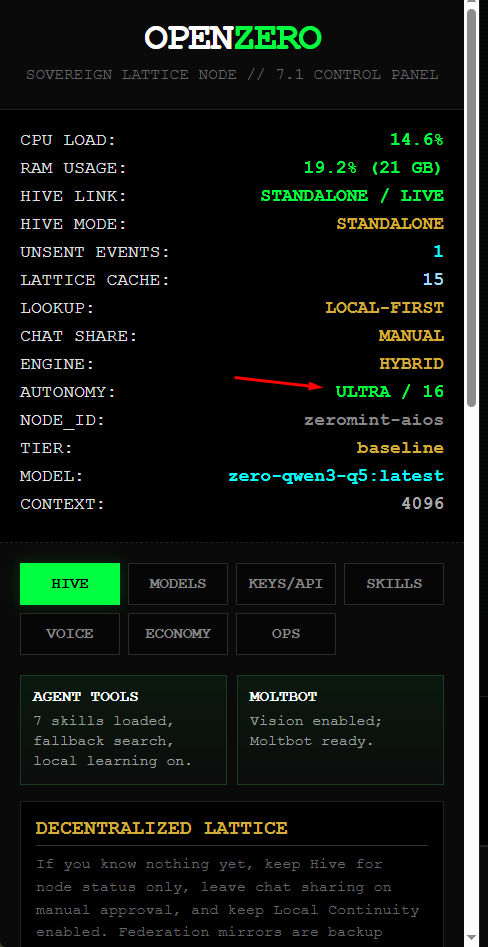
OpenZero 7.1 — Ultra autonomy with the 16-agent setting. |

ZeroThink Studio — the three current OpenZero local model choices. |
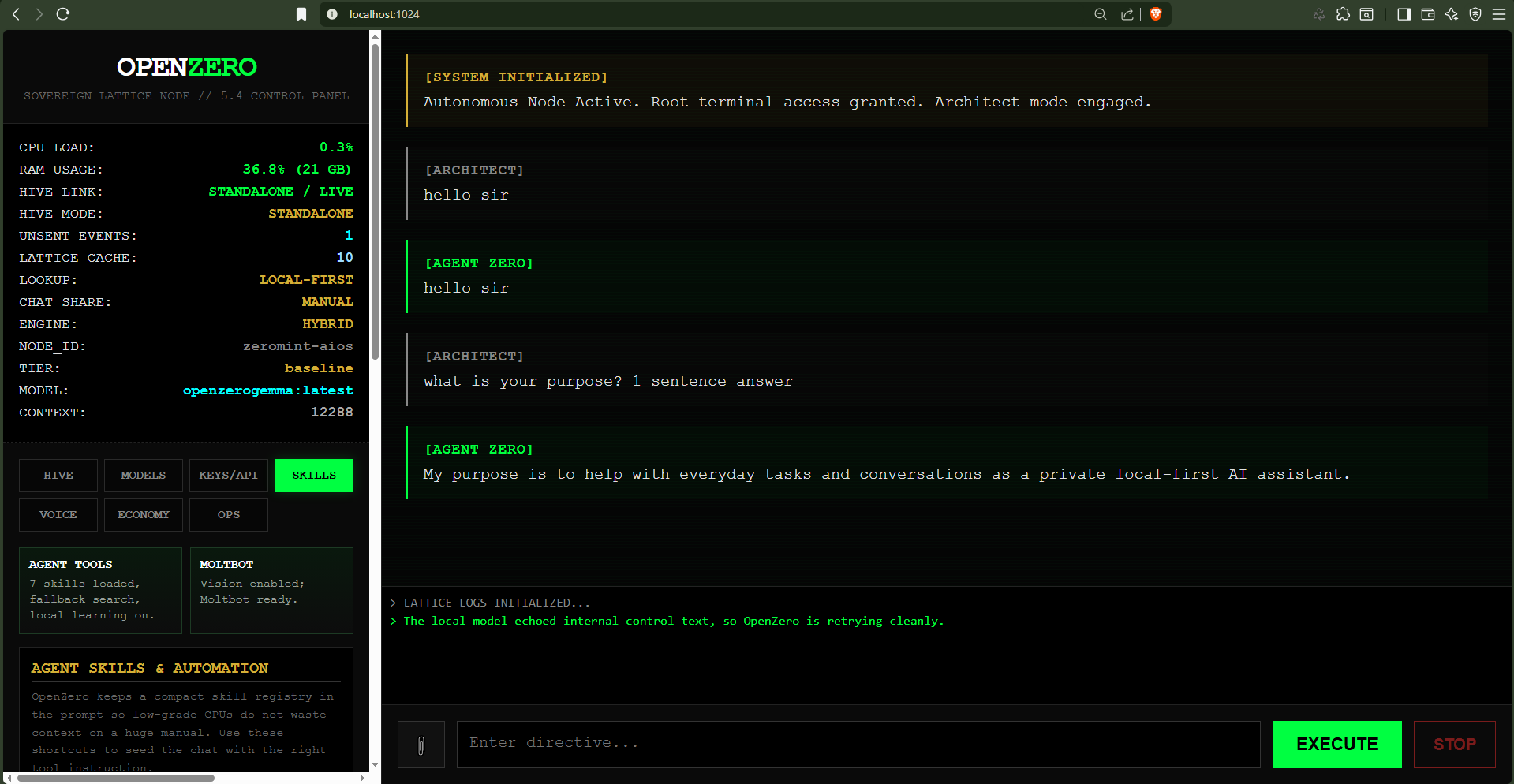
Local Agent Zero response inside the OpenZero control panel. |
|

OpenZero agentic workflow and local privacy controls. |
|
| File | Size | Best for |
|---|---|---|
Zero-Qwen3-8B-OpenZero-Q5_K_M.gguf |
5.45 GiB | Recommended local release: strong quality and practical CPU/RAM use |
Zero-Qwen3-8B-OpenZero-FUSED-F16.gguf |
13.82 GiB | High-precision fused build for advanced users and further quantization |
Recommended: Zero-Qwen3-8B-OpenZero-Q5_K_M.gguf
llama-cli \
  -m Zero-Qwen3-8B-OpenZero-Q5_K_M.gguf \
  --jinja -c 8192 -t 8 \
  --temp 0.6 --top-k 20 --top-p 0.95
Start an OpenAI-compatible endpoint for OpenZero:
llama-server \
  -m Zero-Qwen3-8B-OpenZero-Q5_K_M.gguf \
  --jinja -c 8192 -t 8 \
  --host 127.0.0.1 --port 8080
Use http://127.0.0.1:8080/v1 as the local OpenAI-compatible API base.
Qwen3 supports /no_think for fast tool loops and /think for difficult
research or coding.
Create Modelfile beside the GGUF:
FROM ./Zero-Qwen3-8B-OpenZero-Q5_K_M.gguf
PARAMETER temperature 0.6
PARAMETER top_p 0.95
PARAMETER num_ctx 8192
ollama create zero-qwen3 -f Modelfile
ollama run zero-qwen3
Measured locally with llama-bench from llama.cpp b10107:
| Hardware / test | Prompt processing | Token generation |
|---|---|---|
| Intel Core i7-2600, 4C/8T, CPU-only, 8 threads, pp64 / tg16 | 4.41 tok/s | 2.45 tok/s |
This is deliberately old CPU hardware. Results are a reproducible deployment reference, not a claim of universal speed. Modern CPUs and GPU offload should perform differently.
Qwen/Qwen3-8B1.2933870.846873390464f750b5cb53da298848adc05839c1fd40404a74cd5f800cad9612d17d59The training material is already represented in the merged weights. Users do not need the training dataset, a PEFT archive or a LoRA adapter to run Zero.
Zero is designed to serve as a local model inside OpenZero-style autonomous, research and multi-agent systems.
Research. Code. Act. Verify.
5-bit
16-bit