


Archsloth MODELs
Collection
3 items • Updated • 32
Most quantized weights ship with an adjective. Ours ship with a table.
Head to head with unsloth/Qwen3.8-27B-GGUF,
same Q6_K rung — KL divergence from bf16, lower is better:
Korean −36.9 % · English −15.0 %
Two axes measured, two ahead. What we did not win is further down, with its number.
📚 Collection
▶ Archsloth MODELs — every build in the ARCHsloth Q4 grade Qwen3-4B · Qwen3.5-9B · Qwen3.8-27B




| File | Size | What it is |
|---|---|---|
Qwen3.8-27B-AS-Q6_K.gguf ⭐ |
22.43 GB | The weights. This is the model. |
mmproj-F32.gguf |
1.84 GB | The vision tower. Only needed if you want the model to see images. |
Qwen3.8-27B is a vision-language model. Text-only chat needs the first file alone; pass
--mmproj mmproj-F32.gguf to llama-server to turn the eyes on. The vision tower is not
quantized — it is carried at full precision, exactly as the base model shipped it.
There is no Q4 file in this repository. Why not.
[measured] Q6_K — the same rung, both sides
KL divergence from the bf16 original. Lower is better. llama-perplexity --kl-divergence,
ctx 512, 60 chunks, held-out Korean and English text that is not in the calibration set.
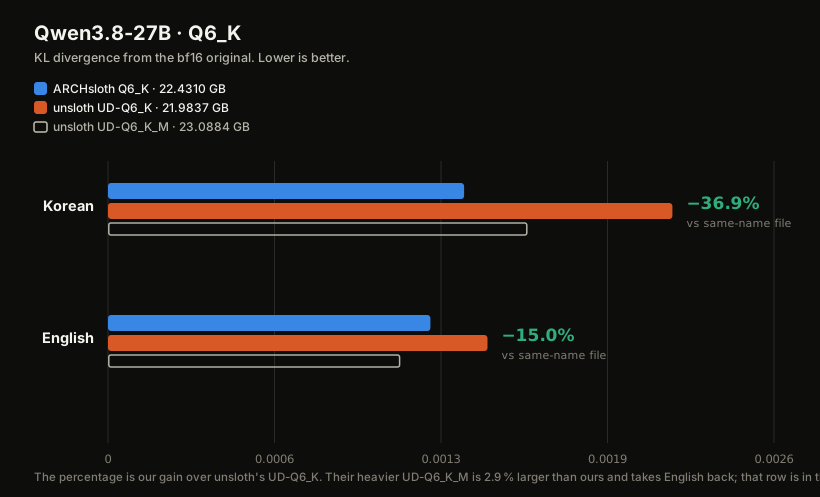
| bytes | Korean | English | |
|---|---|---|---|
ARCHsloth Q6_K |
22,430,999,840 | 0.001385 | 0.001254 |
unsloth UD-Q6_K |
21,983,677,344 | 0.002195 | 0.001476 |
unsloth UD-Q6_K_M |
23,088,409,504 | 0.001632 | 0.001137 |
| Against | Korean | English |
|---|---|---|
unsloth UD-Q6_K — same rung |
−36.9 % | −15.0 % |
unsloth UD-Q6_K_M — 2.9 % larger than ours |
−15.1 % | +10.3 % |
Same-top-p moves the same direction as the divergence on every row (98.222 % vs 97.693 % on
Korean). Full statistics: EVAL.md. Raw per-run logs: eval/logs/.
# text only
llama-cli -m Qwen3.8-27B-AS-Q6_K.gguf -p "안녕하세요" -ngl 99

# OpenAI-compatible server, with vision
llama-server -m Qwen3.8-27B-AS-Q6_K.gguf --mmproj mmproj-F32.gguf \
  --host 127.0.0.1 --port 8080 --jinja
A 27B is a dense model: every token reads the whole file. Plan for the weights plus the KV cache, and the cache is what decides whether a long-context session fits.
--scheme GGUF:Q6_K       optimize the rounding for the quantizer that is used at export
--enable_alg_ext         sign-gradient rounding search (SignRoundV2, arXiv:2512.04746)
--dataset cal_archsloth.jsonl
--iters 200  --nsamples 128
Nothing else. Bit widths and tensor types are llama.cpp's standard Q6_K. Nothing below
4 bits anywhere.
cal_archsloth.jsonl, 500 samples of exactly 9,000 characters each, Korean and English
interleaved at the sample level. Interleaving is what mattered, not the ratio.
Details: CALIBRATION.md.
[measured] Our Q4_K_M lost English, so it is not in this repository. Against
Qwen3.8-27B-UD-Q4_K_M.gguf it took Korean by −12.8 % and gave English away by
+15.8 %. A rung we do not win is a rung we do not ship. It returns when it wins.[measured] UD-Q6_K_M keeps English. That file is 2.9 % larger than ours. We take
Korean from it by −15.1 % and it takes English back by +10.3 %. Against the file at
our own rung, UD-Q6_K, we are ahead on both.[measured] Two axes, not ten. Korean and English are measured here. The ten-axis sweep
that the 4B card carries has not been run
on this model. We publish only what we ran ourselves.[pending] Long-context retrieval, agentic tool use, and the vision axis.# 1. the comparison file, straight from its own repository
hf download unsloth/Qwen3.8-27B-GGUF Qwen3.8-27B-UD-Q6_K.gguf --local-dir rival
# 2. the reference the distance is measured from
python llama.cpp/convert_hf_to_gguf.py Qwen/Qwen3.8-27B --outtype bf16 --outfile ref-BF16.gguf
# 3. teacher logits, once per evaluation text
llama-perplexity -m ref-BF16.gguf -f eval/eval_ko.txt \
--kl-divergence-base base_ko.dat -ngl 99 -c 512 --chunks 60
# 4. every candidate against the same teacher, same text, same chunks
llama-perplexity -m <candidate>.gguf -f eval/eval_ko.txt \
--kl-divergence --kl-divergence-base base_ko.dat -ngl 99 -c 512 --chunks 60
If a number here does not replicate on your hardware, open a discussion and we will correct it.
| Component | Origin |
|---|---|
| Weights | Qwen/Qwen3.8-27B, unmodified — quantized from the original, not from anyone else's quantization |
| Layout, bit widths, tensor types | llama.cpp standard Q6_K, unchanged |
| Vision tower | carried at full precision, not quantized |
| Runtime | upstream llama.cpp, unmodified |
| Rounding search | Intel AutoRound with enable_alg_ext (SignRoundV2) |
| Calibration corpus, evaluation set, and the measurement | ours — all three ship in this repo |
Apache-2.0, inherited from the base model. Comparison files are named so you can fetch the exact bytes we measured.
6-bit
Base model
Qwen/Qwen3.8-27B
ollama run hf.co/Archsloth/Qwen3.8-27B-GGUF:Q6_K