| # JMO 2013 Solution Notes |
|
|
| Evan Chen《陳誼廷》 |
|
|
| 15 April 2024 |
|
|
|
|
| #### Abstract |
|
|
| This is a compilation of solutions for the 2013 JMO. The ideas of the solution are a mix of my own work, the solutions provided by the competition organizers, and solutions found by the community. However, all the writing is maintained by me. |
|
|
| These notes will tend to be a bit more advanced and terse than the "official" solutions from the organizers. In particular, if a theorem or technique is not known to beginners but is still considered "standard", then I often prefer to use this theory anyways, rather than try to work around or conceal it. For example, in geometry problems I typically use directed angles without further comment, rather than awkwardly work around configuration issues. Similarly, sentences like "let $\mathbb{R}$ denote the set of real numbers" are typically omitted entirely. |
|
|
| Corrections and comments are welcome! |
|
|
|
|
| ## Contents |
|
|
| 0 Problems |
| 1 Solutions to Day 1 |
| 1.1 JMO 2013/1, proposed by Titu Andreescu ..... 3 |
| 1.2 JMO 2013/2, proposed by Sungyoon Kim ..... 4 |
| 1.3 JMO 2013/3, proposed by Zuming Feng |
| 2 Solutions to Day 2 ..... 6 |
| 2.1 JMO 2013/4, proposed by Kiran Kedlaya ..... 6 |
| 2.2 JMO 2013/5, proposed by Zuming Feng ..... 7 |
| 2.3 JMO 2013/6, proposed by Titu Andreescu ..... 8 |
|
|
| ## §0 Problems |
|
|
| 1. Are there integers $a$ and $b$ such that $a^{5} b+3$ and $a b^{5}+3$ are both perfect cubes of integers? |
| 2. Each cell of an $m \times n$ board is filled with some nonnegative integer. Two numbers in the filling are said to be adjacent if their cells share a common side. The filling is called a garden if it satisfies the following two conditions: |
| (i) The difference between any two adjacent numbers is either 0 or 1 . |
| (ii) If a number is less than or equal to all of its adjacent numbers, then it is equal to 0. |
|
|
| Determine the number of distinct gardens in terms of $m$ and $n$. |
| 3. In triangle $A B C$, points $P, Q, R$ lie on sides $B C, C A, A B$, respectively. Let $\omega_{A}$, $\omega_{B}, \omega_{C}$ denote the circumcircles of triangles $A Q R, B R P, C P Q$, respectively. Given the fact that segment $A P$ intersects $\omega_{A}, \omega_{B}, \omega_{C}$ again at $X, Y, Z$ respectively, prove that $Y X / X Z=B P / P C$. |
| 4. Let $f(n)$ be the number of ways to write $n$ as a sum of powers of 2 , where we keep track of the order of the summation. For example, $f(4)=6$ because 4 can be written as $4,2+2,2+1+1,1+2+1,1+1+2$, and $1+1+1+1$. Find the smallest $n$ greater than 2013 for which $f(n)$ is odd. |
| 5. Quadrilateral $X A B Y$ is inscribed in the semicircle $\omega$ with diameter $\overline{X Y}$. Segments $A Y$ and $B X$ meet at $P$. Point $Z$ is the foot of the perpendicular from $P$ to line $\overline{X Y}$. Point $C$ lies on $\omega$ such that line $X C$ is perpendicular to line $A Z$. Let $Q$ be the intersection of segments $A Y$ and $X C$. Prove that |
|
|
| $$ |
| \frac{B Y}{X P}+\frac{C Y}{X Q}=\frac{A Y}{A X} |
| $$ |
|
|
| 6. Find all real numbers $x, y, z \geq 1$ satisfying |
|
|
| $$ |
| \min (\sqrt{x+x y z}, \sqrt{y+x y z}, \sqrt{z+x y z})=\sqrt{x-1}+\sqrt{y-1}+\sqrt{z-1} . |
| $$ |
|
|
| ## §1 Solutions to Day 1 |
|
|
| ## §1.1 JMO 2013/1, proposed by Titu Andreescu |
|
|
| Available online at https://aops.com/community/p3041819. |
|
|
| ## Problem statement |
|
|
| Are there integers $a$ and $b$ such that $a^{5} b+3$ and $a b^{5}+3$ are both perfect cubes of integers? |
|
|
| No, there do not exist such $a$ and $b$. |
| We prove this in two cases. |
|
|
| - Assume $3 \mid a b$. WLOG we have $3 \mid a$, but then $a^{5} b+3 \equiv 3(\bmod 9)$, contradiction. |
| - Assume $3 \nmid a b$. Then $a^{5} b+3$ is a cube not divisible by 3 , so it is $\pm 1 \bmod 9$, and we conclude |
|
|
| $$ |
| a^{5} b \in\{5,7\} \quad(\bmod 9) |
| $$ |
|
|
| Analogously |
|
|
| $$ |
| a b^{5} \in\{5,7\} \quad(\bmod 9) |
| $$ |
|
|
| We claim however these two equations cannot hold simultaneously. Indeed $(a b)^{6} \equiv 1$ $(\bmod 9)$ by Euler's theorem, despite $5 \cdot 5 \equiv 7,5 \cdot 7 \equiv 8,7 \cdot 7 \equiv 4 \bmod 9$. |
|
|
| ## §1.2 JMO 2013/2, proposed by Sungyoon Kim |
|
|
| Available online at https://aops.com/community/p3041818. |
|
|
| ## Problem statement |
|
|
| Each cell of an $m \times n$ board is filled with some nonnegative integer. Two numbers in the filling are said to be adjacent if their cells share a common side. The filling is called a garden if it satisfies the following two conditions: |
| (i) The difference between any two adjacent numbers is either 0 or 1 . |
| (ii) If a number is less than or equal to all of its adjacent numbers, then it is equal to 0 . |
|
|
| Determine the number of distinct gardens in terms of $m$ and $n$. |
|
|
| The numerical answer is $2^{m n}-1$. But we claim much more, by giving an explicit description of all gardens: |
|
|
| Let $S$ be any nonempty subset of the $m n$ cells. Suppose we fill each cell $\theta$ with the minimum (taxicab) distance from $\theta$ to some cell in $S$ (in particular, we write 0 if $\theta \in S$ ). Then |
|
|
| - This gives a garden, and |
| - All gardens are of this form. |
|
|
| Since there are $2^{m n}-1$ such nonempty subsets $S$, this would finish the problem. An example of a garden with $|S|=3$ is shown below. |
|
|
| $$ |
| \left[\begin{array}{llllll} |
| 2 & 1 & 2 & 1 & 0 & 1 \\ |
| 1 & 0 & 1 & 2 & 1 & 2 \\ |
| 1 & 1 & 2 & 3 & 2 & 3 \\ |
| 0 & 1 & 2 & 3 & 3 & 4 |
| \end{array}\right] |
| $$ |
|
|
| It is actually fairly easy to see that this procedure always gives a garden; so we focus our attention on showing that every garden is of this form. |
|
|
| Given a garden, note first that it has at least one cell with a zero in it - by considering the minimum number across the entire garden. Now let $S$ be the (thus nonempty) set of cells with a zero written in them. We contend that this works, i.e. the following sentence holds: |
|
|
| Claim - If a cell $\theta$ is labeled $d$, then the minimum distance from that cell to a cell in $S$ is $d$. |
|
|
| Proof. The proof is by induction on $d$, with $d=0$ being by definition. Now, consider any cell $\theta$ labeled $d \geq 1$. Every neighbor of $\theta$ has label at least $d-1$, so any path will necessarily take $d-1$ steps after leaving $\theta$. Conversely, there is some $d-1$ adjacent to $\theta$ by (ii). Stepping on this cell and using the minimal path (by induction hypothesis) gives us a path to a cell in $S$ with length exactly $d$. So the shortest path does indeed have distance $d$, as desired. |
|
|
| ## §1.3 JMO 2013/3, proposed by Zuming Feng |
|
|
| Available online at https://aops.com/community/p3041822. |
|
|
| ## Problem statement |
|
|
| In triangle $A B C$, points $P, Q, R$ lie on sides $B C, C A, A B$, respectively. Let $\omega_{A}$, $\omega_{B}, \omega_{C}$ denote the circumcircles of triangles $A Q R, B R P, C P Q$, respectively. Given the fact that segment $A P$ intersects $\omega_{A}, \omega_{B}, \omega_{C}$ again at $X, Y, Z$ respectively, prove that $Y X / X Z=B P / P C$. |
|
|
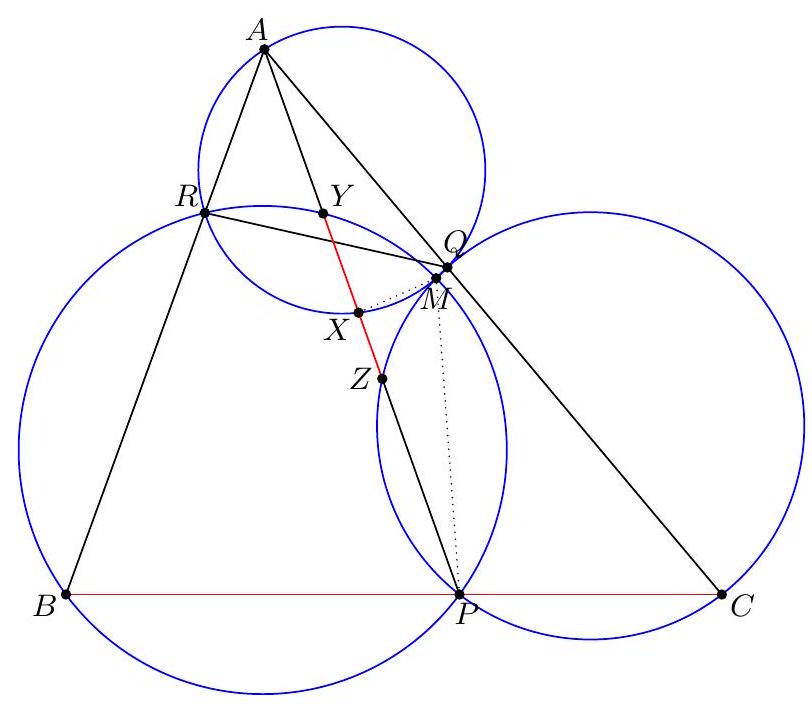
| Let $M$ be the concurrence point of $\omega_{A}, \omega_{B}, \omega_{C}$ (by Miquel's theorem). |
|  |
| |
| Then $M$ is the center of a spiral similarity sending $\overline{Y Z}$ to $\overline{B C}$. So it suffices to show that this spiral similarity also sends $X$ to $P$, but |
| |
| $$ |
| \measuredangle M X Y=\measuredangle M X A=\measuredangle M R A=\measuredangle M R B=\measuredangle M P B |
| $$ |
| |
| so this follows. |
| |
| ## §2 Solutions to Day 2 |
| |
| ## §2.1 JMO 2013/4, proposed by Kiran Kedlaya |
| |
| Available online at https://aops.com/community/p3043748. |
| |
| ## Problem statement |
| |
| Let $f(n)$ be the number of ways to write $n$ as a sum of powers of 2 , where we keep track of the order of the summation. For example, $f(4)=6$ because 4 can be written as $4,2+2,2+1+1,1+2+1,1+1+2$, and $1+1+1+1$. Find the smallest $n$ greater than 2013 for which $f(n)$ is odd. |
| |
| The answer is 2047. |
| For convenience, we agree that $f(0)=1$. Then by considering cases on the first number in the representation, we derive the recurrence |
| |
| $$ |
| f(n)=\sum_{k=0}^{\left\lfloor\log _{2} n\right\rfloor} f\left(n-2^{k}\right) |
| $$ |
| |
| We wish to understand the parity of $f$. The first few values are |
| |
| $$ |
| \begin{aligned} |
| & f(0)=1 \\ |
| & f(1)=1 \\ |
| & f(2)=2 \\ |
| & f(3)=3 \\ |
| & f(4)=6 \\ |
| & f(5)=10 \\ |
| & f(6)=18 \\ |
| & f(7)=31 . |
| \end{aligned} |
| $$ |
| |
| Inspired by the data we make the key claim that |
| Claim - $f(n)$ is odd if and only if $n+1$ is a power of 2. |
| |
| Proof. We call a number repetitive if it is zero or its binary representation consists entirely of 1 's. So we want to prove that $f(n)$ is odd if and only if $n$ is repetitive. |
| |
| This only takes a few cases: |
| |
| - If $n=2^{k}$, then $(\odot)$ has exactly two repetitive terms on the right-hand side, namely 0 and $2^{k}-1$. |
| - If $n=2^{k}+2^{\ell}-1$, then $(\odot)$ has exactly two repetitive terms on the right-hand side, namely $2^{\ell+1}-1$ and $2^{\ell}-1$. |
| - If $n=2^{k}-1$, then $(\bigcirc)$ has exactly one repetitive terms on the right-hand side, namely $2^{k-1}-1$. |
| - For other $n$, there are no repetitive terms at all on the right-hand side of $(\Omega)$. |
| |
| Thus the induction checks out. |
| So the final answer to the problem is 2047. |
| |
| ## §2.2 JMO 2013/5, proposed by Zuming Feng |
| |
| Available online at https://aops.com/community/p3043750. |
| |
| ## Problem statement |
| |
| Quadrilateral $X A B Y$ is inscribed in the semicircle $\omega$ with diameter $\overline{X Y}$. Segments $A Y$ and $B X$ meet at $P$. Point $Z$ is the foot of the perpendicular from $P$ to line $\overline{X Y}$. Point $C$ lies on $\omega$ such that line $X C$ is perpendicular to line $A Z$. Let $Q$ be the intersection of segments $A Y$ and $X C$. Prove that |
| |
| $$ |
| \frac{B Y}{X P}+\frac{C Y}{X Q}=\frac{A Y}{A X} |
| $$ |
| |
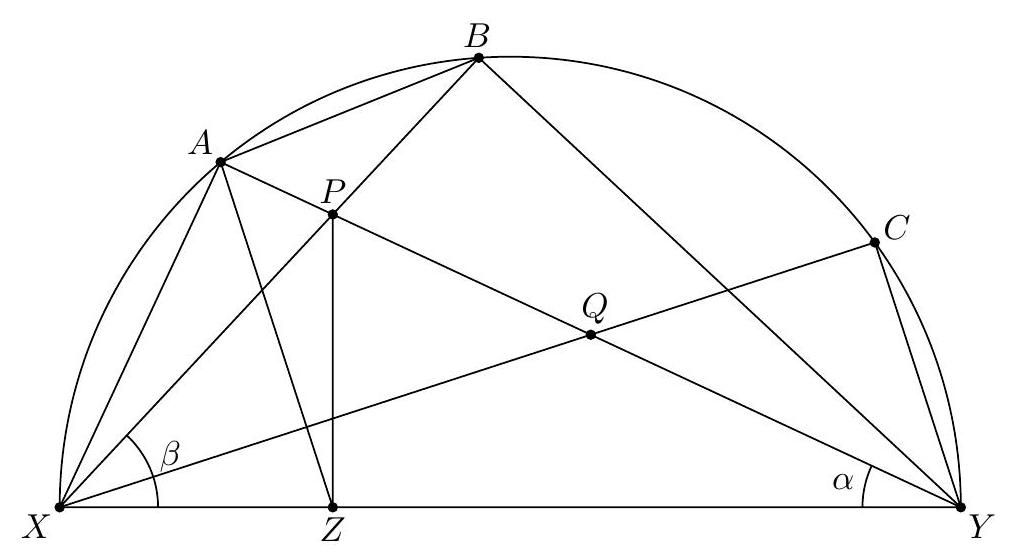
| Let $\beta=\angle Y X P$ and $\alpha=\angle P Y X$ and set $X Y=1$. We do not direct angles in the following solution. |
|  |
| |
| Observe that |
| |
| $$ |
| \angle A Z X=\angle A P X=\alpha+\beta |
| $$ |
| |
| since $A P Z X$ is cyclic. In particular, $\angle C X Y=90^{\circ}-(\alpha+\beta)$. It is immediate that |
| |
| $$ |
| B Y=\sin \beta, \quad C Y=\cos (\alpha+\beta), \quad A Y=\cos \alpha, \quad A X=\sin \alpha |
| $$ |
| |
| The Law of Sines on $\triangle X P Y$ gives $X P=X Y \frac{\sin \alpha}{\sin (\alpha+\beta)}$, and on $\triangle X Q Y$ gives $X Q=$ $X Y \frac{\sin \alpha}{\sin (90+\beta)}=\frac{\sin \alpha}{\cos \beta}$. So, the given is equivalent to |
| |
| $$ |
| \frac{\sin \beta}{\frac{\sin \alpha}{\sin (\alpha+\beta)}}+\frac{\cos (\alpha+\beta)}{\frac{\sin \alpha}{\cos \beta}}=\frac{\cos \alpha}{\sin \alpha} |
| $$ |
| |
| which is equivalent to $\cos \alpha=\cos \beta \cos (\alpha+\beta)+\sin \beta \sin (\alpha+\beta)$. This is obvious, because the right-hand side is just $\cos ((\alpha+\beta)-\beta)$. |
| |
| ## §2.3 JMO 2013/6, proposed by Titu Andreescu |
| |
| Available online at https://aops.com/community/p3043752. |
| |
| ## Problem statement |
| |
| Find all real numbers $x, y, z \geq 1$ satisfying |
| |
| $$ |
| \min (\sqrt{x+x y z}, \sqrt{y+x y z}, \sqrt{z+x y z})=\sqrt{x-1}+\sqrt{y-1}+\sqrt{z-1} |
| $$ |
| |
| Set $x=1+a, y=1+b, z=1+c$ which eliminates the $x, y, z \geq 1$ condition. Assume without loss of generality that $a \leq b \leq c$. Then the given equation rewrites as |
| |
| $$ |
| \sqrt{(1+a)(1+(1+b)(1+c))}=\sqrt{a}+\sqrt{b}+\sqrt{c} |
| $$ |
| |
| In fact, we are going to prove the left-hand side always exceeds the right-hand side, and then determine the equality cases. We have: |
| |
| $$ |
| \begin{aligned} |
| (1+a)(1+(1+b)(1+c)) & =(a+1)(1+(b+1)(1+c)) \\ |
| & \leq(a+1)\left(1+(\sqrt{b}+\sqrt{c})^{2}\right) \\ |
| & \leq(\sqrt{a}+(\sqrt{b}+\sqrt{c}))^{2} |
| \end{aligned} |
| $$ |
| |
| by two applications of Cauchy-Schwarz. |
| Equality holds if $b c=1$ and $1 / a=\sqrt{b}+\sqrt{c}$. Letting $c=t^{2}$ for $t \geq 1$, we recover $b=t^{-2} \leq t^{2}$ and $a=\frac{1}{t+1 / t} \leq t^{2}$. |
| |
| Hence the solution set is |
| |
| $$ |
| (x, y, z)=\left(1+\left(\frac{t}{t^{2}+1}\right)^{2}, 1+\frac{1}{t^{2}}, 1+t^{2}\right) |
| $$ |
| |
| and permutations, for any $t>0$. |
| |
| |