| # JMO 2022 Solution Notes |
|
|
| Evan Chen《陳誼廷》 |
|
|
| 15 April 2024 |
|
|
|
|
| #### Abstract |
|
|
| This is a compilation of solutions for the 2022 JMO. The ideas of the solution are a mix of my own work, the solutions provided by the competition organizers, and solutions found by the community. However, all the writing is maintained by me. |
|
|
| These notes will tend to be a bit more advanced and terse than the "official" solutions from the organizers. In particular, if a theorem or technique is not known to beginners but is still considered "standard", then I often prefer to use this theory anyways, rather than try to work around or conceal it. For example, in geometry problems I typically use directed angles without further comment, rather than awkwardly work around configuration issues. Similarly, sentences like "let $\mathbb{R}$ denote the set of real numbers" are typically omitted entirely. |
|
|
| Corrections and comments are welcome! |
|
|
|
|
| ## Contents |
|
|
| 0 Problems |
| 1 Solutions to Day 1 |
| 1.1 JMO 2022/1, proposed by Holden Mui ..... 3 |
| 1.2 JMO 2022/2, proposed by Ankan Bhattacharya ..... 4 |
| 1.3 JMO 2022/3, proposed by Ankan Bhattacharya |
| 2 Solutions to Day 2 ..... 7 |
| 2.1 JMO 2022/4, proposed by Ankan Bhattacharya ..... 7 |
| 2.2 JMO 2022/5, proposed by Holden Mui ..... 9 |
| 2.3 JMO 2022/6, proposed by Ankan Bhattacharya ..... 10 |
|
|
| ## §0 Problems |
|
|
| 1. For which positive integers $m$ does there exist an infinite sequence in $\mathbb{Z} / m \mathbb{Z}$ which is both an arithmetic progression and a geometric progression, but is nonconstant? |
| 2. Let $a$ and $b$ be positive integers. Every cell of an $(a+b+1) \times(a+b+1)$ grid is colored either amber or bronze such that there are at least $a^{2}+a b-b$ amber cells and at least $b^{2}+a b-a$ bronze cells. Prove that it is possible to choose $a$ amber cells and $b$ bronze cells such that no two of the $a+b$ chosen cells lie in the same row or column. |
| 3. Let $b \geq 2$ and $w \geq 2$ be fixed integers, and $n=b+w$. Given are $2 b$ identical black rods and $2 w$ identical white rods, each of side length 1. |
|
|
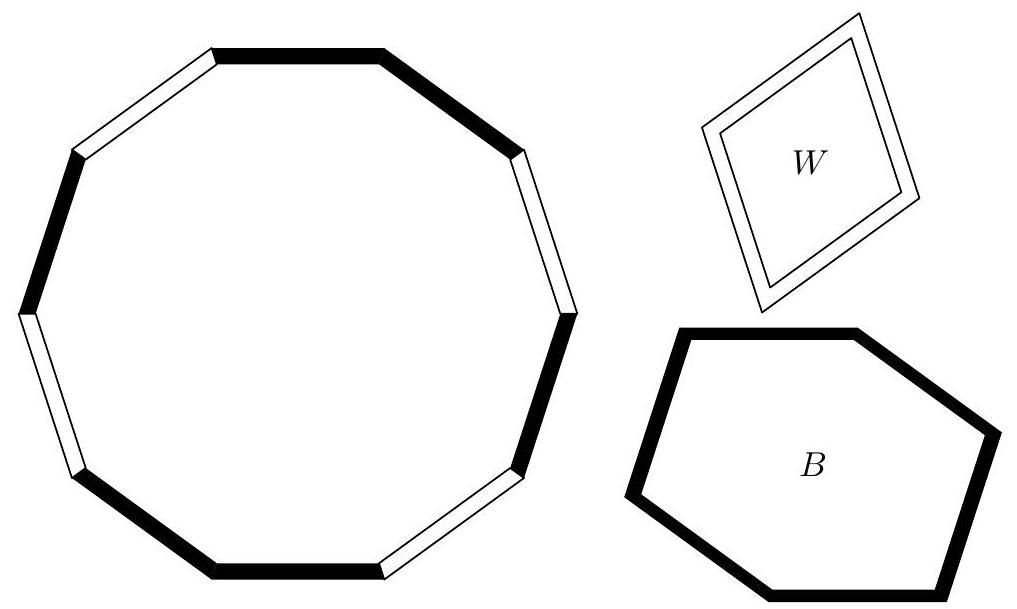
| We assemble a regular $2 n$-gon using these rods so that parallel sides are the same color. Then, a convex $2 b$-gon $B$ is formed by translating the black rods, and a convex $2 w$-gon $W$ is formed by translating the white rods. An example of one way of doing the assembly when $b=3$ and $w=2$ is shown below, as well as the resulting polygons $B$ and $W$. |
|  |
|
|
| Prove that the difference of the areas of $B$ and $W$ depends only on the numbers $b$ and $w$, and not on how the $2 n$-gon was assembled. |
| 4. Let $A B C D$ be a rhombus, and let $K$ and $L$ be points such that $K$ lies inside the rhombus, $L$ lies outside the rhombus, and $K A=K B=L C=L D$. Prove that there exist points $X$ and $Y$ on lines $A C$ and $B D$ such that $K X L Y$ is also a rhombus. |
| 5. Find all pairs of primes $(p, q)$ for which $p-q$ and $p q-q$ are both perfect squares. |
| 6. Let $a_{0}, b_{0}, c_{0}$ be complex numbers, and define |
| |
| $$ |
| \begin{aligned} |
| a_{n+1} & =a_{n}^{2}+2 b_{n} c_{n} \\ |
| b_{n+1} & =b_{n}^{2}+2 c_{n} a_{n} \\ |
| c_{n+1} & =c_{n}^{2}+2 a_{n} b_{n} |
| \end{aligned} |
| $$ |
| |
| for all nonnegative integers $n$. Suppose that $\max \left\{\left|a_{n}\right|,\left|b_{n}\right|,\left|c_{n}\right|\right\} \leq 2022$ for all $n \geq 0$. Prove that |
|
|
| $$ |
| \left|a_{0}\right|^{2}+\left|b_{0}\right|^{2}+\left|c_{0}\right|^{2} \leq 1 |
| $$ |
| |
| ## §1 Solutions to Day 1 |
| |
| ## §1.1 JMO 2022/1, proposed by Holden Mui |
| |
| Available online at https://aops.com/community/p24774800. |
| |
| ## Problem statement |
| |
| For which positive integers $m$ does there exist an infinite sequence in $\mathbb{Z} / m \mathbb{Z}$ which is both an arithmetic progression and a geometric progression, but is nonconstant? |
| |
| Answer: $m$ must not be squarefree. |
| The problem is essentially asking when there exists a nonconstant arithmetic progression in $\mathbb{Z} / m \mathbb{Z}$ which is also a geometric progression. Now, |
| |
| - If $m$ is squarefree, then consider three $(s-d, d, s+d)$ in arithmetic progression. It's geometric if and only if $d^{2}=(s-d)(s+d)(\bmod m)$, meaning $d^{2} \equiv 0(\bmod m)$. Then $d \equiv 0(\bmod m)$. So any arithmetic progression which is also geometric is constant in this case. |
| - Conversely if $p^{2} \mid m$ for some prime $p$, then any arithmetic progression with common difference $m / p$ is geometric by the same calculation. |
| |
| |
| ## §1.2 JMO 2022/2, proposed by Ankan Bhattacharya |
| |
| Available online at https://aops.com/community/p24774812. |
| |
| ## Problem statement |
| |
| Let $a$ and $b$ be positive integers. Every cell of an $(a+b+1) \times(a+b+1)$ grid is colored either amber or bronze such that there are at least $a^{2}+a b-b$ amber cells and at least $b^{2}+a b-a$ bronze cells. Prove that it is possible to choose $a$ amber cells and $b$ bronze cells such that no two of the $a+b$ chosen cells lie in the same row or column. |
| |
| Claim - There exists a transversal $T_{a}$ with at least $a$ amber cells. Analogously, there exists a transversal $T_{b}$ with at least $b$ bronze cells. |
| |
| Proof. If one picks a random transversal, the expected value of the number of amber cells is at least |
| |
| $$ |
| \frac{a^{2}+a b-b}{a+b+1}=(a-1)+\frac{1}{a+b+1}>a-1 |
| $$ |
| |
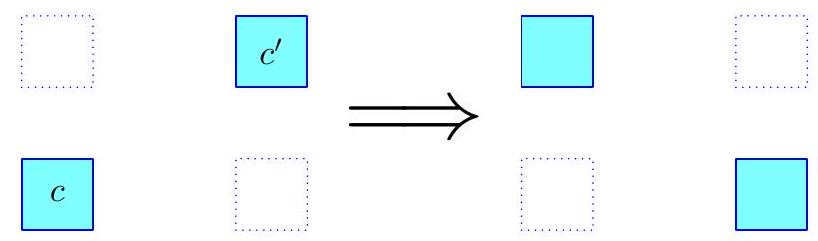
| Now imagine we transform $T_{a}$ to $T_{b}$ in some number of steps, by repeatedly choosing cells $c$ and $c^{\prime}$ and swapping them with the two other corners of the rectangle formed by their row/column, as shown in the figure. |
|  |
| |
| By "discrete intermediate value theorem", the number of amber cells will be either $a$ or $a+1$ at some point during this transformation. This completes the proof. |
| |
| ## §1.3 JMO 2022/3, proposed by Ankan Bhattacharya |
| |
| Available online at https://aops.com/community/p24775345. |
| |
| ## Problem statement |
| |
| Let $b \geq 2$ and $w \geq 2$ be fixed integers, and $n=b+w$. Given are $2 b$ identical black rods and $2 w$ identical white rods, each of side length 1. |
| |
| We assemble a regular $2 n$-gon using these rods so that parallel sides are the same color. Then, a convex $2 b$-gon $B$ is formed by translating the black rods, and a convex $2 w$-gon $W$ is formed by translating the white rods. An example of one way of doing the assembly when $b=3$ and $w=2$ is shown below, as well as the resulting polygons $B$ and $W$. |
|  |
| |
| Prove that the difference of the areas of $B$ and $W$ depends only on the numbers $b$ and $w$, and not on how the $2 n$-gon was assembled. |
| |
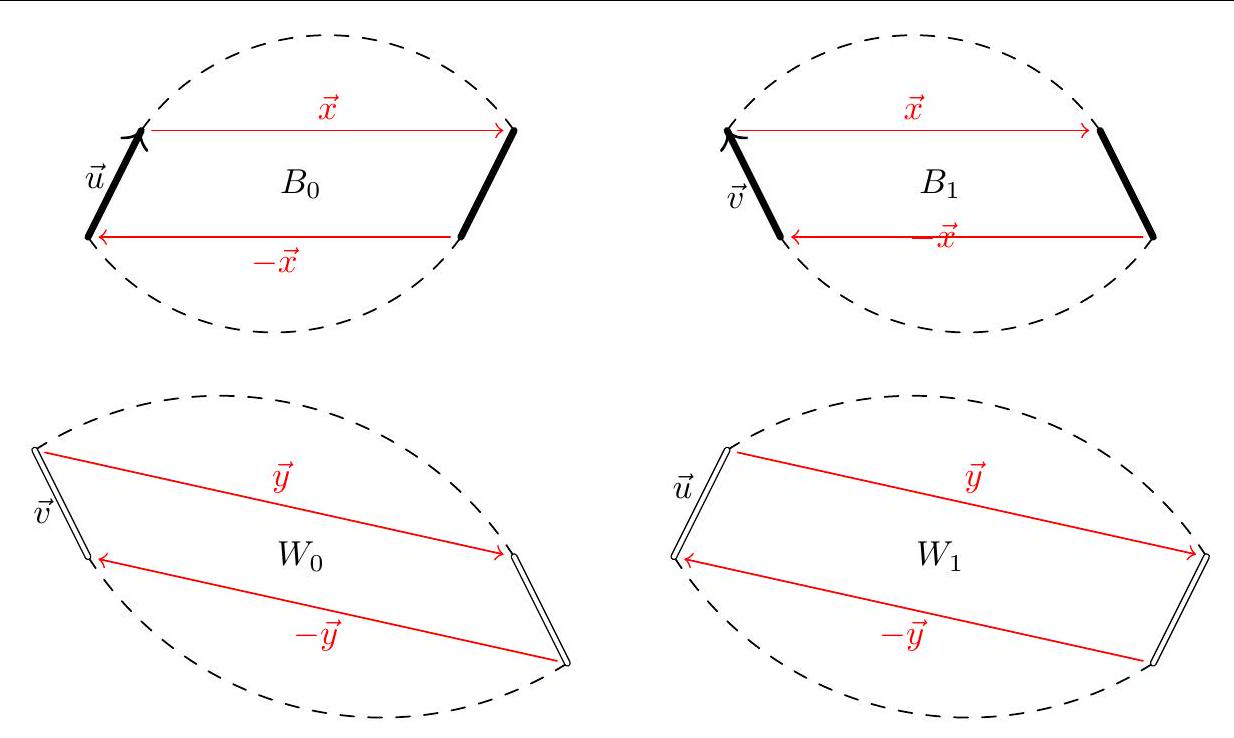
| We are going to prove that one may swap a black rod with an adjacent white rod (as well as the rods parallel to them) without affecting the difference in the areas of $B-W$. Let $\vec{u}$ and $\vec{v}$ denote the originally black and white vectors that were adjacent on the $2 n$-gon and are now going to be swapped. Let $\vec{x}$ denote the sum of all the other black vectors between $\vec{u}$ and $-\vec{u}$, and define $\vec{y}$ similarly. See the diagram below, where $B_{0}$ and $W_{0}$ are the polygons before the swap, and $B_{1}$ and $W_{1}$ are the resulting changed polygons. |
|  |
| |
| Observe that the only change in $B$ and $W$ is in the parallelograms shown above in each diagram. Letting $\wedge$ denote the wedge product, we need to show that |
| |
| $$ |
| \vec{u} \wedge \vec{x}-\vec{v} \wedge \vec{y}=\vec{v} \wedge \vec{x}-\vec{u} \wedge \vec{y} |
| $$ |
| |
| which can be rewritten as |
| |
| $$ |
| (\vec{u}-\vec{v}) \wedge(\vec{x}+\vec{y})=0 |
| $$ |
| |
| In other words, it would suffice to show $\vec{u}-\vec{v}$ and $\vec{x}+\vec{y}$ are parallel. (Students not familiar with wedge products can replace every $\wedge$ with the cross product $\times$ instead.) |
| |
| Claim - Both $\vec{u}-\vec{v}$ and $\vec{x}+\vec{y}$ are perpendicular to vector $\vec{u}+\vec{v}$. |
| |
| Proof. We have $(\vec{u}-\vec{v}) \perp(\vec{u}+\vec{v})$ because $\vec{u}$ and $\vec{v}$ are the same length. |
| For the other perpendicularity, note that $\vec{u}+\vec{v}+\vec{x}+\vec{y}$ traces out a diameter of the circumcircle of the original $2 n$-gon; call this diameter $A B$, so |
| |
| $$ |
| A+\vec{u}+\vec{v}+\vec{x}+\vec{y}=B |
| $$ |
| |
| Now point $A+\vec{u}+\vec{v}$ is a point on this semicircle, which means (by the inscribed angle theorem) the angle between $\vec{u}+\vec{v}$ and $\vec{x}+\vec{y}$ is $90^{\circ}$. |
| |
| ## §2 Solutions to Day 2 |
| |
| ## §2.1 JMO 2022/4, proposed by Ankan Bhattacharya |
| |
| Available online at https://aops.com/community/p24774800. |
| |
| ## Problem statement |
| |
| Let $A B C D$ be a rhombus, and let $K$ and $L$ be points such that $K$ lies inside the rhombus, $L$ lies outside the rhombus, and $K A=K B=L C=L D$. Prove that there exist points $X$ and $Y$ on lines $A C$ and $B D$ such that $K X L Y$ is also a rhombus. |
| |
| To start, notice that $\triangle A K B \cong \triangle D L C$ by SSS. Then by the condition $K$ lies inside the rhombus while $L$ lies outside it, we find that the two congruent triangles are just translations of each other (i.e. they have the same orientation). |
| |
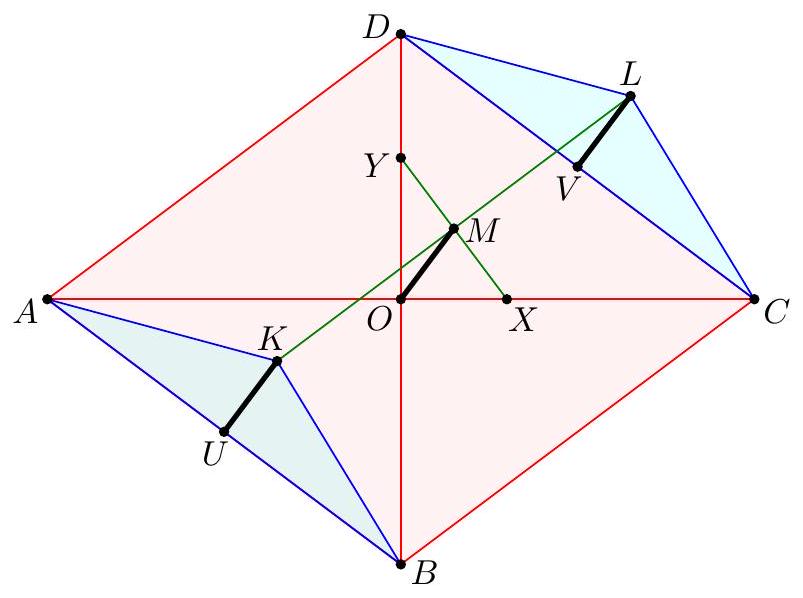
| 『 First solution. Let $M$ be the midpoint of $\overline{K L}$ and is $O$ the center of the rhombus. |
| |
| $$ |
| \text { Claim }-\overline{M O} \perp \overline{A B} . |
| $$ |
| |
| Proof. Let $U$ and $V$ denote the midpoint of $\overline{A B}$ and $\overline{C D}$ respectively. Then $\overline{K U}$ and $\overline{L V}$ are obviously translates, and perpendicular to $\overline{A B} \| \overline{C D}$. Since $M$ is the midpoint of $\overline{K L}$ and $O$ is the midpoint of $\overline{U V}$, the result follows. |
| |
| We choose $X$ and $Y$ to be the intersections of the perpendicular bisector of $\overline{K L}$ with $\overline{A C}$ and $\overline{B D}$. |
|  |
| |
| Claim - The midpoint of $\overline{X Y}$ coincides with the midpoint of $\overline{K L}$. |
| Proof. Because |
| |
| $$ |
| \begin{aligned} |
| & \overline{X Y} \perp \overline{K L} \| \overline{B C} \\ |
| & \overline{M O} \perp \overline{A B} \\ |
| & \overline{B D} \perp \overline{A C} |
| \end{aligned} |
| $$ |
| |
| it follows that $\triangle M O Y$, which was determined by the three lines $\overline{X Y}, \overline{M O}, \overline{B D}$, is similar to $\triangle A B C$. In particular, it is isosceles with $M Y=M O$. Analogously, $M X=M O$. |
| |
| Remark. It is also possible to simply use coordinates to prove both claims. |
| |
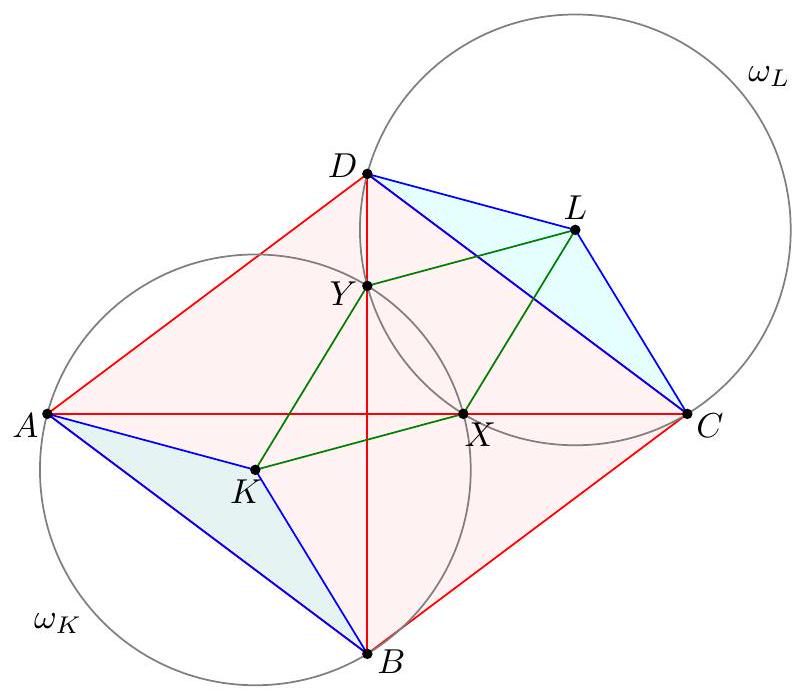
| 【 Second solution (author's solution). In this solution, we instead define $X$ and $Y$ as the intersections of the circles centered at $K$ and $L$ of equal radii $K A$, which will be denoted $\omega_{K}$ and $\omega_{L}$. It is clear that $K X L Y$ is a rhombus under this construction, so it suffices to show that $X$ and $Y$ lie on $A C$ and $B D$ (in some order). |
|  |
| |
| To see this, let $\overline{A C}$ meet $\omega_{K}$ again at $X^{\prime}$. We have |
|
|
| $$ |
| \measuredangle C X^{\prime} D=\measuredangle B X^{\prime} C=\measuredangle B X^{\prime} A=\frac{1}{2} \mathrm{~m} \overparen{A B}=\mathrm{m} \overparen{C D} |
| $$ |
|
|
| where the arcs are directed modulo $360^{\circ}$; here $\overparen{A B}$ is the arc of $\omega_{K}$ cut out by $\measuredangle A X B$, and $\overparen{D C}$ is the analogous arc of $\omega_{L}$. This implies $X^{\prime}$ lies on $\omega_{L}$ by the inscribed angle theorem. Hence $X=X^{\prime}$, and it follows $X$ lies on $\overline{A C}$. |
| |
| Analogously $Y$ lies on $B D$. |
| Remark. The angle calculation above can also be replaced with a length calculation, as follows. |
| |
| Let $M$ and $N$ be the projections of $K$ and $L$ onto $\overline{A C}$, respectively. Then $X^{\prime}$ is the reflection of $A$ across $M$; analogously, the second intersection $X^{\prime \prime}$ with $\overline{A C}$ should be the reflection of $C$ across $N$. So to get $X=X^{\prime}=X^{\prime \prime}$, we would need to show $A C=2 M N$. |
| |
| However, note that $A K L D$ is a parallelogram. As $M N$ was the projection of $\overline{K L}$ onto $\overline{A C}$, its length should be the same as the projection of $\overline{A D}$ onto $\overline{A C}$, which is obviously $\frac{1}{2} A C$ because the projection of $D$ onto $\overline{A C}$ is exactly the midpoint of $\overline{A C}$ (i.e. the center of the rhombus). |
| |
| ## §2.2 JMO 2022/5, proposed by Holden Mui |
| |
| Available online at https://aops.com/community/p24774670. |
| |
| ## Problem statement |
| |
| Find all pairs of primes $(p, q)$ for which $p-q$ and $p q-q$ are both perfect squares. |
| |
| The answer is $(3,2)$ only. This obviously works so we focus on showing it is the only one. |
| 【 Approach using difference of squares (from author). Set |
| |
| $$ |
| \begin{aligned} |
| a^{2} & =p-q \\ |
| b^{2} & =p q-q . |
| \end{aligned} |
| $$ |
| |
| Note that $0<a<p$, and $0<b<p$ (because $q \leq p$ ). Now subtracting gives |
| |
| $$ |
| \underbrace{(b-a)}_{<p} \underbrace{(b+a)}_{<2 p}=b^{2}-a^{2}=p(q-1) |
| $$ |
| |
| The inequalities above now force $b+a=p$. Hence $q-1=b-a$. |
| This means $p$ and $q-1$ have the same parity, which can only occur if $q=2$. Finally, taking $\bmod 3$ shows $p \equiv 0(\bmod 3)$. So $(3,2)$ is the only possibility (and it does work). |
| |
| 【 Divisibility approach (Aharshi Roy). Since $p q-q=q(p-1)$ is a square, it follows that $q$ divides $p-1$ and that $\frac{p-1}{q}$ is a perfect square too. Hence the number |
| |
| $$ |
| s^{2}:=(p-q) \cdot \frac{p-1}{q}=\frac{p^{2}-q p-p+q}{q} |
| $$ |
| |
| is also a perfect square. Rewriting this equation gives |
| |
| $$ |
| q=\frac{p^{2}-p}{s^{2}+(p-1)} |
| $$ |
| |
| In particular, $s^{2}+(p-1)$ divides $p^{2}-p$, and in particular $s \leq p$. We consider two cases: |
| |
| - If $s^{2}+(p-1)$ is not divisible by $p$, then it must divide $p-1$, which can only happen if $s^{2}=0$, or $p=q$. However, it's easy to check there are no solutions in this case. |
| - Otherwise, we should have $s^{2} \equiv 1(\bmod p)$, so either $s=1$ or $s=p-1$. If $s=p-1$ we get $q=1$ which is absurd. On the other hand, if $s=1$ we conclude $q=p-1$ and hence $q=2, p=3$. |
| |
| |
| ## §2.3 JMO 2022/6, proposed by Ankan Bhattacharya |
| |
| Available online at https://aops.com/community/p24775314. |
| |
| ## Problem statement |
| |
| Let $a_{0}, b_{0}, c_{0}$ be complex numbers, and define |
| |
| $$ |
| \begin{aligned} |
| a_{n+1} & =a_{n}^{2}+2 b_{n} c_{n} \\ |
| b_{n+1} & =b_{n}^{2}+2 c_{n} a_{n} \\ |
| c_{n+1} & =c_{n}^{2}+2 a_{n} b_{n} |
| \end{aligned} |
| $$ |
| |
| for all nonnegative integers $n$. Suppose that $\max \left\{\left|a_{n}\right|,\left|b_{n}\right|,\left|c_{n}\right|\right\} \leq 2022$ for all $n \geq 0$. Prove that |
| |
| $$ |
| \left|a_{0}\right|^{2}+\left|b_{0}\right|^{2}+\left|c_{0}\right|^{2} \leq 1 |
| $$ |
| |
| For brevity, set $s_{n}:=\left|a_{n}\right|^{2}+\left|b_{n}\right|^{2}+\left|c_{n}\right|^{2}$. Note that the $s_{n}$ are real numbers. |
| Claim (Key miraculous identity) - We have |
| |
| $$ |
| s_{n+1}-s_{n}^{2}=2\left|a_{n} \overline{b_{n}}+b_{n} \overline{c_{n}}+c_{n} \overline{a_{n}}\right|^{2} |
| $$ |
| |
| Proof. We prove this by mechanical calculation. First, |
| |
| $$ |
| \begin{aligned} |
| s_{n+1} & =\left|a_{n}^{2}+2 b_{n} c_{n}\right|^{2}+\left|b_{n}^{2}+2 c_{n} a_{n}\right|^{2}+\left|c_{n}^{2}+2 a_{n} b_{n}\right|^{2} \\ |
| & =\sum_{\text {cyc }}\left|a_{n}^{2}+2 b_{n} c_{n}\right|^{2} \\ |
| & =\sum_{\text {cyc }}\left(a_{n}^{2}+2 b_{n} c_{n}\right)\left({\overline{a_{n}}}^{2}+2 \overline{b_{n}} \overline{c_{n}}\right) \\ |
| & =\sum_{\text {cyc }}\left(\left|a_{n}\right|^{4}+2{\overline{a_{n}}}^{2} b_{n} c_{n}+2 a_{n}^{2} \overline{b_{n}} \overline{c_{n}}+4\left|b_{n}\right|^{2}\left|c_{n}\right|^{2}\right) \\ |
| & =s_{n}^{2}+2 \sum_{\text {cyc }}\left({\overline{a_{n}}}^{2} b_{n} c_{n}+a_{n}^{2} \overline{b_{n}} \overline{c_{n}}+\left|b_{n}\right|^{2}\left|c_{n}\right|^{2}\right) |
| \end{aligned} |
| $$ |
| |
| Meanwhile, |
| |
| $$ |
| \begin{aligned} |
| &\left|a_{n} \overline{b_{n}}+b_{n} \overline{c_{n}}+c_{n} \overline{a_{n}}\right|^{2}=\left(a_{n} \overline{b_{n}}+b_{n} \overline{c_{n}}+c_{n} \overline{a_{n}}\right)\left(\overline{a_{n}} b_{n}+\overline{b_{n}} c_{n}+\overline{c_{n}} a_{n}\right) \\ |
| &=\left|a_{n}\right|^{2}\left|b_{n}^{2}\right|+a_{n}{\overline{b_{n}}}^{2} c_{n}+a_{n}^{2} \overline{b_{n}} \overline{c_{n}} \\ |
| &+\overline{a_{n}} b_{n}^{2} \overline{c_{n}}+\left|b_{n}\right|^{2}\left|c_{n}\right|^{2}+a_{n} b_{n} \bar{c}^{2} \\ |
| &+{\overline{a_{n}}}^{2} b_{n} c_{n}+\overline{a_{n}} \overline{b_{n}} c_{n}^{2}+\left|a_{n}\right|^{2}\left|c_{n}\right|^{2} |
| \end{aligned} |
| $$ |
| |
| which exactly matches the earlier sum, term for term. |
| In particular, $s_{n+1} \geq s_{n}^{2}$, so applying repeatedly, |
| |
| $$ |
| s_{n} \geq s_{0}^{2^{n}} |
| $$ |
| |
| Hence if $s_{0}>1$, it follows $s_{n}$ is unbounded, contradicting $\max \left\{\left|a_{n}\right|,\left|b_{n}\right|,\left|c_{n}\right|\right\} \leq 2022$. |
| |
| Remark. The originally intended solution was to capture all three recursions in the following way. First, change the recursion to |
| |
| $$ |
| \begin{aligned} |
| a_{n+1} & =a_{n}^{2}+2 b_{n} c_{n} \\ |
| c_{n+1} & =b_{n}^{2}+2 c_{n} a_{n} \\ |
| b_{n+1} & =c_{n}^{2}+2 a_{n} b_{n} |
| \end{aligned} |
| $$ |
| |
| which is OK because we are just rearranging the terms in each triple. Then if $\omega$ is any complex number with $\omega^{3}=1$, and we define |
| |
| $$ |
| z_{n}:=a_{n}+b_{n} \omega+c_{n} \omega^{2}, |
| $$ |
| |
| the recursion amounts to saying that $z_{n+1}=z_{n}^{2}$. This allows us to analyze $\left|z_{n}\right|$ in a similar way as above, as now $\left|z_{n}\right|=\left|z_{0}\right|^{2^{n}}$. |
|
|
|
|


