


The $27^{\text {th }}$ Nordic Mathematical Contest
Monday, 8 April 2013
Solution
Each problem is worth 5 points.
PRoblem 1. Let $\left(a_{n}\right){n \geq 1}$ be a sequence with $a{1}=1$ and
for all $n \geq 1$, where $\lfloor x\rfloor$ denotes the greatest integer less than or equal to $x$. Find all $n \leq 2013$ such that $a_{n}$ is a perfect square.
Solution. We will show by induction that $a_{n}=1+\left\lfloor\frac{n}{2}\right\rfloor\left\lfloor\frac{n+1}{2}\right\rfloor$, which is equivalent to $a_{2 m}=1+m^{2}$ and $a_{2 m+1}=1+m(m+1)$. Clearly this is true for $a_{1}$. If $a_{2 m+1}=1+m(m+1)$ then
and since $m+\frac{1}{2}<\sqrt{m^{2}+m+1}<m+1$ (easily seen by squaring), we get $a_{2 m+2}=\left(m^{2}+m+1\right)+(m+1)=1+(m+1)^{2}$.
And if $a_{2 m}=1+m^{2}$ then
and here $m<\sqrt{m^{2}+1}<m+\frac{1}{2}$, so $a_{2 m+1}=\left(m^{2}+1\right)+m=1+m(m+1)$.
If $m \geq 1$ then $m^{2}<1+m^{2}<(m+1)^{2}$ and $m^{2}<m^{2}+m+1<(m+1)^{2}$, so $a_{n}$ cannot be a perfect square if $n>1$. Therefore $a_{1}=1$ is the only perfect square in the sequence.
Problem 2. In a football tournament there are $n$ teams, with $n \geq 4$, and each pair of teams meets exactly once. Suppose that, at the end of the tournament, the final scores form an arithmetic sequence where each team scores 1 more point than the following team on the scoreboard. Determine the maximum possible score of the lowest scoring team, assuming usual scoring for football games (where the winner of a game gets 3 points, the loser 0 points, and if there is a tie both teams get 1 point).
Solution. Note that the total number of games equals the number of different pairings, that is, $n(n-1) / 2$. Suppose the lowest scoring team ends with $k$ points. Then the total score for all teams is
Some games must end in a tie, for otherwise, all team scores would be a multiple of 3 and cannot be 1 point apart. Since the total score of a tie is only 2 points compared to 3 points if one of the teams wins, we therefore know that
so $n k<n(n-1)$, and hence $k<n-1$. It follows that the lowest scoring team can score no more than $n-2$ points.
We now show by induction that it is indeed possible for the lowest scoring team to score $n-2$ points.
The following scoreboard shows this is possible for $n=4$ :
| - | 3 | 1 | 1 | 5 |
|---|---|---|---|---|
| 0 | - | 1 | 3 | 4 |
| 1 | 1 | - | 1 | 3 |
| 1 | 0 | 1 | - | 2 |
Now suppose we have a scoreboard for $n$ teams labelled $T_{n-2}, \ldots, T_{2 n-3}$, where team $T_{i}$ scores $i$ points. Keep the results among these teams unchanged while adding one more team.
Write $n=3 q+r$ with $r \in{1,-1,0}$, and let the new team tie with just one of the original teams, lose against $q$ teams, and win against the rest of them. The new team thus wins $n-1-q$ games, and gets $1+3(n-1-q)=3 n-2-3 q=2 n-2+r$ points.
Moreover, we arrange for the $q$ teams which win against the new team to form an arithmetic sequence $T_{j}, T_{j+3}, \ldots, T_{j+3(q-1)}=T_{j+n-r-3}$, so that each of them, itself having gained three points, fills the slot vacated by the next one.
(i) If $r=1$, then let the new team tie with team $T_{n-2}$ and lose to each of the teams $T_{n-1}, T_{n+2}, \ldots, T_{n-1+n-r-3}=T_{2 n-5}$.
Team $T_{n-2}$ now has $n-1$ points and takes the place vacated by $T_{n-1}$. At the other end, $T_{2 n-5}$ now has $2 n-2$ points, just one more than the previous top team $T_{2 n-3}$. And the new team has $2 n-2+r=2 n-1$ points, becoming the new top team. The teams now have all scores from $n-1$ up to $2 n-1$.
(ii) If $r=-1$, then let the new team tie with team $T_{2 n-3}$ and lose to each of the teams $T_{n-2}, T_{n+1}, \ldots, T_{n-2+n-r-3}=T_{2 n-4}$.
The old top team $T_{2 n-3}$ now has $2 n-2$ points, and its former place is filled by the new team, which gets $2 n-2+r=2 n-3$ points. $T_{2 n-4}$ now has $2 n-1$ points and is the new top team. So again we have all scores ranging from $n-1$ up to $2 n-1$.
(iii) If $r=0$, then let the new team tie with team $T_{n-2}$ and lose to teams $T_{n-1}, T_{n+2}, \ldots, T_{n-1+n-r-3}=T_{2 n-4}$.
Team $T_{n-2}$ now has $n-1$ points and fills the slot vacated by $T_{n-1}$. At the top end, $T_{2 n-4}$ now has $2 n-1$ points, while the new team has $2 n-2+r=2 n-2$ points, and yet again we have all scores from $n-1$ to $2 n-1$.
This concludes the proof.
Problem 3. Define a sequence $\left(n_{k}\right){k \geq 0}$ by $n{0}=n_{1}=1$, and $n_{2 k}=n_{k}+n_{k-1}$ and $n_{2 k+1}=n_{k}$ for $k \geq 1$. Let further $q_{k}=n_{k} / n_{k-1}$ for each $k \geq 1$. Show that every positive rational number is present exactly once in the sequence $\left(q_{k}\right)_{k \geq 1}$.
Solution. Clearly, all the numbers $n_{k}$ are positive integers. Moreover,
and similarly,
In particular, $q_{k}>1$ when $k$ is even, and $q_{k}<1$ when $k \geq 3$ is odd.
We will show the following by induction on $t=2,3,4, \ldots$ :
Claim: Every rational number $r / s$ where $r$, s are positive integers with $\operatorname{gcd}(r, s)=$ 1 and $r+s \leq t$ occurs precisely once among the numbers $q_{k}$.
The claim is clearly true for $t=2$, since then $r / s=1 / 1=1$ is the only possibility, and $q_{1}$ is the only occurrence of 1 in the sequence.
Now, assume that $u \geq 3$ and that the claim holds for $t=u-1$. Let $r$ and $s$ be positive integers with $\operatorname{gcd}(r, s)=1$ and $r+s=u$.
First, assume that $r>s$. We know that $r / s=q_{m}$ is only possible if $m$ is even. But
by (1), and moreover, the latter equality holds for precisely one $k$ according to the induction hypothesis, since $\operatorname{gcd}(r-s, s)=1$ and $(r-s)+s=r \leq t$.
Next, assume that $r<s$. We know that $r / s=q_{m}$ is only possible if $m$ is odd. But
by (2), and moreover, the latter equality holds for precisely one $k$ according to the induction hypothesis, since $\operatorname{gcd}(s-r, r)=1$ and $(s-r)+r=s \leq t$.
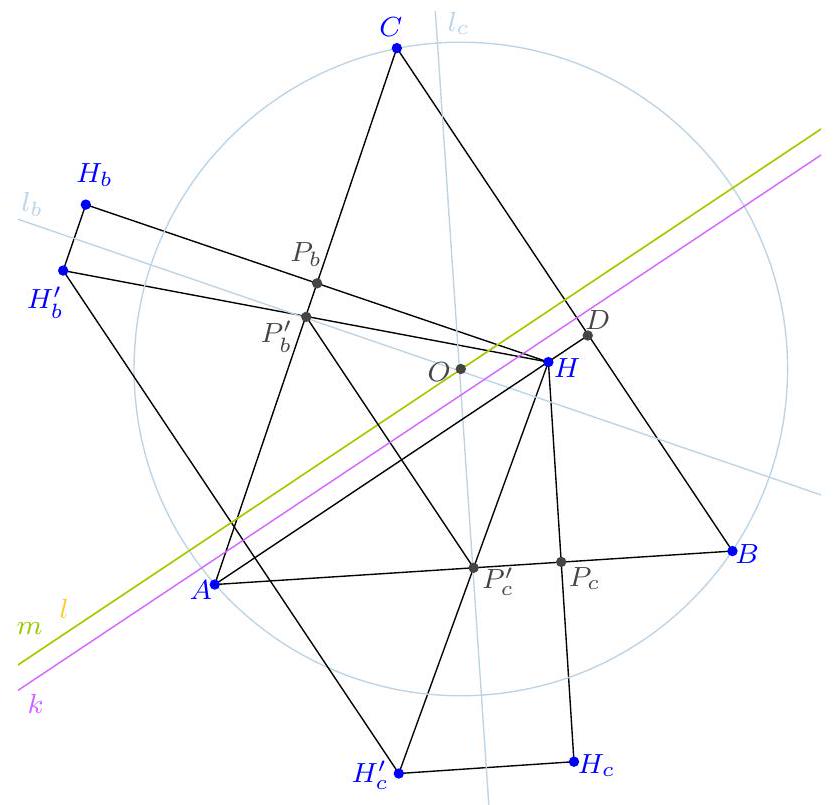
Problem 4. Let $A B C$ be an acute angled triangle, and $H$ a point in its interior. Let the reflections of $H$ through the sides $A B$ and $A C$ be called $H_{c}$ and $H_{b}$, respectively, and let the reflections of $H$ through the midpoints of these same sides be called $H_{c}^{\prime}$ and $H_{b}^{\prime}$, respectively. Show that the four points $H_{b}, H_{b}^{\prime}, H_{c}$, and $H_{c}^{\prime}$ are concyclic if and only if at least two of them coincide or $H$ lies on the altitude from $A$ in triangle $A B C$.
Solution. If at least two of the four points $H_{b}, H_{b}^{\prime}, H_{c}$, and $H_{c}^{\prime}$ coincide, all four are obviously concyclic. Therefore we may assume that these four points are distinct.
Let $P_{b}$ denote the midpoint of segment $H H_{b}, P_{b}^{\prime}$ the midpoint of segment $H H_{b}^{\prime}, P_{c}$ the midpoint of segment $H H_{c}$, and $P_{c}^{\prime}$ the midpoint of segment $H H_{c}^{\prime}$.
The triangle $H H_{b} H_{b}^{\prime}$ being right-angled in $H_{b}$, it follows that the perpendicular bisector $\ell_{b}$ of the side $H_{b} H_{b}^{\prime}$ goes through the point $P_{b}^{\prime}$. Since the segments $P_{b} P_{b}^{\prime}$ and $H_{b} H_{b}^{\prime}$ are parallel and $P_{b}^{\prime}$ is the midpoint of the side $A C$, we then conclude that $\ell_{b}$ also goes through the circumcentre $O$ of triangle $A B C$.
Similarly the perpendicular bisector $\ell_{c}$ of the segment $H_{c} H_{c}^{\prime}$ also goes through $O$. Hence the four points $H_{b}, H_{b}^{\prime}, H_{c}$, and $H_{c}^{\prime}$ are concyclic if and only if also the perpendicular bisector $\ell$ of the segment $H_{b}^{\prime} H_{c}^{\prime}$ goes through the point $O$. Since $H_{b}^{\prime} H_{c}^{\prime}\left|P_{b}^{\prime} P_{c}^{\prime}\right| B C$, this is the case if and only if $\ell$ is the perpendicular bisector $m$ of the segment $B C$.
Let $k$ denote the perpendicular bisector of the segment $P_{b}^{\prime} P_{c}^{\prime}$. Since the lines $\ell$ and $m$ are obtained from $k$ by similarities of ratio 2 and centres $H$ and $A$, respectively, they coincide if and only if $H A$ is parallel to $m$. Thus $H_{b}, H_{b}^{\prime}, H_{c}$, and $H_{c}^{\prime}$ are concyclic if and only if $H$ lies on the altitude from $A$ in triangle $A B C$.
Click here to experiment with the figure in GeoGebra.