


JMO 2010 Solution Notes
Evan Chen《陳誼廷》
15 April 2024
Abstract
This is a compilation of solutions for the 2010 JMO. The ideas of the solution are a mix of my own work, the solutions provided by the competition organizers, and solutions found by the community. However, all the writing is maintained by me.
These notes will tend to be a bit more advanced and terse than the "official" solutions from the organizers. In particular, if a theorem or technique is not known to beginners but is still considered "standard", then I often prefer to use this theory anyways, rather than try to work around or conceal it. For example, in geometry problems I typically use directed angles without further comment, rather than awkwardly work around configuration issues. Similarly, sentences like "let $\mathbb{R}$ denote the set of real numbers" are typically omitted entirely.
Corrections and comments are welcome!
Contents
0 Problems 1 Solutions to Day 1 1.1 JMO 2010/1, proposed by Andy Niedermier ..... 3 1.2 JMO 2010/2, proposed by Răzvan Gelca ..... 4 1.3 JMO 2010/3, proposed by Titu Andreescu 2 Solutions to Day 2 ..... 7 2.1 JMO 2010/4, proposed by Zuming Feng ..... 7 2.2 JMO 2010/5, proposed by Gregory Galperin ..... 8 2.3 JMO 2010/6, proposed by Zuming Feng ..... 9
§0 Problems
- Let $P(n)$ be the number of permutations $\left(a_{1}, \ldots, a_{n}\right)$ of the numbers $(1,2, \ldots, n)$ for which $k a_{k}$ is a perfect square for all $1 \leq k \leq n$. Find with proof the smallest $n$ such that $P(n)$ is a multiple of 2010 .
- Let $n>1$ be an integer. Find, with proof, all sequences $x_{1}, x_{2}, \ldots, x_{n-1}$ of positive integers with the following three properties: (a) $x_{1}<x_{2}<\cdots<x_{n-1}$; (b) $x_{i}+x_{n-i}=2 n$ for all $i=1,2, \ldots, n-1$; (c) given any two indices $i$ and $j$ (not necessarily distinct) for which $x_{i}+x_{j}<2 n$, there is an index $k$ such that $x_{i}+x_{j}=x_{k}$.
- Let $A X Y Z B$ be a convex pentagon inscribed in a semicircle of diameter $A B$. Denote by $P, Q, R, S$ the feet of the perpendiculars from $Y$ onto lines $A X, B X$, $A Z, B Z$, respectively. Prove that the acute angle formed by lines $P Q$ and $R S$ is half the size of $\angle X O Z$, where $O$ is the midpoint of segment $A B$.
- A triangle is called a parabolic triangle if its vertices lie on a parabola $y=x^{2}$. Prove that for every nonnegative integer $n$, there is an odd number $m$ and a parabolic triangle with vertices at three distinct points with integer coordinates with area $\left(2^{n} m\right)^{2}$ 。
- Two permutations $a_{1}, a_{2}, \ldots, a_{2010}$ and $b_{1}, b_{2}, \ldots, b_{2010}$ of the numbers $1,2, \ldots, 2010$ are said to intersect if $a_{k}=b_{k}$ for some value of $k$ in the range $1 \leq k \leq 2010$. Show that there exist 1006 permutations of the numbers $1,2, \ldots, 2010$ such that any other such permutation is guaranteed to intersect at least one of these 1006 permutations.
- Let $A B C$ be a triangle with $\angle A=90^{\circ}$. Points $D$ and $E$ lie on sides $A C$ and $A B$, respectively, such that $\angle A B D=\angle D B C$ and $\angle A C E=\angle E C B$. Segments $B D$ and $C E$ meet at $I$. Determine whether or not it is possible for segments $A B, A C, B I$, $I D, C I, I E$ to all have integer lengths.
§1 Solutions to Day 1
§1.1 JMO 2010/1, proposed by Andy Niedermier
Available online at https://aops.com/community/p1860909.
Problem statement
Let $P(n)$ be the number of permutations $\left(a_{1}, \ldots, a_{n}\right)$ of the numbers $(1,2, \ldots, n)$ for which $k a_{k}$ is a perfect square for all $1 \leq k \leq n$. Find with proof the smallest $n$ such that $P(n)$ is a multiple of 2010.
The answer is $n=4489$. We begin by giving a complete description of $P(n)$ :
Claim - We have
Proof. Every positive integer can be uniquely expressed in the form $c \cdot m^{2}$ where $c$ is a squarefree integer and $m$ is a perfect square. So we may, for each squarefree positive integer $c$, define the set
and each integer from 1 through $n$ will be in exactly one $S_{c}$. Note also that
Then, the permutations in the problem are exactly those which send elements of $S_{c}$ to elements of $S_{c}$. In other words,
We want the smallest $n$ such that 2010 divides $P(n)$.
- Note that $P\left(67^{2}\right)$ contains 67 ! as a term, which is divisible by 2010 , so $67^{2}$ is a candidate.
- On the other hand, if $n<67^{2}$, then no term in the product for $P(n)$ is divisible by the prime 67 .
So $n=67^{2}=4489$ is indeed the minimum.
§1.2 JMO 2010/2, proposed by Răzvan Gelca
Available online at https://aops.com/community/p1860914.
Problem statement
Let $n>1$ be an integer. Find, with proof, all sequences $x_{1}, x_{2}, \ldots, x_{n-1}$ of positive integers with the following three properties: (a) $x_{1}<x_{2}<\cdots<x_{n-1}$; (b) $x_{i}+x_{n-i}=2 n$ for all $i=1,2, \ldots, n-1$; (c) given any two indices $i$ and $j$ (not necessarily distinct) for which $x_{i}+x_{j}<2 n$, there is an index $k$ such that $x_{i}+x_{j}=x_{k}$.
The answer is $x_{k}=2 k$ only, which obviously work, so we prove they are the only ones. Let $x_{1}<x_{2}<\cdots<x_{n}$ be any sequence satisfying the conditions. Consider:
All these are results of condition (c), since $x_{1}+x_{n-2}<x_{1}+x_{n-1}=2 n$. So each of these must be a member of the sequence. However, there are $n-2$ of these terms, and there are exactly $n-2$ terms greater than $x_{1}$ in our sequence. Therefore, we get the one-to-one correspondence below:
It follows that $x_{2}=2 x_{1}$, so that $x_{3}=3 x_{1}$ and so on. Therefore, $x_{m}=m x_{1}$. We now solve for $x_{1}$ in condition (b) to find that $x_{1}=2$ is the only solution, and the desired conclusion follows.
§1.3 JMO 2010/3, proposed by Titu Andreescu
Available online at https://aops.com/community/p1860802.
Problem statement
Let $A X Y Z B$ be a convex pentagon inscribed in a semicircle of diameter $A B$. Denote by $P, Q, R, S$ the feet of the perpendiculars from $Y$ onto lines $A X, B X, A Z, B Z$, respectively. Prove that the acute angle formed by lines $P Q$ and $R S$ is half the size of $\angle X O Z$, where $O$ is the midpoint of segment $A B$.
We present two possible approaches. The first approach is just "bare-hands" angle chasing. The second approach requires more insight but makes it clearer what is going on; it shows the intersection point of lines $P Q$ and $R S$ is the foot from the altitude from $Y$ to $A B$ using Simson lines. The second approach also has the advantage that it works even if $\overline{A B}$ is not a diameter of the circle.
【 First approach using angle chasing. Define $T=\overline{P Q} \cap \overline{R S}$. Also, let $2 \alpha, 2 \beta, 2 \gamma, 2 \delta$ denote the measures of arcs $\overparen{A X}, \widehat{X Y}, \widehat{Y Z}, \widehat{Z B}$, respectively, so that $\alpha+\beta+\gamma+\delta=90^{\circ}$.
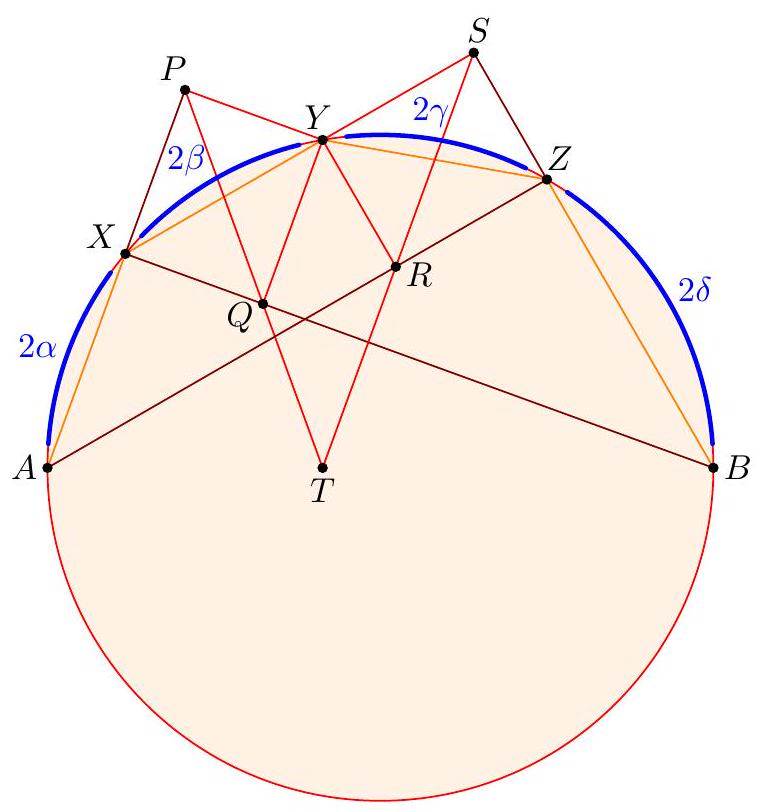
We now compute the following angles:
Hence, we can then compute
Since $\angle X O Z=\frac{2 \beta+2 \gamma}{2}=\beta+\gamma$, the proof is complete. 【 Second approach using Simson lines, ignoring the diameter condition. In this solution, we will ignore the condition that $\overline{A B}$ is a diameter; the solution works equally well without it, as long as $O$ is redefined as the center of $(A X Y Z B)$ instead. We will again show the angle formed by lines $P Q$ and $R S$ is half the measure of $\widehat{X Z}$.
Unlike the previous solution, we instead define $T$ to be the foot from $Y$ to $\overline{A B}$. Then the Simson line of $Y$ with respect to $\triangle X A B$ passes through $P, Q, T$. Similarly, the Simson line of $Y$ with respect to $\triangle Z A B$ passes through $R, S, T$. Therefore, point $T$ coincides with $\overline{P Q} \cap \overline{R S}$.
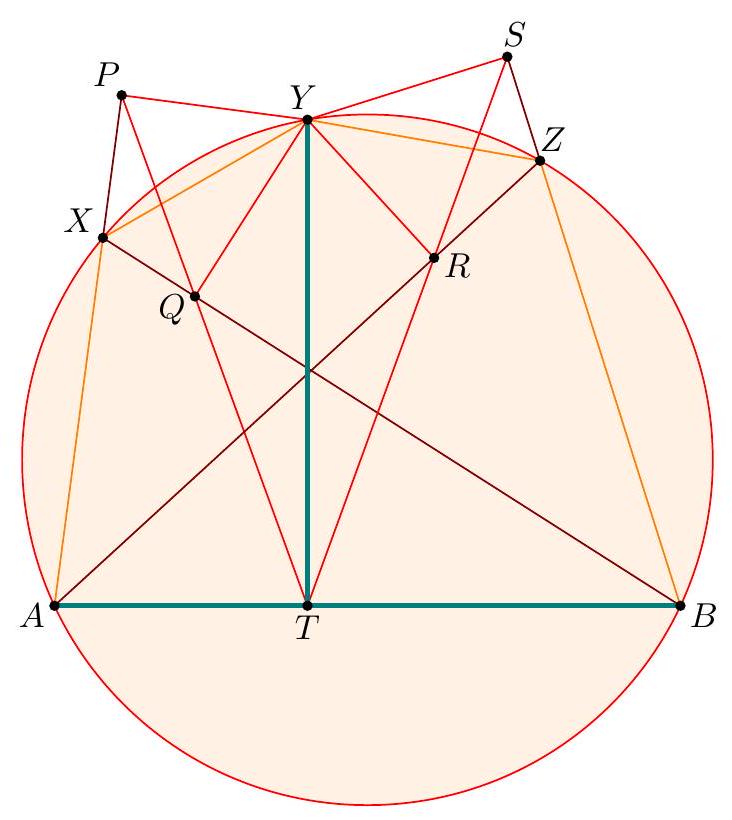
Now it's straightforward to see $A P Y R T$ is cyclic (in the circle with diameter $\overline{A Y}$ ), and therefore
Similarly,
Summing these gives $\angle R T Q$ is equal to half the measure of arc $\widehat{X Z}$ as needed.
§2 Solutions to Day 2
§2.1 JMO 2010/4, proposed by Zuming Feng
Available online at https://aops.com/community/p1860772.
Problem statement
A triangle is called a parabolic triangle if its vertices lie on a parabola $y=x^{2}$. Prove that for every nonnegative integer $n$, there is an odd number $m$ and a parabolic triangle with vertices at three distinct points with integer coordinates with area $\left(2^{n} m\right)^{2}$.
For $n=0$, take instead $(a, b)=(1,0)$. For $n>0$, consider a triangle with vertices at $\left(a, a^{2}\right),\left(-a, a^{2}\right)$ and $\left(b, b^{2}\right)$. Then the area of this triangle was equal to
To make this equal $2^{2 n} m^{2}$, simply pick $a=2^{2 n}$, and then pick $b$ such that $b^{2}-m^{2}=2^{4 n}$, for example $m=2^{4 n-2}-1$ and $b=2^{4 n-2}+1$.
§2.2 JMO 2010/5, proposed by Gregory Galperin
Available online at https://aops.com/community/p1860912.
Problem statement
Two permutations $a_{1}, a_{2}, \ldots, a_{2010}$ and $b_{1}, b_{2}, \ldots, b_{2010}$ of the numbers $1,2, \ldots, 2010$ are said to intersect if $a_{k}=b_{k}$ for some value of $k$ in the range $1 \leq k \leq 2010$. Show that there exist 1006 permutations of the numbers $1,2, \ldots, 2010$ such that any other such permutation is guaranteed to intersect at least one of these 1006 permutations.
A valid choice is the following 1006 permutations:
| 1 | 2 | 3 | $\cdots$ | 1004 | 1005 | 1006 | 1007 | 1008 | $\cdots$ | 2009 | 2010 |
|---|---|---|---|---|---|---|---|---|---|---|---|
| 2 | 3 | 4 | $\cdots$ | 1005 | 1006 | 1 | 1007 | 1008 | $\cdots$ | 2009 | 2010 |
| 3 | 4 | 5 | $\cdots$ | 1006 | 1 | 2 | 1007 | 1008 | $\cdots$ | 2009 | 2010 |
| $\vdots$ | $\vdots$ | $\vdots$ | $\ddots$ | $\vdots$ | $\vdots$ | $\vdots$ | $\vdots$ | $\vdots$ | $\vdots$ | $\vdots$ | $\vdots$ |
| 1004 | 1005 | 1006 | $\cdots$ | 1001 | 1002 | 1003 | 1007 | 1008 | $\cdots$ | 2009 | 2010 |
| 1005 | 1006 | 1 | $\cdots$ | 1002 | 1003 | 1004 | 1007 | 1008 | $\cdots$ | 2009 | 2010 |
| 1006 | 1 | 2 | $\cdots$ | 1003 | 1004 | 1005 | 1007 | 1008 | $\cdots$ | 2009 | 2010 |
This works. Indeed, any permutation should have one of ${1,2, \ldots, 1006}$ somewhere in the first 1006 positions, so one will get an intersection.
Remark. In fact, the last 1004 entries do not matter with this construction, and we chose to leave them as $1007,1008, \ldots, 2010$ only for concreteness.
Remark. Using Hall's marriage lemma one may prove that the result becomes false with 1006 replaced by 1005 .
§2.3 JMO 2010/6, proposed by Zuming Feng
Available online at https://aops.com/community/p1860753.
Problem statement
Let $A B C$ be a triangle with $\angle A=90^{\circ}$. Points $D$ and $E$ lie on sides $A C$ and $A B$, respectively, such that $\angle A B D=\angle D B C$ and $\angle A C E=\angle E C B$. Segments $B D$ and $C E$ meet at $I$. Determine whether or not it is possible for segments $A B, A C, B I$, $I D, C I, I E$ to all have integer lengths.
The answer is no. We prove that it is not even possible that $A B, A C, C I, I B$ are all integers.

First, we claim that $\angle B I C=135^{\circ}$. To see why, note that
So, $\angle B I C=180^{\circ}-(\angle I B C+\angle I C B)=135^{\circ}$, as desired. We now proceed by contradiction. The Pythagorean theorem implies
and so $B C^{2}$ is an integer. However, the law of cosines gives
which is irrational, and this produces the desired contradiction.