| # JMO 2010 Solution Notes |
|
|
| Evan Chen《陳誼廷》 |
|
|
| 15 April 2024 |
|
|
|
|
| #### Abstract |
|
|
| This is a compilation of solutions for the 2010 JMO. The ideas of the solution are a mix of my own work, the solutions provided by the competition organizers, and solutions found by the community. However, all the writing is maintained by me. |
|
|
| These notes will tend to be a bit more advanced and terse than the "official" solutions from the organizers. In particular, if a theorem or technique is not known to beginners but is still considered "standard", then I often prefer to use this theory anyways, rather than try to work around or conceal it. For example, in geometry problems I typically use directed angles without further comment, rather than awkwardly work around configuration issues. Similarly, sentences like "let $\mathbb{R}$ denote the set of real numbers" are typically omitted entirely. |
|
|
| Corrections and comments are welcome! |
|
|
|
|
| ## Contents |
|
|
| 0 Problems |
| 1 Solutions to Day 1 |
| 1.1 JMO 2010/1, proposed by Andy Niedermier ..... 3 |
| 1.2 JMO 2010/2, proposed by Răzvan Gelca ..... 4 |
| 1.3 JMO 2010/3, proposed by Titu Andreescu |
| 2 Solutions to Day 2 ..... 7 |
| 2.1 JMO 2010/4, proposed by Zuming Feng ..... 7 |
| 2.2 JMO 2010/5, proposed by Gregory Galperin ..... 8 |
| 2.3 JMO 2010/6, proposed by Zuming Feng ..... 9 |
|
|
| ## §0 Problems |
|
|
| 1. Let $P(n)$ be the number of permutations $\left(a_{1}, \ldots, a_{n}\right)$ of the numbers $(1,2, \ldots, n)$ for which $k a_{k}$ is a perfect square for all $1 \leq k \leq n$. Find with proof the smallest $n$ such that $P(n)$ is a multiple of 2010 . |
| 2. Let $n>1$ be an integer. Find, with proof, all sequences $x_{1}, x_{2}, \ldots, x_{n-1}$ of positive integers with the following three properties: |
| (a) $x_{1}<x_{2}<\cdots<x_{n-1}$; |
| (b) $x_{i}+x_{n-i}=2 n$ for all $i=1,2, \ldots, n-1$; |
| (c) given any two indices $i$ and $j$ (not necessarily distinct) for which $x_{i}+x_{j}<2 n$, there is an index $k$ such that $x_{i}+x_{j}=x_{k}$. |
| 3. Let $A X Y Z B$ be a convex pentagon inscribed in a semicircle of diameter $A B$. Denote by $P, Q, R, S$ the feet of the perpendiculars from $Y$ onto lines $A X, B X$, $A Z, B Z$, respectively. Prove that the acute angle formed by lines $P Q$ and $R S$ is half the size of $\angle X O Z$, where $O$ is the midpoint of segment $A B$. |
| 4. A triangle is called a parabolic triangle if its vertices lie on a parabola $y=x^{2}$. Prove that for every nonnegative integer $n$, there is an odd number $m$ and a parabolic triangle with vertices at three distinct points with integer coordinates with area $\left(2^{n} m\right)^{2}$ 。 |
| 5. Two permutations $a_{1}, a_{2}, \ldots, a_{2010}$ and $b_{1}, b_{2}, \ldots, b_{2010}$ of the numbers $1,2, \ldots, 2010$ are said to intersect if $a_{k}=b_{k}$ for some value of $k$ in the range $1 \leq k \leq 2010$. Show that there exist 1006 permutations of the numbers $1,2, \ldots, 2010$ such that any other such permutation is guaranteed to intersect at least one of these 1006 permutations. |
| 6. Let $A B C$ be a triangle with $\angle A=90^{\circ}$. Points $D$ and $E$ lie on sides $A C$ and $A B$, respectively, such that $\angle A B D=\angle D B C$ and $\angle A C E=\angle E C B$. Segments $B D$ and $C E$ meet at $I$. Determine whether or not it is possible for segments $A B, A C, B I$, $I D, C I, I E$ to all have integer lengths. |
| |
| ## §1 Solutions to Day 1 |
| |
| ## §1.1 JMO 2010/1, proposed by Andy Niedermier |
| |
| Available online at https://aops.com/community/p1860909. |
| |
| ## Problem statement |
| |
| Let $P(n)$ be the number of permutations $\left(a_{1}, \ldots, a_{n}\right)$ of the numbers $(1,2, \ldots, n)$ for which $k a_{k}$ is a perfect square for all $1 \leq k \leq n$. Find with proof the smallest $n$ such that $P(n)$ is a multiple of 2010. |
| |
| The answer is $n=4489$. |
| We begin by giving a complete description of $P(n)$ : |
| |
| Claim - We have |
| |
| $$ |
| P(n)=\prod_{c \text { squarefree }}\left\lfloor\sqrt{\frac{n}{c}}\right\rfloor! |
| $$ |
| |
| Proof. Every positive integer can be uniquely expressed in the form $c \cdot m^{2}$ where $c$ is a squarefree integer and $m$ is a perfect square. So we may, for each squarefree positive integer $c$, define the set |
| |
| $$ |
| S_{c}=\left\{c \cdot 1^{2}, c \cdot 2^{2}, c \cdot 3^{2}, \ldots\right\} \cap\{1,2, \ldots, n\} |
| $$ |
| |
| and each integer from 1 through $n$ will be in exactly one $S_{c}$. Note also that |
| |
| $$ |
| \left|S_{c}\right|=\left\lfloor\sqrt{\frac{n}{c}}\right\rfloor . |
| $$ |
| |
| Then, the permutations in the problem are exactly those which send elements of $S_{c}$ to elements of $S_{c}$. In other words, |
| |
| $$ |
| P(n)=\prod_{c \text { squarefree }}\left|S_{c}\right|!=\prod_{c \text { squarefree }}\left\lfloor\sqrt{\frac{n}{c}}\right\rfloor! |
| $$ |
| |
| We want the smallest $n$ such that 2010 divides $P(n)$. |
| |
| - Note that $P\left(67^{2}\right)$ contains 67 ! as a term, which is divisible by 2010 , so $67^{2}$ is a candidate. |
| - On the other hand, if $n<67^{2}$, then no term in the product for $P(n)$ is divisible by the prime 67 . |
| |
| So $n=67^{2}=4489$ is indeed the minimum. |
| |
| ## §1.2 JMO 2010/2, proposed by Răzvan Gelca |
| |
| Available online at https://aops.com/community/p1860914. |
| |
| ## Problem statement |
| |
| Let $n>1$ be an integer. Find, with proof, all sequences $x_{1}, x_{2}, \ldots, x_{n-1}$ of positive integers with the following three properties: |
| (a) $x_{1}<x_{2}<\cdots<x_{n-1}$; |
| (b) $x_{i}+x_{n-i}=2 n$ for all $i=1,2, \ldots, n-1$; |
| (c) given any two indices $i$ and $j$ (not necessarily distinct) for which $x_{i}+x_{j}<2 n$, there is an index $k$ such that $x_{i}+x_{j}=x_{k}$. |
| |
| The answer is $x_{k}=2 k$ only, which obviously work, so we prove they are the only ones. |
| Let $x_{1}<x_{2}<\cdots<x_{n}$ be any sequence satisfying the conditions. Consider: |
| |
| $$ |
| x_{1}+x_{1}<x_{1}+x_{2}<x_{1}+x_{3}<\cdots<x_{1}+x_{n-2} |
| $$ |
| |
| All these are results of condition (c), since $x_{1}+x_{n-2}<x_{1}+x_{n-1}=2 n$. So each of these must be a member of the sequence. |
| However, there are $n-2$ of these terms, and there are exactly $n-2$ terms greater than $x_{1}$ in our sequence. Therefore, we get the one-to-one correspondence below: |
| |
| $$ |
| \begin{aligned} |
| x_{2} & =x_{1}+x_{1} \\ |
| x_{3} & =x_{1}+x_{2} \\ |
| & \vdots \\ |
| x_{n-1} & =x_{1}+x_{n-2} |
| \end{aligned} |
| $$ |
| |
| It follows that $x_{2}=2 x_{1}$, so that $x_{3}=3 x_{1}$ and so on. Therefore, $x_{m}=m x_{1}$. We now solve for $x_{1}$ in condition (b) to find that $x_{1}=2$ is the only solution, and the desired conclusion follows. |
| |
| ## §1.3 JMO 2010/3, proposed by Titu Andreescu |
| |
| Available online at https://aops.com/community/p1860802. |
| |
| ## Problem statement |
| |
| Let $A X Y Z B$ be a convex pentagon inscribed in a semicircle of diameter $A B$. Denote by $P, Q, R, S$ the feet of the perpendiculars from $Y$ onto lines $A X, B X, A Z, B Z$, respectively. Prove that the acute angle formed by lines $P Q$ and $R S$ is half the size of $\angle X O Z$, where $O$ is the midpoint of segment $A B$. |
| |
| We present two possible approaches. The first approach is just "bare-hands" angle chasing. The second approach requires more insight but makes it clearer what is going on; it shows the intersection point of lines $P Q$ and $R S$ is the foot from the altitude from $Y$ to $A B$ using Simson lines. The second approach also has the advantage that it works even if $\overline{A B}$ is not a diameter of the circle. |
| |
| 【 First approach using angle chasing. Define $T=\overline{P Q} \cap \overline{R S}$. Also, let $2 \alpha, 2 \beta, 2 \gamma, 2 \delta$ denote the measures of arcs $\overparen{A X}, \widehat{X Y}, \widehat{Y Z}, \widehat{Z B}$, respectively, so that $\alpha+\beta+\gamma+\delta=90^{\circ}$. |
| 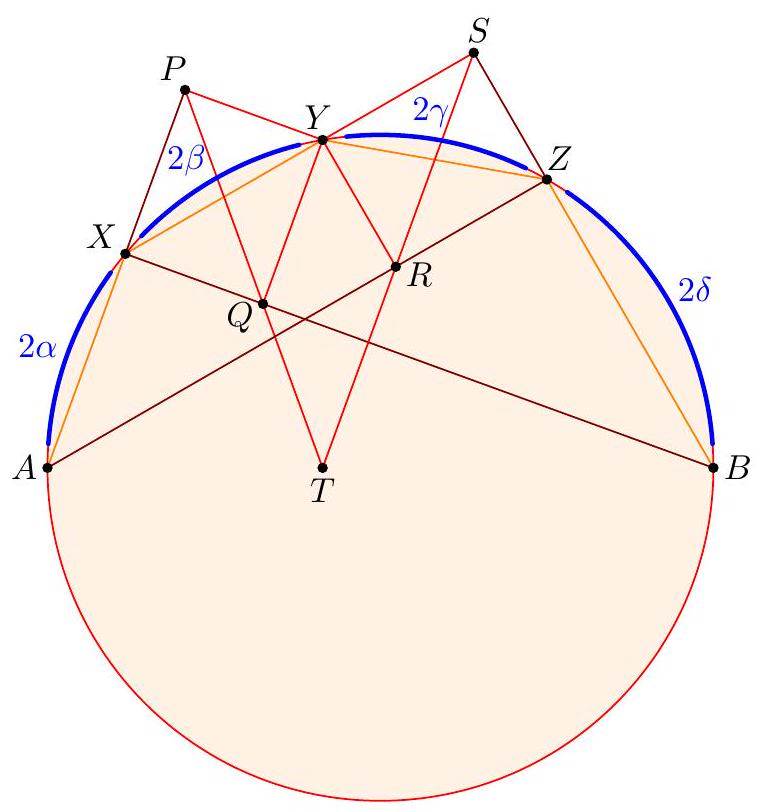 |
| |
| We now compute the following angles: |
| |
| $$ |
| \begin{aligned} |
| & \angle S R Y=\angle S Z Y=90^{\circ}-\angle Y Z A=90^{\circ}-(\alpha+\beta) \\ |
| & \angle Y Q P=\angle Y X P=90^{\circ}-\angle B X Y=90^{\circ}-(\gamma+\delta) \\ |
| & \angle Q Y R=180^{\circ}-\angle(\overline{Z R}, \overline{Q X})=180^{\circ}-\frac{2 \beta+2 \gamma+180^{\circ}}{2}=90^{\circ}-(\beta+\gamma) |
| \end{aligned} |
| $$ |
| |
| Hence, we can then compute |
| |
| $$ |
| \begin{aligned} |
| \angle R T Q & =360^{\circ}-\left(\angle Q Y R+\left(180^{\circ}-\angle S R Y\right)+\left(180^{\circ}-\angle Y Q P\right)\right) \\ |
| & =\angle S R Y+\angle Y Q P-\angle Q Y R \\ |
| & =\left(90^{\circ}-(\alpha+\beta)\right)+\left(90^{\circ}-(\gamma+\delta)\right)-\left(90^{\circ}-(\beta+\gamma)\right) |
| \end{aligned} |
| $$ |
| |
| $$ |
| \begin{aligned} |
| & =90^{\circ}-(\alpha+\delta) \\ |
| & =\beta+\gamma |
| \end{aligned} |
| $$ |
| |
| Since $\angle X O Z=\frac{2 \beta+2 \gamma}{2}=\beta+\gamma$, the proof is complete. |
| 【 Second approach using Simson lines, ignoring the diameter condition. In this solution, we will ignore the condition that $\overline{A B}$ is a diameter; the solution works equally well without it, as long as $O$ is redefined as the center of $(A X Y Z B)$ instead. We will again show the angle formed by lines $P Q$ and $R S$ is half the measure of $\widehat{X Z}$. |
| |
| Unlike the previous solution, we instead define $T$ to be the foot from $Y$ to $\overline{A B}$. Then the Simson line of $Y$ with respect to $\triangle X A B$ passes through $P, Q, T$. Similarly, the Simson line of $Y$ with respect to $\triangle Z A B$ passes through $R, S, T$. Therefore, point $T$ coincides with $\overline{P Q} \cap \overline{R S}$. |
| 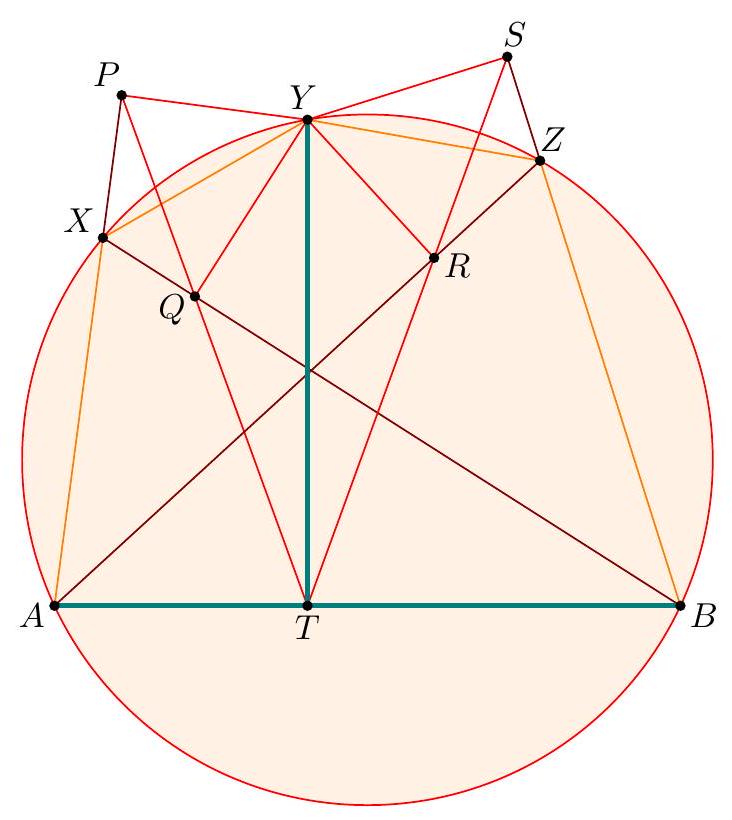 |
| |
| Now it's straightforward to see $A P Y R T$ is cyclic (in the circle with diameter $\overline{A Y}$ ), and therefore |
| |
| $$ |
| \angle R T Y=\angle R A Y=\angle Z A Y |
| $$ |
| |
| Similarly, |
| |
| $$ |
| \angle Y T Q=\angle Y B Q=\angle Y B X |
| $$ |
| |
| Summing these gives $\angle R T Q$ is equal to half the measure of arc $\widehat{X Z}$ as needed. |
| |
| ## §2 Solutions to Day 2 |
| |
| ## §2.1 JMO 2010/4, proposed by Zuming Feng |
| |
| Available online at https://aops.com/community/p1860772. |
| |
| ## Problem statement |
| |
| A triangle is called a parabolic triangle if its vertices lie on a parabola $y=x^{2}$. Prove that for every nonnegative integer $n$, there is an odd number $m$ and a parabolic triangle with vertices at three distinct points with integer coordinates with area $\left(2^{n} m\right)^{2}$. |
| |
| For $n=0$, take instead $(a, b)=(1,0)$. |
| For $n>0$, consider a triangle with vertices at $\left(a, a^{2}\right),\left(-a, a^{2}\right)$ and $\left(b, b^{2}\right)$. Then the area of this triangle was equal to |
| |
| $$ |
| \frac{1}{2}(2 a)\left(b^{2}-a^{2}\right)=a\left(b^{2}-a^{2}\right) . |
| $$ |
| |
| To make this equal $2^{2 n} m^{2}$, simply pick $a=2^{2 n}$, and then pick $b$ such that $b^{2}-m^{2}=2^{4 n}$, for example $m=2^{4 n-2}-1$ and $b=2^{4 n-2}+1$. |
| |
| ## §2.2 JMO 2010/5, proposed by Gregory Galperin |
| |
| Available online at https://aops.com/community/p1860912. |
| |
| ## Problem statement |
| |
| Two permutations $a_{1}, a_{2}, \ldots, a_{2010}$ and $b_{1}, b_{2}, \ldots, b_{2010}$ of the numbers $1,2, \ldots, 2010$ are said to intersect if $a_{k}=b_{k}$ for some value of $k$ in the range $1 \leq k \leq 2010$. Show that there exist 1006 permutations of the numbers $1,2, \ldots, 2010$ such that any other such permutation is guaranteed to intersect at least one of these 1006 permutations. |
| |
| A valid choice is the following 1006 permutations: |
| |
| | 1 | 2 | 3 | $\cdots$ | 1004 | 1005 | 1006 | 1007 | 1008 | $\cdots$ | 2009 | 2010 | |
| | :---: | :---: | :---: | :---: | :---: | :---: | :---: | :---: | :---: | :---: | :---: | :---: | |
| | 2 | 3 | 4 | $\cdots$ | 1005 | 1006 | 1 | 1007 | 1008 | $\cdots$ | 2009 | 2010 | |
| | 3 | 4 | 5 | $\cdots$ | 1006 | 1 | 2 | 1007 | 1008 | $\cdots$ | 2009 | 2010 | |
| | $\vdots$ | $\vdots$ | $\vdots$ | $\ddots$ | $\vdots$ | $\vdots$ | $\vdots$ | $\vdots$ | $\vdots$ | $\vdots$ | $\vdots$ | $\vdots$ | |
| | 1004 | 1005 | 1006 | $\cdots$ | 1001 | 1002 | 1003 | 1007 | 1008 | $\cdots$ | 2009 | 2010 | |
| | 1005 | 1006 | 1 | $\cdots$ | 1002 | 1003 | 1004 | 1007 | 1008 | $\cdots$ | 2009 | 2010 | |
| | 1006 | 1 | 2 | $\cdots$ | 1003 | 1004 | 1005 | 1007 | 1008 | $\cdots$ | 2009 | 2010 | |
| |
| This works. Indeed, any permutation should have one of $\{1,2, \ldots, 1006\}$ somewhere in the first 1006 positions, so one will get an intersection. |
| |
| Remark. In fact, the last 1004 entries do not matter with this construction, and we chose to leave them as $1007,1008, \ldots, 2010$ only for concreteness. |
| |
| Remark. Using Hall's marriage lemma one may prove that the result becomes false with 1006 replaced by 1005 . |
| |
| ## §2.3 JMO 2010/6, proposed by Zuming Feng |
| |
| Available online at https://aops.com/community/p1860753. |
| |
| ## Problem statement |
| |
| Let $A B C$ be a triangle with $\angle A=90^{\circ}$. Points $D$ and $E$ lie on sides $A C$ and $A B$, respectively, such that $\angle A B D=\angle D B C$ and $\angle A C E=\angle E C B$. Segments $B D$ and $C E$ meet at $I$. Determine whether or not it is possible for segments $A B, A C, B I$, $I D, C I, I E$ to all have integer lengths. |
| |
| The answer is no. We prove that it is not even possible that $A B, A C, C I, I B$ are all integers. |
|  |
| |
| First, we claim that $\angle B I C=135^{\circ}$. To see why, note that |
| |
| $$ |
| \angle I B C+\angle I C B=\frac{\angle B}{2}+\frac{\angle C}{2}=\frac{90^{\circ}}{2}=45^{\circ} . |
| $$ |
| |
| So, $\angle B I C=180^{\circ}-(\angle I B C+\angle I C B)=135^{\circ}$, as desired. |
| We now proceed by contradiction. The Pythagorean theorem implies |
| |
| $$ |
| B C^{2}=A B^{2}+A C^{2} |
| $$ |
| |
| and so $B C^{2}$ is an integer. However, the law of cosines gives |
| |
| $$ |
| \begin{aligned} |
| B C^{2} & =B I^{2}+C I^{2}-2 B I \cdot C I \cos \angle B I C \\ |
| & =B I^{2}+C I^{2}+B I \cdot C I \cdot \sqrt{2} . |
| \end{aligned} |
| $$ |
| |
| which is irrational, and this produces the desired contradiction. |
| |
| |


