| 20 |
|
|
| 21 15th Middle European |
|
|
| Mathematical |
|
|
| Olympiad |
|
|
| Croatia |
|
|
| # Problems and Solutions |
|
|
| ## The Problem Selection Committee |
|
|
| The Jury and the Problem Selection Committee selected 12 problems proposed by the following countries: |
|
|
| Problem I-1 Czech Republic |
|
|
| Problem I-2 Slovakia |
|
|
| Problem I-3 Slovakia |
|
|
| Problem I-4 Czech Republic |
|
|
| Problem T-1 Austria |
|
|
| Problem T-2 Croatia |
|
|
| Problem T-3 Czech Republic |
|
|
| Problem T-4 Hungary |
|
|
| Problem T-5 Austria |
|
|
| Problem T-6 Poland |
|
|
| Problem T-7 Croatia |
|
|
| Problem T-8 Slovakia |
|
|
| ## Contents |
|
|
| I Individual Competition ..... 1 |
| Problem I-1 ..... 2 |
| First Solution ..... 2 |
| Second Solution ..... 2 |
| Third Solution ..... 2 |
| Problem I-2 ..... 4 |
| First Solution ..... 4 |
| Second Solution ..... 4 |
| Problem I-3 ..... 6 |
| First solution ..... 6 |
| Second solution ..... 7 |
| Third Solution ..... 7 |
| Problem I-4 ..... 9 |
| Solution ..... 9 |
| II Team Competition ..... 10 |
| Problem T-1 ..... 11 |
| Solution ..... 11 |
| Problem T-2 ..... 12 |
| Solution ..... 12 |
| Problem T-3 ..... 14 |
| Solution ..... 14 |
| Problem T-4 ..... 15 |
| Solution ..... 15 |
| Problem T-5 ..... 17 |
| Solution ..... 17 |
| Problem T-6 ..... 19 |
| First Solution ..... 19 |
| Second Solution ..... 20 |
| Third Solution ..... 20 |
| Problem T-7 ..... 21 |
| Solution ..... 21 |
| Problem T-8 ..... 22 |
| Solution ..... 22 |
|
|
| ## Part I |
|
|
| ## Individual Competition <br> August 25, 2021 |
|
|
| ## Problem I-1 |
|
|
| Determine all real numbers $A$ such that every sequence of non-zero real numbers $x_{1}, x_{2}, \ldots$ satisfying |
|
|
| $$ |
| x_{n+1}=A-\frac{1}{x_{n}} |
| $$ |
|
|
| for every integer $n \geqslant 1$, has only finitely many negative terms. |
|
|
| Answer. All $A \geq 2$ satisfy the given property. |
|
|
| ## First Solution |
|
|
| Let us assume that $A \geqslant 2$ holds and there is some $n \geqslant 1$ with $x_{n}<0$. Then $x_{n+1}>A \geqslant 2$. |
|
|
| We claim that $x_{n+k}>1$ for all $k \geq 1$. This is easily proven by induction: we already did this for $k=1$, and the induction step follows from |
| |
| $$ |
| x_{n+k+1}=A-\frac{1}{x_{n+k}}>A-1 \geqslant 1 |
| $$ |
| |
| Hence, there is at most one negative term if $A \geqslant 2$. |
| |
| Let us assume that $A<2$ holds and there is a sequence $\left(x_{n}\right)$ such that $x_{n}>0$ for all $n \geqslant N$. We write |
| |
| $$ |
| x_{n+2}+2 \leqslant x_{n+2}+x_{n+1}+\frac{1}{x_{n+1}}=x_{n+1}+A |
| $$ |
|
|
| hence $x_{n+2} \leqslant x_{n+1}+(A-2)$ and thus $x_{n+k}<0$ for large enough $k$, contradiction. |
| |
| ## Second Solution |
| |
| The case $A \geqslant 2$ is handled as in the above solution. |
| |
| In the case $A<2$ assume that only finitely many members of the sequence are positive. Without loss of generality we can assume all members are positive. We have that |
| |
| $$ |
| x_{n+1}=A-\frac{1}{x_{n}}<A<2 |
| $$ |
| |
| so the sequence is bounded above. Additionally we have |
| |
| $$ |
| x_{n+1}-x_{n}=\frac{x_{n}-x_{n-1}}{x_{n} x_{n-1}} |
| $$ |
| |
| so the sequence is monotonic due to $x_{n} x_{n-1}>0$. As we have that the sequence is bounded below by 0 and bounded above, we have that it has a limit, denote it $L>0$. Taking the limit of the recursive relation we obtain |
| |
| $$ |
| L=A-\frac{1}{L} \Longrightarrow A=L+\frac{1}{L} \geqslant 2 |
| $$ |
| |
| which is a contradiction. |
| |
| ## Third Solution |
| |
| The case $A \geqslant 2$ is handled as in the above solution. |
| |
| Let us assume that there is a sequence $\left(x_{n}\right)$ such that $x_{n}>0$ for all $n \geqslant N$. Without loss of generality, we may assume that $x_{n}>0$ for all $n \geqslant 0$. Summing the first $n$ equalities we obtain |
|
|
| $$ |
| x_{2}+\ldots+x_{n+1}+\frac{1}{x_{1}}+\ldots+\frac{1}{x_{n}}=n A |
| $$ |
|
|
| Since $x_{k}+\frac{1}{x_{k}} \geqslant 2$ for $k=2, \ldots, n$, we get |
|
|
| $$ |
| 0 \leqslant x_{n+1}+\frac{1}{x_{1}} \leqslant n A-2(n-1)=2-n(2-A) |
| $$ |
|
|
| For large enough $n$ this expression is negative so we get a contradiction. |
|
|
| ## Problem I-2 |
|
|
| Let $m$ and $n$ be positive integers. Some squares of an $m \times n$ board are coloured red. A sequence $a_{1}, a_{2}, \ldots, a_{2 r}$ of $2 r \geqslant 4$ pairwise distinct red squares is called a bishop circuit if for every $k \in\{1, \ldots, 2 r\}$, the squares $a_{k}$ and $a_{k+1}$ lie on a diagonal, but the squares $a_{k}$ and $a_{k+2}$ do not lie on a diagonal (here $a_{2 r+1}=a_{1}$ and $a_{2 r+2}=a_{2}$ ). |
| |
| In terms of $m$ and $n$, determine the maximum possible number of red squares on an $m \times n$ board without a bishop circuit. |
| |
| (Remark. Two squares lie on a diagonal if the line passing through their centres intersects the sides of the board at an angle of $45^{\circ}$.) |
| |
| ## First Solution |
| |
| Obviously, for the tables $1 \times n$ and $n \times 1$, the largest number of black cells is $n$. Therefore, we assume that $m \geq 2$ a $n \geq 2$ for the rest of the solution. In the table $m \times n$, we can color the first two rows, the first column and the last column, which is $2 m+2 n-4$ black cells in total. It is easy to see that such a table contains no bishop circuit. |
| |
| Now we show that if there is no bishop circuit, there are at most $2 m+2 n-4$ black cells in the table $m \times n$. We denote the cell in $i$-th row and $j$-th column by $(i, j)$. The $k$-th positive diagonal is a set of cells $(i, j)$, such that $i+j-1=k$. Similarly, the $k$-th negative diagonal is a set of cells $(i, j)$, such that $n+i-j=k$. |
| |
| Consider a bipartite graph $G$ with partitions |
| |
| $$ |
| A=\left\{a_{1}, a_{2}, \ldots, a_{m+n-1}\right\} \quad \text { and } \quad B=\left\{b_{1}, b_{2}, \ldots, b_{m+n-1}\right\} |
| $$ |
| |
| where the vertices $a_{i}$ and $b_{j}$ are connected by an edge if and only if the cell in the intersection of the $i$-th positive diagonal and the $j$-th negative diagonal is black. Notice that a bishop circuit corresponds to a circuit in $G$ and vice versa. |
| |
| The graph $G$ has at least two components: If we color the cells of the table alternately green and red like in chess, then the edges of $G$ corresponding to green cells lie in a different component that the edges of $G$ corresponding to red cells - it is not possible to move a bishop between a green and a red cell. |
| |
| Furthermore, $G$ has $2 n+2 m-2$ vertices. If $G$ is acyclic, then $G$ is a forest consisting of at least two trees. Therefore, $G$ contains at most $2 n+2 m-2-2=2 n+2 m-4$ edges and that is the upper bound on the number of black cells we wanted to prove. |
| |
| ## Second Solution |
| |
| Denote by $S$ the coloring configuration from the first proof consisting of the first two rows and the first and the last column of the table. It is easy to see that $S$ does not contain the bishop circle. Also, $S$ is maximal in the sense that if we add any new cell to it, the new coloring will contain a bishop circle. |
| |
| We will show that any optimal coloring $C$ has the same number of cells as $S$ by transforming $C$ to $S$ by iterating the following steps: |
| |
| 1) First we choose any cell $a$ which is in $S$, but not in $C$. If there is no such cell, we are done since maximality of $S$ and optimality of $C$ imply that $S=C$. |
| 2) From the optimality of $C$ it follows that there is a bishop circle $B$ in the coloring $C \cup\{a\}$ containing $a$. Since $S$ does not contain a bishop circle, there is an element $b$ in cycle $B$ which is not in $S$. We replace coloring $C$ with the coloring $\tilde{C}=$ $(C \cup\{a\}) \backslash\{b\}$. |
| |
| To finish the proof, we need to show that $\tilde{C}$ is optimal. For that we need to prove that $B$ is a unique cycle in $C \cup\{a\}$ containing $a$. |
| |
| Assume the opposite. Let $a_{0}, a, a_{1}, \ldots a_{2 r}$ and $b_{0}, a, b_{1}, \ldots b_{2 s}$ be two bishop cycles in $C \cup\{a\}$ such that $a_{0}$ and $b_{1}$ (as well as $a_{1}$ and $b_{0}$ ) are on the same diagonal. Consider the cycle in $C$ (every two consecutive cells are on the same diagonal) |
| |
| $$ |
| a_{0}, b_{1}, b_{2}, \ldots, b_{2 s}, b_{0}, a_{1}, a_{2}, \ldots, a_{2 r} |
| $$ |
| |
| It remains to prove that it contains a bishop circle which will contradict the optimality of $C$. |
| |
| Note that no three consecutive cells are on the same diagonal, so the only problem is if the cells are not pairwise different. Thus we can assume that we can write the cycle in the following form |
| |
| $$ |
| c_{1}, \ldots c_{k}, c_{1}, d_{1}, d_{2}, \ldots, d_{t-1} |
| $$ |
| |
| where $t \geq k$. If we remove first $k$ cells we obtain the cycle |
| |
| $$ |
| c_{1}, d_{1}, d_{2}, \ldots, d_{t-1} |
| $$ |
| |
| Furthermore, if $d_{t-1}, c_{1}$ and $d_{1}$ are on the same diagonal, we remove $c_{1}$. By repeating this procedure, we end up with the bishop's circuit. |
| |
| ## Problem I-3 |
| |
| Let $A B C$ be an acute triangle and $D$ an interior point of segment $B C$. Points $E$ and $F$ lie in the half-plane determined by the line $B C$ containing $A$ such that $D E$ is perpendicular to $B E$ and $D E$ is tangent to the circumcircle of $A C D$, while $D F$ is perpendicular to $C F$ and $D F$ is tangent to the circumcircle of $A B D$. Prove that the points $A, D, E$ and $F$ are concyclic. |
| |
| ## First solution |
| |
| Denote by $T$ the intersection point of $B E$ and $C F$. Clearly, $D, E, F, T$ are concyclic because of the right angle $D E T$ and $T F D$. |
| |
|  |
| |
| The tangent line $D E$ gives $\angle A D E=\angle A C D$. Similarly $\angle F D A=\angle D B A$, therefore $\angle F D E=180^{\circ}-\angle B A C$. This gives |
| |
| $$ |
| \angle B T C=\angle E T F=180^{\circ}-\angle E D F=180^{\circ}-\left(180^{\circ}-\angle B A C\right)=\angle B A C |
| $$ |
| |
| which means that $B, C, A, T$ are also concyclic. With this we have |
| |
| $$ |
| \angle A T E=\angle A T B=\angle A C B=\angle A C D=\angle A D E |
| $$ |
| |
| which shows that $A, E, D, T$ are also concyclic. |
| |
| Therefore all points $A, D, E, F, T$ are concyclic. |
| |
| ## Second solution |
| |
| Denote the angles of $A B C$ conventionally by $\alpha, \beta, \gamma$, also let $\angle B A D=x$ and $\angle D A C=y$. As in the previous solution, notice that $\angle F D E=180^{\circ}-\alpha$. It is enough to show that $\angle E A F=\alpha$. |
| |
| Because of the tangent line $D E$, it holds that $\angle D B E=90^{\circ}-\angle E D B=90^{\circ}-y$, and analogously $\angle F C D=90^{\circ}-x$. |
| |
| We will show that it cannot happen that both points $E$ and $F$ lie inside or outside $A B C$. If they both were outside, we would have $\angle D B E>\angle A B D$ and $\angle F C D>\angle A C D$, in other words $90^{\circ}-y>\beta$ and $90^{\circ}-x>\gamma$. The sum of these inequalities gives $180^{\circ}-x-y>\beta+\gamma$, which is a contradiction, since $x+y=\alpha$. Analogously, $E, F$, cannot be both inside. |
| |
|  |
| |
| Without loss of generality assume that $E$ is not outside $A B C$ (i.e. it is inside or on $A B$ ) and $F$ is not inside (i.e. it is outside or an $A C$ ). In order to show that $\angle E A F=\alpha$, it remains to show that triangles $A E B$ and $A F C$ are similar. |
| |
| We have $\angle E B A=\beta-\left(90^{\circ}-x\right)$ and $\angle F C A=\left(90^{\circ}-y\right)-\gamma$. These two angles are equal, since |
| |
| $$ |
| \beta-\left(90^{\circ}-x\right)-\left(\left(90^{\circ}-y\right)-\gamma\right)=x+y+\beta+\gamma-180^{\circ}=\alpha+\beta+\gamma-180^{\circ}=0 |
| $$ |
| |
| Now we can finish the proof by calculating ratios: |
| |
| $$ |
| \frac{B E}{C F}=\frac{B D \cdot \sin y}{C D \cdot \sin x}=\frac{B D}{\sin x} \cdot \frac{\sin y}{C D}=\frac{A B}{\sin \angle A D B} \cdot \frac{\sin \angle A D C}{A C}=\frac{A B}{A C} |
| $$ |
| |
| ## Third Solution |
| |
| Let $G$ be the point on the line $F D$ such that the quadrilateral $A D C G$ is cyclic. |
| |
| Since $D F$ is tangent to the circumcircle of $A B D$ we have $\angle G A C=\angle G D C=\angle D A B$. Similarly, since $D E$ is tangent to the circumcircle of $A C D$ we have $\angle G C A=\angle G D A=$ $\angle F D A=\angle D B A$. We hence conclude that the triangles $A B D$ and $A C G$ are spirally similar with center at $A$. |
| |
|  |
| |
| Additionally, since $\angle F G C=\angle D G C=\angle D A C=\angle B D E$ and $\angle B E D=\angle C F G=90^{\circ}$ (and thus $\triangle B E D \sim \triangle C F G$ ), we have that the same spiral similarity maps the point $E$ to point $F$. From this we get $\angle E A F=\angle B A C$. |
| |
| Since $D E$ and $D F$ are tangent to the circumcircles of $A C D$ and $A B D$ respectively, we also have $\angle A D E=\angle A C D$ and $\angle F D A=\angle D B A$. Therefore, |
| |
| $$ |
| \angle F D E=\angle F D A+\angle A D E=\angle D B A+\angle A C D=180^{\circ}-\angle B A C |
| $$ |
| |
| By combining the above equalities, we get that $\angle E A F=\angle B A C=180^{\circ}-\angle F D E$ and thus $A, D, E, F$ are concyclic, as desired. |
| |
| ## Problem I-4 |
| |
| Let $n \geqslant 3$ be an integer. Zagi the squirrel sits at a vertex of a regular $n$-gon. Zagi plans to make a journey of $n-1$ jumps such that in the $i$-th jump, it jumps by $i$ edges clockwise, for $i \in\{1, \ldots, n-1\}$. Prove that if after $\left\lceil\frac{n}{2}\right\rceil$ jumps Zagi has visited $\left\lceil\frac{n}{2}\right\rceil+1$ distinct vertices, then after $n-1$ jumps Zagi will have visited all of the vertices. |
| |
| (Remark. For a real number $x$, we denote by $\lceil x\rceil$ the smallest integer larger or equal to $x$.) |
| |
| ## Solution |
| |
| Number the vertices $0,1, \ldots, n-1$ clockwise starting at the vertex Zagi is on. After his $i$-th jump Zagi will be at a vertex numbered $1+2+\cdots+i=\frac{i(i+1)}{2}(\bmod n)$. We need to prove that if for all $k \in\left\{0,1,2, \ldots,\left\lceil\frac{n}{2}\right\rceil\right\}$ the fractions $\frac{k(k+1)}{2}$ achieve different values modulo $n$ then they achieve different values modulo $n$ even for all $k \in\{0,1,2, \ldots, n-1\}$. We will in fact prove two following claims: |
| |
| - for numbers of the form $n=2^{r}$, with $r \geq 2$, all $k \in\{0,1,2, \ldots, n-1\}$ the fractions $\frac{k(k+1)}{2}$ achieve different values mod $n$; |
| - for numbers of the form $n=2^{r} \cdot l$, with $r \geq 0$ and $l \geq 3$ odd, we have that there exist distinct $a, b \in\left\{0,1,2, \ldots,\left\lceil\frac{n}{2}\right\rceil\right\}$ such that $\frac{a(a+1)}{2} \equiv \frac{b(b+1)}{2}(\bmod n)$. |
| |
| Let us firstly observe $n$ of the form $2^{r}$, with $r \geq 2$. Let as assume that there are $1 \leq$ $b<a \leq n-1$ such that $\frac{a(a+1)}{2} \equiv \frac{b(b+1)}{2}\left(\bmod 2^{r}\right)$. Equivalently, $2^{r+1} \mid(a-b)(a+b+1)$. Factors on the right hand side have different parity, thus we have either $2^{r+1} \mid a-b$ or $2^{r+1} \mid a+b+1$. In the first case we have that $a-b \leq n-1<2 n$. In the second case we have $a+b+1 \leq(n-1)+(n-2)+1=2 n-2<2 n$. Hence, in both cases we obtain contradiction, and we can conclude that there indeed do not exist such $a$ and $b$. |
| |
| Let us now observe $n$ of the form $2^{r} \cdot l$, with $r \geq 0, l \geq 3$ odd. Set $M=\max \left\{2^{r+1}, l\right\}$ and $m=\min \left\{2^{r+1}, l\right\}$. We claim that the pair $(a, b)=\left(\frac{M+m-1}{2}, \frac{M-m-1}{2}\right)$ satisfies the desired conditions. Indeed: |
| |
| - Since $2^{r+1}$ is even and $l$ is odd, both $M+m-1$ and $M-m-1$ are even and thus $a, b$ are integers. |
| - We have: $\frac{a(a+1)}{2}-\frac{b(b+1)}{2}=\frac{1}{2}(a-b)(a+b+1)=\frac{1}{2} m \cdot M=2^{r} l=n$. |
| - Since $M>m>0$, we have $0 \leq b<a$. |
| |
| It remains to argue that $a \leq\left\lceil\frac{n}{2}\right\rceil$. Since $r \geq 0$ and $l \geq 3$ we conclude that both $m, M$ greater or equal to $\min \left\{2^{r+1}, l\right\} \geq 2$. From $m N=2 n$, they are both less or equal to $n$. So we have inequality $(m-n)(m-2) \leq 0$, which implies $m+M=m+\frac{2 n}{m} \leq 2+n$. Hence $a=\frac{M+m-1}{2} \leq \frac{n+1}{2} \leq\left\lceil\frac{n}{2}\right\rceil$ as desired. |
| |
| ## Part II |
| |
| ## Team Competition August 26, 2021 |
| |
| ## Problem T -1 |
| |
| Determine all functions $f: \mathbb{R} \rightarrow \mathbb{R}$ such that the inequality |
| |
| $$ |
| f\left(x^{2}\right)-f\left(y^{2}\right) \leqslant(f(x)+y)(x-f(y)) |
| $$ |
| |
| holds for all real numbers $x$ and $y$. |
| |
| Answer. We have either $f(x)=x$ for all $x$ or $f(x)=-x$ for all $x$. |
| |
| ## Solution |
| |
| It is easy to verify that the claimed solutions satisfy the desired inequality for all real numbers $x$ and $y$. |
| |
| Plugging in $x=y=0$ we get |
| |
| $$ |
| 0 \leqslant-(f(0))^{2} |
| $$ |
| |
| which implies $f(0)=0$. |
| |
| Now setting $y=0$ we obtain |
| |
| $$ |
| f\left(x^{2}\right) \leqslant x f(x) |
| $$ |
| |
| On the other hand setting $x=0$, we get |
| |
| $$ |
| -f\left(y^{2}\right) \leqslant-y f(y) |
| $$ |
| |
| Therefore |
| |
| $$ |
| f\left(x^{2}\right)=x f(x) |
| $$ |
| |
| holds for all real $x$. Replacing $x$ here with $-x$ and comparing the expressions we obtain $-x f(-x)=x f(x)$. Therefore when $x \neq 0$ we have $f(-x)=-f(x)$. We also know this holds for $x=0$ since we showed $f(0)=0$ so $f$ is an odd function. |
| |
| Replacing $x$ with $y$ and $y$ with $-x$ in the original inequality we obtain: |
| |
| $$ |
| \left(f\left(y^{2}\right)-f\left(x^{2}\right)\right) \leqslant(f(y)-x)(y+f(x)) |
| $$ |
| |
| This together with the original inequality implies |
| |
| $$ |
| \left(f\left(x^{2}\right)-f\left(y^{2}\right)\right)=(f(x)+y)(x-f(y)) |
| $$ |
| |
| for all $x, y \in \mathbb{R}$. |
| |
| We further obtain (using (1)), that |
| |
| $$ |
| x f(x)-y f(y)=(f(x)+y)(x-f(y)) |
| $$ |
| |
| which after expanding implies |
| |
| $$ |
| 0=x y-f(x) f(y) |
| $$ |
| |
| for all reals $x$ and $y$. |
| |
| Setting $y=1$, we get $x=f(x) f(1)$ for all $x \in \mathbb{R}$. Choosing $x=1$ implies $f(1)= \pm 1$. |
| |
| ## Problem T-2 |
| |
| Given a positive integer $n$, we say that a polynomial $P$ with real coefficients is $n$-pretty if the equation $P(\lfloor x\rfloor)=\lfloor P(x)\rfloor$ has exactly $n$ real solutions. Show that for each positive integer $n$ |
| |
| (a) there exists an $n$-pretty polynomial; |
| |
| (b) any $n$-pretty polynomial has a degree of at least $\frac{2 n+1}{3}$. |
| |
| (Remark. For a real number $x$, we denote by $\lfloor x\rfloor$ the largest integer smaller than or equal to $x$. ) |
| |
| ## Solution |
| |
| We begin by making some preliminary observations. Let $P$ be a real polynomial. We associate to it the sets |
| |
| $$ |
| S(P)=\{x \in \mathbb{R} \mid P(\lfloor x\rfloor)=\lfloor P(x)\rfloor\} \text { and } I(P)=\{x \in \mathbb{Z} \mid P(x) \in \mathbb{Z}\} |
| $$ |
| |
| Then it is easily seen that |
| |
| $$ |
| S(P)=I(P) \cup \bigcup_{i \in I(P)}\{x \in(i, i+1) \mid P(x) \in[P(i), P(i)+1)\} |
| $$ |
| |
| (i) We claim that $P(x)=-\sqrt{2}(x-1)^{2}(x-2)^{2} \cdot \ldots \cdot(x-n)^{2}$ is $n$-pretty. Indeed, we will show that $S(P)=\{1,2, \ldots, n\}$. To see this, first observe that for all $x \in \mathbb{R}$ we have $P(x) \leqslant 0$, with equality iff $x \in\{1,2, \ldots, n\}$. It follows that $I(P) \supseteq\{1,2, \ldots, n\}$, but $I(P) \subseteq\{1,2, \ldots, n\}$ is also immediate because $\sqrt{2}$ is irrational. Hence, we have $I(P)=\{1,2, \ldots, n\}$. Finally, if $i \in I(P)$ and $x \in(i, i+1)$, then $P(x)<0$, so $P(x) \notin$ $[P(i), P(i)+1)$. The claim now follows by $(\dagger)$. |
| |
| (ii) Suppose $P$ is a real polynomial with $|S(P)|=n$. It follows from ( $\dagger$ ) that we may write $I(P)=\left\{i_{1}, i_{2}, \ldots, i_{k}\right\}$ for some positive integer $k$. Furthermore, if we define |
| |
| $$ |
| S_{j}=\left\{x \in\left(i_{j}, i_{j}+1\right) \mid P(x) \in\left[P\left(i_{j}\right), P\left(i_{j}\right)+1\right)\right\} |
| $$ |
| |
| for $1 \leqslant j \leqslant k$, then $(\dagger)$ can be rewritten as |
| |
| $$ |
| S(P)=I(P) \cup \bigcup_{j=1}^{k} S_{j} |
| $$ |
| |
| Claim 1. $k \leqslant d$ |
| |
| Proof: Suppose that $k \geq d+1$ holds. By the Lagrange interpolation formula, we have |
| |
| $$ |
| P(x)=\sum_{j=1}^{d+1} P\left(i_{j}\right) \prod_{l \neq j} \frac{x-i_{l}}{i_{j}-i_{l}} |
| $$ |
| |
| Hence, $P$ has rational coefficients, so we can write $P(x)=\frac{Q(x)}{M}$, where $M$ is a positive integer and $Q$ has integer coefficients. Then $i_{1}+M \mathbb{Z} \subseteq I(P)$, so $I(P)$ is infinite, which |
| is a contradiction. |
| |
| Claim 2. For each $1 \leqslant j \leqslant k$, we have $P(x) \leqslant P\left(i_{j}\right)$ for all $x \in\left[i_{j}, i_{j}+1\right)$. |
| |
| Proof: Suppose not and pick $x \in\left(i_{j}, i_{j}+1\right)$ such that $P(x)>P\left(i_{j}\right)$. Note that $P$ is continuous, so by the intermediate value theorem, there exists $y \in\left(i_{j}, x\right)$ such that $P(y)=\min \left(\frac{P(x)+P\left(i_{j}\right)}{2}, P\left(i_{j}\right)+\frac{1}{2}\right) \in\left(P\left(i_{j}\right), P\left(i_{j}\right)+1\right)$. By continuity of $P$, there exists $\delta>0$ such that $(y-\delta, y+\delta) \subseteq S_{j}$. By ( ††), S(P) is infinite, which is a contradiction. |
|
|
| Claim 3. For each $1 \leqslant j \leqslant k, P^{\prime}$ has at least $2\left|S_{j}\right|$ zeroes in $\left(i_{j}, i_{j}+1\right)$. |
| |
| Proof: Indeed, fix $j \in\{1, \ldots, k\}$ and let $S_{j}=\left\{x_{1}, \ldots, x_{m}\right\}$, where we may assume $i_{j}<x_{1}<\ldots<x_{m}<i_{j}+1$. By Claim 2, we have $P\left(x_{\ell}\right)=P\left(i_{j}\right)$ for all $1 \leqslant \ell \leqslant m$. Then note that each $x_{\ell}$ is zero of $P^{\prime}$ since it is a local maximum of $P$. Letting $x_{0}=i_{j}$, note that $P\left(x_{\ell-1}\right)=P\left(x_{\ell}\right)$, so Rolle's theorem implies that $\left(x_{\ell-1}, x_{\ell}\right)$ contains at least one zero of $P^{\prime}$ for each $1 \leqslant \ell \leqslant m$. In total, there are at least $2 m$ zeroes of $P^{\prime}$ in $\left(i_{j}, i_{j}+1\right)$. |
| |
| Finally, ( $\dagger \dagger$ ) implies that $\sum_{j=1}^{k}\left|S_{j}\right|=n-k$. It follows from Claim 1 that $P$ is nonconstant, so $P^{\prime}$ has at most $d-1$ zeroes. Hence, Claim 3 implies that $2 \sum_{j=1}^{k}\left|S_{j}\right| \leqslant d-1$. Therefore, $2(n-k) \leqslant d-1$, so using Claim 1 we get $2(n-d) \leqslant d-1$. The desired conclusion follows. |
| |
| ## Problem T -3 |
| |
| Let $n, b$ and $c$ be positive integers. A group of $n$ pirates wants to fairly split their treasure. The treasure consists of $c \cdot n$ identical coins distributed over $b \cdot n$ bags, of which at least $n-1$ bags are initially empty. Captain Jack inspects the contents of each bag and then performs a sequence of moves. In one move, he can take any number of coins from a single bag and put them into one empty bag. Prove that no matter how the coins are initially distributed, Jack can perform at most $n-1$ moves and then split the bags among the pirates such that each pirate gets $b$ bags and $c$ coins. |
| |
| ## Solution |
| |
| We proceed by induction on $n$. The case $n=1$ is trivial. Below we show that using one move we can always create a $b$-tuple of non-empty bags with precisely $c$ coins in total. This finishes the proof as we can put that $b$-tuple of bags aside for one pirate and finish by induction. |
| |
| Sort the non-empty bags by size (the number of coins in them). Take a $b$-tuple $B_{1}$ with $b$ smallest non-empty bags and a $b$-tuple $B_{2}$ with $b$ largest non-empty bags. If $B_{1}$ contains $c$ coins in total, we are done. Otherwise, $B_{1}$ contains fewer than $c$ coins and $B_{2}$ contains more than $c$ coins. One by one, replace a bag in $B_{1}$ by a bag in $B_{2}$. At some point, the number of coins reaches (or exceeds) $c$ for the first time. Suppose this happened when a bag with $x$ coins was replaced by a bag with $y>x$ coins, the other $b-1$ bags in the $b$-tuple containing $a$ coins in total. Then we have $a+x<c \leqslant a+y$. Therefore we can move $a+y-c<y-x \leqslant y$ coins from the last bag to one empty bag which leaves the $b$-tuple with precisely $c$ coins and decreases the number of empty bags by one (if $a+y=c$, i.e. we don't move any coins, we still think of one bag becoming non-empty and containing 0 coins). |
| |
| ## Problem T -4 |
| |
| Let $n$ be a positive integer. Prove that in a regular $6 n$-gon, we can draw $3 n$ diagonals with pairwise distinct ends and partition the drawn diagonals into $n$ triplets so that: |
| |
| - the diagonals in each triplet intersect in one interior point of the polygon and |
| - all these $n$ intersection points are distinct. |
| |
| |
| ## Solution |
| |
| For $n=1$ take the main diagonals. |
| |
| For $n=2$ we have the following construction: |
| |
|  |
| |
| Denote the vertices $A_{1}, A_{2} \ldots, A_{12}$. We will show that the lines $A_{1} A_{4}, A_{2} A_{6}$ and $A_{3} A_{11}$ are concurrent. Let $X$ be the intersection point of $A_{2} A_{6}$ and $A_{3} A_{11}$. By symmetry, $A_{2} A_{3} X$ is isosceles right-angled triangle, so we have $\angle A_{6} A_{2} A_{3}=\angle A_{11} A_{3} A_{2}=45^{\circ}$. Also in the isosceles trapezium $A_{1} A_{2} A_{3} A_{4}$, we have $\angle A_{2} A_{1} A_{4}=\angle A_{3} A_{4} A_{1}=30^{\circ}$. Hence we can calculate the angles in the triangles $A_{1} A_{2} X$ and $A_{3} A_{4} X$ and we see |
| |
| $$ |
| \angle A_{1} X A_{2}+\angle A_{2} X A_{3}+\angle A_{3} X A_{4}=45^{\circ}+90^{\circ}+45^{\circ}=180^{\circ} |
| $$ |
| |
| This shows that $X$ also lies on the line $A_{1} A_{4}$. In a similar manner we show that the lines $A_{5} A_{9}, A_{7} A_{10}$ and $A_{8} A_{12}$ are concurrent. |
| |
| For $n=2^{k}$, we can make the same construction and rotate it $2^{k-1}$ times. |
| |
| Next we give the construction for odd primes $n$. Let $A_{1}, A_{2} \ldots, A_{6 n}$ be the vertices. Take every third main diagonal, starting at $A_{1}$. Now let the other two diagonals for the main diagonal $A_{1} A_{3 n}$ be $A_{2} A_{6 n-1}$ and $A_{3} A_{6 n}$. For the main diagonal $A_{7} A_{3 n+7}$ take $A_{5} A_{8}$ and $A_{6} A_{9}$ and so on. Going around this way we get a correct construction. The figure shows it for $n=3$. |
| |
|  |
| |
| This shows that a construction exist for all odd prime $n$ and in these constructions all the $n$ points lie on main diagonals, and none of them is the midpoint of the $6 n$-gon. For any positive integer $n$ which is not a power of 2 , we can choose an odd prime $p$ that divides $n$. Then we can rotate the construction for $p$ with angle $\frac{360^{\circ}}{6 n}$. around the middle of the $p$-gon. If we rotate it $\frac{n}{p}$-times, then we get a construction for $n$, and all the $n$ intersection points are different. This holds, since all of the points lie on a main diagonal, and these main diagonals are distinct for each rotation. |
| |
| ## Problem T-5 |
| |
| Let $A D$ be the diameter of the circumcircle of an acute triangle $A B C$. The lines through $D$ parallel to $A B$ and $A C$ meet lines $A C$ and $A B$ in points $E$ and $F$, respectively. Lines $E F$ and $B C$ meet at $G$. Prove that $A D$ and $D G$ are perpendicular. |
| |
| ## Solution |
| |
| Let $G^{\prime}$ denote the intersection of the line through $D$ perpendicular to $A D$ with line $B C$. We will use Menelaus' theorem to prove that $E, F$ and $G^{\prime}$ are collinear and hence, $G=G^{\prime}$. |
| |
| 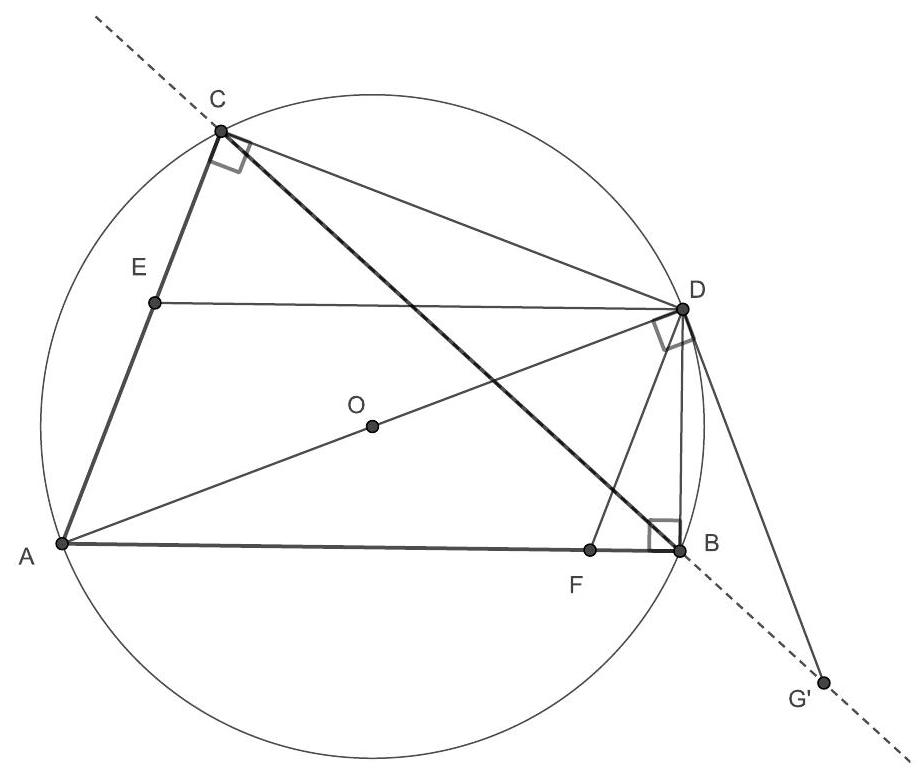 |
| |
| First, observe that because $\angle D B E=\angle F C D=90^{\circ}$ and $\angle D F C=\angle B E D$, triangles $E B D$ and $F C D$ are similar. Let |
| |
| $$ |
| \lambda:=\frac{B E}{C F}=\frac{D B}{D C}=\frac{D E}{D F} |
| $$ |
| |
| Since $A E D F$ is a parallelogram, $\lambda=\frac{D E}{D F}=\frac{F A}{A E}$. |
| |
| By the tangent angle theorem, triangles $G^{\prime} C D$ and $G^{\prime} D B$ are similar. From the sine theorem we obtain |
| |
| $$ |
| \frac{C G^{\prime}}{G^{\prime} D}=\frac{\sin \left(\angle G^{\prime} D C\right)}{\sin \left(\angle D C G^{\prime}\right)}=\frac{\sin (\angle D B C)}{\sin (\angle B C D)}=\frac{D C}{D B} |
| $$ |
| |
| Analogously, we infer $\frac{B G^{\prime}}{G^{\prime} D}=\frac{D B}{D C}$. Therefore, |
| |
| $$ |
| \frac{B G^{\prime}}{G^{\prime} C}=\frac{B G^{\prime}}{G^{\prime} D} \cdot \frac{G^{\prime} D}{C G^{\prime}}=\left(\frac{D B}{D C}\right)^{2}=\lambda^{2} |
| $$ |
| |
| In total, we obtain |
| |
| $$ |
| \frac{C F}{E B} \cdot \frac{A E}{F A} \cdot \frac{B G^{\prime}}{G^{\prime} C}=\frac{1}{\lambda} \cdot \frac{1}{\lambda} \cdot \lambda^{2}=1 |
| $$ |
| |
| and since $E$ and $F$ lie on segments $A B$ and $A C$ by acuteness of $\angle B A C$, and $G^{\prime}$ lies outside of the segment $B C$ by convexity, Menelaus' theorem implies $G=G^{\prime}$ as desired. Thus, $\angle G D A=90^{\circ}$. |
| |
| ## Problem T-6 |
| |
| Let $A B C$ be a triangle and let $M$ be the midpoint of the segment $B C$. Let $X$ be a point on the ray $A B$ such that $2 \angle C X A=\angle C M A$. Let $Y$ be a point on the ray $A C$ such that $2 \angle A Y B=\angle A M B$. The line $B C$ intersects the circumcircle of the triangle $A X Y$ at $P$ and $Q$, such that the points $P, B, C$, and $Q$ lie in this order on the line $B C$. Prove that $P B=Q C$. |
| |
| ## First Solution |
| |
| Let $P^{\prime}$ and $Q^{\prime}$ be points on line $B C$ such that $P^{\prime} M=A M=Q^{\prime} M$ and $B$ and $P^{\prime}$ are on the same side of the line $A M$. |
| |
| We have $\angle P^{\prime} A M=\angle M P^{\prime} A=\frac{1}{2} \angle C M A=\angle C X A$. Therefore points $P^{\prime}, A, C, X$ are concyclic. |
| |
|  |
| |
| This gives us that $B P^{\prime} \cdot B C=B X \cdot B A$. Power of point $B$ with respect to the circumcircle of triangle $A X Y$ gives that $B X \cdot B A=B P \cdot B Q$. By combining the above equalities, we get $B P^{\prime} \cdot B C=B P \cdot B Q$. |
| |
| Analogously as above, by considering point $Q^{\prime}$ instead of $P^{\prime}$, we get that $Q^{\prime}, A, B, Y$ are concyclic and thus $C Q^{\prime} \cdot B C=C P \cdot C Q$. |
| |
| Since $C Q^{\prime}=B P^{\prime}$, we get $B P \cdot B Q=C P \cdot C Q$ which is equivalent to $B P \cdot(B C+C Q)=$ $(B P+B C) \cdot C Q$, which finally gives $B P=C Q$, as desired. |
| |
| ## Second Solution |
| |
| Denote the circumcircle of $A X Y$ by $\omega$. Let $O$ be the center of $\omega$. Let $X C$ and $Y B$ intersect $\omega$ again at $Z$ and $T$, respectively. Note that |
| |
| $$ |
| \angle Z X T=\angle Z X A+\angle A Y T=\frac{1}{2} \angle C M A+\frac{1}{2} \angle A M B=\frac{1}{2} \angle C M B=90^{\circ} |
| $$ |
| |
| and therefore $O$ is the midpoint of $T Z$. |
| |
| Using Pascal's theorem for degenerated hexagon $A A X Z T Y$ we obtain that the intersection of $Z T$ with the tangent line $\ell$ at $A$ to $\omega$ is collinear with the points $A X \cap T Y=B$ and $X Z \cap Y A=C$. In other words, $\ell, Z T$, and $B C$ concur at a single point, which we shall denote by $R$. |
| |
| Let $M^{\prime}$ be the midpoint of $P Q$. Then $M^{\prime}$ is the projection of $O$ onto $P Q$. Points $A, O$, $M^{\prime}$, and $R$ lie on the circle with diameter $O R$. Hence |
| |
| $$ |
| \angle A M^{\prime} B=\angle A O R=2 \angle A Y T=\angle A M B |
| $$ |
| |
| and it follows that $M^{\prime}$ coincides with $M$. |
| |
| Finally, since $B C$ and $P Q$ share their midpoints, we have $P B=Q C$. |
| |
| ## Third Solution |
| |
| Choose a point $D$ on the ray $A M$ beyond the point $M$ such that $D M=B M=C M$. Then |
| |
| $$ |
| \angle A D B=\frac{1}{2} \angle A M B=\angle A Y B |
| $$ |
| |
| hence $A, B, D, Y$ lie on a circle. Similarly, $A, C, D, X$ lie on a circle. Thus $\angle D X B=$ $\angle D C Y$ and $\angle X B D=\angle C Y D$. It follows that $\triangle D X B \sim \triangle D C Y$. Hence |
| |
| $$ |
| \frac{B X}{C Y}=\frac{B D}{D Y} |
| $$ |
| |
| The sine rule yields |
| |
| $$ |
| \frac{B D}{D Y}=\frac{\sin \angle B A D}{\sin \angle D A Y} |
| $$ |
| |
| Moreover, |
| |
| $$ |
| \frac{B M}{A B}=\frac{\sin \angle B A M}{\sin \angle A M B} \quad \text { and } \quad \frac{C M}{A C}=\frac{\sin \angle M A C}{\sin \angle C M A} |
| $$ |
| |
| hence |
| |
| $$ |
| \frac{\sin \angle B A M}{\sin \angle M A C}=\frac{A C}{A B} |
| $$ |
| |
| Combining all of these gives |
| |
| $$ |
| \frac{B X}{C Y}=\frac{A C}{A B} |
| $$ |
| |
| This means $B X \cdot A B=A C \cdot C Y$, i.e. the power of points $B$ and $C$ with respect to the circumcircle of $A X Y$ are equal. Hence $P B \cdot B Q=P C \cdot C Q$, so $P B \cdot(B C+C Q)=$ $(P B+B C) \cdot C Q$. This simplifies to $P B=C Q$. |
| |
| ## Problem T -7 |
| |
| Find all pairs $(n, p)$ of positive integers such that $p$ is prime and |
| |
| $$ |
| 1+2+\cdots+n=3 \cdot\left(1^{2}+2^{2}+\cdots+p^{2}\right) |
| $$ |
| |
| Answer. The only such pair is $(n, p)=(5,2)$. |
| |
| ## Solution |
| |
| The equation can be rewritten as |
| |
| $$ |
| n(n+1)=p(p+1)(2 p+1) |
| $$ |
| |
| We conclude that $p$ divides $n$ or $n+1$, so we divide the solution in two cases. |
| |
| In the first case, if $n=k p$ for some integer $k>0$, then $k(k p+1)=(p+1)(2 p+1)$. Firstly, after observing the equation modulo $p$ we can deduce that $p \mid k-1$. Secondly, the equation can be written as quadratic equation in $p$ : |
| |
| $$ |
| 2 p^{2}+\left(3-k^{2}\right) p+1-k=0 |
| $$ |
| |
| Its discriminant is $D=\left(k^{2}-3\right)^{2}+8(k-1)$. If $k=1$ we obtain $n=p$, but this does not lead to any solution. If $k>1$, then $D$ is strictly greater than $\left(k^{2}-3\right)^{2}$. To be a perfect square, $D$ must be greater than or equal to $\left(k^{2}-2\right)^{2}$. Hence we obtain |
| |
| $$ |
| \left(k^{2}-3\right)^{2}+8(k-1) \geq\left(k^{2}-2\right)^{2} \Longrightarrow 2(k-2)^{2} \geq 5 |
| $$ |
| |
| which holds only for $k=1,2,3$. The case $k=1$ is already solved. The case $k=2$ implies that $p \mid 2-1=1$, which leads to contradiction. In the case $k=3$, we similarly obtain that $p$ must be equal to 2 , but the pair $(k, p)=(3,2)$ does not satisfy the equation $k(k p+1)=(p+1)(2 p+1)$. |
| |
| In the second case, if $p \mid n+1$, then we again introduce positive integer $k$ such that $n+1=k p$ and obtain equation $k(k p-1)=(p+1)(2 p+1)$. Now we have that $p \mid k+1$, and the quadratic equation in terms of $p$ is |
| |
| $$ |
| 2 p^{2}+\left(3-k^{2}\right) p+1+k=0 |
| $$ |
| |
| It discriminant $D=\left(k^{2}-3\right)^{2}-8(k+1)$ is less than $\left(k^{2}-3\right)^{2}$, so it must be less than or equal to $\left(k^{2}-4\right)^{2}$ : |
| |
| $$ |
| \left(k^{2}-3\right)^{2}-8(k+1) \leq\left(k^{2}-4\right)^{2} \Longrightarrow 2(k-2)^{2} \leq 23 |
| $$ |
| |
| We conclude $k \leq 5$. Since $p \mid k+1$, we have that $p$ divides one of the numbers $2,3,4,5,6$, so we have $p \in\{2,3,5\}$. After we plug in those choices for $p$ in (2), we obtain the only solution $(n, p)=(5,2)$. |
| |
| ## Problem T-8 |
| |
| Prove that there are infinitely many positive integers $n$ such that $n^{2}$ written in base 4 contains only digits 1 and 2 . |
| |
| ## Solution |
| |
| We prove that there are infinitely many $n$ 's such that $n^{2}$ written in base 4 contains only 1 and 2 , with the first and last digit being 1 . One example is $n=5$, for which $n^{2}=25=121_{4}$. |
|
|
| Now we describe how for given such $n$ we can obtain another, bigger one, which satisfies these requirements as well. Let $n^{2}$ have $k$ digits in base 4 and satisfy aforementioned requirements. Now let us consider the number $n^{\prime}=2^{2 k-1} n+n$. Then we have |
|
|
| $$ |
| n^{\prime 2}=\left(2^{2 k-1} n+n\right)^{2}=4^{2 k-1} n^{2}+2 \cdot 2^{2 k-1} n^{2}+n^{2}=4^{2 k-1} n^{2}+4^{k} n^{2}+n^{2} |
| $$ |
|
|
| In base 4 this number consists of three copies of $n^{2}$, with the first one $\left(n^{2}\right)$ ending on the right, the second one $\left(4^{k} n^{2}\right)$ ending right before the beginning of first one and the third one ( $4^{2 k-1} n^{2}$ ) overlapping by its last digit with first digit of second one. As both first and last digit of $n^{2}$ are 1 , in this place 2 digits 1 get summed to digit 2. Otherwise there are no other places where two non-zero digits would overlap, neither is there any 'empty space' which would get filled by zeros, so $n^{\prime 2}$ contains only digits 1 and 2. Furthermore, first and last digit of ${n^{\prime 2}}^{2}$ is same as first and last digit of $n^{2}$, so this property also remains. |
|
|
| By repeating this construction one gets an infinite sequence of numbers satisfying the problem statement. |
|
|
|
|


