


Problems and Solutions: INMO-2015
- Let $A B C$ be a right-angled triangle with $\angle B=90^{\circ}$. Let $B D$ be the altitude from $B$ on to $A C$. Let $P, Q$ and $I$ be the incentres of triangles $A B D, C B D$ and $A B C$ respectively. Show that the circumcentre of of the triangle $P I Q$ lies on the hypotenuse $A C$.
Solution: We begin with the following lemma:
Lemma: Let $X Y Z$ be a triangle with $\angle X Y Z=90+\alpha$. Construct an isosceles triangle $X E Z$, externally on the side $X Z$, with base angle $\alpha$. Then $E$ is the circumcentre of $\triangle X Y Z$.
Proof of the Lemma: Draw $E D \perp$ $X Z$. Then $D E$ is the perpendicular bisector of $X Z$. We also observe that $\angle X E D=\angle Z E D=90-\alpha$. Observe that $E$ is on the perpendicular bisector of $X Z$. Construct the circumcircle of $X Y Z$. Draw perpendicular bisector of $X Y$ and let it meet $D E$ in $F$. Then $F$ is the circumcentre of $\triangle X Y Z$. Join $X F$. Then $\angle X F D=90-\alpha$. But we know
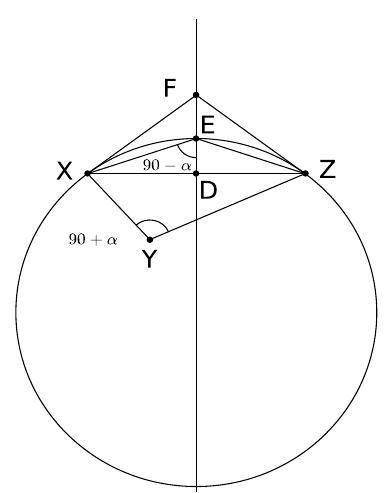 that $\angle X E D=90-\alpha$. Hence $E=F$. Let $r_{1}, r_{2}$ and $r$ be the inradii of the triangles $A B D, C B D$ and $A B C$ respectively. Join $P D$ and $D Q$. Observe that $\angle P D Q=90^{\circ}$. Hence
Let $s_{1}=(A B+B D+D A) / 2$. Observe that $B D=c a / b$ and $A D=$ $\sqrt{A B^{2}-B D^{2}}=\sqrt{c^{2}-\left(\frac{c a}{b}\right)^{2}}=c^{2} / b$. This gives $s_{1}=c s / b$. But $r_{1}=$ $s_{1}-c=(c / b)(s-b)=c r / b$. Similarly, $r_{2}=a r / b$. Hence
Consider $\triangle P I Q$. Observe that $\angle P I Q=90+(B / 2)=135$. Hence $P Q$ subtends $90^{\circ}$ on the circumference of the circumcircle of $\triangle P I Q$. But we have seen that $\angle P D Q=90^{\circ}$. Now construct a circle with $P Q$ as diameter. Let it cut $A C$ again in $K$. It follows that $\angle P K Q=90^{\circ}$ and the points $P, D, K, Q$ are concyclic. We also notice $\angle K P Q=\angle K D Q=45^{\circ}$
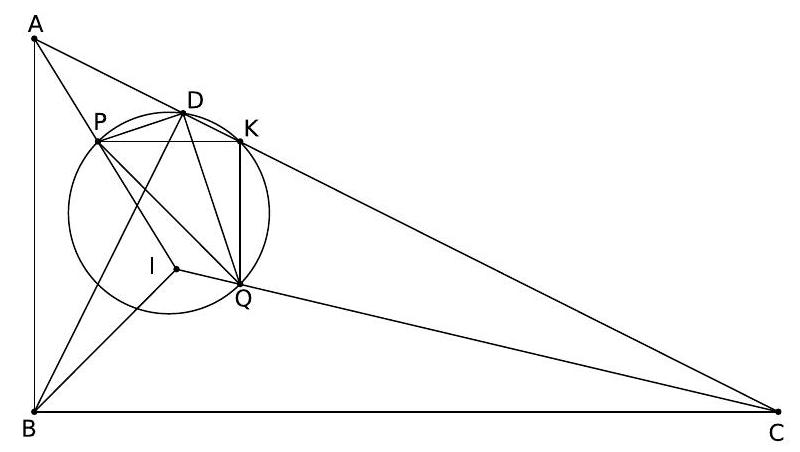 and $\angle P Q K=\angle P D A=45^{\circ}$.
Thus $P K Q$ is an isosceles right-angled triangle with $K P=K Q$. Therfore $K P^{2}+K Q^{2}=P Q^{2}=2 r^{2}$ and hence $K P=K Q=r$.
Now $\angle P I Q=90+45$ and $\angle P K Q=2 \times 45^{\circ}=90^{\circ}$ with $K P=K Q=r$.
Hence $K$ is the circumcentre of $\triangle P I Q$.
(Incidentally, This also shows that $K I=r$ and hence $K$ is the point of contact of the incircle of $\triangle A B C$ with $A C$.)
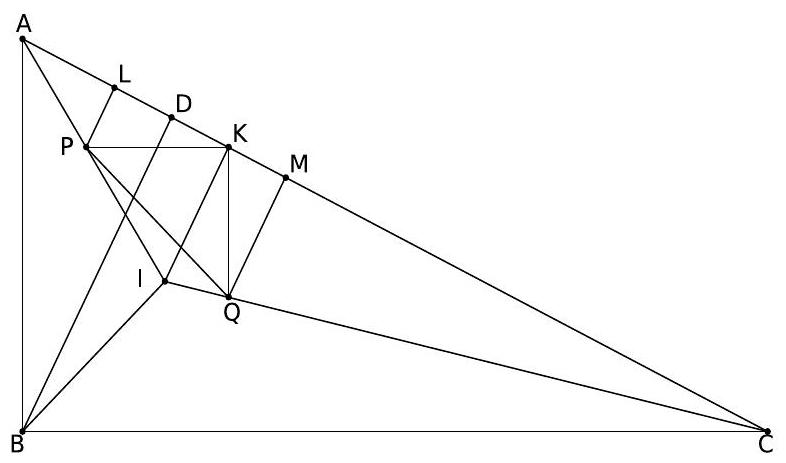
Solution 2: Here we use computation to prove that the point of contact $K$ of the incircle with $A C$ is the circumcentre of $\triangle P I Q$. We show that $K P=K Q=r$. Let $r_{1}$ and $r_{2}$ be the inradii of triangles $A B D$ and $C B D$ respectively. Draw $P L \perp A C$ and $Q M \perp A C$. If $s_{1}$ is the semiperimeter of $\triangle A B D$, then $A L=s_{1}-B D$.
But
Hence $s_{1}=c s / b$. This gives $r_{1}=s_{1}-c=c r / b, A L=s_{1}-B D=c(s-a) / b$. Hence $K L=A K-A L=(s-a)-\frac{c(s-a)}{b}=\frac{(b-c)(s-a)}{b}$. We observe that $2 r^{2}=\frac{(c+a-b)^{2}}{2}=\frac{c^{2}+a^{2}+b^{2}-2 b c-2 a b+2 c a}{2}=\left(b^{2}-b a-b c+a c\right)=(b-c)(b-a)$.
This gives
Thus $K L=r a / b$. Finally,
Thus $K P=r$. Similarly, $K Q=r$. This gives $K P=K I=K Q=r$ and therefore $K$ is the circumcentre of $\triangle K I Q$.
(Incidentally, this also shows that $K L=c a / b=r_{2}$ and $K M=r_{1}$.)
- For any natural number $n>1$, write the infinite decimal expansion of $1 / n$ (for example, we write $1 / 2=0.4 \overline{9}$ as its infinite decimal expansion, not 0.5 ). Determine the length of the non-periodic part of the (infinite) decimal expansion of $1 / n$.
Solution: For any prime $p$, let $\nu_{p}(n)$ be the maximum power of $p$ dividing $n$; ie $p^{\nu_{p}(n)}$ divides $n$ but not higher power. Let $r$ be the length of the non-periodic part of the infinite decimal expansion of $1 / n$.
Write
We show that $r=\max \left(\nu_{2}(n), \nu_{5}(n)\right)$.
Let $a$ and $b$ be the numbers $a_{1} a_{2} \cdots a_{r}$ and $b=b_{1} b_{2} \cdots b_{s}$ respectively. (Here $a_{1}$ and $b_{1}$ can be both 0.) Then
Thus we get $10^{r}\left(10^{s}-1\right)=n\left(\left(10^{s}-1\right) a+b\right)$. It shows that $r \geq$ $\max \left(\nu_{2}(n), \nu_{5}(n)\right)$. Suppose $r>\max \left(\nu_{2}(n), \nu_{5}(n)\right)$. Then 10 divides $b-a$. Hence the last digits of $a$ and $b$ are equal: $a_{r}=b_{s}$. This means
This contradicts the definition of $r$. Therefore $r=\max \left(\nu_{2}(n), \nu_{5}(n)\right)$.
- Find all real functions $f$ from $\mathbb{R} \rightarrow \mathbb{R}$ satisfying the relation
Solution: Put $x=0$ and we get $f(y f(0))=0$. If $f(0) \neq 0$, then $y f(0)$ takes all real values when $y$ varies over real line. We get $f(x) \equiv 0$. Suppose $f(0)=0$. Taking $y=-x$, we get $f\left(x^{2}-x f(x)\right)=0$ for all real $x$.
Suppose there exists $x_{0} \neq 0$ in $\mathbb{R}$ such that $f\left(x_{0}\right)=0$. Putting $x=x_{0}$ in the given relation we get
for all $y \in \mathbb{R}$. Now the left side is a constant and hence it follows that $f$ is a constant function. But the only constant function which satisfies the equation is identically zero function, which is already obtained. Hence we may consider the case where $f(x) \neq 0$ for all $x \neq 0$.
Since $f\left(x^{2}-x f(x)\right)=0$, we conclude that $x^{2}-x f(x)=0$ for all $x \neq 0$. This implies that $f(x)=x$ for all $x \neq 0$. Since $f(0)=0$, we conclude that $f(x)=x$ for all $x \in R$.
Thus we have two functions: $f(x) \equiv 0$ and $f(x)=x$ for all $x \in \mathbb{R}$.
- There are four basket-ball players $A, B, C, D$. Initially, the ball is with $A$. The ball is always passed from one person to a different person. In how many ways can the ball come back to $A$ after seven passes? (For example $A \rightarrow C \rightarrow B \rightarrow D \rightarrow A \rightarrow B \rightarrow C \rightarrow A$ and $A \rightarrow D \rightarrow A \rightarrow D \rightarrow C \rightarrow A \rightarrow B \rightarrow A$ are two ways in which the ball can come back to $A$ after seven passes.)
Solution: Let $x_{n}$ be the number of ways in which $A$ can get back the ball after $n$ passes. Let $y_{n}$ be the number of ways in which the ball goes back to a fixed person other than $A$ after $n$ passes. Then
and
We also have $x_{1}=0, x_{2}=3, y_{1}=1$ and $y_{2}=2$.
Eliminating $y_{n}$ and $y_{n-1}$, we get $x_{n+1}=3 x_{n-1}+2 x_{n}$. Thus
Alternate solution: Since the ball goes back to one of the other 3 persons, we have
since there are $3^{n}$ ways of passing the ball in $n$ passes. Using $x_{n}=$ $3 y_{n-1}$, we obtain
with $x_{1}=0$. Thus
- Let $A B C D$ be a convex quadrilateral. Let the diagonals $A C$ and $B D$ intersect in $P$. Let $P E, P F, P G$ and $P H$ be the altitudes from $P$ on to the sides $A B, B C, C D$ and $D A$ respectively. Show that $A B C D$ has an incircle if and only if
Solution: Let $A P=p, B P=q, C P=r, D P=s ; A B=a, B C=b$, $C D=c$ and $D A=d$. Let $\angle A P B=\angle C P D=\theta$. Then $\angle B P C=\angle D P A=$ $\pi-\theta$. Let us also write $P E=h_{1}, P F=h_{2}, P G=h_{3}$ and $P H=h_{4}$.
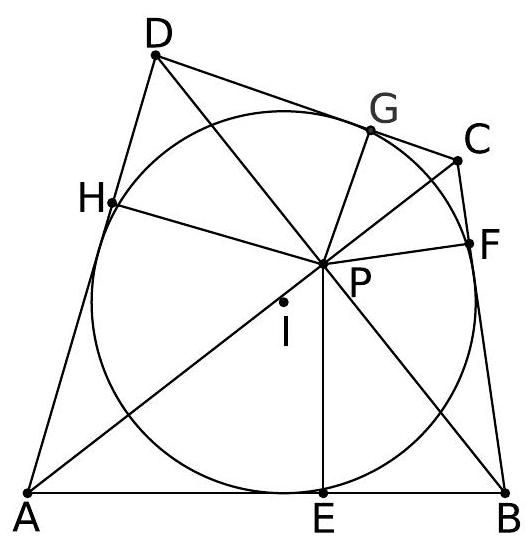
Observe that
Hence
is equivalent to
This is the same as
Thus we have to prove that $a+c=b+d$ if and only if $a r s+c p q=b s p+d q r$. Now we can write $a+c=b+d$ as
But we know that
Hence $a+c=b+d$ is equivalent to
Similarly, by squaring ars $+c p q=b s p+d q r$ we can show that it is equivalent to
We conclude that $a+c=b+d$ is equivalent to $c p q+a r s=b p s+d q r$. Hence $A B C D$ has an in circle if and only if
- From a set of 11 square integers, show that one can choose 6 numbers $a^{2}, b^{2}, c^{2}, d^{2}, e^{2}, f^{2}$ such that
Solution: The first observation is that we can find 5 pairs of squares such that the two numbers in a pair have the same parity. We can see this as follows:
| Odd numbers | Even numbers | Odd pairs | Even pairs | Total pairs |
|---|---|---|---|---|
| 0 | 11 | 0 | 5 | 5 |
| 1 | 10 | 0 | 5 | 5 |
| 2 | 9 | 1 | 4 | 5 |
| 3 | 8 | 1 | 4 | 5 |
| 4 | 7 | 2 | 3 | 5 |
| 5 | 6 | 2 | 3 | 5 |
| 6 | 5 | 3 | 2 | 5 |
| 7 | 4 | 3 | 2 | 5 |
| 8 | 3 | 4 | 1 | 5 |
| 9 | 2 | 4 | 1 | 5 |
| 10 | 1 | 5 | 0 | 5 |
| 11 | 0 | 5 | 0 | 5 |
Let us take such 5 pairs: say $\left(x_{1}^{2}, y_{1}^{2}\right),\left(x_{2}^{2}, y_{2}^{2}\right), \ldots,\left(x_{5}^{2}, y_{5}^{2}\right)$. Then $x_{j}^{2}-y_{j}^{2}$ is divisible by 4 for $1 \leq j \leq 5$. Let $r_{j}$ be the remainder when $x_{j}^{2}-y_{j}^{2}$ is divisible by $3,1 \leq j \leq 3$. We have 5 remainders $r_{1}, r_{2}, r_{3}, r_{4}, r_{5}$. But these can be 0,1 or 2 . Hence either one of the remainders occur 3 times or each of the remainders occur once. If, for example $r_{1}=r_{2}=r_{3}$, then 3 divides $r_{1}+r_{2}+r_{3}$; if $r_{1}=0, r_{2}=1$ and $r_{3}=2$, then again 3 divides $r_{1}+r_{2}+r_{3}$. Thus we can always find three remainders whose sum is divisible by 3 . This means we can find 3 pairs, say, $\left(x_{1}^{2}, y_{1}^{2}\right),\left(x_{2}^{2}, y_{2}^{2}\right),\left(x_{3}^{2}, y_{3}^{2}\right)$ such that 3 divides $\left(x_{1}^{2}-y_{1}^{2}\right)+\left(x_{2}^{2}-y_{2}^{2}\right)+\left(x_{3}^{2}-y_{3}^{2}\right)$. Since each difference is divisible by 4 , we conclude that we can find 6 numbers $a^{2}, b^{2}, c^{2}, d^{2}, e^{2}, f^{2}$ such that