


APMO 1993 - Problems and Solutions
Problem 1
Let $A B C D$ be a quadrilateral such that all sides have equal length and angle $\angle A B C$ is 60 degrees. Let $\ell$ be a line passing through $D$ and not intersecting the quadrilateral (except at $D)$. Let $E$ and $F$ be the points of intersection of $\ell$ with $A B$ and $B C$ respectively. Let $M$ be the point of intersection of $C E$ and $A F$. Prove that $C A^{2}=C M \times C E$.
Solution
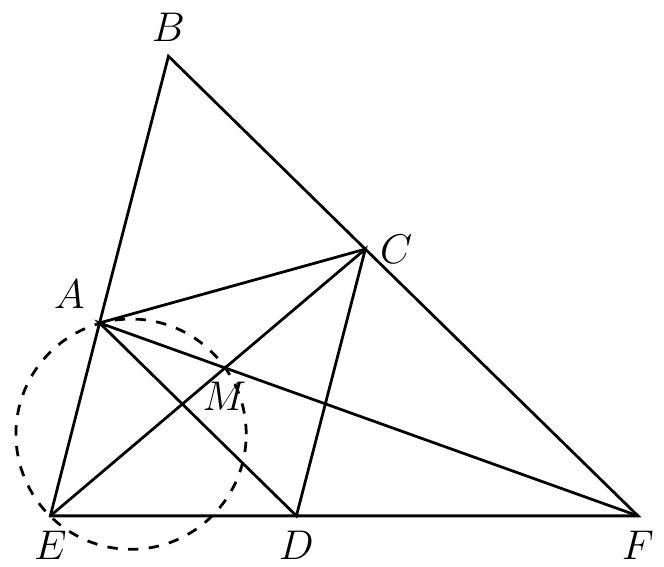
Triangles $A E D$ and $C D F$ are similar, because $A D | C F$ and $A E | C D$. Thus, since $A B C$ and $A C D$ are equilateral triangles,
The last equality combined with
shows that triangles $E A C$ and $A C F$ are also similar. Therefore $\angle C A M=\angle C A F=\angle A E C$, which implies that line $A C$ is tangent to the circumcircle of $A M E$. By the power of a point, $C A^{2}=C M \cdot C E$, and we are done.
Problem 2
Find the total number of different integer values the function
takes for real numbers $x$ with $0 \leq x \leq 100$. Note: $[t]$ is the largest integer that does not exceed $t$. Answer: 734.
Solution
Note that, since $[x+n]=[x]+n$ for any integer $n$,
one only needs to investigate the interval $[0,3)$. The numbers in this interval at which at least one of the real numbers $x, 2 x, \frac{5 x}{3}, 3 x, 4 x$ is an integer are
- $0,1,2$ for $x$;
- $\frac{n}{2}, 0 \leq n \leq 5$ for $2 x$;
- $\frac{3 n}{5}, 0 \leq n \leq 4$ for $\frac{5 x}{3}$;
- $\frac{n}{3}, 0 \leq n \leq 8$ for $3 x$;
- $\frac{n}{4}, 0 \leq n \leq 11$ for $4 x$.
Of these numbers there are
- 3 integers $(0,1,2)$;
- 3 irreducible fractions with 2 as denominator (the numerators are $1,3,5$ );
- 6 irreducible fractions with 3 as denominator (the numerators are $1,2,4,5,7,8$ );
- 6 irreducible fractions with 4 as denominator (the numerators are $1,3,5,7,9,11,13,15$ );
- 4 irreducible fractions with 5 as denominator (the numerators are 3,6,9,12).
Therefore $f(x)$ increases 22 times per interval. Since $100=33 \cdot 3+1$, there are $33 \cdot 22$ changes of value in $[0,99)$. Finally, there are 8 more changes in [99,100]: 99, 100, $99 \frac{1}{2}, 99 \frac{1}{3}, 99 \frac{2}{3}, 99 \frac{1}{4}$, $99 \frac{3}{4}, 99 \frac{3}{5}$. The total is then $33 \cdot 22+8=734$. Comment: A more careful inspection shows that the range of $f$ are the numbers congruent modulo 35 to one of
in the interval $[0, f(100)]=[0,1166]$. Since $1166 \equiv 11(\bmod 35)$, this comprises 33 cycles plus the 8 numbers in the previous list.
Problem 3
Let
be non-zero polynomials with real coefficients such that $g(x)=(x+r) f(x)$ for some real number $r$. If $a=\max \left(\left|a_{n}\right|, \ldots,\left|a_{0}\right|\right)$ and $c=\max \left(\left|c_{n+1}\right|, \ldots,\left|c_{0}\right|\right)$, prove that $\frac{a}{c} \leq n+1$.
Solution
Expanding $(x+r) f(x)$, we find that $c_{n+1}=a_{n}, c_{k}=a_{k-1}+r a_{k}$ for $k=1,2, \ldots, n$, and $c_{0}=r a_{0}$. Consider three cases:
- $r=0$. Then $c_{0}=0$ and $c_{k}=a_{k-1}$ for $k=1,2, \ldots, n$, and $a=c \Longrightarrow \frac{a}{c}=1 \leq n+1$.
- $|r| \geq 1$. Then
and inductively if $\left|a_{k}\right| \leq(k+1) c$
Therefore, $\left|a_{k}\right| \leq(k+1) c \leq(n+1) c$ for all $k$, and $a \leq(n+1) c \Longleftrightarrow \frac{a}{c} \leq n+1$.
- $0<|r|<1$. Now work backwards: $\left|a_{n}\right|=\left|c_{n+1}\right| \leq c$,
and inductively if $\left|a_{n-k}\right| \leq(k+1) c$
Therefore, $\left|a_{n-k}\right| \leq(k+1) c \leq(n+1) c$ for all $k$, and $a \leq(n+1) c$ again.
Problem 4
Determine all positive integers $n$ for which the equation
has an integer as a solution.
Answer: $n=1$.
Solution
If $n$ is even, $x^{n}+(2+x)^{n}+(2-x)^{n}>0$, so $n$ is odd. For $n=1$, the equation reduces to $x+(2+x)+(2-x)=0$, which has the unique solution $x=-4$. For $n>1$, notice that $x$ is even, because $x, 2-x$, and $2+x$ have all the same parity. Let $x=2 y$, so the equation reduces to
Looking at this equation modulo 2 yields that $y+(1+y)+(1-y)=y+2$ is even, so $y$ is even. Using the factorization
which has a sum of $n$ terms as the second factor, the equation is now equivalent to
or
Each of the $n$ terms in the second factor is odd, and $n$ is odd, so the second factor is odd. Therefore, $y^{n}$ has only one factor 2 , which is a contradiction to the fact that, $y$ being even, $y^{n}$ has at least $n>1$ factors 2 . Hence there are no solutions if $n>1$.
Problem 5
Let $P_{1}, P_{2}, \ldots, P_{1993}=P_{0}$ be distinct points in the $x y$-plane with the following properties: (i) both coordinates of $P_{i}$ are integers, for $i=1,2, \ldots, 1993$; (ii) there is no point other than $P_{i}$ and $P_{i+1}$ on the line segment joining $P_{i}$ with $P_{i+1}$ whose coordinates are both integers, for $i=0,1, \ldots, 1992$.
Prove that for some $i, 0 \leq i \leq 1992$, there exists a point $Q$ with coordinates $\left(q_{x}, q_{y}\right)$ on the line segment joining $P_{i}$ with $P_{i+1}$ such that both $2 q_{x}$ and $2 q_{y}$ are odd integers.
Solution
Call a point $(x, y) \in \mathbb{Z}^{2}$ even or odd according to the parity of $x+y$. Since there are an odd number of points, there are two points $P_{i}=(a, b)$ and $P_{i+1}=(c, d), 0 \leq i \leq 1992$ with the same parity. This implies that $a+b+c+d$ is even. We claim that the midpoint of $P_{i} P_{i+1}$ is the desired point $Q$. In fact, since $a+b+c+d=(a+c)+(b+d)$ is even, $a$ and $c$ have the same parity if and only if $b$ and $d$ also have the same parity. If both happen then the midpoint of $P_{i} P_{i+1}, Q=\left(\frac{a+c}{2}, \frac{b+d}{2}\right)$, has integer coordinates, which violates condition (ii). Then $a$ and $c$, as well as $b$ and $d$, have different parities, and $2 q_{x}=a+c$ and $2 q_{y}=b+d$ are both odd integers.