


XIX Asian Pacific Mathematics Olympiad

Problem 1. Let $S$ be a set of 9 distinct integers all of whose prime factors are at most 3. Prove that $S$ contains 3 distinct integers such that their product is a perfect cube.
Solution. Without loss of generality, we may assume that $S$ contains only positive integers. Let
It suffices to show that there are $1 \leq i_{1}, i_{2}, i_{3} \leq 9$ such that
For $n=2^{a} 3^{b} \in S$, let's call $(a(\bmod 3), b(\bmod 3))$ the type of $n$. Then there are 9 possible types:
Let $N(i, j)$ be the number of integers in $S$ of type $(i, j)$. We obtain 3 distinct integers whose product is a perfect cube when (1) $N(i, j) \geq 3$ for some $i, j$, or (2) $N(i, 0) N(i, 1) N(i, 2) \neq 0$ for some $i=0,1,2$, or (3) $N(0, j) N(1, j) N(2, j) \neq 0$ for some $j=0,1,2$, or (4) $N\left(i_{1}, j_{1}\right) N\left(i_{2}, j_{2}\right) N\left(i_{3}, j_{3}\right) \neq 0$, where $\left{i_{1}, i_{2}, i_{3}\right}=\left{j_{1}, j_{2}, j_{3}\right}={0,1,2}$.
Assume that none of the conditions (1) (3) holds. Since $N(i, j) \leq 2$ for all $(i, j)$, there are at least five $N(i, j)$ 's that are nonzero. Furthermore, among those nonzero $N(i, j)$ 's, no three have the same $i$ nor the same $j$. Using these facts, one may easily conclude that the condition (4) should hold. (For example, if one places each nonzero $N(i, j)$ in the $(i, j)$-th box of a regular $3 \times 3$ array of boxes whose rows and columns are indexed by 0,1 and 2 , then one can always find three boxes, occupied by at least one nonzero $N(i, j)$, whose rows and columns are all distinct. This implies (4).)
Second solution. Up to $(\dagger)$, we do the same as above and get 9 possible types:
for $n=2^{a} 3^{b} \in S$. Note that (i) among any 5 integers, there exist 3 whose sum is $0(\bmod 3)$, and that (ii) if $i, j, k \in{0,1,2}$, then $i+j+k \equiv 0(\bmod 3)$ if and only if $i=j=k$ or ${i, j, k}={0,1,2}$.
Let's define $T$ : the set of types of the integers in $S$; $N(i)$ : the number of integers in $S$ of the type $(i, \cdot)$; $M(i)$ : the number of integers $j \in{0,1,2}$ such that $(i, j) \in T$. If $N(i) \geq 5$ for some $i$, the result follows from (i). Otherwise, for some permutation $(i, j, k)$ of $(0,1,2)$,
If $M(i)$ or $M(j)$ is 1 or 3 , the result follows from (ii). Otherwise $M(i)=M(j)=2$. Then either
for some permutation $(x, y, z)$ of $(0,1,2)$. Since $N(k) \geq 1$, at least one of $(k, x),(k, y)$ and $(k, z)$ contained in $T$. Therefore, in any case, the result follows from (ii). (For example, if $(k, y) \in T$, then take $(i, y),(j, y),(k, y)$ or $(i, x),(j, z),(k, y)$ from T.)
Problem 2. Let $A B C$ be an acute angled triangle with $\angle B A C=60^{\circ}$ and $A B>A C$. Let $I$ be the incenter, and $H$ the orthocenter of the triangle $A B C$. Prove that
Solution. Let $D$ be the intersection point of the lines $A H$ and $B C$. Let $K$ be the intersection point of the circumcircle $O$ of the triangle $A B C$ and the line $A H$. Let the line through $I$ perpendicular to $B C$ meet $B C$ and the minor arc $B C$ of the circumcircle $O$ at $E$ and $N$, respectively. We have $\angle B I C=180^{\circ}-(\angle I B C+\angle I C B)=180^{\circ}-\frac{1}{2}(\angle A B C+\angle A C B)=90^{\circ}+\frac{1}{2} \angle B A C=120^{\circ}$ and also $\angle B N C=180^{\circ}-\angle B A C=120^{\circ}=\angle B I C$. Since $I N \perp B C$, the quadrilateral $B I C N$ is a kite and thus $I E=E N$.
Now, since $H$ is the orthocenter of the triangle $A B C, H D=D K$. Also because $E D \perp I N$ and $E D \perp H K$, we conclude that $I H K N$ is an isosceles trapezoid with $I H=N K$.
Hence
Since $I E=E N$ and $B E \perp I N$, the triangles $I B E$ and $N B E$ are congruent. Therefore
and thus
Second solution. Let $P, Q$ and $R$ be the intersection points of $B H, C H$ and $A H$ with $A C, A B$ and $B C$, respectively. Then we have $\angle I B H=\angle I C H$. Indeed,
and
because $\angle A B H=\angle A C H=30^{\circ}$ and $\angle A C B+\angle A B C=120^{\circ}$. (Note that $\angle A B P>\angle A B I$ and $\angle A C I>\angle A C H$ because $A B$ is the longest side of the triangle $A B C$ under the given conditions.) Therefore BIHC is a cyclic quadrilateral and thus
On the other hand,
Therefore,
Problem 3. Consider $n$ disks $C_{1}, C_{2}, \ldots, C_{n}$ in a plane such that for each $1 \leq i<n$, the center of $C_{i}$ is on the circumference of $C_{i+1}$, and the center of $C_{n}$ is on the circumference of $C_{1}$. Define the score of such an arrangement of $n$ disks to be the number of pairs $(i, j)$ for which $C_{i}$ properly contains $C_{j}$. Determine the maximum possible score.
Solution. The answer is $(n-1)(n-2) / 2$. Let's call a set of $n$ disks satisfying the given conditions an $n$-configuration. For an $n$ configuration $\mathcal{C}=\left{C_{1}, \ldots, C_{n}\right}$, let $S_{\mathcal{C}}=\left{(i, j) \mid C_{i}\right.$ properly contains $\left.C_{j}\right}$. So, the score of an $n$-configuration $\mathcal{C}$ is $\left|S_{\mathcal{C}}\right|$.
We'll show that (i) there is an $n$-configuration $\mathcal{C}$ for which $\left|S_{\mathcal{C}}\right|=(n-1)(n-2) / 2$, and that (ii) $\left|S_{\mathcal{C}}\right| \leq(n-1)(n-2) / 2$ for any $n$-configuration $\mathcal{C}$.
Let $C_{1}$ be any disk. Then for $i=2, \ldots, n-1$, take $C_{i}$ inside $C_{i-1}$ so that the circumference of $C_{i}$ contains the center of $C_{i-1}$. Finally, let $C_{n}$ be a disk whose center is on the circumference of $C_{1}$ and whose circumference contains the center of $C_{n-1}$. This gives $S_{\mathcal{C}}={(i, j) \mid 1 \leq i<j \leq n-1}$ of size $(n-1)(n-2) / 2$, which proves (i).
For any $n$-configuration $\mathcal{C}, S_{\mathcal{C}}$ must satisfy the following properties: (1) $(i, i) \notin S_{\mathcal{C}}$, (2) $(i+1, i) \notin S_{\mathcal{C}},(1, n) \notin S_{\mathcal{C}}$, (3) if $(i, j),(j, k) \in S_{\mathcal{C}}$, then $(i, k) \in S_{\mathcal{C}}$, (4) if $(i, j) \in S_{\mathcal{C}}$, then $(j, i) \notin S_{\mathcal{C}}$.
Now we show that a set $G$ of ordered pairs of integers between 1 and $n$, satisfying the conditions $(1) \sim(4)$, can have no more than $(n-1)(n-2) / 2$ elements. Suppose that there exists a set $G$ that satisfies the conditions (1) $\sim(4)$, and has more than $(n-1)(n-2) / 2$ elements. Let $n$ be the least positive integer with which there exists such a set $G$. Note that $G$ must have $(i, i+1)$ for some $1 \leq i \leq n$ or $(n, 1)$, since otherwise $G$ can have at most
elements. Without loss of generality we may assume that $(n, 1) \in G$. Then $(1, n-1) \notin G$, since otherwise the condition (3) yields $(n, n-1) \in G$ contradicting the condition (2). Now let $G^{\prime}={(i, j) \in G \mid 1 \leq i, j \leq n-1}$, then $G^{\prime}$ satisfies the conditions (1) (4), with $n-1$.
We now claim that $\left|G-G^{\prime}\right| \leq n-2$ : Suppose that $\left|G-G^{\prime}\right|>n-2$, then $\left|G-G^{\prime}\right|=n-1$ and hence for each $1 \leq i \leq n-1$, either $(i, n)$ or $(n, i)$ must be in $G$. We already know that $(n, 1) \in G$ and $(n-1, n) \in G$ (because $(n, n-1) \notin G$ ) and this implies that $(n, n-2) \notin G$ and $(n-2, n) \in G$. If we keep doing this process, we obtain $(1, n) \in G$, which is a contradiction.
Since $\left|G-G^{\prime}\right| \leq n-2$, we obtain
This, however, contradicts the minimality of $n$, and hence proves (ii).
Problem 4. Let $x, y$ and $z$ be positive real numbers such that $\sqrt{x}+\sqrt{y}+\sqrt{z}=1$. Prove that
Solution. We first note that
Similarly, we have
We now add (1) (3) to get
Thus, it suffices to show that
Now, assume without loss of generality, that $x \geq y \geq z$. Then we have
and
The last quantity is non-negative due to the fact that
This completes the proof.
Second solution. By Cauchy-Schwarz inequality,
and
We now combine (5) and (6) to find
Thus, it suffices to show that
Consider the following inequality using AM-GM inequality
or equivalently
Similarly, we have
Adding the last three inequalities, we get
This completes the proof.
Problem 5. A regular $(5 \times 5)$-array of lights is defective, so that toggling the switch for one light causes each adjacent light in the same row and in the same column as well as the light itself to change state, from on to off, or from off to on. Initially all the lights are switched off. After a certain number of toggles, exactly one light is switched on. Find all the possible positions of this light.
Solution. We assign the following first labels to the 25 positions of the lights:
| 1 | 1 | 0 | 1 | 1 |
|---|---|---|---|---|
| 0 | 0 | 0 | 0 | 0 |
| 1 | 1 | 0 | 1 | 1 |
| 0 | 0 | 0 | 0 | 0 |
| 1 | 1 | 0 | 1 | 1 |
For each on-off combination of lights in the array, define its first value to be the sum of the first labels of those positions at which the lights are switched on. It is easy to check that toggling any switch always leads to an on-off combination of lights whose first value has the same parity(the remainder when divided by 2) as that of the previous on-off combination.
The $90^{\circ}$ rotation of the first labels gives us another labels (let us call it the second labels) which also makes the parity of the second value(the sum of the second labels of those positions at which the lights are switched on) invariant under toggling.
| 1 | 0 | 1 | 0 | 1 |
|---|---|---|---|---|
| 1 | 0 | 1 | 0 | 1 |
| 0 | 0 | 0 | 0 | 0 |
| 1 | 0 | 1 | 0 | 1 |
| 1 | 0 | 1 | 0 | 1 |
Since the parity of the first and the second values of the initial status is 0 , after certain number of toggles the parity must remain unchanged with respect to the first labels and the second labels as well. Therefore, if exactly one light is on after some number of toggles, the label of that position must be 0 with respect to both labels. Hence according to the above pictures, the possible positions are the ones marked with $*_{i}$ 's in the following picture:
| $*_{2}$ | $*_{1}$ | |||
| $*_{0}$ | ||||
| $*_{3}$ | $*_{4}$ | |||
Now we demonstrate that all five positions are possible:
Toggling the positions checked by t (the order of toggling is irrelevant) in the first picture makes the center $\left(_{0}\right)$ the only position with light on and the second picture makes the position ${1}$ the only position with light on. The other $*{i}$ 's can be obtained by rotating the second picture appropriately.
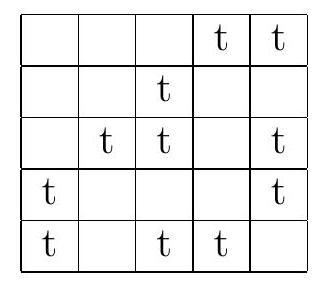
| t | t | |||
|---|---|---|---|---|
| t | t | t | t | |
| t | ||||
| t | t | t | ||
| t |