


XX Asian Pacific Mathematics Olympiad APMO:
March, 2008
Problem 1. Let $A B C$ be a triangle with $\angle A<60^{\circ}$. Let $X$ and $Y$ be the points on the sides $A B$ and $A C$, respectively, such that $C A+A X=C B+B X$ and $B A+A Y=B C+C Y$. Let $P$ be the point in the plane such that the lines $P X$ and $P Y$ are perpendicular to $A B$ and $A C$, respectively. Prove that $\angle B P C<120^{\circ}$.
(Solution) Let $I$ be the incenter of $\triangle A B C$, and let the feet of the perpendiculars from $I$ to $A B$ and to $A C$ be $D$ and $E$, respectively. (Without loss of generality, we may assume that $A C$ is the longest side. Then $X$ lies on the line segment $A D$. Although $P$ may or may not lie inside $\triangle A B C$, the proof below works for both cases. Note that $P$ is on the line perpendicular to $A B$ passing through $X$.) Let $O$ be the midpoint of $I P$, and let the feet of the perpendiculars from $O$ to $A B$ and to $A C$ be $M$ and $N$, respectively. Then $M$ and $N$ are the midpoints of $D X$ and $E Y$, respectively.
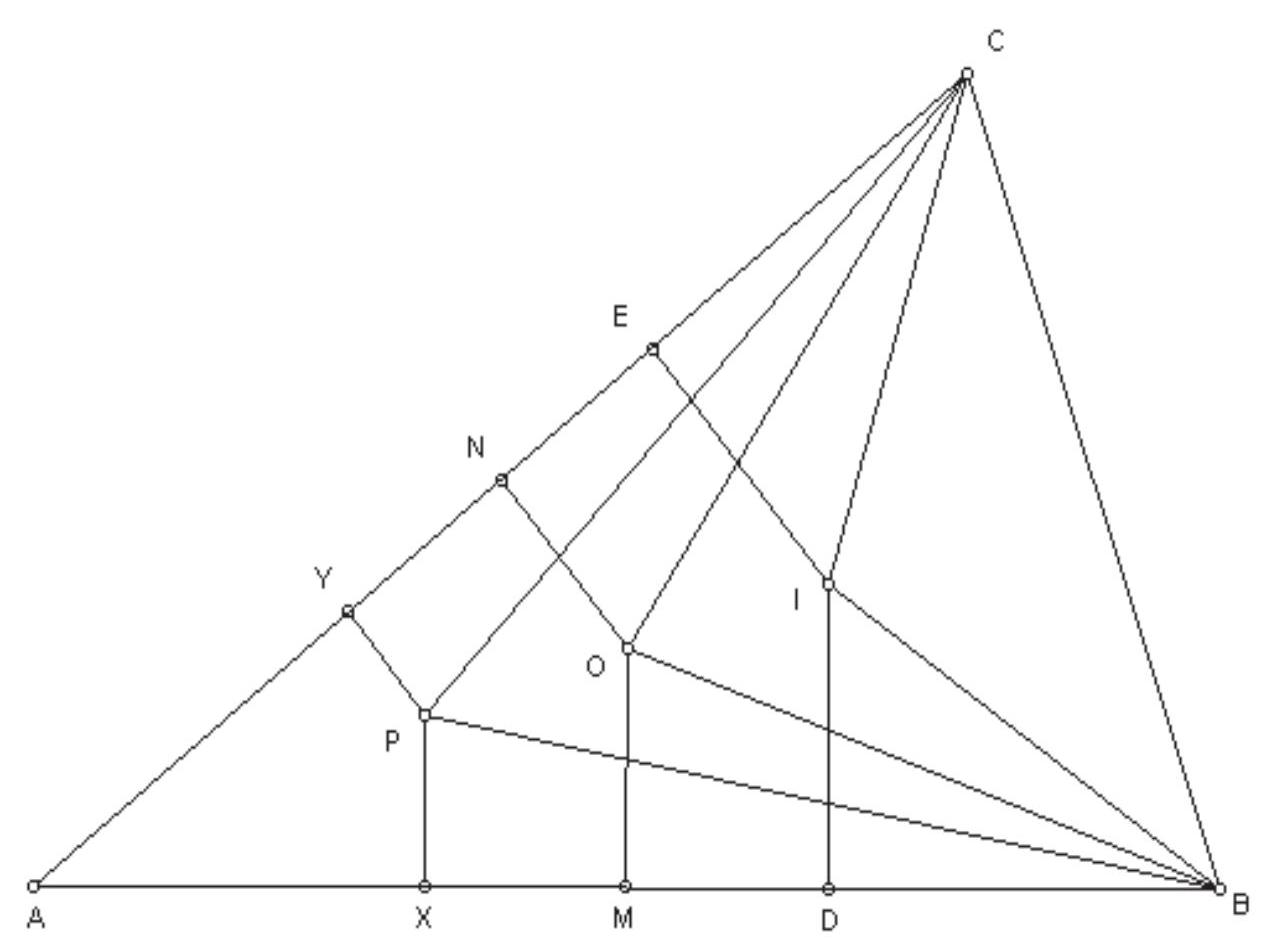
The conditions on the points $X$ and $Y$ yield the equations
From $A D=A E=\frac{C A+A B-B C}{2}$, we obtain
Since $M$ is the midpoint of $D X$, it follows that $M$ is the midpoint of $A B$. Similarly, $N$ is the midpoint of $A C$. Therefore, the perpendicular bisectors of $A B$ and $A C$ meet at $O$, that is, $O$ is the circumcenter of $\triangle A B C$. Since $\angle B A C<60^{\circ}, O$ lies on the same side of $B C$ as the point $A$ and
We can compute $\angle B I C$ as follows:
It follows from $\angle B A C<60^{\circ}$ that
From this it follows that $I$ lies inside the circumcircle of the isosceles triangle $B O C$ because $O$ and $I$ lie on the same side of $B C$. However, as $O$ is the midpoint of $I P, P$ must lie outside the circumcircle of triangle $B O C$ and on the same side of $B C$ as $O$. Therefore
Remark. If one assumes that $\angle A$ is smaller than the other two, then it is clear that the line $P X$ (or the line perpendicular to $A B$ at $X$ if $P=X$ ) runs through the excenter $I_{C}$ of the excircle tangent to the side $A B$. Since $2 \angle A C I_{C}=\angle A C B$ and $B C<A C$, we have $2 \angle P C B>\angle C$. Similarly, $2 \angle P B C>\angle B$. Therefore,
In this way, a special case of the problem can be easily proved.
Problem 2. Students in a class form groups each of which contains exactly three members such that any two distinct groups have at most one member in common. Prove that, when the class size is 46 , there is a set of 10 students in which no group is properly contained. (Solution) We let $C$ be the set of all 46 students in the class and let
Then it suffices to prove that $s \geq 10$. (If $|S|=s>10$, we may choose a subset of $S$ consisting of 10 students.)
Suppose that $s \leq 9$ and let $S$ be a set of size $s$ in which no group is properly contained. Take any student, say $v$, from outside $S$. Because of the maximality of $s$, there should be a group containing the student $v$ and two other students in $S$. The number of ways to choose two students from $S$ is
On the other hand, there are at least $37=46-9$ students outside of $S$. Thus, among those 37 students outside, there is at least one student, say $u$, who does not belong to any group containing two students in $S$ and one outside. This is because no two distinct groups have two members in common. But then, $S$ can be enlarged by including $u$, which is a contradiction.
Remark. One may choose a subset $S$ of $C$ that contains no group properly. Then, assuming $|S|<10$, prove that there is a student outside $S$, say $u$, who does not belong to any group containing two students in $S$. After enlarging $S$ by including $u$, prove that the enlarged $S$ still contains no group properly.
Problem 3. Let $\Gamma$ be the circumcircle of a triangle $A B C$. A circle passing through points $A$ and $C$ meets the sides $B C$ and $B A$ at $D$ and $E$, respectively. The lines $A D$ and $C E$ meet $\Gamma$ again at $G$ and $H$, respectively. The tangent lines of $\Gamma$ at $A$ and $C$ meet the line $D E$ at $L$ and $M$, respectively. Prove that the lines $L H$ and $M G$ meet at $\Gamma$. (Solution) Let $M G$ meet $\Gamma$ at $P$. Since $\angle M C D=\angle C A E$ and $\angle M D C=\angle C A E$, we have $M C=M D$. Thus
and hence $M D$ is tangent to the circumcircle of $\triangle D G P$. Therefore $\angle D G P=\angle E D P$. Let $\Gamma^{\prime}$ be the circumcircle of $\triangle B D E$. If $B=P$, then, since $\angle B G D=\angle B D E$, the tangent lines of $\Gamma^{\prime}$ and $\Gamma$ at $B$ should coincide, that is $\Gamma^{\prime}$ is tangent to $\Gamma$ from inside. Let $B \neq P$. If $P$ lies in the same side of the line $B C$ as $G$, then we have
because $\angle D G P+\angle A B P=180^{\circ}$. That is, the quadrilateral $B P D E$ is cyclic, and hence $P$ is on the intersection of $\Gamma^{\prime}$ with $\Gamma$.
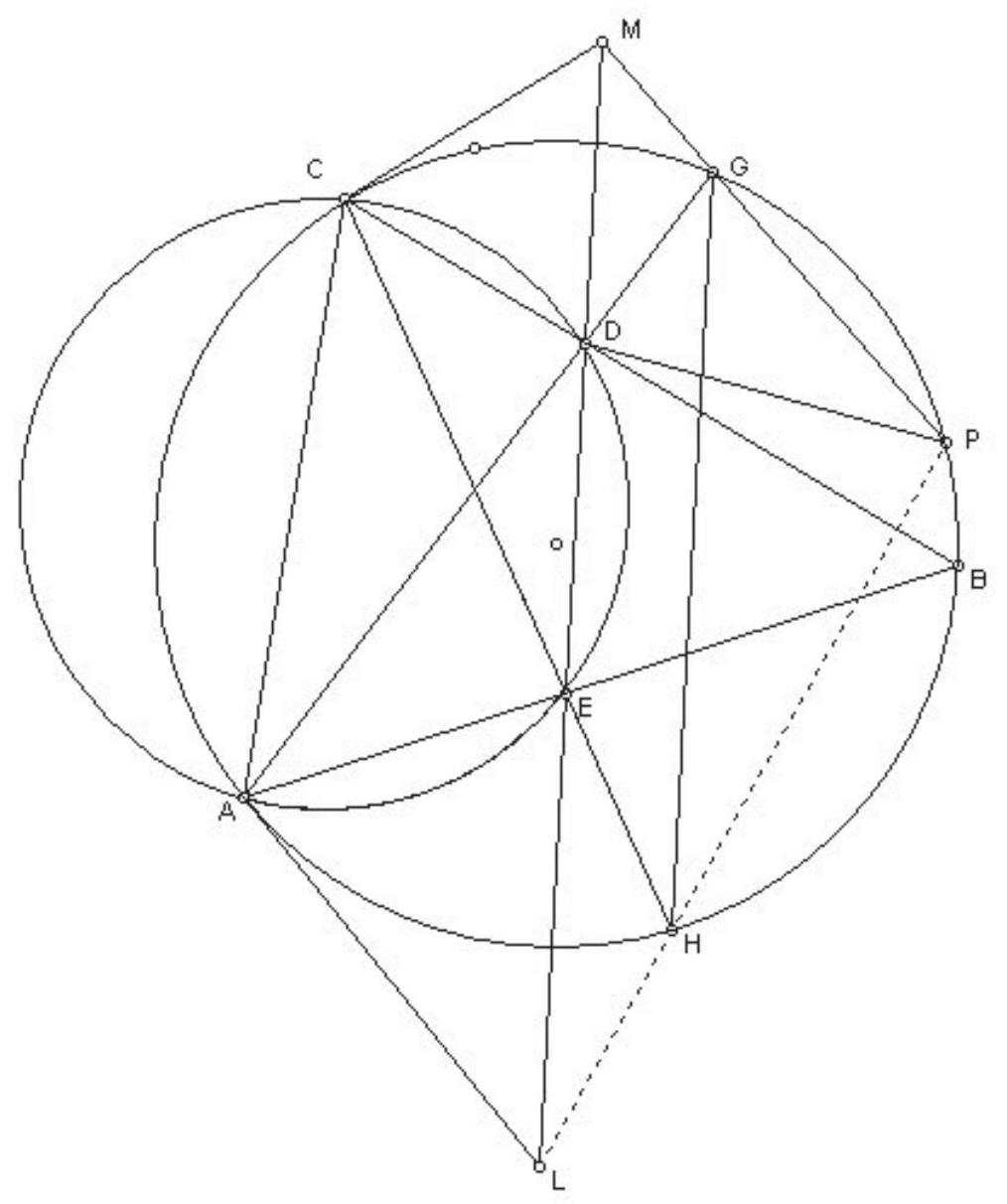
Otherwise,
Therefore the quadrilateral $P B D E$ is cyclic, and hence $P$ again is on the intersection of $\Gamma^{\prime}$ with $\Gamma$.
Similarly, if $L H$ meets $\Gamma$ at $Q$, we either have $Q=B$, in which case $\Gamma^{\prime}$ is tangent to $\Gamma$ from inside, or $Q \neq B$. In the latter case, $Q$ is on the intersection of $\Gamma^{\prime}$ with $\Gamma$. In either case, we have $P=Q$.
Problem 4. Consider the function $f: \mathbb{N}{0} \rightarrow \mathbb{N}{0}$, where $\mathbb{N}{0}$ is the set of all non-negative integers, defined by the following conditions: (i) $f(0)=0$, (ii) $f(2 n)=2 f(n)$ and (iii) $f(2 n+1)=n+2 f(n)$ for all $n \geq 0$. (a) Determine the three sets $L:={n \mid f(n)<f(n+1)}, E:={n \mid f(n)=f(n+1)}$, and $G:={n \mid f(n)>f(n+1)}$. (b) For each $k \geq 0$, find a formula for $a{k}:=\max \left{f(n): 0 \leq n \leq 2^{k}\right}$ in terms of $k$. (Solution) (a) Let
We will show that $L_{1}=L, E_{1}=E$, and $G_{1}=G$. It suffices to verify that $L_{1} \subseteq E, E_{1} \subseteq E$, and $G_{1} \subseteq G$ because $L_{1}, E_{1}$, and $G_{1}$ are mutually disjoint and $L_{1} \cup E_{1} \cup G_{1}=\mathbb{N}_{0}$.
Firstly, if $k>0$, then $f(2 k)-f(2 k+1)=-k<0$ and therefore $L_{1} \subseteq L$. Secondly, $f(0)=0$ and
for all $k \geq 0$. Thus, $E_{1} \subseteq E$. Lastly, in order to prove $G_{1} \subset G$, we claim that $f(n+1)-f(n) \leq n$ for all $n$. (In fact, one can prove a stronger inequality : $f(n+1)-f(n) \leq n / 2$.) This is clearly true for even $n$ from the definition since for $n=2 t$,
If $n=2 t+1$ is odd, then (assuming inductively that the result holds for all nonnegative $m<n$ ), we have
For all $k \geq 0$,
This proves $G_{1} \subseteq G$. (b) Note that $a_{0}=a_{1}=f(1)=0$. Let $k \geq 2$ and let $N_{k}=\left{0,1,2, \ldots, 2^{k}\right}$. First we claim that the maximum $a_{k}$ occurs at the largest number in $G \cap N_{k}$, that is, $a_{k}=f\left(2^{k}-1\right)$. We use mathematical induction on $k$ to prove the claim. Note that $a_{2}=f(3)=f\left(2^{2}-1\right)$.
Now let $k \geq 3$. For every even number $2 t$ with $2^{k-1}+1<2 t \leq 2^{k}$,
by induction hypothesis. For every odd number $2 t+1$ with $2^{k-1}+1 \leq 2 t+1<2^{k}$,
again by induction hypothesis. Combining ( $\dagger$ ), ( $\ddagger$ ) and
we may conclude that $a_{k}=f\left(2^{k}-1\right)$ as desired. Furthermore, we obtain
for all $k \geq 3$. Note that this recursive formula for $a_{k}$ also holds for $k \geq 0,1$ and 2 . Unwinding this recursive formula, we finally get
Problem 5. Let $a, b, c$ be integers satisfying $0<a<c-1$ and $1<b<c$. For each $k$, $0 \leq k \leq a$, let $r_{k}, 0 \leq r_{k}<c$, be the remainder of $k b$ when divided by $c$. Prove that the two sets $\left{r_{0}, r_{1}, r_{2}, \ldots, r_{a}\right}$ and ${0,1,2, \ldots, a}$ are different. (Solution) Suppose that two sets are equal. Then $\operatorname{gcd}(b, c)=1$ and the polynomial
is divisible by $x^{c}-1$. (This is because: $m=n+c q \Longrightarrow x^{m}-x^{n}=x^{n+c q}-x^{n}=x^{n}\left(x^{c q}-1\right)$ and $\left(x^{c q}-1\right)=\left(x^{c}-1\right)\left(\left(x^{c}\right)^{q-1}+\left(x^{c}\right)^{q-2}+\cdots+1\right)$.) From
where $F(x)=x^{a b+b+1}+x^{b}+x^{a+1}-x^{a b+b}-x^{a+b+1}-x$, we have
Since $x^{c} \equiv 1\left(\bmod x^{c}-1\right)$, we may conclude that
Thus,
But neither $b \equiv 1(\bmod c)$ nor $b \equiv a+b+1(\bmod c)$ are possible by the given conditions. Therefore, $b \equiv a b+b(\bmod c)$. But this is also impossible because $\operatorname{gcd}(b, c)=1$.