


Problem 1. Let $n(n \geq 1)$ be an integer. Consider the equation
where $x$ is the unknown real variable.
(a) Solve the equation for $n=8$.
(b) Prove that there exists an integer $n$ for which the equation has at least 2021 solutions. (For any real number $y$ by $\lfloor y\rfloor$ we denote the largest integer $m$ such that $m \leq y$.)
Solution. Let $k=\left[\frac{1}{2 x}\right], k \in \mathbb{Z}$.
(a) For $n=8$, the equation becomes
Since $x \neq 0$, we have $k \neq 8$, and the last relation implies $k=\left[\frac{1}{2 x}\right]=\left[\frac{18}{8-k}\right]$. Checking signs, we see that $0<k<8$. By direct verification, we find the solutions $k=3$ (hence $x=\frac{5}{36}$ and $k=4$ (hence $x=\frac{1}{9}$ ).
(b) From the given equation we have $x \neq 0$ and $x=\frac{2(n-k)}{n(n+1)}$. Therefore, $k \neq n$ and $k=\left[\frac{1}{2 x}\right]=\left[\frac{n(n+1)}{4(n-k)}\right]$. Again, checking signs we see that $0 \leq k<n$. The last equation implies
Conversely, if $k \in \mathbb{Z}$ satisfies (2) and $0<k<n$, then $x=\frac{2(n-k)}{n(n+1}$ is a solution to the given equation. It remains to note that choosing $n$ such that $\sqrt{n+1}>2021$ ensures that there exist at least 2021 integer values of $k$ which satisfy (2).
Problem 2. For any set $A=\left{x_{1}, x_{2}, x_{3}, x_{4}, x_{5}\right}$ of five distinct positive integers denote by $S_{A}$ the sum of its elements, and denote by $T_{A}$ the number of triples $(i, j, k)$ with $1 \leqslant i<j<k \leqslant 5$ for which $x_{i}+x_{j}+x_{k}$ divides $S_{A}$.
Find the largest possible value of $T_{A}$.
Solution. We will prove that the maximum value that $T_{A}$ can attain is 4 . Let $A=$ $\left{x_{1}, x_{2}, x_{3}, x_{4}, x_{5}\right}$ be a set of five positive integers such that $x_{1}<x_{2}<x_{3}<x_{4}<x_{5}$. Call a triple $(i, j, k)$ with $1 \leqslant i<j<k \leqslant 5$ good if $x_{i}+x_{j}+x_{k}$ divides $S_{A}$. None of the triples $(3,4,5),(2,4,5),(1,4,5),(2,3,5),(1,3,5)$ is good, since, for example
which is impossible since $x_{5}>x_{4}$ and $x_{3}>x_{2}$. Analogously we can show that any triple of form $(x, y, 5)$ where $y>2$ isn't good.
By above, the number of good triples can be at most 5 and only triples $(1,2,5),(2,3,4)$, $(1,3,4),(1,2,4),(1,2,3)$ can be good. But if triples $(1,2,5)$ and $(2,3,4)$ are simultaneously good we have that:
and
which is impossible. Therefore, $T_{A} \leqslant 4$.
Alternatively, one can prove the statement above by adding up the two inequalities $x_{1}+x_{2}+x_{4}<x_{3}+x_{4}$ and $x_{2}+x_{3}+x_{4}<x_{1}+x_{5}$ that are derived from the divisibilities.
To show that $T_{A}=4$ is possible, consider the numbers $1,2,3,4,494$. This works because $6|498,7| 497,8 \mid 496$, and $9 \mid 495$.
Remark. The motivation for construction is to realize that if we choose $x_{1}, x_{2}, x_{3}, x_{4}$ we can get all the conditions $x_{5}$ must satisfy. Let $S=x_{1}+x_{2}+x_{3}+x_{4}$. Now we have to choose $x_{5}$ such that
By the Chinese Remainder Theorem it is obvious that if $S-x_{1}, S-x_{2}, S-x_{3}, S-x_{4}$ are pairwise coprime, such $x_{5}$ must exist. To make all these numbers pairwise coprime it's natural to take $x_{1}, x_{2}, x_{3}, x_{4}$ to be all odd and then solve mod 3 issues. Fortunately it can be seen that $1,5,7,11$ easily works because $13,17,19,23$ are pairwise coprime.
However, even without the knowledge of this theorem it makes sense intuitively that this system must have a solution for some $x_{1}, x_{2}, x_{3}, x_{4}$. By taking $\left(x_{1}, x_{2}, x_{3}, x_{4}\right)=$ $(1,2,3,4)$ we get pretty simple system which can be solved by hand rather easily.
Problem 3. Let $A B C$ be an acute scalene triangle with circumcenter $O$. Let $D$ be the foot of the altitude from $A$ to the side $B C$. The lines $B C$ and $A O$ intersect at $E$. Let $s$ be the line through $E$ perpendicular to $A O$. The line $s$ intersects $A B$ and $A C$ at $K$ and $L$, respectively. Denote by $\omega$ the circumcircle of triangle $A K L$. Line $A D$ intersects $\omega$ again at $X$.
Prove that $\omega$ and the circumcircles of triangles $A B C$ and $D E X$ have a common point.
Solution.
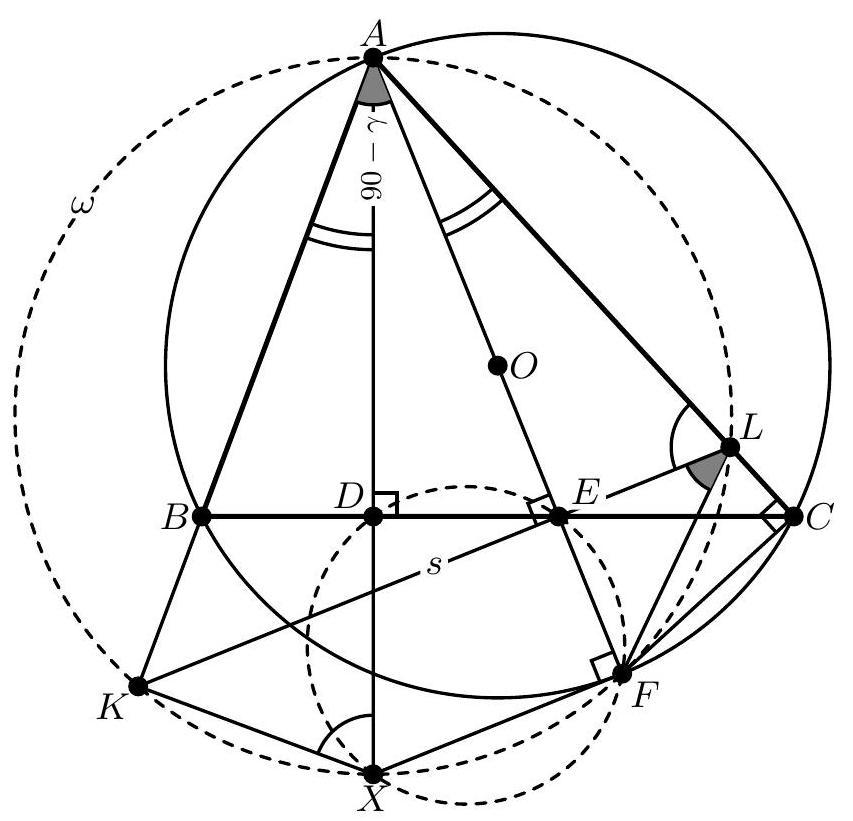
Let us denote angles of triangle $A B C$ with $\alpha, \beta, \gamma$ in a standard way. By basic anglechasing we have
Using the fact that lines $A E$ and $A X$ are isogonal with respect to $\angle K A L$ we can conclude that $X$ is an $A$-antipode on $\omega$. (This fact can be purely angle-chased: we have
which implies $\angle A K X=90^{\circ}$ ). Now let $F$ be the projection of $X$ on the line $A E$. Using that $A X$ is a diameter of $\omega$ and $\angle E D X=90^{\circ}$ it's clear that $F$ is the intersection point of $\omega$ and the circumcircle of triangle $D E X$. Now it suffices to show that $A B F C$ is cyclic. We have $\angle K L F=\angle K A F=90^{\circ}-\gamma$ and from $\angle F E L=90^{\circ}$ we have that $\angle E F L=\gamma=\angle E C L$ so quadrilateral $E F C L$ is cyclic. Next, we have
(where last equality holds because of $\angle A E L=90^{\circ}$ and $\angle E A L=90^{\circ}-\beta$ ).
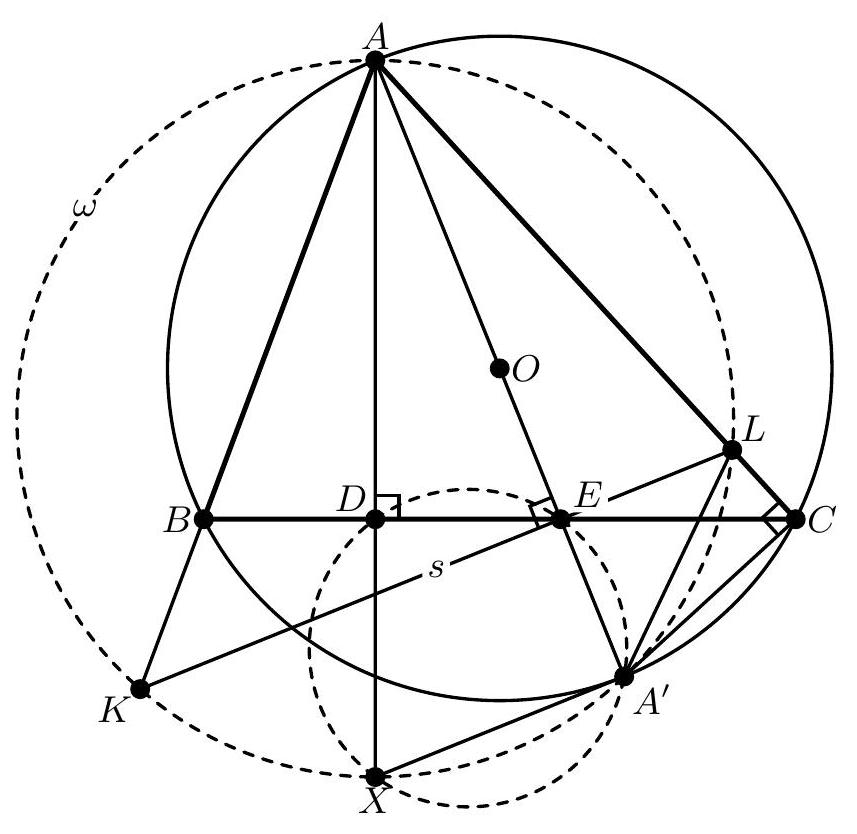
Solution 2. We have $\angle B A D=90^{\circ}-\beta=\angle O A C$ and that $A X$ is the diameter of $\omega$. Also we note that
so $B K C L$ is cyclic. Let $A O$ intersect circumcircle of $A B C$ again at $A^{\prime}$. We will show that $A^{\prime}$ is the desired concurrence point. Obviously $A A^{\prime}$ is the diameter of circumcircle of triangle $A B C$ so $\angle A^{\prime} C A=90^{\circ}$ which implies that $A^{\prime} C L E$ is cyclic. From power of point $E$ we have that $E K \cdot E L=E B \cdot E C=E A \cdot E A^{\prime}$ so we can conclude that $A^{\prime} \in \omega$. Now using the fact that $A X$ is a diameter of $\omega$ implies $\angle A X A^{\prime}=90^{\circ}$ we have that $D X A^{\prime} E$ is cyclic because of $\angle E D X=90^{\circ}$ which finishes the proof. $\square$
Problem 4. Let $M$ be a subset of the set of 2021 integers ${1,2,3, \ldots, 2021}$ such that for any three elements (not necessarily distinct) $a, b, c$ of $M$ we have $|a+b-c|>10$. Determine the largest possible number of elements of $M$.
Solution. The set $M={1016,1017, \ldots, 2021}$ has 1006 elements and satisfies the required property, since $a, b, c \in M$ implies that $a+b-c \geqslant 1016+1016-2021=11$. We will show that this is optimal.
Suppose $M$ satisfies the condition in the problem. Let $k$ be the minimal element of $M$. Then $k=|k+k-k|>10 \Rightarrow k \geqslant 11$. Note also that for every $m$, the integers $m, m+k-10$ cannot both belong to $M$, since $k+m-(m+k-10)=10$.
Claim 1: $M$ contains at most $k-10$ out of any $2 k-20$ consecutive integers.
Proof: We can partition the set ${m, m+1, \ldots, m+2 k-21}$ into $k-10$ pairs as follows:
It remains to note that $M$ can contain at most one element of each pair.
Claim 2: $M$ contains at most $[(t+k-10) / 2]$ out of any $t$ consecutive integers.
Proof: Write $t=q(2 k-20)+r$ with $r \in{0,1,2 \ldots, 2 k-21}$. From the set of the first $q(2 k-20)$ integers, by Claim 1 at most $q(k-10)$ can belong to $M$. Also by claim 1, it follows that from the last $r$ integers, at $\operatorname{most} \min {r, k-10}$ can belong to $M$.
Thus,
- If $r \leqslant k-10$, then at most
- If $r>k-10$, then at most
By Claim 2, the number of elements of $M$ amongst $k+1, k+2, \ldots, 2021$ is at most
Since amongst ${1,2, \ldots, k}$ only $k$ belongs to $M$, we conclude that $M$ has at most 1006 elements as claimed.