



22nd Junior Balkan Mathematical Olympiad Rhodes 19-24 J une 2018
Solutions
Problem 1. Find all the pairs $(m, n)$ of integers which satisfy the equation
Solution. If one of $m, n$ is 0 , the other has to be 0 too, and $(m, n)=(0,0)$ is one solution. If $m n \neq 0$, let $d=\operatorname{gcd}(m, n)$ and we write $m=d a, n=d b, a, b \in \mathbb{Z}$ with $(a, b)=1$. Then, the given equation is transformed into
So, by the above equation, we conclude that $a \mid d^{3} b^{5}$ and thus $a \mid d^{3}$. Similarly $b \mid d^{3}$. Since $(a, b)=1$, we get that $a b \mid d^{3}$, so we can write $d^{3}=a b r$ with $r \in \mathbb{Z}$. Then, equation (1) becomes
Therefore, the difference $a^{5}-b^{5}$ must divide 16. Therefore, the difference $a^{5}-b^{5}$ must divide 16. This means that
The smaller values of $\left|a^{5}-b^{5}\right|$ are 1 or 2 . Indeed, if $\left|a^{5}-b^{5}\right|=1$ then $a= \pm 1$ and $b=0$ or $a=0$ and $b= \pm 1$, a contradiction. If $\left|a^{5}-b^{5}\right|=2$, then $a=1$ and $b=-1$ or $a=-1$ and $b=1$. Then $r=-8$, and $d^{3}=-8$ or $d=-2$. Therefore, $(m, n)=(-2,2)$. If $\left|a^{5}-b^{5}\right|>2$ then, without loss of generality, let $a>b$ and $a \geq 2$. Putting $a=x+1$ with $x \geq 1$, we have
which is impossible. Thus, the only solutions are $(m, n)=(0,0)$ or $(-2,2)$.
Problem 2. Let $n$ three-digit numbers satisfy the following properties:
(1) No number contains the digit 0 .
(2) The sum of the digits of each number is 9 .
(3) The units digits of any two numbers are different.
(4) The tens digits of any two numbers are different.
(5) The hundreds digits of any two numbers are different.
Find the largest possible value of $n$.
Solution. Let $S$ denote the set of three-digit numbers that have digit sum equal to 9 and no digit equal to 0 . We will first find the cardinality of $S$. We start from the number 111 and each element of $S$ can be obtained from 111 by a string of 6 A's (which means that we add 1 to the current digit) and $2 G$ 's (which means go to the next digit). Then for example 324 can be obtained from 111 by the string AAGAGAAA. There are in total
such words, so $S$ contains 28 numbers. Now, from the conditions (3), (4), (5), if $\overline{a b c}$ is in $T$ then each of the other numbers of the form $\overline{* c}$ cannot be in $T$, neither $\overline{* *}$ can be, nor $\overline{a * *}$. Since there are $a+b-2$ numbers of the first category, $a+c-2$ from the second and $b+c-2$ from the third one. In these three categories there are
distinct numbers that cannot be in $T$ if $\overline{a b c}$ is in $T$. So, if $T$ has $n$ numbers, then $12 n$ are the forbidden ones that are in $S$, but each number from $S$ can be a forbidden number no more than three times, once for each of its digits, so
and since $n$ is an integer, we get $n \leq 5$. A possible example for $n=5$ is
Comment by PSC. It is classical to compute the cardinality of $S$ and this can be done in many ways. In general, the number of solutions of the equation
in positive integers, where the order of $x_{i}$ matters, is well known that equals to $\binom{n-1}{k-1}$. In our case, we want to count the number of positive solutions to $a+b+c=9$. By the above, this equals to $\binom{9-1}{3-1}=28$. Using the general result above, we can also find that there are $a+b-2$ numbers of the form $\overline{* c}$.
Problem 3. Let $k>1$ be a positive integer and $n>2018$ be an odd positive integer. The nonzero rational numbers $x_{1}, x_{2}, \ldots, x_{n}$ are not all equal and satisfy
Find:
a) the product $x_{1} x_{2} \ldots x_{n}$ as a function of $k$ and $n$
b) the least value of $k$, such that there exist $n, x_{1}, x_{2}, \ldots, x_{n}$ satisfying the given conditions.
a) If $x_{i}=x_{i+1}$ for some $i$ (assuming $x_{n+1}=x_{1}$ ), then by the given identity all $x_{i}$ will be equal, a contradiction. Thus $x_{1} \neq x_{2}$ and
Analogously
Since $x_{1} \neq x_{2}$ we get
If one among these two values, positive or negative, is obtained, then the other one will be also obtained by changing the sign of all $x_{i}$ since $n$ is odd.
b) From the above result, as $n$ is odd, we conclude that $k$ is a perfect square, so $k \geq 4$. For $k=4$ let $n=2019$ and $x_{3 j}=4, x_{3 j-1}=1, x_{3 j-2}=-2$ for $j=1,2, \ldots, 673$. So the required least value is $k=4$.
Comment by PSC. There are many ways to construct the example when $k=4$ and $n=2019$. Since 3 | 2019, the idea is to find three numbers $x_{1}, x_{2}, x_{3}$ satisfying the given equations, not all equal, and repeat them as values for the rest of the $x_{i}$ 's. So, we want to find $x_{1}, x_{2}, x_{3}$ such that
As above, $x_{1} x_{2} x_{3}= \pm 8$. Suppose without loss of generality that $x_{1} x_{2} x_{3}=-8$. Then, solving the above system we see that if $x_{1} \neq 2$, then
leading to infinitely many solutions. The example in the official solution is obtained by choosing $x_{1}=-2$.
Problem 4. Let $A B C$ be an acute triangle, $A^{\prime}, B^{\prime}$ and $C^{\prime}$ be the reflections of the vertices $A, B$ and $C$ with respect to $B C, C A$, and $A B$, respectively, and let the circumcircles of triangles $A B B^{\prime}$ and $A C C^{\prime}$ meet again at $A_{1}$. Points $B_{1}$ and $C_{1}$ are defined similarly. Prove that the lines $A A_{1}, B B_{1}$ and $C C_{1}$ have a common point.
Solution. Let $O_{1}, O_{2}$ and $O$ be the circumcenters of triangles $A B B^{\prime}, A C C^{\prime}$ and $A B C$ respectively. As $A B$ is the perpendicular bisector of the line segment $C C^{\prime}, O_{2}$ is the intersection of the perpendicular bisector of $A C$ with $A B$. Similarly, $O_{1}$ is the intersection of the perpendicular bisector of $A B$ with $A C$. It follows that $O$ is the orthocenter of triangle $A O_{1} O_{2}$. This means that $A O$ is perpendicular to $O_{1} O_{2}$. On the other hand, the segment $A A_{1}$ is the common chord of the two circles, thus it is perpendicular to $O_{1} O_{2}$. As a result, $A A_{1}$ passes through $O$. Similarly, $B B_{1}$ and $C C_{1}$ pass through $O$, so the three lines are concurrent at $O$.
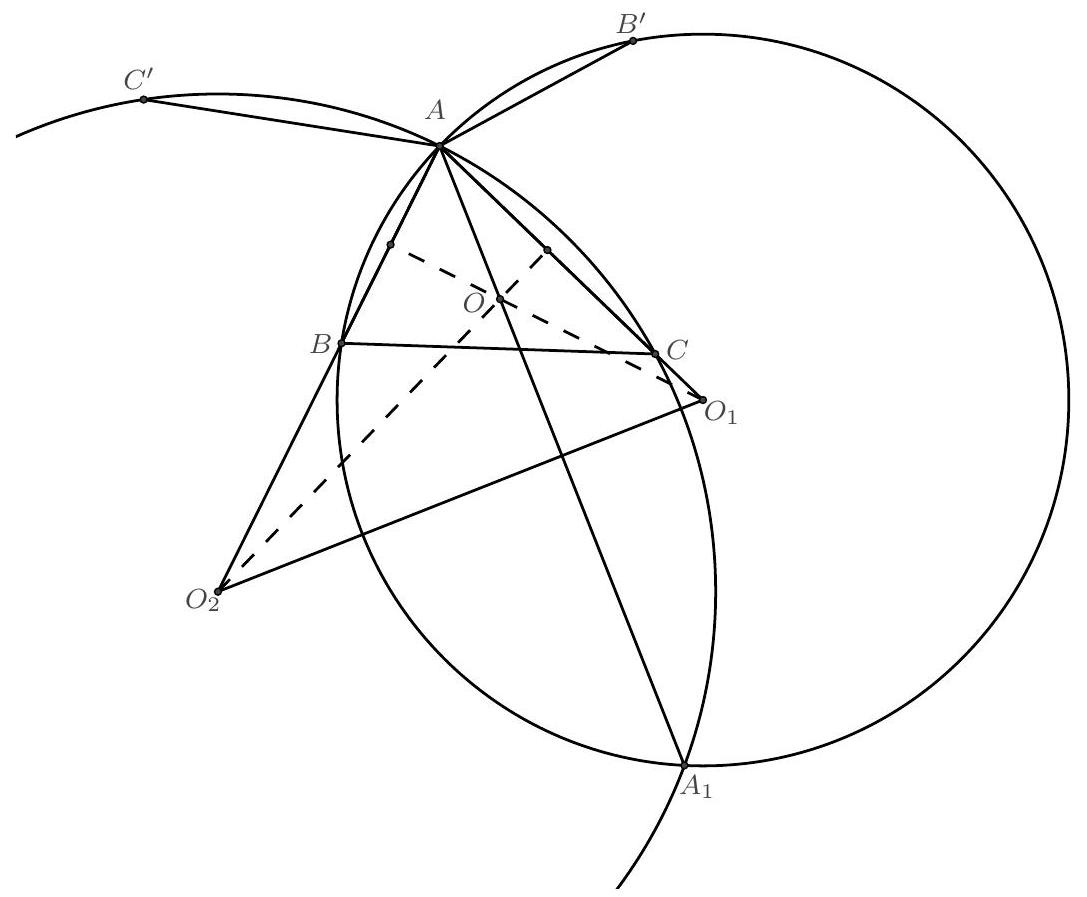
Comment by PSC. We present here a different approach.
We first prove that $A_{1}, B$ and $C^{\prime}$ are collinear. Indeed, since $\angle B A B^{\prime}=\angle C A C^{\prime}=2 \angle B A C$, then from the circles $\left(A B B^{\prime}\right),\left(A C C^{\prime}\right)$ we get
It follows that
On the other hand, if $O$ is the circumcenter of $A B C$, then
From (1) and (2) we conclude that $A_{1}, A$ and $O$ are collinear. Similarly, $B B_{1}$ and $C C_{1}$ pass through $O$, so the three lines are concurrent in $O$.