|  |
|
|
| # 22nd Junior Balkan Mathematical Olympiad Rhodes 19-24 J une 2018 |
|
|
| ## Solutions |
|
|
| Problem 1. Find all the pairs $(m, n)$ of integers which satisfy the equation |
|
|
| $$ |
| m^{5}-n^{5}=16 m n |
| $$ |
|
|
| Solution. If one of $m, n$ is 0 , the other has to be 0 too, and $(m, n)=(0,0)$ is one solution. If $m n \neq 0$, let $d=\operatorname{gcd}(m, n)$ and we write $m=d a, n=d b, a, b \in \mathbb{Z}$ with $(a, b)=1$. Then, the given equation is transformed into |
|
|
| $$ |
| d^{3} a^{5}-d^{3} b^{5}=16 a b |
| $$ |
|
|
| So, by the above equation, we conclude that $a \mid d^{3} b^{5}$ and thus $a \mid d^{3}$. Similarly $b \mid d^{3}$. Since $(a, b)=1$, we get that $a b \mid d^{3}$, so we can write $d^{3}=a b r$ with $r \in \mathbb{Z}$. Then, equation (1) becomes |
|
|
| $$ |
| \begin{aligned} |
| a b r a^{5}-a b r b^{5} & =16 a b \Rightarrow \\ |
| r\left(a^{5}-b^{5}\right) & =16 |
| \end{aligned} |
| $$ |
|
|
| Therefore, the difference $a^{5}-b^{5}$ must divide 16. Therefore, the difference $a^{5}-b^{5}$ must divide 16. This means that |
|
|
| $$ |
| a^{5}-b^{5}= \pm 1, \pm 2, \pm 4, \pm 8, \pm 16 |
| $$ |
|
|
| The smaller values of $\left|a^{5}-b^{5}\right|$ are 1 or 2 . Indeed, if $\left|a^{5}-b^{5}\right|=1$ then $a= \pm 1$ and $b=0$ or $a=0$ and $b= \pm 1$, a contradiction. If $\left|a^{5}-b^{5}\right|=2$, then $a=1$ and $b=-1$ or $a=-1$ and $b=1$. Then $r=-8$, and $d^{3}=-8$ or $d=-2$. Therefore, $(m, n)=(-2,2)$. If $\left|a^{5}-b^{5}\right|>2$ then, without loss of generality, let $a>b$ and $a \geq 2$. Putting $a=x+1$ with $x \geq 1$, we have |
|
|
| $$ |
| \begin{aligned} |
| \left|a^{5}-b^{5}\right| & =\left|(x+1)^{5}-b^{5}\right| \\ |
| & \geq\left|(x+1)^{5}-x^{5}\right| \\ |
| & =\left|5 x^{4}+10 x^{3}+10 x^{2}+5 x+1\right| \geq 31 |
| \end{aligned} |
| $$ |
|
|
| which is impossible. Thus, the only solutions are $(m, n)=(0,0)$ or $(-2,2)$. |
|
|
| Problem 2. Let $n$ three-digit numbers satisfy the following properties: |
|
|
| (1) No number contains the digit 0 . |
|
|
| (2) The sum of the digits of each number is 9 . |
|
|
| (3) The units digits of any two numbers are different. |
|
|
| (4) The tens digits of any two numbers are different. |
|
|
| (5) The hundreds digits of any two numbers are different. |
|
|
| Find the largest possible value of $n$. |
|
|
| Solution. Let $S$ denote the set of three-digit numbers that have digit sum equal to 9 and no digit equal to 0 . We will first find the cardinality of $S$. We start from the number 111 and each element of $S$ can be obtained from 111 by a string of 6 A's (which means that we add 1 to the current digit) and $2 G$ 's (which means go to the next digit). Then for example 324 can be obtained from 111 by the string AAGAGAAA. There are in total |
|
|
| $$ |
| \frac{8!}{6!\cdot 2!}=28 |
| $$ |
|
|
| such words, so $S$ contains 28 numbers. Now, from the conditions (3), (4), (5), if $\overline{a b c}$ is in $T$ then each of the other numbers of the form $\overline{* c}$ cannot be in $T$, neither $\overline{* *}$ can be, nor $\overline{a * *}$. Since there are $a+b-2$ numbers of the first category, $a+c-2$ from the second and $b+c-2$ from the third one. In these three categories there are |
| |
| $$ |
| (a+b-2)+(b+c-2)+(c+a-2)=2(a+b+c)-6=2 \cdot 9-6=12 |
| $$ |
| |
| distinct numbers that cannot be in $T$ if $\overline{a b c}$ is in $T$. So, if $T$ has $n$ numbers, then $12 n$ are the forbidden ones that are in $S$, but each number from $S$ can be a forbidden number no more than three times, once for each of its digits, so |
| |
| $$ |
| n+\frac{12 n}{3} \leq 28 \Longleftrightarrow n \leq \frac{28}{5} |
| $$ |
| |
| and since $n$ is an integer, we get $n \leq 5$. A possible example for $n=5$ is |
| |
| $$ |
| T=\{144,252,315,423,531\} |
| $$ |
| |
| Comment by PSC. It is classical to compute the cardinality of $S$ and this can be done in many ways. In general, the number of solutions of the equation |
| |
| $$ |
| x_{1}+x_{2}+\cdots+x_{k}=n |
| $$ |
| |
| in positive integers, where the order of $x_{i}$ matters, is well known that equals to $\binom{n-1}{k-1}$. In our case, we want to count the number of positive solutions to $a+b+c=9$. By the above, this equals to $\binom{9-1}{3-1}=28$. Using the general result above, we can also find that there are $a+b-2$ numbers of the form $\overline{* c}$. |
|
|
| Problem 3. Let $k>1$ be a positive integer and $n>2018$ be an odd positive integer. The nonzero rational numbers $x_{1}, x_{2}, \ldots, x_{n}$ are not all equal and satisfy |
| |
| $$ |
| x_{1}+\frac{k}{x_{2}}=x_{2}+\frac{k}{x_{3}}=x_{3}+\frac{k}{x_{4}}=\cdots=x_{n-1}+\frac{k}{x_{n}}=x_{n}+\frac{k}{x_{1}} |
| $$ |
| |
| Find: |
| |
| a) the product $x_{1} x_{2} \ldots x_{n}$ as a function of $k$ and $n$ |
|
|
| b) the least value of $k$, such that there exist $n, x_{1}, x_{2}, \ldots, x_{n}$ satisfying the given conditions. |
| |
| a) If $x_{i}=x_{i+1}$ for some $i$ (assuming $x_{n+1}=x_{1}$ ), then by the given identity all $x_{i}$ will be equal, a contradiction. Thus $x_{1} \neq x_{2}$ and |
|
|
| $$ |
| x_{1}-x_{2}=k \frac{x_{2}-x_{3}}{x_{2} x_{3}} |
| $$ |
|
|
| Analogously |
|
|
| $$ |
| x_{1}-x_{2}=k \frac{x_{2}-x_{3}}{x_{2} x_{3}}=k^{2} \frac{x_{3}-x_{4}}{\left(x_{2} x_{3}\right)\left(x_{3} x_{4}\right)}=\cdots=k^{n} \frac{x_{1}-x_{2}}{\left(x_{2} x_{3}\right)\left(x_{3} x_{4}\right) \ldots\left(x_{1} x_{2}\right)} |
| $$ |
|
|
| Since $x_{1} \neq x_{2}$ we get |
|
|
| $$ |
| x_{1} x_{2} \ldots x_{n}= \pm \sqrt{k^{n}}= \pm k^{\frac{n-1}{2}} \sqrt{k} |
| $$ |
| |
| If one among these two values, positive or negative, is obtained, then the other one will be also obtained by changing the sign of all $x_{i}$ since $n$ is odd. |
|
|
| b) From the above result, as $n$ is odd, we conclude that $k$ is a perfect square, so $k \geq 4$. For $k=4$ let $n=2019$ and $x_{3 j}=4, x_{3 j-1}=1, x_{3 j-2}=-2$ for $j=1,2, \ldots, 673$. So the required least value is $k=4$. |
| |
| Comment by PSC. There are many ways to construct the example when $k=4$ and $n=2019$. Since 3 | 2019, the idea is to find three numbers $x_{1}, x_{2}, x_{3}$ satisfying the given equations, not all equal, and repeat them as values for the rest of the $x_{i}$ 's. So, we want to find $x_{1}, x_{2}, x_{3}$ such that |
|
|
| $$ |
| x_{1}+\frac{4}{x_{2}}=x_{2}+\frac{4}{x_{3}}=x_{3}+\frac{4}{x_{1}} |
| $$ |
|
|
| As above, $x_{1} x_{2} x_{3}= \pm 8$. Suppose without loss of generality that $x_{1} x_{2} x_{3}=-8$. Then, solving the above system we see that if $x_{1} \neq 2$, then |
| |
| $$ |
| x_{2}=-\frac{4}{x_{1}-2} \quad \text { and } \quad x_{3}=2-\frac{4}{x_{1}} |
| $$ |
| |
| leading to infinitely many solutions. The example in the official solution is obtained by choosing $x_{1}=-2$. |
|
|
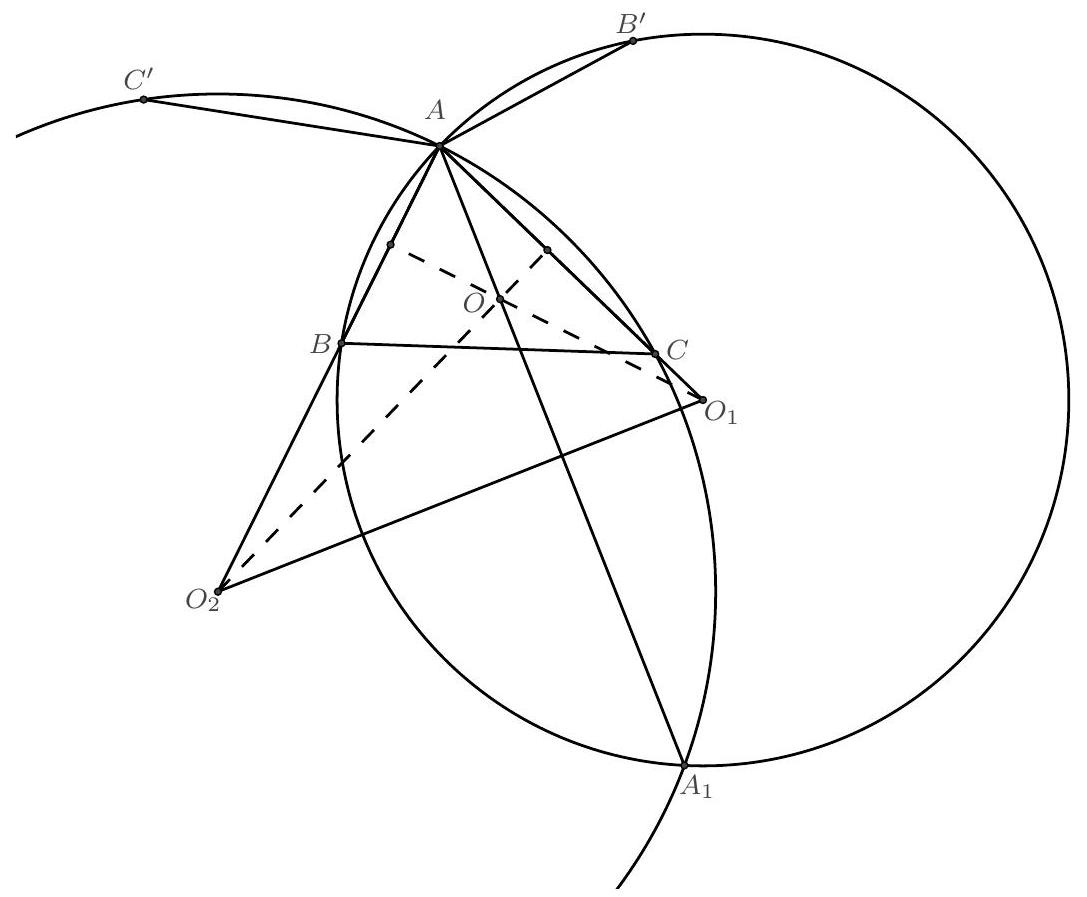
| Problem 4. Let $A B C$ be an acute triangle, $A^{\prime}, B^{\prime}$ and $C^{\prime}$ be the reflections of the vertices $A, B$ and $C$ with respect to $B C, C A$, and $A B$, respectively, and let the circumcircles of triangles $A B B^{\prime}$ and $A C C^{\prime}$ meet again at $A_{1}$. Points $B_{1}$ and $C_{1}$ are defined similarly. Prove that the lines $A A_{1}, B B_{1}$ and $C C_{1}$ have a common point. |
|
|
| Solution. Let $O_{1}, O_{2}$ and $O$ be the circumcenters of triangles $A B B^{\prime}, A C C^{\prime}$ and $A B C$ respectively. As $A B$ is the perpendicular bisector of the line segment $C C^{\prime}, O_{2}$ is the intersection of the perpendicular bisector of $A C$ with $A B$. Similarly, $O_{1}$ is the intersection of the perpendicular bisector of $A B$ with $A C$. It follows that $O$ is the orthocenter of triangle $A O_{1} O_{2}$. This means that $A O$ is perpendicular to $O_{1} O_{2}$. On the other hand, the segment $A A_{1}$ is the common chord of the two circles, thus it is perpendicular to $O_{1} O_{2}$. As a result, $A A_{1}$ passes through $O$. Similarly, $B B_{1}$ and $C C_{1}$ pass through $O$, so the three lines are concurrent at $O$. |
|
|
|  |
|
|
| Comment by PSC. We present here a different approach. |
|
|
| We first prove that $A_{1}, B$ and $C^{\prime}$ are collinear. Indeed, since $\angle B A B^{\prime}=\angle C A C^{\prime}=2 \angle B A C$, then from the circles $\left(A B B^{\prime}\right),\left(A C C^{\prime}\right)$ we get |
| |
| $$ |
| \angle A A_{1} B=\frac{\angle B A_{1} B^{\prime}}{2}=\frac{180^{\circ}-\angle B A B^{\prime}}{2}=90^{\circ}-\angle B A C=\angle A A_{1} C^{\prime} |
| $$ |
|
|
| It follows that |
|
|
| $$ |
| \angle A_{1} A C=\angle A_{1} C^{\prime} C=\angle B C^{\prime} C=90^{\circ}-\angle A B C |
| $$ |
|
|
| On the other hand, if $O$ is the circumcenter of $A B C$, then |
|
|
| $$ |
| \angle O A C=90^{\circ}-\angle A B C \text {. } |
| $$ |
|
|
| From (1) and (2) we conclude that $A_{1}, A$ and $O$ are collinear. Similarly, $B B_{1}$ and $C C_{1}$ pass through $O$, so the three lines are concurrent in $O$. |
| |
| |


