| Problem 1. Find all triples $(a, b, c)$ of real numbers such that the following system holds: |
|
|
| $$ |
| \left\{\begin{array}{l} |
| a+b+c=\frac{1}{a}+\frac{1}{b}+\frac{1}{c} \\ |
| a^{2}+b^{2}+c^{2}=\frac{1}{a^{2}}+\frac{1}{b^{2}}+\frac{1}{c^{2}} |
| \end{array}\right. |
| $$ |
|
|
| Solution. First of all if $(a, b, c)$ is a solution of the system then also $(-a,-b,-c)$ is a solution. Hence we can suppose that $a b c>0$. From the first condition we have |
|
|
| $$ |
| a+b+c=\frac{a b+b c+c a}{a b c} |
| $$ |
|
|
| Now, from the first condition and the second condition we get |
|
|
| $$ |
| (a+b+c)^{2}-\left(a^{2}+b^{2}+c^{2}\right)=\left(\frac{1}{a}+\frac{1}{b}+\frac{1}{c}\right)^{2}-\left(\frac{1}{a^{2}}+\frac{1}{b^{2}}+\frac{1}{c^{2}}\right) |
| $$ |
|
|
| The last one simplifies to |
|
|
| $$ |
| a b+b c+c a=\frac{a+b+c}{a b c} |
| $$ |
|
|
| First we show that $a+b+c$ and $a b+b c+c a$ are different from 0 . Suppose on contrary then from relation (1) or (2) we have $a+b+c=a b+b c+c a=0$. But then we would have |
|
|
| $$ |
| a^{2}+b^{2}+c^{2}=(a+b+c)^{2}-2(a b+b c+c a)=0 |
| $$ |
|
|
| which means that $a=b=c=0$. This is not possible since $a, b, c$ should be different from 0 . Now multiplying (1) and (2) we have |
|
|
| $$ |
| (a+b+c)(a b+b c+c a)=\frac{(a+b+c)(a b+b c+c a)}{(a b c)^{2}} |
| $$ |
|
|
| Since $a+b+c$ and $a b+b c+c a$ are different from 0 , we get $(a b c)^{2}=1$ and using the fact that $a b c>0$ we obtain that $a b c=1$. So relations (1) and (2) transform to |
|
|
| $$ |
| a+b+c=a b+b c+c a . |
| $$ |
|
|
| Therefore, |
|
|
| $$ |
| (a-1)(b-1)(c-1)=a b c-a b-b c-c a+a+b+c-1=0 \text {. } |
| $$ |
|
|
| This means that at least one of the numbers $a, b, c$ is equal to 1 . Suppose that $c=1$ then relations (1) and (2) transform to $a+b+1=a b+a+b \Rightarrow a b=1$. Taking $a=t$ then we have $b=\frac{1}{t}$. We can now verify that any triple $(a, b, c)=\left(t, \frac{1}{t}, 1\right)$ satisfies both conditions. $t \in \mathbb{R} \backslash\{0\}$. From the initial observation any triple $(a, b, c)=\left(t, \frac{1}{t},-1\right)$ satisfies both conditions. $t \in \mathbb{R} \backslash\{0\}$. So, all triples that satisfy both conditions are $(a, b, c)=\left(t, \frac{1}{t}, 1\right),\left(t, \frac{1}{t},-1\right)$ and all permutations for any $t \in \mathbb{R} \backslash\{0\}$. |
|
|
| Comment by PSC. After finding that $a b c=1$ and |
|
|
| $$ |
| a+b+c=a b+b c+c a |
| $$ |
|
|
| we can avoid the trick considering $(a-1)(b-1)(c-1)$ as follows. By the Vieta's relations we have that $a, b, c$ are roots of the polynomial |
|
|
| $$ |
| P(x)=x^{3}-s x^{2}+s x-1 |
| $$ |
|
|
| which has one root equal to 1 . Then, we can conclude as in the above solution. |
|
|
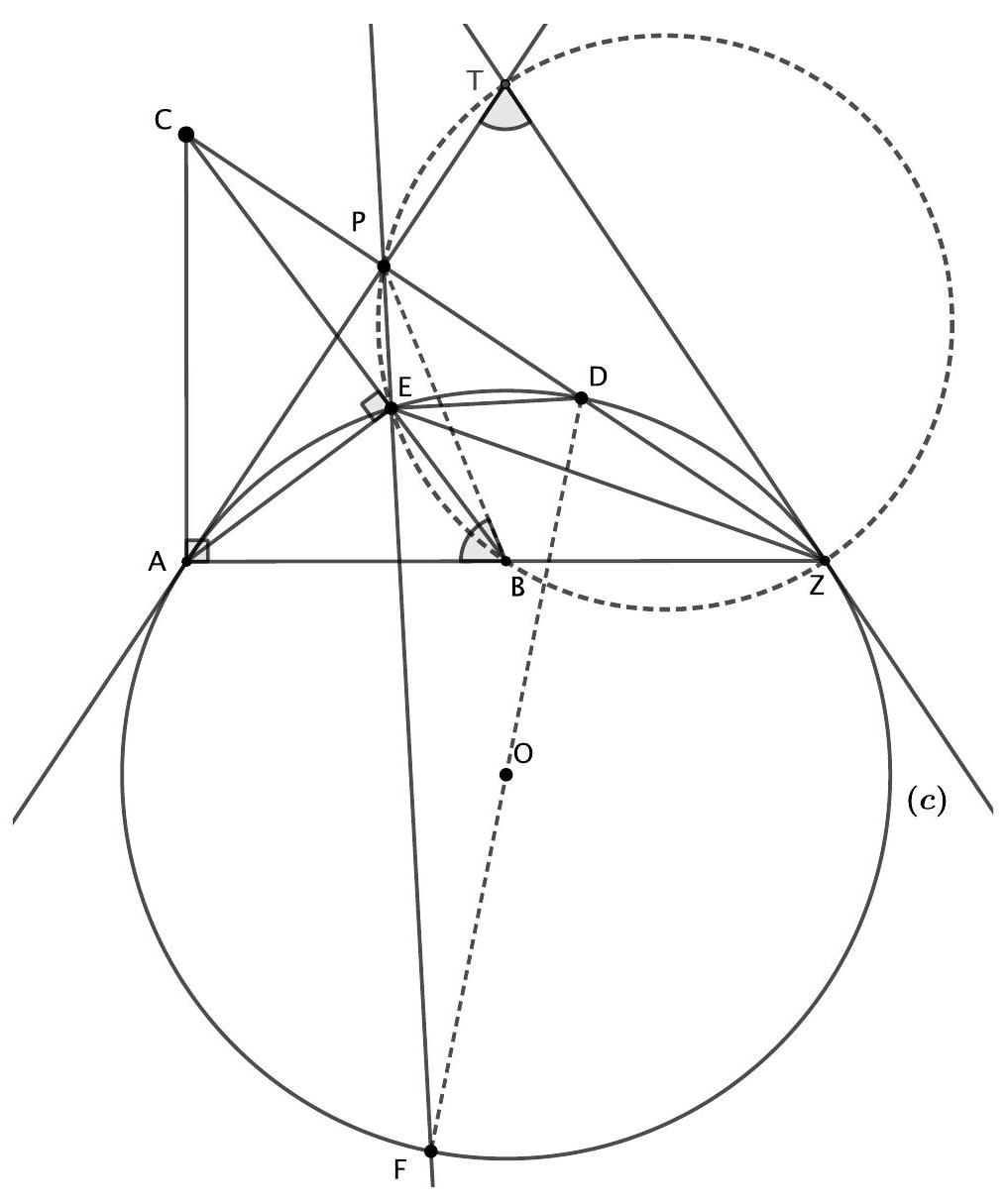
| Problem 2. Let $\triangle A B C$ be a right-angled triangle with $\angle B A C=90^{\circ}$ and let $E$ be the foot of the perpendicular from $A$ on $B C$. Let $Z \neq A$ be a point on the line $A B$ with $A B=B Z$. Let (c) be the circumcircle of the triangle $\triangle A E Z$. Let $D$ be the second point of intersection of $(c)$ with $Z C$ and let $F$ be the antidiametric point of $D$ with respect to (c). Let $P$ be the point of intersection of the lines $F E$ and $C Z$. If the tangent to (c) at $Z$ meets $P A$ at $T$, prove that the points $T, E, B, Z$ are concyclic. |
|
|
| Solution. We will first show that $P A$ is tangent to $(c)$ at $A$. |
|
|
| Since $E, D, Z, A$ are concyclic, then $\angle E D C=\angle E A Z=\angle E A B$. Since also the triangles $\triangle A B C$ and $\triangle E B A$ are similar, then $\angle E A B=\angle B C A$, therefore $\angle E D C=\angle B C A$. |
|
|
| Since $\angle F E D=90^{\circ}$, then $\angle P E D=90^{\circ}$ and so |
|
|
| $$ |
| \angle E P D=90^{\circ}-\angle E D C=90^{\circ}-\angle B C A=\angle E A C |
| $$ |
|
|
| Therefore the points $E, A, C, P$ are concyclic. It follows that $\angle C P A=90^{\circ}$ and therefore the triangle $\angle P A Z$ is right-angled. Since also $B$ is the midpoint of $A Z$, then $P B=A B=B Z$ and so $\angle Z P B=$ $\angle P Z B$. |
|
|
|  |
|
|
| Furthermore, $\angle E P D=\angle E A C=\angle C B A=\angle E B A$ from which it follows that the points $P, E, B, Z$ are also concyclic. |
|
|
| Now observe that |
|
|
| $$ |
| \angle P A E=\angle P C E=\angle Z P B-\angle P B E=\angle P Z B-\angle P Z E=\angle E Z B |
| $$ |
|
|
| Therefore $P A$ is tangent to $(c)$ at $A$ as claimed. |
|
|
| It now follows that $T A=T Z$. Therefore |
|
|
| $$ |
| \begin{aligned} |
| \angle P T Z & =180^{\circ}-2(\angle T A B)=180^{\circ}-2(\angle P A E+\angle E A B)=180^{\circ}-2(\angle E C P+\angle A C B) \\ |
| & =180^{\circ}-2\left(90^{\circ}-\angle P Z B\right)=2(\angle P Z B)=\angle P Z B+\angle B P Z=\angle P B A . |
| \end{aligned} |
| $$ |
|
|
| Thus $T, P, B, Z$ are concyclic, and since $P, E, B, Z$ are also concyclic then $T, E, B, Z$ are concyclic as required. |
|
|
| Problem 3. Alice and Bob play the following game: Alice picks a set $A=\{1,2, \ldots, n\}$ for some natural number $n \geqslant 2$. Then starting with Bob, they alternatively choose one number from the set $A$, according to the following conditions: initially Bob chooses any number he wants, afterwards the number chosen at each step should be distinct from all the already chosen numbers, and should differ by 1 from an already chosen number. The game ends when all numbers from the set $A$ are chosen. Alice wins if the sum of all of the numbers that she has chosen is composite. Otherwise Bob wins. Decide which player has a winning strategy. |
|
|
| Solution. To say that Alice has a winning strategy means that she can find a number $n$ to form the set A, so that she can respond appropriately to all choices of Bob and always get at the end a composite number for the sum of her choices. If such $n$ does not exist, this would mean that Bob has a winning strategy instead. |
|
|
| Alice can try first to check the small values of $n$. Indeed, this gives the following winning strategy for her: she initially picks $n=8$ and responds to all possible choices made by Bob as in the list below (in each row the choices of Bob and Alice are given alternatively, starting with Bob): |
|
|
| $\begin{array}{llllllll}1 & 2 & 3 & 4 & 5 & 6 & 7 & 8\end{array}$ |
|
|
| $\begin{array}{llllllll}2 & 3 & 1 & 4 & 5 & 6 & 7 & 8\end{array}$ |
|
|
| $\begin{array}{llllllll}2 & 3 & 4 & 1 & 5 & 6 & 7 & 8\end{array}$ |
|
|
| $\begin{array}{llllllll}3 & 2 & 1 & 4 & 5 & 6 & 7 & 8\end{array}$ |
|
|
| $\begin{array}{llllllll}3 & 2 & 4 & 5 & 1 & 6 & 7 & 8\end{array}$ |
|
|
| $\begin{array}{llllllll}3 & 2 & 4 & 5 & 6 & 1 & 7 & 8\end{array}$ |
|
|
| $\begin{array}{llllllll}4 & 5 & 3 & 6 & 2 & 1 & 7 & 8\end{array}$ |
|
|
| $\begin{array}{llllllll}4 & 5 & 3 & 6 & 7 & 8 & 2 & 1\end{array}$ |
|
|
| $\begin{array}{llllllll}4 & 5 & 6 & 7 & 3 & 2 & 1 & 8\end{array}$ |
|
|
| $\begin{array}{llllllll}4 & 5 & 6 & 7 & 3 & 2 & 8 & 1\end{array}$ |
|
|
| $\begin{array}{llllllll}4 & 5 & 6 & 7 & 8 & 3 & 2 & 1\end{array}$ |
|
|
| $\begin{array}{llllllll}5 & 4 & 3 & 2 & 1 & 6 & 7 & 8\end{array}$ |
|
|
| $\begin{array}{llllllll}5 & 4 & 3 & 2 & 6 & 7 & 1 & 8\end{array}$ |
|
|
| $\begin{array}{llllllll}5 & 4 & 3 & 2 & 6 & 7 & 8 & 1\end{array}$ |
|
|
| $\begin{array}{llllllll}5 & 4 & 6 & 3 & 2 & 1 & 7 & 8\end{array}$ |
|
|
| $\begin{array}{llllllll}5 & 4 & 6 & 3 & 7 & 8 & 2 & 1\end{array}$ |
|
|
| $\begin{array}{llllllll}6 & 7 & 5 & 4 & 3 & 8 & 2 & 1\end{array}$ |
|
|
| $\begin{array}{llllllll}6 & 7 & 5 & 4 & 8 & 3 & 2 & 1\end{array}$ |
|
|
| $\begin{array}{llllllll}6 & 7 & 8 & 5 & 4 & 3 & 2 & 1\end{array}$ |
|
|
| $\begin{array}{llllllll}7 & 6 & 8 & 5 & 4 & 3 & 2 & 1\end{array}$ |
|
|
| $\begin{array}{llllllll}7 & 6 & 5 & 8 & 4 & 3 & 2 & 1\end{array}$ |
|
|
| $\begin{array}{llllllll}8 & 7 & 6 & 5 & 4 & 3 & 2 & 1\end{array}$ |
|
|
| In all cases, Alice's sum is either an even number greater than 2 , or else 15 or 21 , thus Alice always wins. |
|
|
| Problem 4. Find all pairs $(p, q)$ of prime numbers such that |
|
|
| $$ |
| 1+\frac{p^{q}-q^{p}}{p+q} |
| $$ |
|
|
| is a prime number. |
|
|
| Solution. It is clear that $p \neq q$. We set |
|
|
| $$ |
| 1+\frac{p^{q}-q^{p}}{p+q}=r |
| $$ |
|
|
| and we have that |
|
|
| $$ |
| p^{q}-q^{p}=(r-1)(p+q) |
| $$ |
|
|
| From Fermat's Little Theorem we have |
|
|
| $$ |
| p^{q}-q^{p} \equiv-q \quad(\bmod p) |
| $$ |
|
|
| Since we also have that |
|
|
| $$ |
| (r-1)(p+q) \equiv-r q-q \quad(\bmod p) |
| $$ |
|
|
| from (3) we get that |
|
|
| $$ |
| r q \equiv 0 \quad(\bmod p) \Rightarrow p \mid q r |
| $$ |
|
|
| hence $p \mid r$, which means that $p=r$. Therefore, (3) takes the form |
|
|
| $$ |
| p^{q}-q^{p}=(p-1)(p+q) |
| $$ |
|
|
| We will prove that $p=2$. Indeed, if $p$ is odd, then from Fermat's Little Theorem we have |
|
|
| $$ |
| p^{q}-q^{p} \equiv p \quad(\bmod q) |
| $$ |
|
|
| and since |
|
|
| $$ |
| (p-1)(p+q) \equiv p(p-1) \quad(\bmod q) |
| $$ |
|
|
| we have |
|
|
| $$ |
| p(p-2) \equiv 0 \quad(\bmod q) \Rightarrow q|p(p-2) \Rightarrow q| p-2 \Rightarrow q \leq p-2<p |
| $$ |
| |
| Now, from (4) we have |
| |
| $$ |
| p^{q}-q^{p} \equiv 0 \quad(\bmod p-1) \Rightarrow 1-q^{p} \equiv 0 \quad(\bmod p-1) \Rightarrow q^{p} \equiv 1 \quad(\bmod p-1) |
| $$ |
| |
| Clearly $\operatorname{gcd}(q, p-1)=1$ and if we set $k=\operatorname{ord}_{p-1}(q)$, it is well-known that $k \mid p$ and $k<p$, therefore $k=1$. It follows that |
| |
| $$ |
| q \equiv 1 \quad(\bmod p-1) \Rightarrow p-1 \mid q-1 \Rightarrow p-1 \leq q-1 \Rightarrow p \leq q |
| $$ |
| |
| a contradiction. |
| |
| Therefore, $p=2$ and (4) transforms to |
| |
| $$ |
| 2^{q}=q^{2}+q+2 |
| $$ |
| |
| We can easily check by induction that for every positive integer $n \geq 6$ we have $2^{n}>n^{2}+n+2$. This means that $q \leq 5$ and the only solution is for $q=5$. Hence the only pair which satisfy the condition is $(p, q)=(2,5)$. |
|
|
| Comment by the PSC. From the problem condition, we get that $p^{q}$ should be bigger than $q^{p}$, which gives |
|
|
| $$ |
| q \ln p>p \ln q \Longleftrightarrow \frac{\ln p}{p}>\frac{\ln q}{q} |
| $$ |
|
|
| The function $\frac{\ln x}{x}$ is decreasing for $x>e$, thus if $p$ and $q$ are odd primes, we obtain $q>p$. |
|
|
|
|